


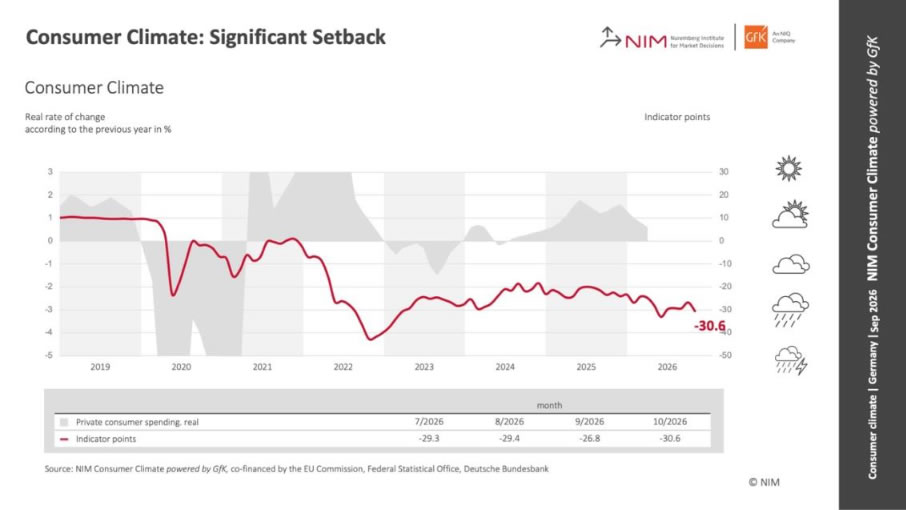
Germany’s NIM Consumer Climate powered by GfK deteriorated sharply from a revised -26.8 to -30.6 for October, marking what the institute described as a “significant setback.” The main drag came from income expectations, which plunged from 1.7 to -15.0, their weakest level since April. NIM said households increasingly expect high energy prices to reduce purchasing power, making them more skeptical about their financial situation over the next 12 months.
The deterioration was reinforced by a marked rise in willingness to save from 15.5 to 21.5, as consumers became more cautious in response to high energy costs and uncertainty. NIM noted that a similarly elevated saving indicator was last seen during the 2008 financial and economic crisis. Willingness to buy slipped only modestly from -9.8 to -10.8, but remained at an extremely low level around which it has hovered for more than three years.
The report therefore points to a household-finance shock rather than a broad collapse in economic confidence. Economic expectations actually improved from -3.9 to -3.4, their fifth consecutive increase, even as consumers became much more pessimistic about income and more inclined to save. That divergence suggests the main risk to consumption is not worsening expectations for the German economy itself, but the erosion of household purchasing power from elevated energy costs.
Data Summary
| Indicator | Previous | Current |
|---|---|---|
| Consumer Climate | -26.8 (revised) | -30.6 |
| Income Expectations | 1.7 | -15.0 |
| Willingness to Buy | -9.8 | -10.8 |
| Willingness to Save | 15.5 | 21.5 |
| Economic Expectations | -3.9 | -3.4 |
The deterioration in consumer climate was driven mainly by the sharp fall in income expectations and a strong rise in willingness to save, while economic expectations improved slightly.
Key Takeaways
- Germany’s Consumer Climate fell from a revised -26.8 to -30.6, marking what NIM called a significant setback.
- Income expectations plunged from 1.7 to -15.0, the weakest reading since April, as households worried that high energy prices would erode purchasing power.
- Willingness to save jumped from 15.5 to 21.5, reflecting rising caution and uncertainty among households.
- NIM noted that a similarly high saving indicator was last seen during the 2008 financial and economic crisis.
- Willingness to buy slipped from -9.8 to -10.8, remaining at an extremely weak level around which it has hovered for more than three years.
- Economic expectations improved from -3.9 to -3.4, extending their rise for a fifth consecutive month.
- The report therefore points to a household purchasing-power problem rather than a broad deterioration in macroeconomic confidence.
- The main consumption risk is that elevated energy costs encourage households to save more and spend less, even as views on the broader economy stabilize.





