


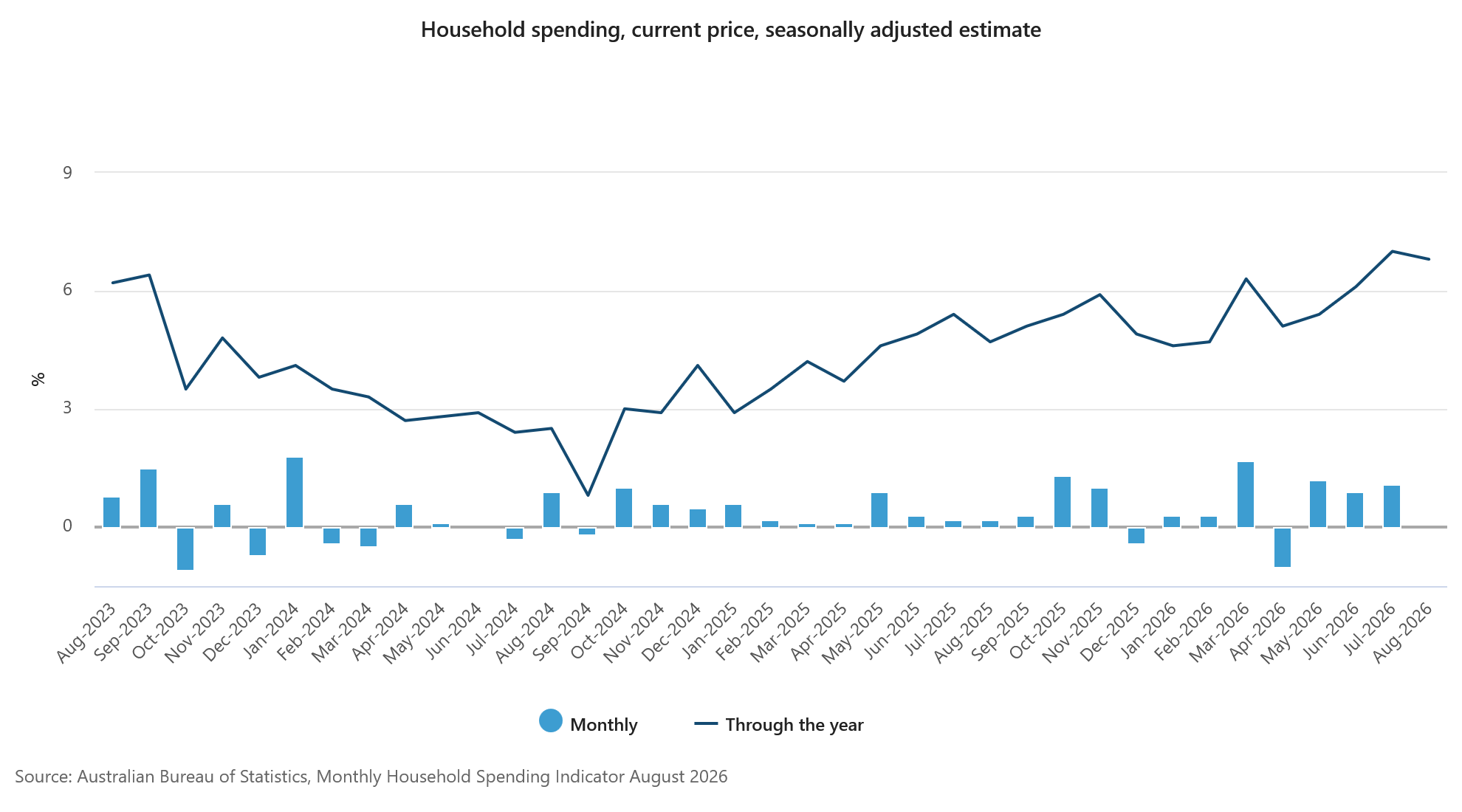
Australian household spending slowed sharply in August, with growth easing from 1.1% in July to 0.0%, after a 0.9% rise in June. Spending was still 6.8% higher than a year earlier, but the flat headline overstated underlying demand because higher transport costs provided an important offset to weakness elsewhere. Transport spending rose 2.3%, while recreation and culture fell 1.4%, clothing and footwear dropped 1.0%, and alcoholic beverages and tobacco declined 1.0%.
The main distortion came from fuel spending, which surged 8.1% following the full restoration of fuel excise duty from August 3. Excluding fuel, the ABS said total household spending would have fallen 0.3%. The distinction between prices and demand was particularly clear in experimental volume estimates, which showed the volume of fuel spending actually fell 0.5% after a 4.6% decline in July. Goods spending nevertheless rose 0.3%, helped by motoring goods and vehicle purchases, while services spending fell 0.3%.
The composition therefore points to a loss of household spending momentum rather than broad demand strength after two solid months. Discretionary spending fell 0.3%, led by recreation, clothing and recreational goods, while non-discretionary spending rose 0.6%, supported by motoring goods and transport. August does not establish a sustained consumer downturn, particularly with annual spending growth still elevated, but the underlying picture was clearly softer than the unchanged headline suggests: higher fuel outlays helped hold nominal spending flat even as households pulled back across a wider range of categories.
Data Summary
| Indicator | Previous (Jul) | Current (Aug) |
|---|---|---|
| Household spending, m/m | +1.1% | 0.0% |
| Household spending, y/y | +7.0% | +6.8% |
Spending Components
| Component | August change |
|---|---|
| Household spending ex-fuel | -0.3% |
| Fuel spending | +8.1% |
| Fuel spending volume | -0.5% |
| Goods spending | +0.3% |
| Services spending | -0.3% |
| Discretionary spending | -0.3% |
| Non-discretionary spending | +0.6% |
| Transport | +2.3% |
| Hotels, cafes and restaurants | +0.8% |
| Recreation and culture | -1.4% |
| Clothing and footwear | -1.0% |
| Alcoholic beverages and tobacco | -1.0% |
The ABS data show that spending increased in only three of nine categories, while the goods/services and discretionary/non-discretionary splits also pointed to softer underlying demand.
Key Takeaways
- Australian household spending slowed from +1.1% in July to 0.0% in August, ending the strong momentum seen over the previous two months.
- The headline was flattered by an 8.1% surge in fuel spending following the restoration of full fuel excise. Excluding fuel, household spending would have fallen 0.3%.
- The fuel increase was largely a price effect rather than stronger consumption, with experimental fuel volumes actually falling 0.5%.
- Discretionary spending fell 0.3%, while non-discretionary spending rose 0.6%, suggesting household outlays tilted toward transport and essential spending rather than broad consumer strength.
- Services spending declined 0.3%, while goods rose 0.3%, helped by motoring goods and vehicle purchases.
- The release points to a loss of momentum rather than a clear consumer downturn: annual spending was still 6.8% higher, but August’s composition was noticeably softer than the flat headline implied.





