


New Zealand business confidence strengthened sharply in the September quarter, with a net 14% → 40% of firms expecting an improvement in the general economic outlook on a seasonally adjusted basis. The improvement in sentiment was much stronger than the change in firms’ own conditions, however. A net 1% rise → 1% decline in domestic trading activity was reported over the quarter, while expectations for activity over the next three months improved more moderately from 11% → 15%. NZIER said the lift in optimism came despite renewed US-Iran conflict and higher global oil prices, although weak demand remained the main constraint on businesses.
Forward-looking indicators were more constructive. Firms moved from caution earlier in the year to planning increased investment in buildings, plant and machinery, while hiring intentions also improved despite a net 5% reporting staff reductions in the September quarter. Confidence strengthened across all surveyed sectors, with retailers particularly optimistic and a net 57% expecting better general economic conditions. But the gap between expectations and actual performance remained evident: retailers reported weaker orders and sales, services firms saw lower volumes, while builders recorded the clearest improvement in current demand through stronger orders and output. Manufacturers also reported stronger domestic and export demand, although profitability deteriorated as costs remained elevated and pricing power weakened.
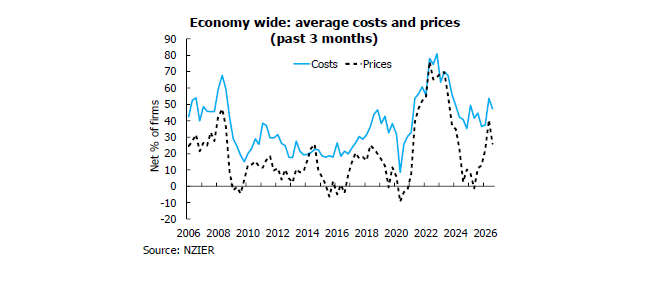
Inflation-related indicators eased from high levels. The proportion of firms reporting higher costs fell from 54% → 47%, while fewer firms raised selling prices as soft demand constrained pass-through. Expectations for future cost increases also declined. NZIER said the moderation in cost and pricing indicators suggests a reduced risk that higher fuel prices will feed into broader inflation pressures, even as firms reported that skilled workers were becoming harder to find. Overall, the survey points to a recovery that is becoming more visible in confidence, investment intentions and some forward indicators, but has yet to translate into a broad improvement in realized activity.
Data Summary
| Indicator | Sep qtr | Jun qtr |
|---|---|---|
| General business outlook | 40% | 14% |
| Own trading activity | -1% | 1% |
| Expected trading activity | 15% | 11% |
| Firms reporting higher costs | 47% | 54% |
| Firms raising selling prices | 27% | 37% |
| Expected selling prices | 45% | 51% |
Key Takeaways
- Business confidence surged: a net 40% of firms expect better general economic conditions, up from 14% in the June quarter.
- Current activity remained weak: own domestic trading activity slipped from a net 1% increase to a 1% decline.
- Near-term demand expectations improved: expected trading activity rose from 11% to 15%.
- Investment intentions strengthened: firms turned more positive on spending on buildings, plant and machinery.
- Hiring intentions improved despite recent staff cuts: a net 5% of firms reduced staff in the September quarter, but firms were considerably more positive about hiring next quarter.
- Spare capacity may be narrowing: skilled workers became harder to find even though lack of demand remained the main constraint.
- Pricing pressure eased: the share of firms reporting higher costs fell from 54% to 47%, while those raising selling prices declined from 37% to 27%.
- Fuel-price pass-through remains contained for now: NZIER said easing cost and pricing indicators point to a reduced risk that higher fuel prices will spread into broader inflation.
- The overall picture is much stronger confidence without an equally strong recovery in realized activity, alongside easing cost pressures.
Full NZIER Quarterly Survey of Business Opinion release here.





