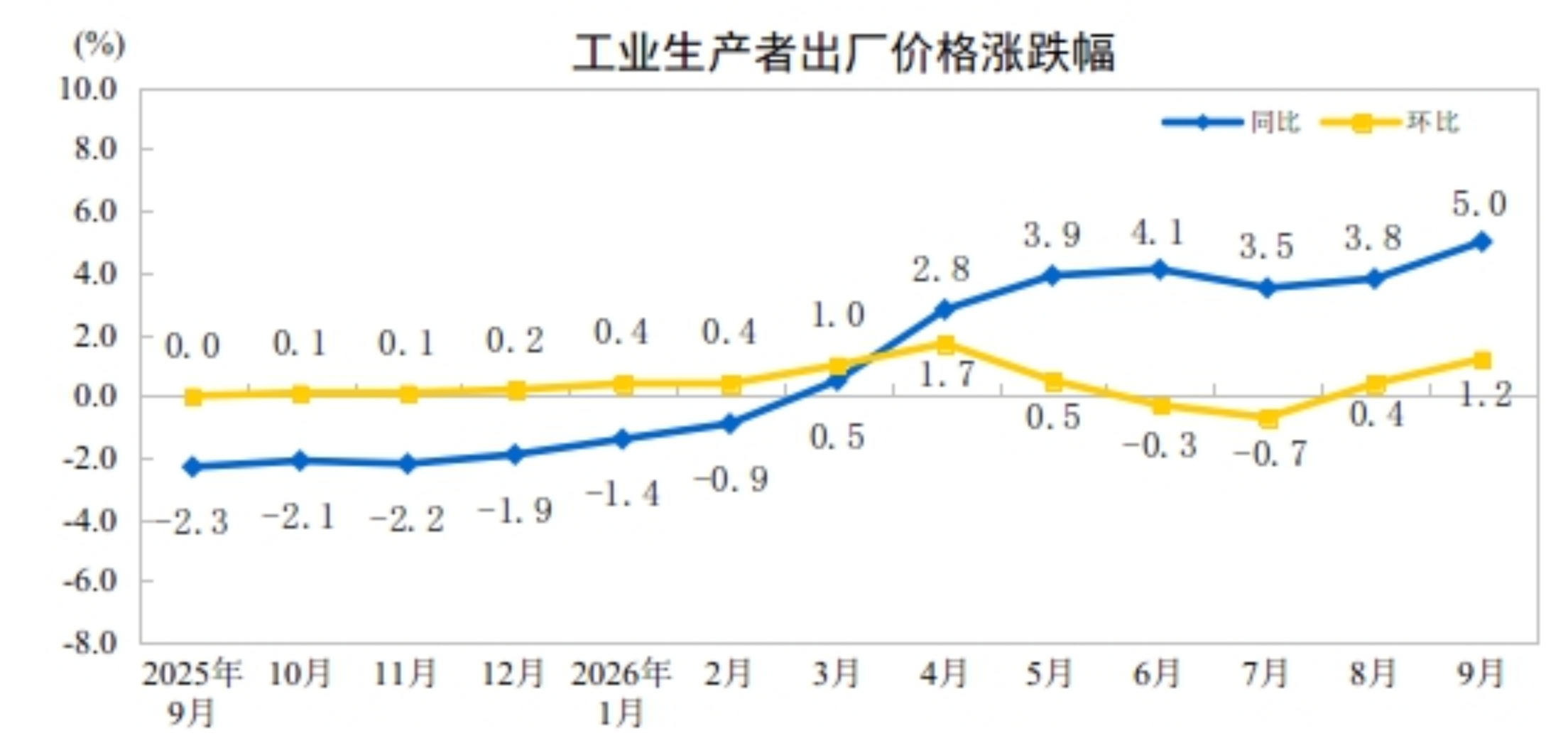
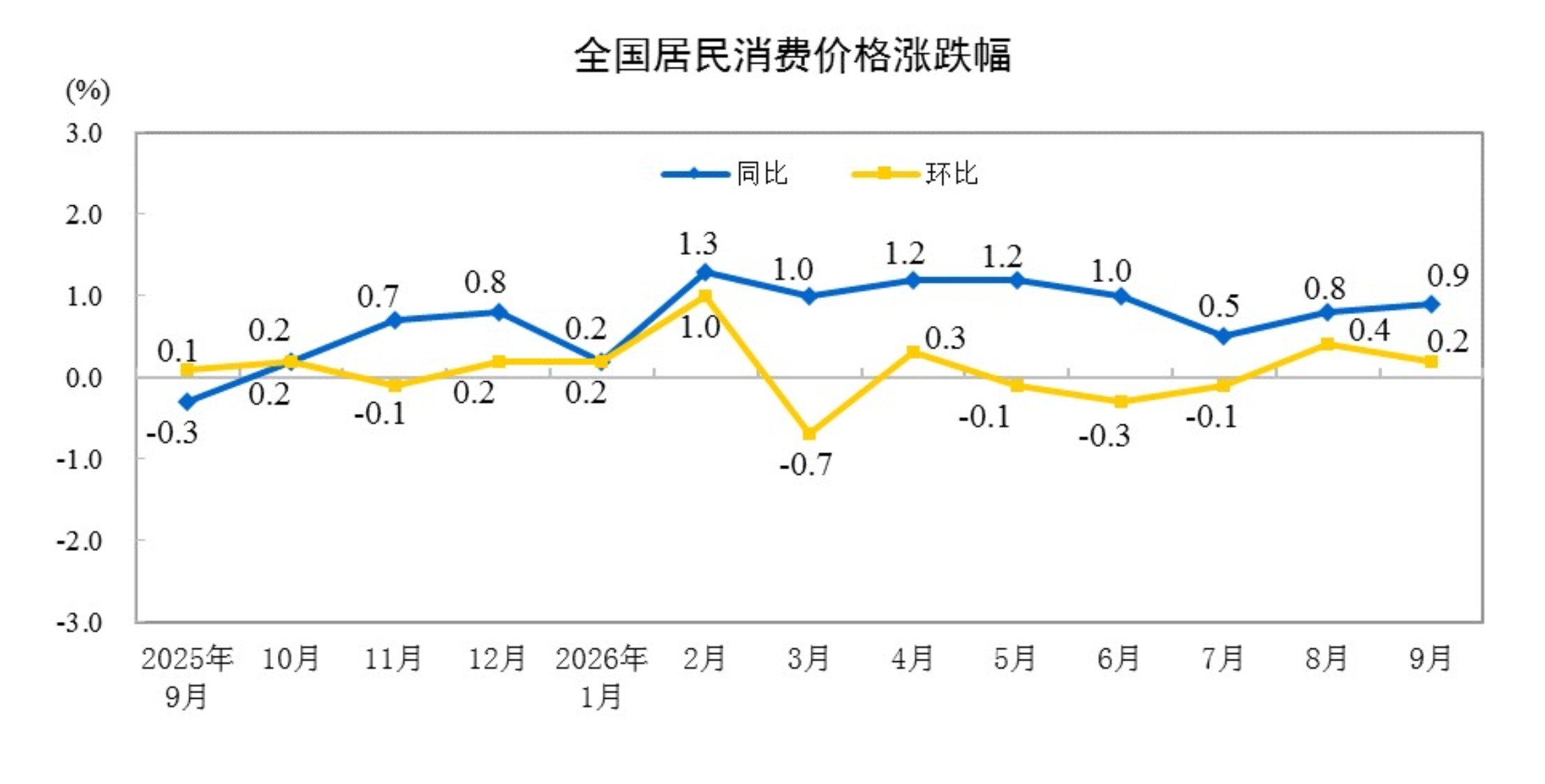
China’s producer price inflation accelerated sharply in September, reaching its highest level since June 2022, as rising energy and commodity costs intensified pressure on manufacturers. PPI jumped from 3.8% yoy in August to 5.0% yoy, exceeding expectations of 4.5%. Producer prices also rose 1.2% month-on-month. However, the surge in factory-gate inflation contrasted with persistently subdued consumer prices. CPI edged up from 0.8% to 0.9% yoy, missing expectations of 1.0%, while monthly inflation slowed from 0.4% to 0.2%, below the 0.3% forecast.
The PPI acceleration was overwhelmingly concentrated in upstream industrial prices. Prices of production materials rose 6.5% yoy, contributing approximately 5.07 percentage points to headline PPI inflation. Mining prices surged 25.4%, while raw materials and processing-industry prices increased 9.4% and 3.4%, respectively. On a monthly basis, mining prices jumped 7.7% and raw materials rose 2.6%, compared with just 0.2% for processing industries. Meanwhile, factory-gate prices of consumer goods declined 0.1% yoy. The divergence indicates that higher energy and commodity costs, rather than broad-based improvement in industrial pricing power, were the principal drivers of producer inflation.
Consumer inflation showed much weaker underlying momentum. Gasoline prices surged 16.6% yoy, contributing approximately 0.47 percentage points to headline CPI inflation, according to the National Bureau of Statistics. However, food prices fell 1.7%, with pork declining 10.0% and fresh vegetables dropping 8.1%, offsetting part of the energy-driven increase. Services inflation remained subdued at 0.8% yoy, while core CPI, excluding food and energy, was unchanged at 1.0% yoy. The combination suggests that higher commodity costs are lifting headline inflation without generating a comparable acceleration in broader consumer prices.
The widening divergence between PPI and CPI highlights China’s uneven inflation dynamics, with manufacturers facing substantial upstream cost pressures while subdued household demand appears to be limiting their transmission to consumers. The sharp rise in producer prices should therefore not be mistaken for evidence of a broad recovery in domestic demand or pricing power. Until stronger consumption and underlying inflation emerge, China’s inflation picture will remain dominated by externally driven cost pressures rather than a convincing revival in domestic demand.
Data Summary — China September 2026 Inflation
Headline Inflation Data
| Indicator | August | September | Consensus |
|---|---|---|---|
| PPI y/y | +3.8% | +5.0% | +4.5% |
| CPI y/y | +0.8% | +0.9% | +1.0% |
| CPI m/m | +0.4% | +0.2% | +0.3% |
Inflation Components
| Component | September |
|---|---|
| Core CPI y/y | +1.0% |
| PPI m/m | +1.2% |
| Industrial Purchasing Prices y/y | +6.9% |
| Production Materials PPI y/y | +6.5% |
| Mining PPI y/y | +25.4% |
| Raw Materials PPI y/y | +9.4% |
| Processing Industries PPI y/y | +3.4% |
| Consumer Goods PPI y/y | -0.1% |
| Gasoline CPI y/y | +16.6% |
| Food CPI y/y | -1.7% |
| Services CPI y/y | +0.8% |
Key Takeaways
- Producer inflation hits a four-year high: China’s PPI accelerated from 3.8% to 5.0% yoy in September, exceeding expectations of 4.5% and recording its fastest increase since June 2022.
- Industrial inflation is concentrated upstream: Mining prices surged 25.4% yoy, while raw materials rose 9.4%. Production-material prices accounted for virtually the entire headline PPI increase, reflecting substantial energy and commodity cost pressures.
- Consumer inflation remains subdued: CPI edged up from 0.8% to 0.9% yoy, missing expectations of 1.0%. Monthly inflation slowed from 0.4% to 0.2%, indicating limited broader price momentum.
- Energy inflation is offset by falling food prices: Gasoline prices jumped 16.6% yoy, adding approximately 0.47 percentage points to headline CPI. However, food prices declined 1.7%, including a 10.0% fall in pork prices.
- PPI-CPI divergence highlights weak domestic demand: Core CPI remained unchanged at 1.0% yoy, while consumer-goods producer prices fell 0.1%. The widening gap suggests that higher industrial costs are not translating into broad-based consumer inflation, consistent with subdued household demand.