Japan’s core consumer inflation accelerated from 1.7% to 2.1% yoy in September, matching expectations and returning above BoJ’s 2% target for the first time since December 2025. More notably, CPI excluding fresh food and energy rose from 1.9% to 2.4%, pointing to a stronger pickup in underlying price pressures. Headline CPI also increased from 1.9% to 2.1%, while goods inflation accelerated from 2.6% to 2.8% and services inflation from 1.2% to 1.5%. The simultaneous strengthening across these measures suggests that inflation is becoming more widespread.
The acceleration occurred despite continued declines in consumer energy prices, which fell 0.6% yoy following a 0.7% drop in August. Gasoline and electricity prices remained below year-earlier levels, while rice prices declined 20.6% and fresh-food inflation slowed from 6.0% to 2.1%. Nevertheless, food inflation excluding fresh items increased from 2.7% to 2.9%, while industrial-product inflation accelerated from 3.4% to 3.9%. Higher accommodation charges, household durable goods prices and water rates also contributed to the broader increase, indicating that inflation pressures extended beyond direct energy costs.
The report reinforces evidence of more persistent underlying inflation, although the contribution of imported costs, previous energy increases and individual price adjustments makes it difficult to attribute the acceleration entirely to domestic demand or wage pressures. Stronger services inflation nevertheless adds to indications of broader price pass-through. For BoJ, the figures support the case for continued monetary normalization following September’s rate increase to 1.25%. However, with core CPI matching expectations and the previous hike still recent, the data do not necessarily imply another increase at the October 30 meeting, with December remaining a possibility for the next move.
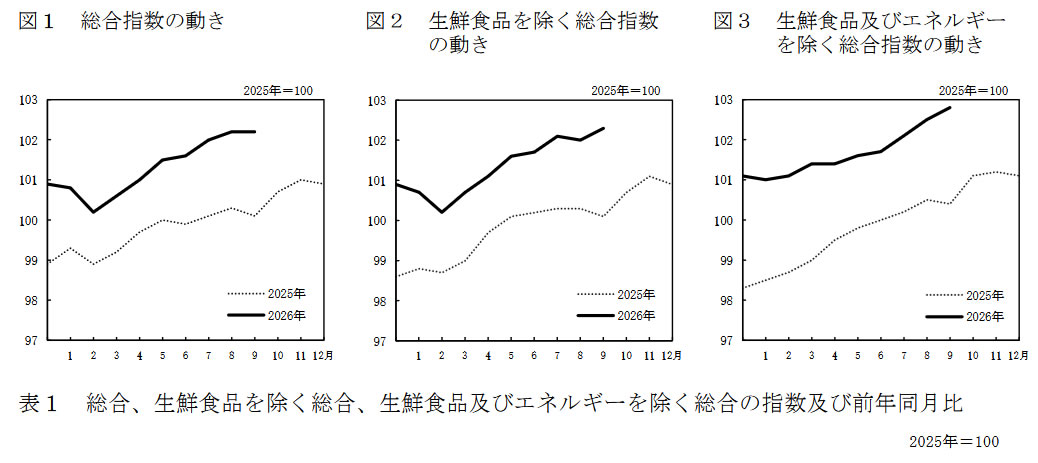
Data Summary
Headline Inflation Data
| Indicator | Previous | Expected | Current |
|---|---|---|---|
| Headline CPI Y/Y | 1.9% | — | 2.1% |
| Core CPI Y/Y (ex-fresh food) | 1.7% | 2.1% | 2.1% |
| CPI Y/Y (ex-fresh food and energy) | 1.9% | — | 2.4% |
Inflation Components — Y/Y
| Indicator | Previous | Current |
|---|---|---|
| Goods Inflation | 2.6% | 2.8% |
| Services Inflation | 1.2% | 1.5% |
| Industrial Products | 3.4% | 3.9% |
| Food Ex-Fresh Food | 2.7% | 2.9% |
| Fresh Food | 6.0% | 2.1% |
| Energy | -0.7% | -0.6% |
| Gasoline | -2.6% | -2.6% |
| Electricity | -2.4% | -2.4% |
| Rice | -15.7% | -20.6% |
| Household Durable Goods | 3.9% | 6.2% |
| Accommodation | -1.4% | 4.6% |
| Water Charges | -3.5% | 4.9% |
Seasonally Adjusted Monthly Inflation
| Indicator | Previous | Current |
|---|---|---|
| Headline CPI M/M | 0.0% | 0.4% |
| Core CPI M/M | 0.1% | 0.5% |
| CPI Ex-Fresh Food and Energy M/M | 0.3% | 0.5% |
Key Takeaways
- Core inflation returns above BoJ’s 2% target: Core CPI accelerated from 1.7% to 2.1% yoy in September, matching market expectations and exceeding 2% for the first time since December 2025.
- Underlying inflation strengthens more sharply: CPI excluding fresh food and energy rose from 1.9% to 2.4%, suggesting that the acceleration extended beyond direct energy-price movements.
- Goods and services inflation both accelerate: Goods inflation increased from 2.6% to 2.8%, while services inflation climbed from 1.2% to 1.5%, indicating broader price pressures across the economy.
- Energy deflation fails to prevent the inflation pickup: Energy prices remained in annual decline at -0.6%, while gasoline and electricity prices fell 2.6% and 2.4%, respectively. Government measures continued to cushion direct energy costs.
- Food inflation presents contrasting trends: Food prices excluding fresh items accelerated from 2.7% to 2.9%, even as fresh-food inflation slowed from 6.0% to 2.1% and rice prices fell 20.6% yoy.
- Selected goods and services contribute to broader inflation: Industrial-product inflation accelerated to 3.9%, while household durable goods, accommodation and water charges recorded notable increases. These developments contributed to the rise in overall inflation.
- Stronger inflation supports further BoJ normalization, but not necessarily an immediate hike: The data reinforce the case for additional tightening after September’s increase to 1.25%. However, core CPI matched expectations, and the release alone does not establish a need for another increase at the October 30 meeting.