


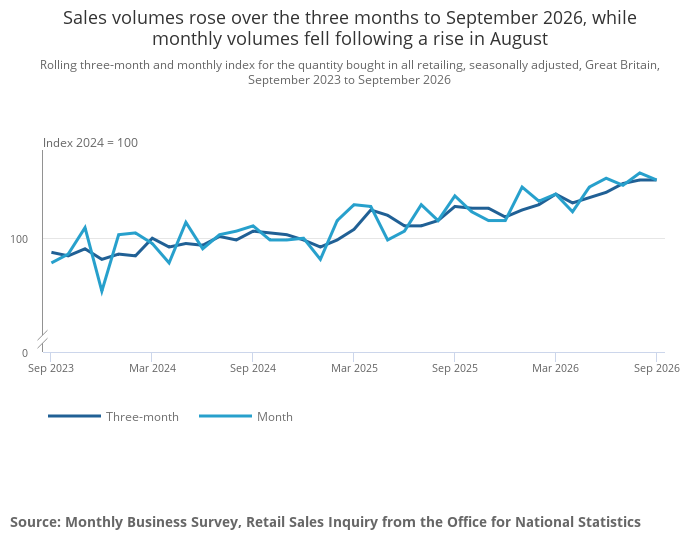
UK retail sales volumes fell 0.4% mom in September, worse than expectations of a 0.1% decline, reversing part of August’s upwardly revised 0.7% increase. Annual growth slowed from a revised 2.7% to 0.8%, also missing the 1.0% consensus. The previous monthly readings were revised higher, with August’s growth upgraded from 0.5% to 0.7% and July’s decline revised from 0.5% to 0.4%. The September setback was therefore disappointing, but followed a stronger period of retail activity than previously estimated.
The monthly weakness was concentrated in supermarkets, non-store retailers and non-food shops, with unusually warm weather disrupting demand for autumn and winter clothing. Online clothing retailers reported disappointing sales of seasonal ranges, while supermarkets gave back some of their gains from July and August. Clothing, footwear, sports equipment and hardware retailers also experienced weaker sales, with some businesses citing reduced footfall and customers cutting back. Automotive fuel volumes provided a partial offset, increasing despite continued rises in fuel prices.
Nevertheless, retail sales volumes increased 0.7% qoq in Q3, supported by recovering fuel purchases and stronger food-store demand earlier in the quarter. Sales were also 1.5% higher than in the corresponding quarter of 2025, indicating that the broader trend remained positive despite September’s decline. The contrasting monthly and quarterly figures suggest that consumer spending retained some resilience through the summer, although the weaker finish raises questions about momentum entering Q4. With weather-related disruptions contributing to the latest decline, one month’s weakness is insufficient to establish a sustained deterioration in household demand.
Data Summary
Headline Retail Sales
| Indicator | Previous | Expected | Current |
|---|---|---|---|
| Retail Sales M/M | +0.7% | -0.1% | -0.4% |
| Retail Sales Y/Y | +2.7% | +1.0% | +0.8% |
Supporting Retail Sales Data
| Indicator | Reading |
|---|---|
| Retail Sales Volumes Q/Q (Q3) | +0.7% |
| Retail Sales Volumes Y/Y (Q3) | +1.5% |
| Non-Food Stores M/M | -0.4% |
| Online Spending Value M/M | -0.4% |
| Online Spending Value Y/Y | +6.8% |
| Total Retail Spending Value M/M | +0.3% |
| Online Share of Retail Spending | 28.9% → 28.8% |
Revisions: August’s monthly retail sales growth was revised from +0.5% to +0.7%, while July’s decline was revised from -0.5% to -0.4%. August’s annual growth was revised from +2.4% to +2.7%.
Key Takeaways
- Retail sales disappoint in September: Sales volumes fell from +0.7% to -0.4% mom, weaker than expectations of -0.1%. Annual growth slowed from a revised 2.7% to 0.8%, also missing the 1.0% consensus.
- Warm weather disrupts seasonal clothing demand: Unusually warm September conditions weakened sales of autumn and winter clothing, particularly among online retailers. The ONS reported that September was the joint-fourth warmest on record.
- Supermarkets and non-food stores contribute to the decline: Supermarket sales fell following increases in July and August, while clothing, footwear, sports equipment and hardware retailers experienced weaker demand. Some businesses cited reduced footfall and customers cutting back.
- Fuel sales provide a partial offset: Automotive fuel volumes increased despite continued price rises, following weaker purchases in August. The recovery also contributed to stronger retail activity over the third quarter.
- Quarterly retail growth remains positive: Sales volumes increased 0.7% qoq in Q3 and 1.5% compared with the corresponding quarter of 2025. Upward revisions to July and August further improved the broader picture.
- Online spending also weakens: Online spending values declined 0.4% mom, reversing part of August’s 3.0% increase. However, online sales remained 6.8% higher than a year earlier.
- Consumer spending shows resilience but weaker momentum: The positive Q3 performance suggests retail activity held up through the quarter, but September’s setback indicates a softer finish. Weather-related disruptions complicate the interpretation, while weaker footfall and reduced discretionary purchases point to some consumer caution.