


GBP/USD starts the final week of October at 1.3369, with the pound remaining near its highest level in a month. Investors are assessing a mixed set of macroeconomic data ahead of this week’s Budget and the Bank of England meeting on 5 November.
Preliminary PMIs showed UK private sector activity accelerating to its fastest pace since February, with manufacturing and services both performing better than expected. At the same time, September retail sales fell more sharply than forecast, while consumer confidence recorded its steepest monthly drop since the pandemic amid cost-of-living pressures and concerns related to the Middle East conflict.
Stronger inflation data released earlier this week led markets to increase bets on further Bank of England policy tightening. Markets are now pricing in at least three 25-basis-point rate hikes by April 2027, with the first potentially coming on 5 November.
Attention now shifts to this week’s Budget. Chancellor John Healey is expected to emphasise fiscal discipline. The pound will therefore be caught between expectations of tighter Bank of England policy and economic conditions, against a backdrop of weak consumer demand.
Technical Analysis
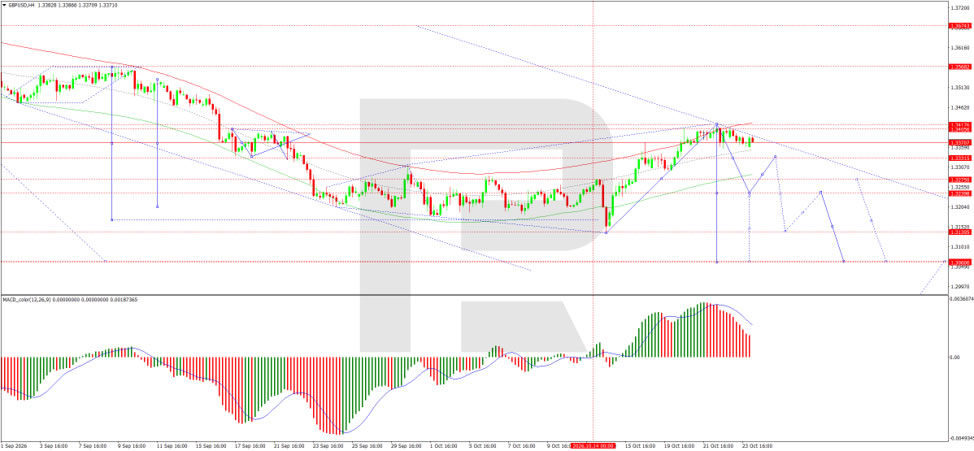
On the four-hour GBP/USD chart, the market completed its upward correction at the 1.3417 resistance level. A downward turn formed from this level, marking the beginning of a new downward wave. Today, a decline towards 1.3340 is expected, followed by a technical correction towards 1.3355. A continuation of the decline towards 1.3240 is then anticipated. A break below this support would open the way for a move within the main downtrend towards 1.3060. The nearest resistance is the 1.3406–1.3417 zone. As long as the price remains below this range, sellers retain the advantage. The MACD indicator supports the downward move: its signal line is above zero but turning down from local highs, while the contracting positive histogram indicates buying momentum is gradually weakening.
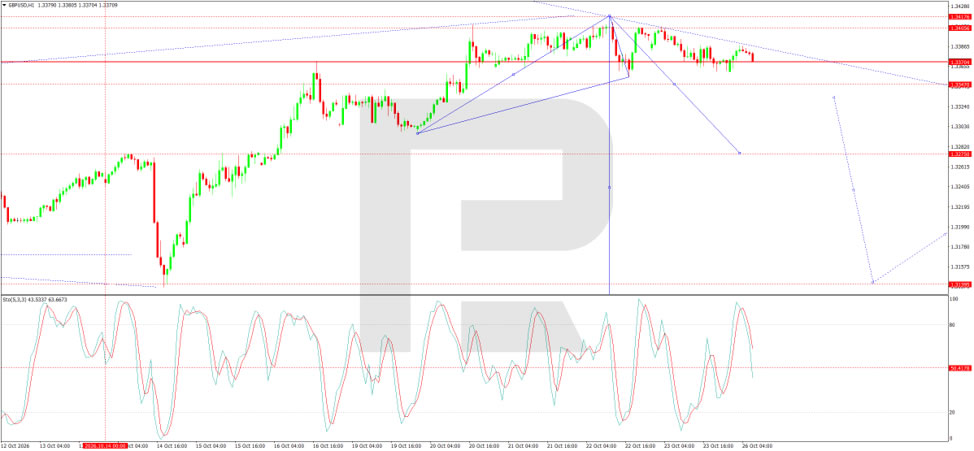
On the hourly GBP/USD chart, a consolidation range has formed around 1.3387. After breaking above the range, the market tested resistance at 1.3406 and returned to support at 1.3370. Today, a break below this level is expected, with a downward wave developing towards 1.3340. After an intermediate recovery towards 1.3355, the move is likely to continue towards 1.3275 and then 1.3240. The Stochastic oscillator confirms sellers’ advantage: its signal line has turned down from the overbought area, crossed below 80 and is heading towards 20. This increases the likelihood of a further decline in the current trading session. An alternative scenario envisages consolidation above 1.3417, which would temporarily invalidate the downside scenario and create the conditions for a recovery.
Conclusion
GBP/USD remains near monthly highs but faces growing risks as mixed UK data paint a conflicting picture. Stronger PMIs and elevated inflation have reinforced expectations of further BoE tightening, while weak retail sales and a sharp drop in consumer confidence highlight household strain. The upcoming Budget and the 5 November BoE meeting will be critical in determining whether the pound can sustain its gains. Technically, the pair appears vulnerable to a decline after failing to break resistance at 1.3417, with the main scenario pointing to a move towards 1.3340, 1.3240 and potentially 1.3060. Sellers retain the advantage below the 1.3406–1.3417 zone, though a break above would require a reassessment of the bearish scenario.