


Australia’s annual CPI inflation accelerated from 4.0% to 4.3% in September, exceeding market expectations of 4.2%, while monthly prices rose 0.8%. For Q3, headline CPI increased 1.3% q/q and 3.9% y/y, both matching forecasts. More significantly, quarterly trimmed-mean inflation rose 1.0%, above expectations of 0.8% and the RBA’s August projection of 0.8%. On the monthly series, annual trimmed-mean inflation also edged up from a revised 3.5% to 3.6%, indicating that underlying price pressures remained persistent even as the headline measure was pushed higher by energy costs.
Transport was a major source of inflation, with annual prices rising 8.7% as automotive fuel costs surged 9.4% m/m in September, following August’s 14.8% increase. Housing inflation remained elevated at 5.2% y/y, reflecting higher electricity and new dwelling costs, although annual new dwelling inflation eased from 5.4% to 4.7%. Domestic inflation pressures also remained substantial, with non-tradables inflation at 4.5% and services inflation at 4.1% y/y. The ABS noted that automotive fuel was excluded from the September trimmed mean, helping explain the divergence between headline and underlying inflation.
The stronger-than-expected quarterly trimmed mean reinforces concerns that Australia’s inflation problem extends beyond the external energy shock, particularly given persistent domestic services and non-tradables price pressures. The result is consistent with recent RBA warnings that demand remains too strong relative to sustainable supply, while higher energy costs are spreading through business supply chains. With the central bank having raised rates four times this year to 4.60%, the latest figures strengthen the case for maintaining monetary restraint and potentially further tightening at the November 3 meeting.
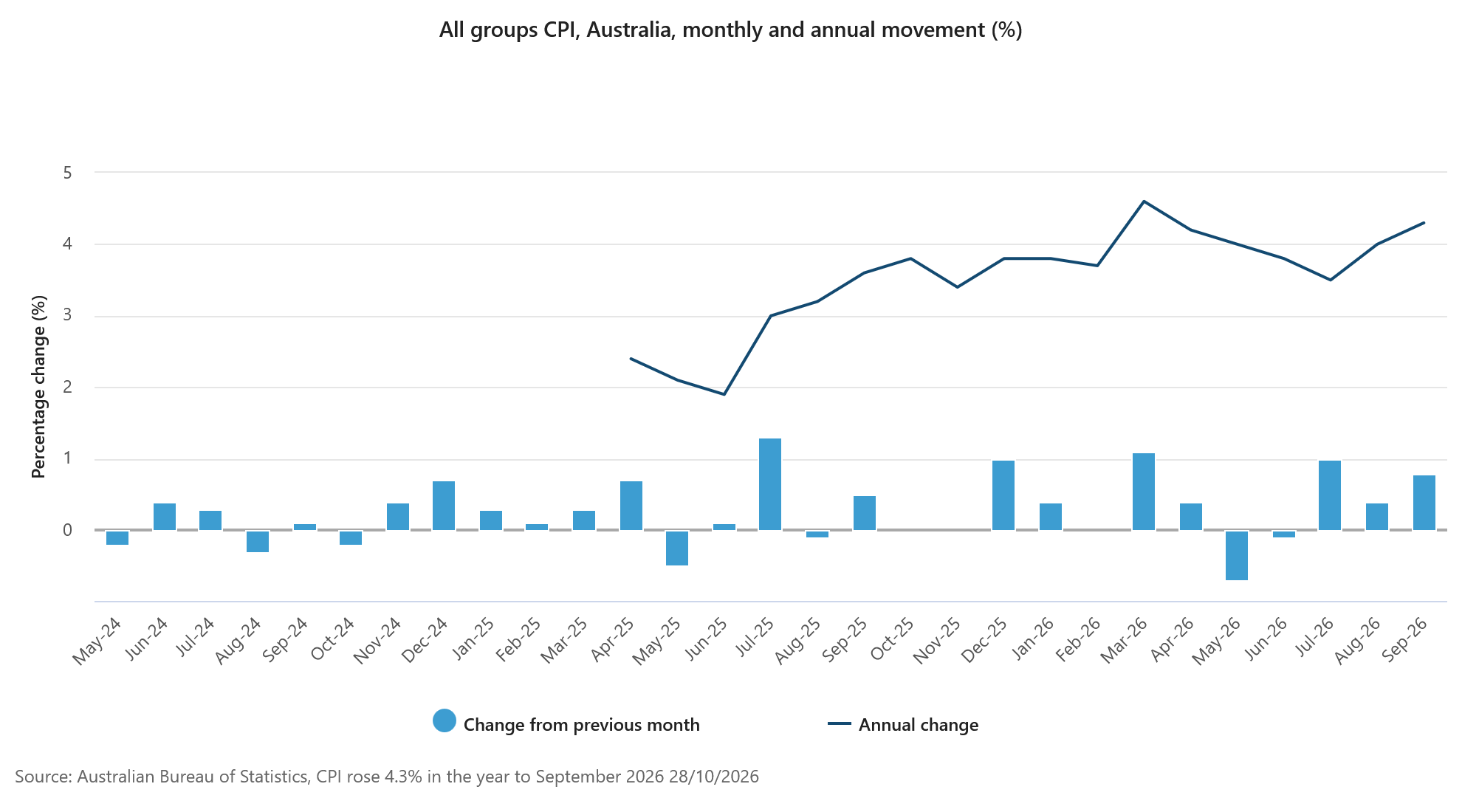
Data Summary
Australia CPI — September and Q3 2026
| Indicator | Previous | Consensus | Actual |
|---|---|---|---|
| Monthly CPI m/m | 0.4% | 0.7% | 0.8% |
| Monthly CPI y/y | 4.0% | 4.2% | 4.3% |
| Monthly Trimmed Mean m/m | 0.2% | 0.3% | 0.3% |
| Monthly Trimmed Mean y/y | 3.5% revised | 3.6% | 3.6% |
| Q3 CPI q/q | 0.6% | 1.3% | 1.3% |
| Q3 CPI y/y | 3.9% | 3.9% | 3.9% |
| Q3 Trimmed Mean q/q | — | 0.8% | 1.0% |
| Q3 Trimmed Mean y/y | — | 3.6% | 3.6% |
Selected Inflation Components — September 2026
| Component | Previous | Current |
|---|---|---|
| Automotive Fuel m/m | +14.8% | +9.4% |
| New Dwelling Prices y/y | +5.4% | +4.7% |
| Housing y/y | — | +5.2% |
| Transport y/y | — | +8.7% |
| Non-Tradables y/y | — | +4.5% |
| Services y/y | — | +4.1% |
Source: Australian Bureau of Statistics, September 2026 CPI release. The ABS reports annual monthly trimmed-mean inflation at 3.6%, rather than the economic calendar’s 3.7%. The quarterly trimmed mean uses the pre-October 2025 methodology.
Key Takeaways
- Headline inflation exceeds expectations: Annual CPI accelerated from 4.0% to 4.3% in September, above the 4.2% consensus, while monthly inflation increased from 0.4% to 0.8%.
- Quarterly underlying inflation delivers the main surprise: Q3 trimmed-mean CPI increased 1.0% q/q, exceeding both market expectations and the RBA’s August forecast of 0.8%. Annual quarterly trimmed-mean inflation stood at 3.6%.
- Quarterly headline CPI matches forecasts: Q3 CPI increased 1.3% q/q and 3.9% y/y, both in line with consensus, indicating that the release was not an across-the-board upside surprise.
- Fuel remains a major inflation driver: Automotive fuel prices rose another 9.4% m/m in September following August’s 14.8% increase, contributing to annual transport inflation of 8.7%.
- Housing inflation stays elevated despite some moderation: Housing prices rose 5.2% y/y, although annual new dwelling inflation eased from 5.4% to 4.7%.
- Domestic price pressures persist beyond energy: Non-tradables inflation stood at 4.5% y/y and services inflation at 4.1%, suggesting that domestic inflation remains substantial even as fuel drives part of the headline increase.
- RBA tightening concerns remain in focus: The stronger quarterly trimmed mean reinforces concerns about underlying inflation persistence ahead of the November 3 RBA meeting, although the quarterly headline matched forecasts and some housing components moderated.