


TL;DR: Moody’s kept France’s Aa3 rating with a negative outlook, and French bonds rallied Monday—yet Euro saw little relief, with EUR/GBP and EUR/CHF still trading near key support. The narrowing OAT-Bund spread hasn’t translated into a Euro rebound, suggesting markets still see France’s fiscal risk as unresolved rather than cleared.
Why This Matters
Euro remains under pressure despite France avoiding an immediate sovereign downgrade from Moody’s, with EUR/GBP and EUR/CHF trading near important technical support levels. Moody’s maintained France’s Aa3 credit rating with a negative outlook last Friday, removing a near-term downgrade threat without resolving concerns over the country’s fiscal outlook and political stability. French government bonds recovered on Monday, with the 10-year OAT yield falling 11.6bps to 4.903% and its spread over German Bunds narrowing to around 153bps. Yet the improvement brought little relief to Euro, suggesting that investors continue to account for unresolved French sovereign risks rather than treating the rating decision as an all-clear.
The weakness also extends beyond these two crosses. Euro has underperformed all major counterparts over the past month, with EUR/GBP and EUR/CHF remaining close to their recent lows despite Monday’s improvement in French bonds and broader equity-market sentiment. The immediate downgrade catalyst has passed, but the underlying sovereign-risk discount appears to persist, acting as a drag on Euro rather than triggering a fresh, concentrated selloff.
French Budget Uncertainty Keeps Sovereign Risks in Focus
Moody’s decision provides France with some breathing room, but the negative outlook underscores continuing concerns about fiscal consolidation and political stability. The government’s proposed 2027 budget targets a deficit of 5% of GDP and depends on approximately €43B in spending reductions, a difficult undertaking without a reliable parliamentary majority. Public debt stands around 120% of GDP, leaving fiscal credibility under close scrutiny.
Parliamentary proceedings resume today, but the budget process could extend for weeks. Disagreements over fiscal measures, potential confidence challenges and the possibility of using constitutional mechanisms to advance legislation all complicate the outlook. Even if the government succeeds in passing a budget, investors will still need to assess whether its deficit-reduction commitments are credible and achievable.
The sovereign bond market illustrates the distinction between immediate relief and lasting confidence. The French-German 10-year yield spread has narrowed over recent sessions, but remains wider than its early-October level:
- October 9: ~135bps
- Last Thursday’s close: ~175bps
- Last Friday (post-Moody’s): 166bps
- Monday: 153bps
The narrowing spread has not translated into a meaningful Euro rebound, suggesting that the currency market has yet to treat the recent bond recovery as evidence of a durable improvement in France’s fiscal outlook. Further budget setbacks or renewed political instability could quickly revive pressure on French assets, while a credible fiscal agreement would provide a stronger basis for unwinding the risk premium.
ECB and Relative Policy Expectations Add to Euro’s Challenges
French sovereign concerns are not the only influence on Euro. Relative monetary-policy expectations and economic performance also matter, particularly for EUR/GBP.
The ECB is widely expected to leave its deposit rate unchanged at 2.50% on Thursday, although markets continue to price a significant probability of further tightening in December. French fiscal stress complicates the outlook because elevated sovereign borrowing costs can tighten financial conditions independently of central-bank action, potentially reducing the need for additional policy restraint.
Sterling, meanwhile, has support from expectations that BoE will raise rates at its November 5 meeting. Wednesday’s UK Budget introduces another important variable, with fiscal decisions potentially influencing gilt yields, Sterling and expectations for monetary policy. The relative policy outlook could therefore reinforce EUR/GBP weakness even without renewed deterioration in French sovereign bonds.
Economic conditions present another challenge. France’s October PMI Composite fell into contraction at 48.4, compared with 51.9 for Eurozone as a whole. Upcoming European growth data will provide further evidence on whether weakness in France is becoming a broader regional concern.
For EUR/CHF, Swiss Franc demand and broader European risk sentiment remain relevant. The cross’s failure to recover meaningfully during Monday’s equity-market rebound suggests that its recent weakness cannot be explained solely by short-term defensive flows.
ActionForex’s Technical View
EUR/CHF, Downside Risk Persists Below 0.9285
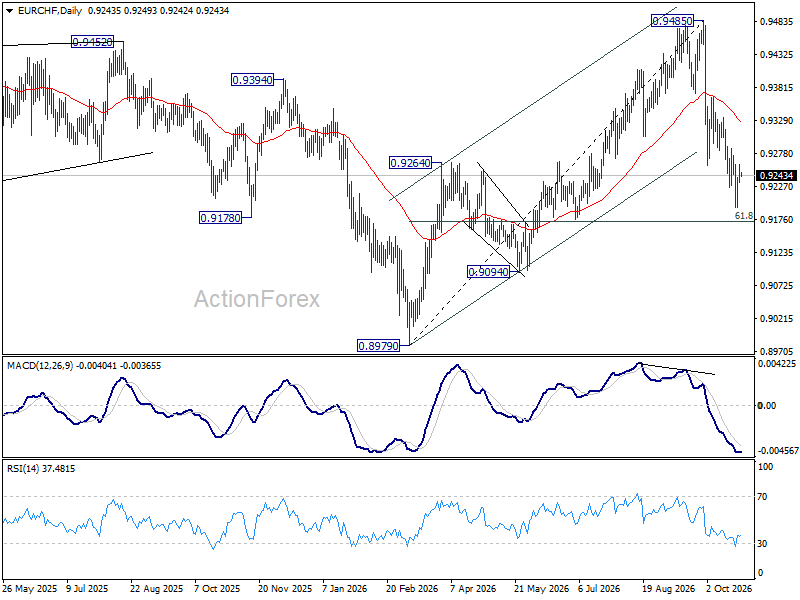
EUR/CHF’s selloff slowed after hitting 0.9193, with some stabilization emerging on the four-hour chart. Nevertheless, risk will stay on the downside as long as 0.9285 resistance holds. A break below 0.9193 will target the 61.8% retracement of 0.8979 to 0.9485 at 0.9172 first.
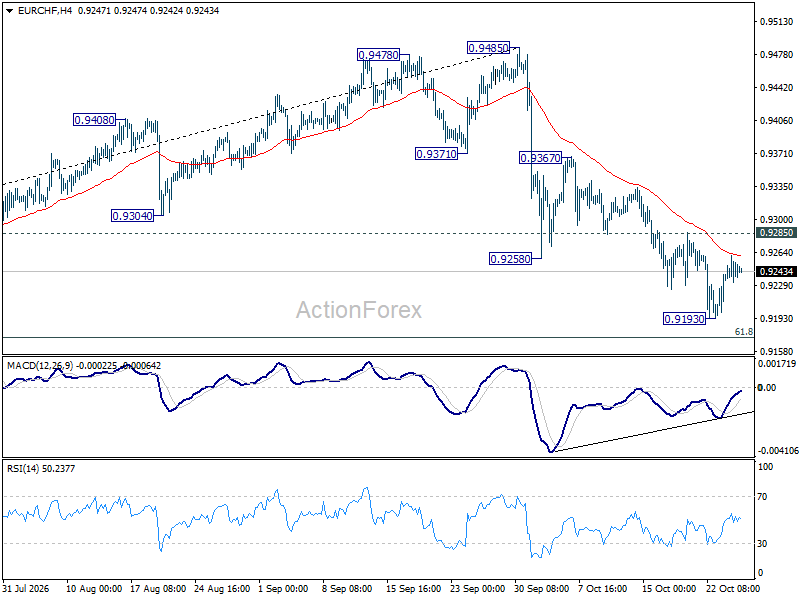
Recent developments suggest that the whole rise from 0.8979 has completed as a three-wave corrective bounce to 0.9485. A sustained break of 0.9172 will strengthen this bearish interpretation and bring a deeper fall back toward the 0.8979 low.
Nevertheless, considering the bullish divergence condition in four-hour MACD, a firm break of 0.9285 will indicate short-term bottoming and bring a stronger rebound toward the daily 55 EMA, now at 0.9330. Such a recovery would ease immediate selling pressure, although it would not by itself reverse the broader bearish outlook.
EUR/GBP, Break Below 0.8360 Could Extend the Decline
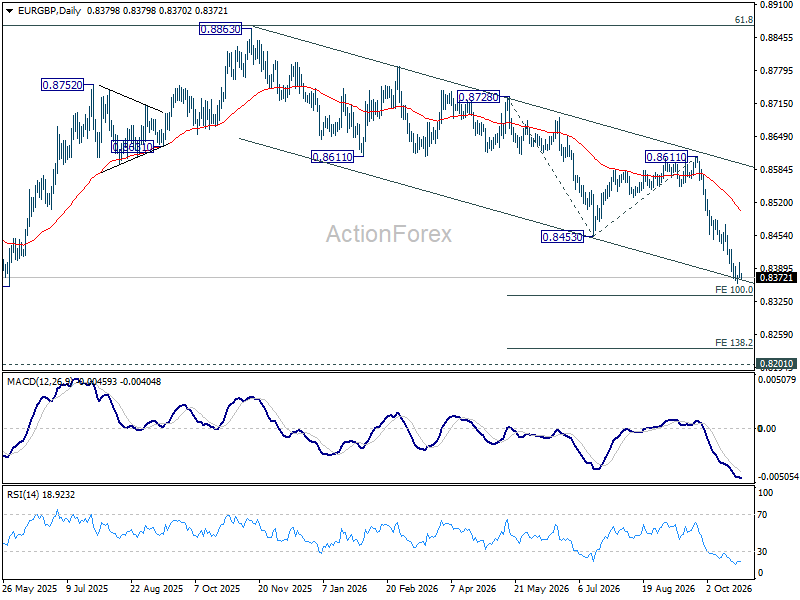
EUR/GBP recovered modestly after hitting 0.8360. While some consolidation could be seen, risk will stay on the downside as long as 0.8453 support-turned-resistance holds. A break below 0.8360 will extend the fall from 0.8611 toward the 100% projection of 0.8728 to 0.8453, measured from 0.8611, at 0.8336. A firm break there will target the 138.2% projection at 0.8231.
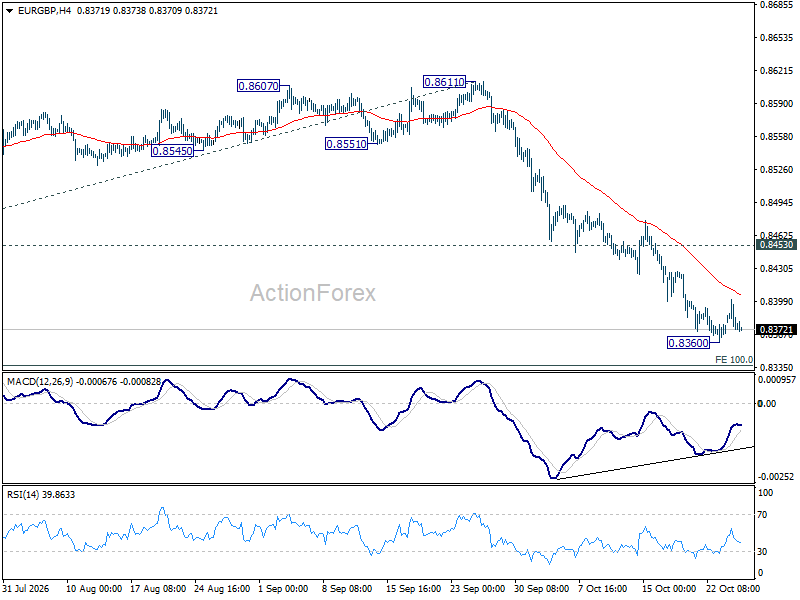
However, daily RSI near 19 indicates deeply oversold conditions, while four-hour MACD shows tentative bullish divergence. These signals leave room for a corrective rebound before the decline resumes.
A firm break of 0.8453 will argue that the fall from 0.8611 has completed, though not yet the broader downtrend from 0.8863, and bring a stronger rebound toward the daily 55 EMA, now at 0.8506.
What Could Unwind Euro’s Sovereign-Risk Discount?
The immediate question is whether improvements in French sovereign bonds can eventually translate into a sustained Euro recovery. A credible budget agreement, further narrowing of the OAT-Bund spread toward its earlier 135bp region, and reassuring ECB communication would provide a more constructive backdrop.
Conversely, renewed widening toward the approximately 175bp spread seen last week, another budget setback or heightened political instability could reinforce the existing pressure. Relative interest-rate expectations and economic data may also drive Euro lower independently of French developments.
Technically, EUR/CHF needs to overcome 0.9285 and EUR/GBP must reclaim 0.8453 to indicate that immediate selling pressure is easing. Until then, the focus remains on whether support at 0.9193 and 0.8360 can withstand another test.
France has avoided an immediate rating downgrade, but the fiscal uncertainty underlying Euro’s weakness has not disappeared. A delayed resolution is not the same as a resolved risk, leaving the currency vulnerable to further downside even after the initial sovereign-bond relief.
Key Takeaways
- Moody’s kept France’s Aa3 rating with a negative outlook, and the OAT-Bund spread has narrowed from 175bps to 153bps since last Thursday—but it’s still wider than October 9’s 135bps, and Euro hasn’t rallied on the relief.
- France’s 2027 budget (targeting a 5% deficit via ~€43B in cuts) faces a parliament without a reliable majority, while public debt near 120% of GDP keeps fiscal credibility under scrutiny.
- EUR/GBP faces an added headwind from diverging policy paths: BoE hike expectations for November 5 versus an ECB hold on Thursday, plus Wednesday’s UK Budget as a wildcard.
- EUR/CHF’s key level is 0.9285 resistance: risk stays downside below it, with a break of 0.9193 targeting 0.9172 and potentially a retest of the 0.8979 low.
- EUR/GBP’s key level is 0.8453 resistance: risk stays downside below it, with a break of 0.8360 opening 0.8336 and then 0.8231, though RSI near 19 suggests a corrective bounce is possible first.