Germany’s GfK Consumer Climate Index edged down from -30.6 to -30.8 for November, missing market expectations of -29.1 and remaining well below the -22.5 recorded a year earlier. The headline weakness contrasted with a continued improvement in consumers’ assessment of the broader economic outlook. Economic Expectations Index rose from -3.4 to +2.1 in October, marking its sixth consecutive monthly increase and moving above zero for the first time since the outbreak of the Iran War. However, the improvement in economic optimism has yet to translate into stronger overall consumer confidence, with the headline indicator continuing to stabilize at a deeply negative level.
Household financial concerns remained the principal obstacle. Income Expectations Index slipped from -15.0 to -15.7, while Willingness to Buy declined from -10.8 to -11.9, indicating continued reluctance to make major purchases. Meanwhile, Price Expectations Index rose from -0.4 to +1.0, reflecting renewed inflation concerns after Germany’s annual inflation rate reached 3.3% in September, partly driven by higher fuel costs. NIM noted that the reintroduction of the gas rebate had so far failed to generate the hoped-for recovery in income expectations. As Rolf Bürkl, Head of Consumer Climate at NIM, observed, “The hope for an economic upswing is there, but the willingness to buy has not yet followed suit.”
Willingness to Save Index fell from +21.5 to +17.2, potentially providing some support to future consumption, but the decline was not accompanied by any improvement in purchase intentions. The divergence suggests that consumers are becoming more optimistic about Germany’s economic prospects without gaining equivalent confidence in their own purchasing power. The findings also echo the latest Ifo survey, which showed improving business expectations alongside weaker assessments of current conditions. Together, the surveys point to tentative improvement in Germany’s economic outlook, but persistent household financial pressures and weak spending intentions suggest that a broader recovery in domestic consumption remains uncertain.
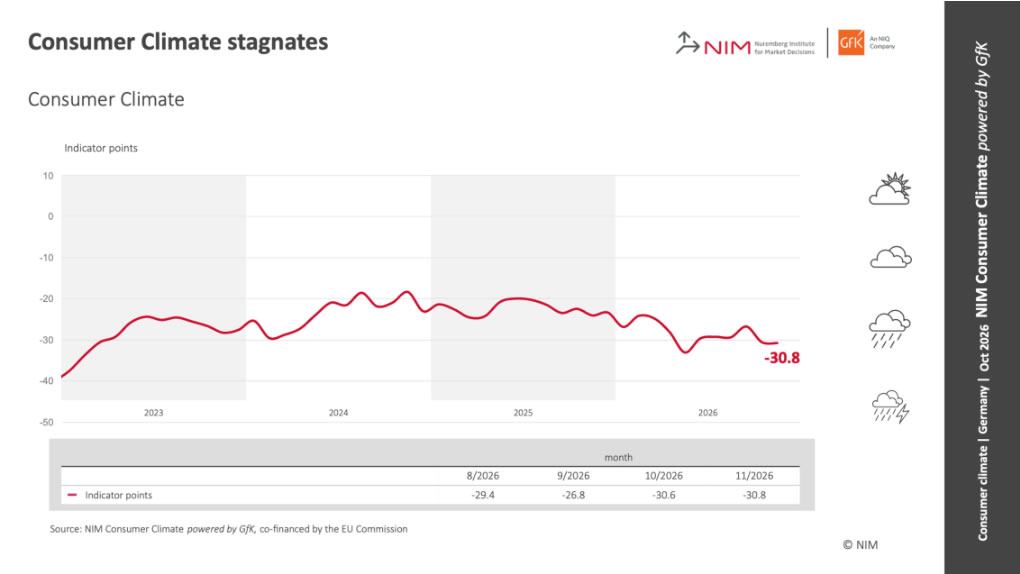
Data Summary
Germany NIM Consumer Climate powered by GfK — November 2026
| Indicator | Previous | Current | Change |
|---|---|---|---|
| Consumer Climate (November) | -30.6 | -30.8 | -0.2 |
| Economic Expectations (October) | -3.4 | +2.1 | +5.5 |
| Income Expectations (October) | -15.0 | -15.7 | -0.7 |
| Willingness to Buy (October) | -10.8 | -11.9 | -1.1 |
| Willingness to Save (October) | +21.5 | +17.2 | -4.3 |
| Price Expectations (October) | -0.4 | +1.0 | +1.4 |
Headline consensus: -29.1, compared with the actual -30.8.
Year-earlier Consumer Climate: -22.5 in November 2025, versus -30.8 in November 2026.
Survey period: October 1–12, 2026.
Source: Nuremberg Institute for Market Decisions (NIM), Consumer Climate powered by GfK, October 28, 2026.
Key Takeaways
- Consumer confidence weakens slightly: Germany’s GfK Consumer Climate slipped from -30.6 to -30.8 for November, missing expectations of -29.1 and remaining substantially below its year-earlier reading of -22.5.
- Economic expectations improve for six consecutive months: The Economic Expectations Index rose from -3.4 to +2.1, moving into positive territory for the first time since the outbreak of the Iran War. Consumers are becoming more optimistic about Germany’s broader economic outlook.
- Income expectations remain depressed: The Income Expectations Index declined from -15.0 to -15.7. NIM noted that the reintroduction of the gas rebate had not produced the hoped-for improvement in household income sentiment.
- Willingness to buy continues deteriorating: The indicator fell from -10.8 to -11.9, suggesting that improving economic optimism has yet to encourage consumers to make major purchases.
- Inflation concerns intensify: Price Expectations rose from -0.4 to +1.0 as German annual inflation reached 3.3% in September, partly driven by higher fuel prices. Elevated living costs continue to constrain purchasing power.
- Lower saving intentions provide little immediate encouragement: Willingness to Save declined from +21.5 to +17.2, but the reduction was not accompanied by stronger purchase intentions.
- Economic optimism remains disconnected from household spending: The divergence between improving economic expectations and weak income and purchasing sentiment suggests that a sustained recovery in private consumption remains uncertain.