- The RBNZ left the OCR at 2.75% – a shock to the market.
- The committee voted 4:3 against a 25bp hike, with Governor Breman within the “on hold” camp.
- The RBNZ delivered on its September strategy of pausing to assess the impact of OCR increases done to date.
- The MPC remains of the view that the OCR will increase eventually, although views on the timing differ among members.
- Westpac expects a 25bp hike in December and continues to expect an eventual peak OCR of 4% in September next year.
- However, a December hike is not a done deal and will depend on data on fuel prices, inflation expectations and second-round pricing pressures and information on evolving global economic risks that accumulate in the next six weeks.
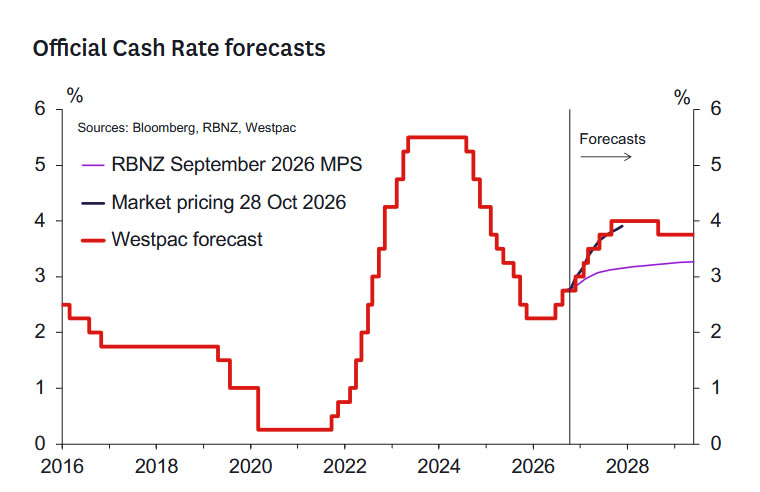
OCR Remains at 2.75%, Further Hikes Remain Their Base Case
Today the RBNZ left the OCR unchanged at 2.75%. This was a shock to markets and most analysts as a 25bp hike had been nearly fully priced by markets. The decision went to a vote which resulted in a 4:3 split in favour of an unchanged OCR.
The RBNZ has followed through on the pause it signalled for this meeting back in the September Monetary Policy Statement. All MPC members continue to see a case for a higher OCR in time, but there are different views around the timing of those increases. The Governor noted that further interest rate increases remain likely in coming meetings but are conditional on the whether the outlook evolves in line with expectations.
The key case made by more hawkish MPC members (Silk, Gourley and Conway) put greater weight on the persistence of underlying inflation and the risk that higher inflation becomes entrenched in price-setting behaviour. They noted that core inflation has been above levels consistent with the 2% target midpoint for some time, and viewed aggregate economic growth as relatively resilient despite weakness among many households and businesses. In their view, tightening now would guard against sustained inflation pressures and reduce the risk of needing to do more later.
The case made by the majority in favour of no change in the OCR (Breman, Hansen, Gai and Williams) argued that the two recent OCR increases warranted more time to assess their effects. They placed weight on inflation having been weaker than expected in the Q3 data (the Governor emphasised this point in answer to questions at the press conference), smaller-than-anticipated indirect effects from higher fuel prices, stable inflation expectations and subdued wage growth. They also emphasised downside risks to the recovery, particularly the continued weakness in household consumption and investment, and judged that there was little evidence so far that businesses were using higher costs as an opportunity to rebuild margins.
One point of note today is that the RBNZ seems more concerned about risks to the global outlook, notwithstanding its recent resilience — possibly channelling some recent comments made by the IMF. The RBNZ notes that geopolitical events, high energy prices, and high and rising public and private debt levels pose downside risk to global growth. It also notes uncertainty about whether the surge in AI investment will be justified by economic fundamentals. In addition, the MPC debated whether higher global interest rates reflected a higher neutral rate — due to higher inflation expectations and demand for funding — or posed the risk of bringing forward a potential global downturn (possibly leading to a rapid decline in the event of an abrupt global adjustment).
The exchange rate has adjusted sharply lower today, reflecting the market shock. The NZD/AUD exchange rate has moved to a new cycle low of around 0.7980 at the time of writing. This is in line with our year-end target for the NZD/AUD exchange rate of 0.79 cents. Compounding the downward pressure on the NZD/AUD exchange rate has been strong CPI data in Australia combined with hawkish RBA commentary. Our colleagues in Australia continue to [LINK?]expect a Cash Rate hike in Australia[/LINK?] on Melbourne Cup Day and some risk of a further Cash Rate rise in February. Hence downward pressure on the NZD exchange rate seems a reasonable prospect given interest rate differentials are weighing heavily on the NZD. The RBNZ does not sound especially perturbed by the prospect of weakness in the exchange rate and noted that the low exchange rate is supportive of the medium-term prospects of the export sector and the economy more broadly.
Westpac Outlook: December Hike Likely, but Not Done Deal
We changed our forecasts from no change in the OCR at the October meeting to a 25bp hike in the wake of the CPI data last week. Given the absence of the hike today we are reverting to the OCR forecast profile we had had in place since July — i.e. one further 25bp hike in 2026 and then 25bp increases in the February and March 2027 meetings, followed by a slower pace of increases at the June and September Monetary Policy Statement meetings. Our forecast of a peak OCR of 4% from September 2027 has remained unchanged throughout, as has our assessment of a 3.75% neutral OCR.
That said, in the current uncertain environment, it goes without saying that the evolution of monetary policy will depend on how both global events and key data evolve (we summarise the near-term economic diary below). Therefore, as the RBNZ noted itself today, the exact timing of the tightening profile is highly uncertain and even the tightening we forecast at the December meeting should not be regarded as a done deal.
Things to Watch Ahead of the 9 December Meeting
The RBNZ’s next policy review is on 9 December, when it will also publish a full Monetary Policy Statement (MPS) and refreshed economic forecasts. How the RBNZ’s policy stance evolves between now and then will depend on both international and domestic factors.
Regarding the former, the MPC has clearly become more concerned about risks to the global economic outlook, stemming from geopolitical events, high energy prices, high and rising public and private debt levels and uncertainty about whether the surge in AI investment will be justified by economic fundamentals. So, the RBNZ will pay close attention to any developments that suggest that downside risk to the global outlook is materialising.
There are only a few important domestic economic indicators scheduled for release ahead of the 9 December meeting (by contrast there is a full slate of indicators due for release prior to the following meeting on 10 February). We think the following are the key ones to watch.
- Q3 labour market surveys (4 November): Indicators from these surveys will cast light on economic activity in Q3, capacity pressures in the labour market and whether the lift in headline inflation is impacting growth in wages and salaries.
- Q4 RBNZ surveys (17 November, 20 November, 24 November): Inflation expectations measures from the RBNZ’s surveys of professional forecasters, households and businesses will be analysed to assess the impact of elevated headline inflation.
- October Selected Prices (17 November): These pricing indicators will provide a partial read on how inflation is tracking early in Q4.
- October/November ANZ Business Outlook (29 October/30 November): The ANZ surveys will provide a timely account of how business activity and pricing behaviour is responding to the sharp rebound in oil prices.
- October PMI and PSI surveys (13 November/16 November): These may provide some early insight regarding GDP growth in Q4.
In addition to the above, we will monitor a range of other high-frequency indicators, such as monthly data on filled jobs, consumer spending, building consents, housing market activity and prices, job ads and consumer confidence. We will also be paying close attention to developments in prices for New Zealand’s key export commodities.
Finally, with the General Election taking place on 7 November, it is possible that opinions regarding the likely path of monetary policy could be impacted should a Labour Party-led government — with an intention to restore the RBNZ’s dual mandate — seem likely to be formed.