Australia’s private-sector activity returned to contraction in October, with PMI Services falling from 51.9 to 48.5, marking its first decline in activity since May and the lowest reading in seven months. The final figure was revised up from the preliminary estimate of 47.8 but remained below the 50 expansion threshold. PMI Composite dropped from 51.3 to 48.2, indicating a broad-based contraction across manufacturing and services at the start of Q4. S&P Global attributed the deterioration to slower growth in new business and operational constraints, while service providers reported that higher interest rates and subdued market confidence were weighing on demand.
Despite the decline in output, new business continued to expand modestly, although growth in services slowed to its weakest pace in the current four-month expansion sequence. Foreign demand provided some support, with new export business increasing at a slightly faster rate amid greater overseas interest and tourism activity. Meanwhile, services firms resumed hiring after reducing staffing in September, seeking to address growing unfinished workloads. Backlogs accumulated for a fourth consecutive month and at their fastest pace since May 2022. However, employment growth remained modest, while business confidence stayed below its long-run average, suggesting that firms remained cautious about expanding capacity despite persistent operational pressures.
Inflation pressures intensified even as activity weakened, highlighting the difficult conditions facing Australian businesses. Higher fuel, freight, labour and other operating expenses pushed services input cost inflation to a five-month high, while output charge inflation accelerated to its fastest pace in three months and exceeded the survey’s long-run average. Both input and output price inflation also strengthened at the composite level. Jingyi Pan, Economics Associate Director at S&P Global Market Intelligence, noted that higher interest rates and weak confidence were “curbing growth in new business” while rising cost pressures were feeding into selling prices. The combination of contracting output and accelerating prices points to a weaker start to Q4, although continued new-order growth and renewed services hiring suggest that the deterioration is not yet uniform across business conditions.
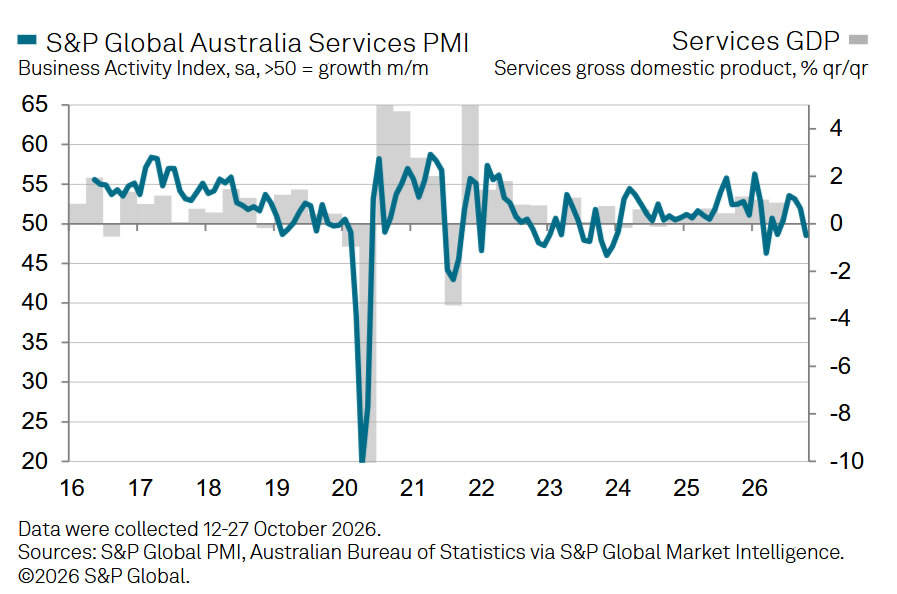
Data Summary
Australia PMI — October 2026 Final
| Indicator | September | October |
|---|---|---|
| PMI Services | 51.9 | 48.5 |
| PMI Composite | 51.3 | 48.2 |
PMI Services was revised up from the preliminary October reading of 47.8. Readings below 50 indicate contraction.
Services — Key Components
| Component | October Trend |
|---|---|
| Business activity | Contracted; seven-month low |
| New business | Modest growth; slowest in four months |
| Export business | Growth accelerated slightly |
| Employment | Returned to growth; modest pace |
| Outstanding business | Fastest accumulation since May 2022 |
| Input costs | Inflation at five-month high |
| Output prices | Inflation at three-month high |
| Business confidence | Below long-run average |
PMI Composite — Key Components
| Component | October Trend |
|---|---|
| Private-sector output | Renewed contraction |
| Manufacturing output | Contracted |
| Services activity | Contracted |
| New business | Marginal growth |
| Export orders | Unchanged |
| Employment | Increased, driven by services |
| Input costs | Inflation accelerated |
| Output prices | Inflation accelerated |
| Business optimism | Subdued |
Key Takeaways
- Australia’s private sector returned to contraction: PMI Composite fell from 51.3 to 48.2 in October, reflecting declining activity across both manufacturing and services at the start of Q4.
- Services activity declined for the first time since May: PMI Services dropped from 51.9 to 48.5, its lowest level in seven months. Although revised higher from the preliminary estimate of 47.8, the final reading remained below the expansion threshold.
- Demand growth slowed but remained positive: Services new business increased at its weakest pace in four months, with higher interest rates and subdued market confidence weighing on demand. Foreign orders provided some support, helped by overseas interest and tourism activity.
- Services hiring resumed despite falling output: Firms increased employment to address unfinished work, with backlogs accumulating for a fourth consecutive month and at their fastest pace since May 2022. However, job creation remained modest and business confidence subdued.
- Inflation pressures intensified: Services input price inflation reached a five-month high, driven by higher fuel, freight, labour and operating costs. Output price inflation accelerated to its fastest pace in three months and exceeded the long-run survey average.
- Weaker activity has not yet translated into easing price pressures: Both input and output inflation accelerated at the composite level, creating a difficult combination of contracting business activity and persistent cost pressures.
- The slowdown is not yet uniform across all indicators: Continued new-order growth and renewed services employment provide some counterweights to the contraction in output, limiting the evidence for a sustained downturn based on October’s survey alone.
Full Australia PMI Services and Composite final release here.