The Post-US-Midterm Rotation Is Spreading Across Major Equity Markets, With Semiconductor and AI-Infrastructure Stocks Facing Renewed Selling While Broader Indices and Selected Sectors Advance
What’s happening: The post-midterm rotation spread across major equity markets on Thursday. Nikkei fell 1.79% to 61,077.90, KOSPI plunged 5.28% and TAIEX lost 3.20%, while Japan’s Topix gained 1.16%, Hang Seng rallied 3.67% and the ASX 200 rose 2.61%. In Europe, the STOXX 600 gained about 0.47% as ASML, Soitec and Infineon declined, and Nasdaq 100 futures fell 0.58% against a 0.57% rise in Dow futures.
Why it matters: The selling is concentrated in semiconductor and AI-infrastructure stocks rather than technology as a whole, and the pressures on leveraged infrastructure providers were building before the election. The evidence is consistent with rotation but does not establish a confirmed global shift in investment flows, and major currencies barely reacted.
Also today:
- BoE raised Bank Rate by 25bps to 4.00% in an 8–1 vote, with Catherine Mann preferring 50bps
- Sterling barely reacted, with GBP/USD near 1.3471 and GBP sixth among the eight currencies on the ActionForex heat map
The post-US-midterm rotation is spreading across major equity markets, with semiconductor and AI-infrastructure stocks facing renewed selling pressure while broader indices and selected sectors continue to advance. The divergence was particularly striking in Asia on Thursday, where Nikkei fell 1.79% and South Korea’s KOSPI plunged 5.28%, while Japan’s broader Topix gained 1.16%. Taiwan’s TAIEX also lost 3.20%, contrasting sharply with Hong Kong’s Hang Seng, which rallied 3.67%.
The pattern suggests that investors are becoming increasingly selective about AI-related exposure following the Democratic sweep of Congress. Political uncertainty surrounding future US data-center development has added to existing concerns about AI infrastructure financing and valuations. However, the selling is far from uniform. Chinese technology stocks rallied strongly, financially established US hyperscalers have held up better than some infrastructure providers, and traditional sectors have continued attracting investor interest.
The more important question is whether this widening divergence represents a temporary adjustment to the election result or the beginning of a more persistent rotation within global equity markets.
Follow the chip-stock selloff and the post-midterm rotation on the ActionForex Telegram channel.
The Post-Midterm Rotation Spreads Across Markets
Thursday’s Asian session provided the clearest evidence that the divergence seen on Wall Street was extending internationally.
In Japan, Nikkei reversed an initially positive opening to close at 61,077.90, down 1.79%, as semiconductor and AI-related heavyweights came under renewed pressure. Advantest, Tokyo Electron, Lasertec and other chip-linked stocks suffered substantial declines.
Yet Topix advanced 1.16% to 3,940.39, producing a 2.95 percentage-point performance gap between Japan’s two major indices.
The divergence was consistent with stronger performance outside the semiconductor complex, although company-specific developments also contributed. Toyota surged 16.7% following stronger earnings and an upgraded profit outlook, providing substantial support to the broader market.
South Korea experienced an even sharper selloff. KOSPI dropped 5.28% to 5,383.81, with SK Hynix and Samsung Electronics among the major casualties as concerns surrounding AI infrastructure demand weighed on chipmakers. The technology-focused Kosdaq also fell 5.11%.
Taiwan’s TAIEX declined 3.20% to 41,574.72. While the move added to the geographical pattern of equity weakness, the available reporting does not establish a specific catalyst for the Taiwanese market’s decline.
Elsewhere in Asia, however, equities performed considerably better.
Hong Kong’s Hang Seng surged 3.67% to 24,796.98, with the Hang Seng Tech index gaining more than 5%. Alibaba and Tencent both advanced more than 6%, demonstrating that the selling was not directed indiscriminately at technology companies.
Australia’s ASX 200 also rose 2.61%, while China’s CSI 300 registered a modest 0.29% gain.
The distinction is important: the market is not simply moving away from technology, but showing pronounced differences between semiconductor-linked exposure, AI infrastructure and other businesses.
A comparable pattern emerged in Europe.
The STOXX 600 gained approximately 0.47% around midday, with DAX, CAC 40 and FTSE 100 also trading higher. Banks and pharmaceutical companies helped support broader indices, while semiconductor-related names including ASML, Soitec and Infineon declined.
The relative weakness in chip-linked shares therefore extended beyond Asia even as broader European markets remained resilient.
US equity futures suggested that the divergence could continue into Thursday’s Wall Street session. Around 12:30 GMT, Dow futures were up approximately 0.57%, S&P 500 futures gained 0.20%, while Nasdaq 100 futures fell 0.58%.
That followed Wednesday’s session, when Dow rallied 3.03% and S&P 500 gained 1.58%. Nasdaq Composite also advanced 1.44%, supported by gains of more than 6% in Microsoft and Amazon.
However, the Philadelphia Semiconductor Index fell 3.1%, while Nvidia, Micron and CoreWeave declined.
The divergence between the broader indices, financially stronger hyperscalers and semiconductor-related businesses is more revealing than the headline Nasdaq performance alone.
Chip-Linked Weakness vs Broader Resilience
| Region | Pressured | Resilient |
|---|---|---|
| Japan | Nikkei −1.79% to 61,077.90, with Advantest, Tokyo Electron and Lasertec lower | Topix +1.16% to 3,940.39, a 2.95 percentage-point gap; Toyota +16.7% on earnings and an upgraded outlook |
| Rest of Asia | KOSPI −5.28% to 5,383.81 and Kosdaq −5.11%; TAIEX −3.20% to 41,574.72 | Hang Seng +3.67% to 24,796.98 (Hang Seng Tech up more than 5%); ASX 200 +2.61%; CSI 300 +0.29% |
| Europe | ASML, Soitec and Infineon lower | STOXX 600 about +0.47% at midday; DAX, CAC 40 and FTSE 100 higher, helped by banks and pharmaceuticals |
| US (Wednesday) | Philadelphia Semiconductor Index −3.1%; Nvidia, Micron and CoreWeave lower | Dow +3.03%, S&P 500 +1.58%, Nasdaq Composite +1.44%; Microsoft and Amazon up more than 6% |
Why the Rotation Could Have Staying Power
The Democratic victory has introduced additional political uncertainty into the US AI infrastructure outlook, but the pressures affecting the sector were developing before the election.
Democratic candidates campaigning partly on restrictions to data-center development won important races in Texas and Georgia, raising concerns about future permitting requirements and potential delays to planned infrastructure projects.
Such measures could become more relevant to capacity planned for 2028 and beyond, while facilities already under construction may face less immediate disruption.
The implications should not be overstated. President Donald Trump retains veto power over federal legislation, and there is no evidence that the broader AI investment cycle has been halted.
Nevertheless, uncertainty over future development could affect the growth assumptions supporting some AI infrastructure valuations.
The more persistent pressure may come from financing.
Companies relying heavily on external borrowing to fund new data centers face a different environment from major hyperscalers with stronger balance sheets and established operating businesses.
JPMorgan’s James Sullivan has highlighted widening borrowing spreads among neocloud companies, increasing their cost of capital relative to the largest technology operators.
Meanwhile, companies with existing infrastructure capacity may become relatively more attractive if permitting restrictions or financing pressures slow new construction.
This creates a potential divide between businesses that already possess valuable capacity and those whose valuations depend heavily on continued expansion financed at favourable rates.
The distinction helps explain why companies such as CoreWeave have struggled while Microsoft and Amazon have performed more strongly.
Importantly, the adjustment was already underway before the midterm elections. CoreWeave, Nebius and Iren each lost at least 30% during October, while the semiconductor sector had also experienced a substantial correction.
The election may therefore be accelerating an existing reassessment rather than creating an entirely new trend.
That gives the divergence a potentially more durable foundation than a reaction based solely on political headlines.
Still, the evidence does not establish that institutional investors are undertaking a broad, sustained reallocation of capital. What is observable is relative performance consistent with rotation.
The distinction matters because recent declines have been sufficiently sharp to leave room for short covering and abrupt rebounds.
The Financing Divide in AI Infrastructure
| Established capacity and stronger balance sheets | Expansion financed externally |
|---|---|
| Major hyperscalers with established operating businesses, such as Microsoft and Amazon, which have performed more strongly | Companies relying heavily on external borrowing to fund new data centers, such as CoreWeave, which has struggled |
| Companies with existing infrastructure capacity may become relatively more attractive if permitting or financing slows new construction | Widening borrowing spreads among neocloud companies, per JPMorgan’s James Sullivan, raise their cost of capital |
| Lower cost of capital relative to the largest technology operators | CoreWeave, Nebius and Iren each lost at least 30% during October |
How the Rotation Will Be Tested: Wall Street and Friday’s Asia Session
The next question is whether the pattern can extend beyond the immediate post-election sessions.
Thursday’s US cash-market trading will offer an important test of whether semiconductor and AI-infrastructure stocks continue underperforming financially stronger hyperscalers and broader equity indices.
The Philadelphia Semiconductor Index, alongside Nvidia, Micron and CoreWeave, should provide a more direct measure of the pressure on AI infrastructure than Nasdaq Composite alone.
Microsoft and Amazon offer useful comparisons because their recent performance has been considerably stronger.
The Nasdaq Composite’s Wednesday close at 25,736.51 also left it slightly below the 25,800 area highlighted in our earlier Nikkei analysis.
However, a recovery in Nasdaq alone would not necessarily invalidate the rotation thesis if semiconductor stocks continued to lag.
More convincing evidence of a sustained rotation would be continued semiconductor underperformance accompanied by resilience in other sectors, rather than simply another decline in technology-heavy indices.
Friday’s Asian session will provide a second test.
If Japanese and Korean chipmakers continue weakening while broader indices hold up, the case for an increasingly persistent cross-market divergence would strengthen.
Conversely, a strong semiconductor recovery accompanied by renewed Nasdaq leadership would suggest that the latest selling pressure may be losing momentum.
The approaching US employment report could also alter the broader market backdrop and interrupt the sector-specific adjustment.
For now, the unresolved regulatory and financing issues suggest that the divergence may extend over the coming sessions, but its durability remains unconfirmed.
FX Markets Have Yet to Reflect the Equity Divergence
Despite the sharp equity-market moves, major currencies remained relatively subdued on Thursday.
The daily ActionForex FX heat map ranked currencies from strongest to weakest as CAD, NZD, USD, JPY, EUR, GBP, AUD and CHF.
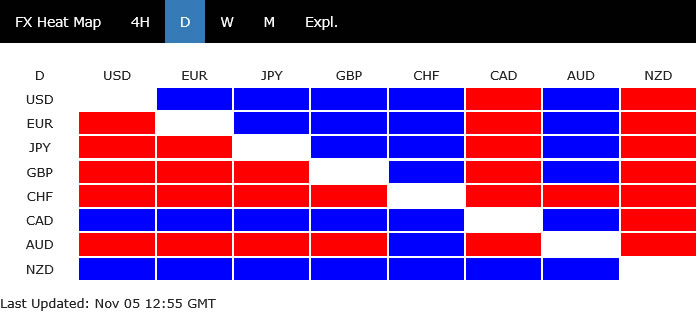
However, the differences were small in absolute terms.
DXY traded around 101.58, up approximately 0.09%, while EUR/USD slipped 0.08% to 1.1220. GBP/USD was virtually unchanged near 1.3471, and USD/JPY held around 158.40.
AUD/USD was little changed near 0.7006, while NZD/USD edged higher to 0.5626.
- Heat map, strongest to weakest: CAD, NZD, USD, JPY, EUR, GBP, AUD, CHF
- DXY: around 101.58, up approximately 0.09%
- EUR/USD: down 0.08% to 1.1220
- GBP/USD: virtually unchanged near 1.3471
- USD/JPY: around 158.40
- AUD/USD: little changed near 0.7006
- NZD/USD: edged higher to 0.5626
Even the Korean Won showed a comparatively limited response to the sharp equity selloff, with USD/KRW rising approximately 0.23% despite KOSPI’s 5.28% decline.
The equity divergence has therefore not translated into an equally clear directional pattern across major currency markets.
The limited FX movements caution against interpreting the equity rotation as a broad, synchronized change in global risk appetite.
BoE Hikes to 4%, but Sterling Barely Reacts
The day’s principal monetary-policy announcement came from BoE, which raised Bank Rate by 25bps to 4.00% in an 8–1 vote.
Catherine Mann preferred a larger 50bps increase, while the Bank sharply raised its inflation forecasts as the prolonged Middle East energy shock continued to affect the UK outlook.
CPI inflation is now expected to approach 5% by mid-2027, although policymakers acknowledged that evidence of substantial second-round effects on wages and prices remained limited.
The Committee was divided over the appropriate next steps.
Several members indicated that further tightening could be needed, while Alan Taylor characterized November’s decision as a “one-for-now” insurance hike, warning that it should not be interpreted as the start of a predetermined tightening cycle.
The statement similarly emphasized that monetary policy was “not on a pre-set path.”
Sterling showed little directional response in the available midday snapshot. GBP/USD traded near 1.3471, virtually unchanged on the day, while GBP ranked sixth among the eight currencies in the ActionForex daily heat map.
The subdued movement contrasted with the significant inflation forecast revisions and the case for additional tightening expressed by several MPC members.
However, the policy disagreement and the limited currency reaction should not be interpreted as evidence of a specific causal relationship.
For further details on the decision and the revised economic outlook, see our analysis, BoE Hikes to 4% as Inflation Forecast Nears 5%, but MPC Divides Over What Comes Next.
A Rotation That Could Outlast the Election Reaction
The most important development since the US midterms is not simply that semiconductor stocks have fallen again.
It is that the divergence between AI infrastructure exposure and other parts of the equity market appears increasingly widespread geographically, while its underlying drivers extend beyond the election itself.
Regulatory uncertainty could complicate future data-center construction, while financing pressures continue distinguishing heavily leveraged infrastructure operators from financially stronger businesses.
Those developments may support continued differentiated performance even after the immediate political reaction subsides.
However, the pattern is not uniform. Chinese technology stocks have rallied, major US hyperscalers have remained relatively resilient, and company-specific earnings have influenced broader index performance.
The evidence therefore supports a widening pattern of relative performance consistent with rotation, rather than a confirmed global shift in investment flows.
Thursday’s Wall Street session and Friday’s Asian trading will provide the next important tests, alongside upcoming US employment data.
If semiconductor and leveraged AI-infrastructure shares continue underperforming while broader markets remain resilient, the case for a more persistent post-midterm rotation will strengthen. If chip stocks recover decisively and regain leadership, the latest divergence may prove less durable.
For now, the post-election adjustment appears to be spreading internationally. Whether it becomes an established market trend is the question investors must resolve next.
Related Coverage
Central Banks and Rates
- BoE Hikes to 4% as Inflation Forecast Nears 5%, but MPC Divides Over What Comes Next: BoE raised Bank Rate from 3.75% to 4.00% by an 8–1 vote as the prolonged Middle East energy shock pushed its inflation forecast sharply higher. CPI inflation is now expected to peak around 4.9% in mid-2027, and the 2027 Q4 projection was raised from 2.1% to 4.0%. The Bank warned that persistent energy costs could generate broader wage and price pressures despite limited evidence of second-round effects so far; several policymakers see a case for further tightening, while others emphasize uncertainty over growth and inflation transmission. The MPR’s energy assumptions also predate this week’s sharp oil decline.
- BoJ Minutes Reveal Shift Toward Preventing Inflation Overshoot, But Rate Hike Pace Divides Members: the September meeting minutes reveal an emerging shift in policymakers’ thinking, from encouraging underlying inflation toward 2% to preventing it from overshooting the target. The Bank raised rates from 1.00% to 1.25% by a 7–2 majority, but members disagreed over whether inflation had already reached target and how quickly further tightening should proceed, with some advocating faster hikes and others warning against rushing. Energy costs, Yen movements and AI-related demand added to inflation risks. Released on November 5, the minutes predate BoJ’s October meeting and provide historical context rather than fresh policy guidance.
- RBA’s Hauser Warns Trust in Inflation Control Is Eroding as Rates Reach 18-Year High: Deputy Governor Andrew Hauser warned that public confidence in the central bank’s ability to control inflation has weakened materially, even though overall institutional trust remains broadly stable. An RBA survey of approximately 12,000 Australians found around 55% expressed high or moderately high trust in the Bank, but confidence in its near-term inflation performance had deteriorated. Hauser emphasized that slower inflation does not reverse accumulated price increases since COVID, and his warning follows the RBA’s hike to 4.85%, the highest in 18 years.
Oil and Gold
- Brent Oil’s $70–120 Iran War Range: What the Collapse Toward $95 Is Telling Markets: Brent has plunged toward $95, surrendering roughly half its advance from $70 to nearly $120 as markets reassess the risk of renewed full-scale escalation in the Iran conflict. The Democratic sweep of Congress has changed expectations for US military action, but there is no confirmed settlement, and although crude shipments through Hormuz have recovered substantially, transportation costs and supply risks remain elevated. JPMorgan estimates the global oil market has returned to surplus, contrasting with the IEA’s reported deficit, and Brent now faces critical support at $88.21–$93.80.
- Gold Rebounds Toward 4,200 as 10-Year Yield Nears 4.8% — Reversal or Corrective Bounce?: Gold has rebounded nearly 7% from its recent low of 3,869.96, breaking short-term resistance as the US 10-year Treasury yield falls toward 4.8%. The recovery coincides with reduced fiscal-stimulus expectations after the Democratic sweep, speculation over future Treasury bond supply and plunging oil prices on hopes of an end to the Iran war, though neither market has confirmed a broader trend reversal. Gold faces major resistance at 4,170–4,200 while the yield approaches support at 4.815–4.800%, and a decisive Gold breakout alongside a yield breakdown would strengthen the bullish case.
Eurozone and Japan Data
- Eurozone PPI Hits 11.1% as Energy Drives Inflation, While Non-Energy Prices Barely Rise: industrial producer inflation surged from 8.3% to 11.1% yoy in September, exceeding expectations of 10.9%, as energy prices rose 30.8% annually. Monthly PPI increased from 2.0% to 2.5%, driven by a 7.8% jump in energy producer prices, while prices excluding energy increased just 0.1% mom, slowing from 0.3%, and annual non-energy inflation edged up only to 3.5%. The figures highlight substantial energy-driven cost pressures without comparable evidence of a fresh acceleration across the broader industrial sector.
- Japan PMI Composite Slips to 52.1 as Hiring Weakens, Despite Firmer Services Growth: PMI Services increased from 51.3 to 51.7 on modestly improving domestic demand, but PMI Composite declined from 52.3 to 52.1 in October as manufacturing production growth slowed. Employment growth weakened to a one-year low across the private sector, with services hiring at its softest pace in 14 months, and business confidence deteriorated amid concerns over inflation, labour shortages and demographic pressures. Input cost inflation eased but prices continued rising sharply by historical standards, pointing to ongoing expansion with increasingly uneven momentum.
FAQ
Why did chip stocks fall across Asia and Europe while broader indices rose?
The selling is concentrated in semiconductor and AI-infrastructure stocks rather than technology generally. Nikkei fell 1.79%, KOSPI 5.28% and TAIEX 3.20%, yet Topix gained 1.16%, Hang Seng rallied 3.67% with Alibaba and Tencent up more than 6%, and the ASX 200 rose 2.61%. In Europe, ASML, Soitec and Infineon declined while the STOXX 600 gained about 0.47%, helped by banks and pharmaceuticals.
Why could the post-midterm rotation have staying power?
The pressures on AI infrastructure were developing before the election, notably financing: JPMorgan’s James Sullivan highlighted widening borrowing spreads among neocloud companies, and CoreWeave, Nebius and Iren each lost at least 30% during October. Democratic wins in Texas and Georgia add data-center permitting uncertainty, though President Trump retains veto power and the AI investment cycle has not been halted. The evidence is consistent with rotation but does not establish a broad, sustained reallocation of capital, and sharp recent declines leave room for short covering.
Why did currencies barely react to the equity selloff and the BoE hike?
Major currencies moved little: DXY traded around 101.58, up about 0.09%, EUR/USD slipped 0.08% to 1.1220 and USD/JPY held around 158.40. GBP/USD stayed near 1.3471 and ranked sixth of eight on the heat map despite the BoE’s 25bps hike to 4.00% in an 8–1 vote and sharply higher inflation forecasts. The limited FX moves caution against reading the equity rotation as a broad change in global risk appetite, and the policy disagreement and subdued Sterling reaction should not be read as evidence of a specific causal relationship.
Key Takeaways
- The rotation spread across Asia on Thursday: Nikkei fell 1.79% to 61,077.90, KOSPI 5.28% to 5,383.81 and TAIEX 3.20%, while Topix gained 1.16% and Hang Seng 3.67%.
- The selling is not a technology exodus: Hang Seng Tech gained more than 5%, Alibaba and Tencent rose more than 6%, and the ASX 200 gained 2.61%.
- Europe and the US showed the same pattern, with the STOXX 600 up about 0.47% as ASML, Soitec and Infineon fell, and Wednesday’s Philadelphia Semiconductor Index down 3.1% against a 3.03% rise in the Dow.
- The pressures predate the election: CoreWeave, Nebius and Iren each lost at least 30% in October, and widening neocloud borrowing spreads separate leveraged infrastructure operators from financially stronger hyperscalers.
- The evidence is consistent with rotation but does not establish a broad, sustained reallocation, and sharp declines leave room for short covering and abrupt rebounds.
- Major currencies were subdued, with DXY around 101.58, EUR/USD at 1.1220 and USD/JPY near 158.40, cautioning against reading a synchronized change in global risk appetite.
- BoE raised Bank Rate 25bps to 4.00% in an 8–1 vote with Mann preferring 50bps and CPI expected to approach 5% by mid-2027, yet GBP/USD stayed near 1.3471.
What to Watch Next
The first tests are Thursday’s US cash session, where the Philadelphia Semiconductor Index, Nvidia, Micron and CoreWeave against Microsoft and Amazon will show whether chip underperformance persists, and Friday’s Asian session for Japanese and Korean chipmakers.
Watch also the US employment report, which could interrupt the sector-specific adjustment, the Nasdaq Composite against the 25,800 area after Wednesday’s 25,736.51 close, and whether the BoE’s “not on a pre-set path” guidance keeps Sterling muted.