UK unemployment rate fell from 4.7% to 4.6% in the three months to September, beating expectations for an unchanged reading, while the employment rate edged up from 75.3% to 75.4%. However, the improvement in headline unemployment was partly driven by changes in the Labour Force Survey sample rather than stronger underlying labour demand. ONS explained that respondents leaving the survey had unusually low employment and high unemployment compared with incoming participants, contributing to the latest improvement. On a non-overlapping quarterly basis, employment increased by 155,000 to 34.625 million, while unemployment fell by 88,000 to 1.684 million. Meanwhile, October’s Claimant Count increased by 33,200, exceeding expectations of 28,100.
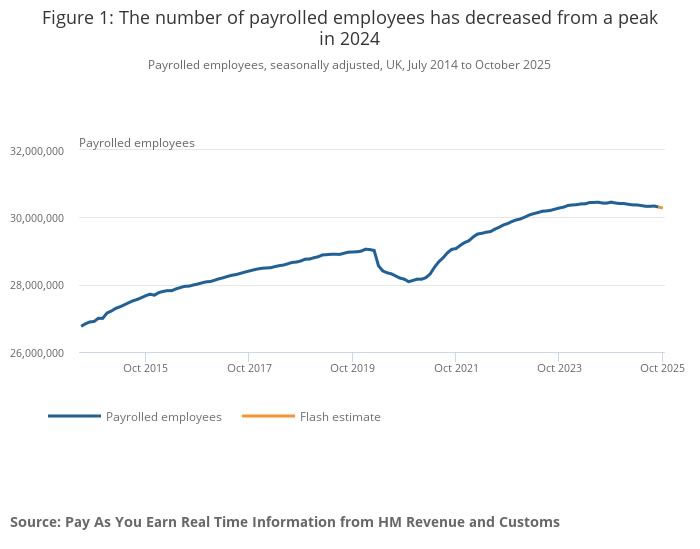
More timely payroll and vacancy data painted a weaker picture. Payrolled employment fell by 34,000 in October to approximately 30.2 million, down 95,000 or 0.3% from a year earlier. September’s increase was revised from 13,000 to 20,000, while October’s preliminary estimate remains subject to revision. Meanwhile, job vacancies declined by 22,000, or 3.0%, to 690,000 in the three months to October, their lowest non-pandemic level since 2014. Vacancies fell across 11 of 18 industries, with reductions in administrative and support services, construction, and transport and storage. Smaller businesses accounted for the entire net quarterly decline, as vacancies among firms employing one to nine workers dropped by 22,000 to 73,000. ONS reported that higher labour and operating costs were discouraging recruitment, reinforcing evidence of weakening underlying hiring demand.
Wage pressures also moderated. Annual growth in regular earnings excluding bonuses slowed from 3.7% to 3.5% in the three months to September, below expectations of 3.6%, while total earnings growth eased from 3.8% to 3.6%. The slowdown in regular pay was driven largely by public-sector earnings as the effects of earlier pay-award timing continued to fade. Public-sector regular earnings rose 5.4% yoy, compared with 3.1% in the private sector, while real regular earnings increased just 0.2% using CPIH inflation. Taken together, declining payroll employment, falling vacancies and slower wage growth suggest labour demand and pay pressures are easing, despite the better unemployment headline. The divergence warrants caution in interpreting the latest improvement in unemployment, particularly given the survey-related distortion identified by ONS.
Data Summary — UK Labour Market (November 2026)
Employment and Unemployment
| Indicator | Actual | Exp. | Previous |
|---|---|---|---|
| Unemployment rate (Jul–Sep) | 4.6% | 4.7% | 4.7% |
| Employment rate (Jul–Sep) | 75.4% | — | 75.3% |
| Economic inactivity rate | 20.8% | — | 20.9% |
| Employment change (Jul–Sep vs Apr–Jun) | +155K | — | — |
| Claimant Count change (Oct) | +33.2K | +28.1K | +30.3K |
| PAYE employment change (Oct) | -34K | — | +20K |
| PAYE employment (yoy) | -95K | — | — |
| Job vacancies (Aug–Oct) | 690K | — | 712K |
Wage Growth — July to September (yoy)
| Indicator | Actual | Exp. | Previous |
|---|---|---|---|
| Regular earnings, excluding bonuses | 3.5% | 3.6% | 3.7% |
| Total earnings, including bonuses | 3.6% | — | 3.8% |
| Private-sector regular earnings | 3.1% | — | — |
| Public-sector regular earnings | 5.4% | — | — |
| Real regular earnings (CPIH adjusted) | 0.2% | — | — |
Note: October PAYE employment is provisional. September’s payroll change was revised to +20K. The ONS cautioned that Labour Force Survey sample rotation contributed to the latest unemployment decline.
Key Takeaways
- Unemployment falls, but improvement is partly statistical: The jobless rate declined from 4.7% to 4.6%, beating expectations, although changes in the Labour Force Survey sample contributed to the improvement.
- Hiring demand continues to weaken: October payroll employment fell by 34,000, while vacancies declined to 690,000, their lowest non-pandemic level since 2014. Smaller businesses accounted for the entire net quarterly vacancy reduction.
- Wage pressures moderate: Regular earnings growth slowed from 3.7% to 3.5%, below expectations, while total pay growth eased from 3.8% to 3.6%. The slowdown reinforces evidence of cooling labour demand, although public-sector pay-award timing contributed.