Dollar Index Edged Down Despite a Modest Rise in US Treasury Yields as Improving Equity Sentiment Reduced Demand for Defensive Assets
What’s happening: Yen and Dollar led losses among major currencies on Thursday as an equity rebound ahead of Anthropic’s Nasdaq debut reduced demand for defensive assets, with Dollar Index down 0.06% to 103.749 despite a modest rise in Treasury yields and USD/JPY up 0.38% to around 159.95. Nasdaq-100 futures advanced 2.11% and VIX fell nearly 9% to 22.37 after Anthropic priced its IPO at USD 83 per share, raising approximately USD 81.3B.
Why it matters: The currency moves reflect tentative relief rather than a change in monetary policy expectations, with CME FedWatch at 90.7% for a 25bps December hike and 9.3% for 50bps after Wednesday’s FOMC minutes, and BoJ tightening expectations little changed. USD/JPY’s return toward 160, with resistance at 160.38 and the risk of intervention, keeps Yen in focus, while Anthropic’s first trading session tests whether the rebound can survive the US opening.
Yen and Dollar are leading losses among major currencies on Thursday as improving equity sentiment reduces demand for defensive assets ahead of Anthropic’s highly anticipated Nasdaq debut. Both currencies occupied the bottom of the daily FX heat map at 11:55 GMT, while European technology shares and US equity futures advanced. Dollar Index edged down 0.06% to 103.749 despite a modest rise in US Treasury yields. Yen suffered broader losses, with USD/JPY recovering toward the psychologically important 160 level.
The currency moves reflect tentative relief after a difficult period for equities, rather than a fundamental change in monetary policy expectations. Fed rate hike bets remain firmly established following Wednesday’s FOMC minutes and hawkish remarks from Governor Christopher Waller, while BoJ tightening expectations have also changed little. The immediate question is whether the rebound in technology shares can survive the US market opening and Anthropic’s first trading session. Japan’s upcoming inflation figures will provide another test for Yen.
Follow the Anthropic-led equity rebound, Yen’s retreat toward 160 and Dollar’s pause on the ActionForex Telegram channel.
Anthropic Debut Fuels Equity Recovery, but AI Concerns Persist
US equity futures pointed toward a strong opening ahead of Anthropic’s Nasdaq listing, with Nasdaq-100 futures advancing 2.11% and broader US equity futures also posting solid gains. Market volatility eased, with VIX falling nearly 9% to 22.37.
Anthropic priced its initial public offering at USD 83 per share, above the expected range, raising approximately USD 81.3B through the sale of around 980M shares. The offering surpassed SpaceX’s June IPO record and provides a significant test of investor appetite for AI-related companies after mounting concerns about the returns on heavy infrastructure spending.
Those concerns have not disappeared. Investors have become increasingly sensitive to the profitability and financing requirements of AI investment, with the AI-focused ETF cited by CNBC losing 11% this month. Wednesday’s FOMC minutes also highlighted rapidly growing AI-related debt and complex financing structures as potential sources of financial instability if investment returns disappoint.
The previous US session offered little evidence of a broad recovery. Nasdaq Composite gained 0.42%, but S&P 500 and Dow both closed lower. Thursday’s Asian trading was similarly uneven, with Nikkei and KOSPI advancing while Hang Seng lost 1.95%.
Equity Rebound and Anthropic IPO at a Glance
- Nasdaq-100 futures: up 2.11%
- VIX: down nearly 9% to 22.37
- Anthropic IPO pricing: USD 83 per share, above the expected range
- Offering size: approximately USD 81.3B through the sale of around 980M shares, surpassing SpaceX’s June IPO record
- AI-focused ETF cited by CNBC: down 11% this month
- Previous US session: Nasdaq Composite up 0.42%, with S&P 500 and Dow both closing lower
- Thursday in Asia: Nikkei and KOSPI higher, Hang Seng down 1.95%
Anthropic’s debut offers a fresh test of investor appetite for AI shares, but the rebound has yet to establish that the broader equity correction is over. Wednesday’s experience, when an earlier futures recovery lost momentum, also argues against treating the latest advance as a decisive reversal.
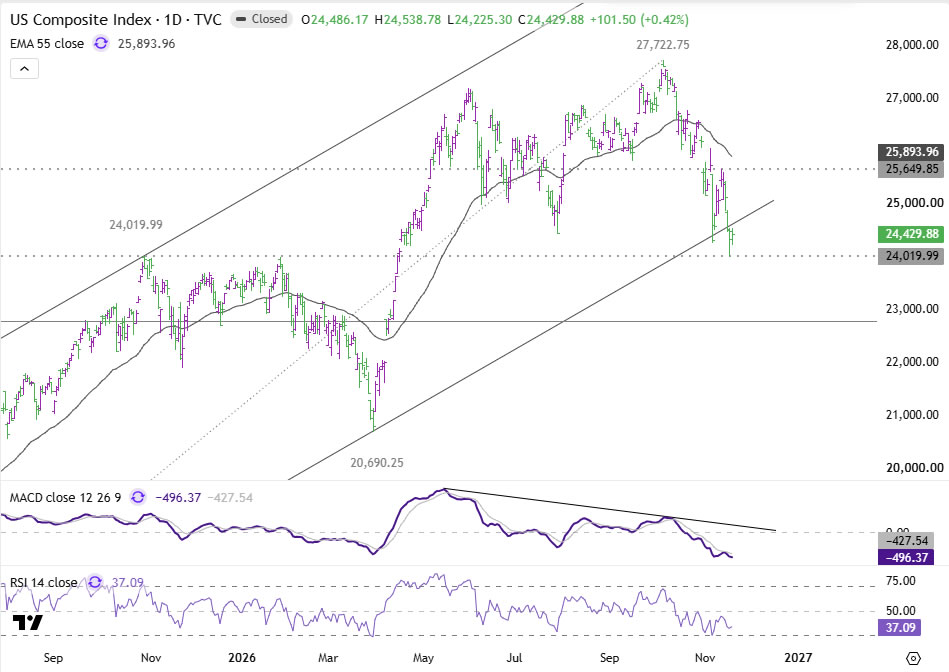
Technically, Nasdaq Composite is finding tentative support around the 24,000 psychological level, close to the October 2025 high at 24,019.99. A recovery from this area would be natural after the recent decline. However, the earlier break below medium-term rising channel support warns that the fall from 27,722.75 could develop into a larger-scale correction.
A break above 25,649.85 is needed to indicate short-term bottoming. The index would then have to sustain trading above the falling 55-day EMA, currently at 25,893.96, to confirm completion of the decline from 27,722.75. Otherwise, any rebound could remain brief, with downside risks continuing to dominate.
Nasdaq Composite: What Each Level Would Signal
| Scenario | Implication |
|---|---|
| Break above 25,649.85 | Indicates short-term bottoming |
| Sustained trading above the falling 55-day EMA, currently at 25,893.96 | Confirms completion of the decline from 27,722.75 |
| Failure to clear those levels | Any rebound could remain brief, with downside risks continuing to dominate |
Dollar Retreats With Risk Sentiment, While Fed Rate Outlook Stays Hawkish
Dollar’s modest decline contrasts with the continued rise in US Treasury yields, suggesting that Thursday’s weakness is more closely associated with improving risk sentiment than a reversal in interest rate expectations.
Dollar Index was down 0.06% at 103.749 after reaching 103.97 earlier in the week, its highest level since April 2025. Despite Thursday’s pullback, the index was still up approximately 0.87% over the preceding week, supported by expectations for further Fed tightening following stronger-than-expected US inflation data.
The rate backdrop remains supportive, with Treasury yields rising modestly across maturities. US 10-year yield gained around 3bps to 5.099%, reinforcing the contrast between higher borrowing rates and a slightly weaker Dollar.
Wednesday’s FOMC minutes showed that almost all participants considered further rate increases likely appropriate, while a couple believed a move larger than 25bps could warrant consideration in December if inflation data proved unfavorable. Governor Christopher Waller subsequently argued that the Fed might need a 50bps December hike unless policymakers clearly signaled further tightening early next year.
According to CME FedWatch, markets assigned a 90.7% probability to a 25bps increase in December, with the remaining 9.3% favoring a larger 50bps move. Pricing also indicated a substantial chance of additional tightening in January.
Dollar: Pulling Down vs Holding Up
| Pulling Dollar down | Holding Dollar up |
|---|---|
| Improving equity sentiment encourages some unwinding of defensive positions | US 10-year yield gained around 3bps to 5.099%, with Treasury yields rising modestly across maturities |
| Dollar Index down 0.06% at 103.749 on Thursday | Dollar Index still up approximately 0.87% over the preceding week, after reaching 103.97, its highest since April 2025 |
| Thursday’s retreat looks more like a pause in the recent advance | FedWatch gives 90.7% to a 25bps December hike and 9.3% to 50bps, after FOMC minutes showing almost all participants saw further hikes as appropriate |
Dollar’s retreat therefore looks more like a pause in its recent advance than a change in the underlying interest rate outlook. Higher Treasury yields and persistent expectations for further Fed tightening continue to provide support, even as improving equity sentiment encourages some unwinding of defensive positions.
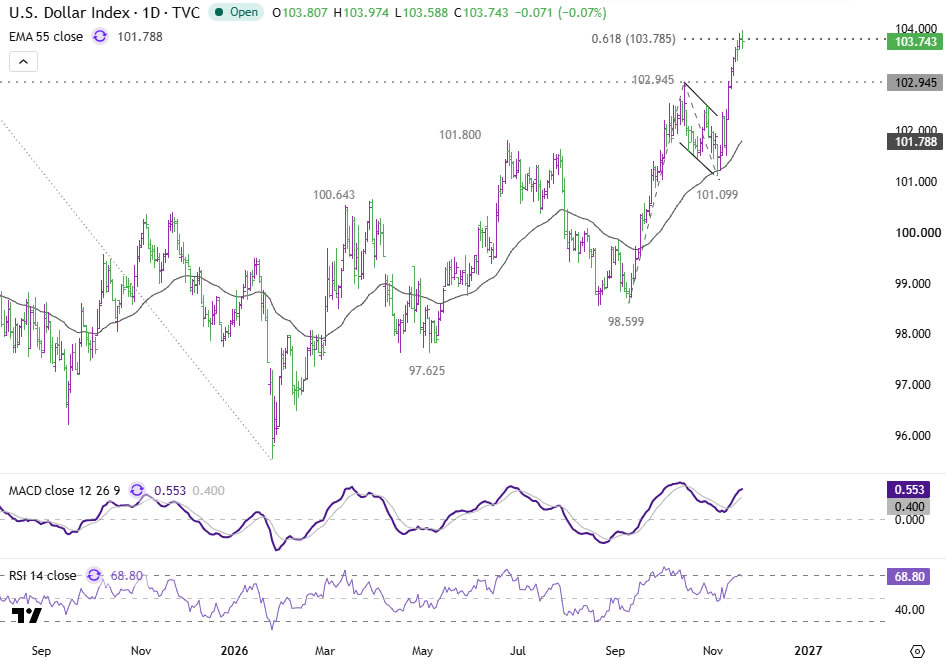
Dollar Index has reached the 61.8% projection of 98.59 to 102.94 from 101.09, at approximately 103.78. With daily RSI near 68.8, a near-term retreat would be unsurprising following the recent advance.
However, a firm break below 102.94, now resistance-turned-support, is needed to indicate short-term topping. Otherwise, the technical outlook continues to favor further upside despite the current consolidation.
Dollar Index Technical Levels
- 61.8% projection of 98.59 to 102.94 from 101.09: approximately 103.78
- Daily RSI: near 68.8
- Support: 102.94, now resistance-turned-support
- Signal of short-term topping: a firm break below 102.94
Yen Leads Losses as Haven Demand Fades, USD/JPY Approaches 160
Yen experienced a more pronounced retreat than Dollar, weakening against every other major currency as the previous week’s defensive demand unwound. USD/JPY rose 0.38% to around 159.95, while NZD/JPY gained more than 1%, illustrating the breadth of Yen selling.
The reversal contrasts with Yen’s performance earlier in the week, when it ranked as the strongest major currency amid heightened equity market uncertainty. Despite Thursday’s losses, several Yen crosses remained lower over the preceding week, indicating that the latest move was reversing only part of the earlier haven-driven advance.
Interest rate differentials also contributed to USD/JPY’s recovery. US 10-year Treasury yield rose around 3bps, while Japanese 10-year government bond yield declined by a similar amount to 2.833%, widening the yield differential by approximately 6bps.
That shift provides additional support for USD/JPY, although it cannot explain Yen’s broad underperformance against other major currencies.
Importantly, the BoJ tightening outlook has not materially weakened. OIS-implied pricing continued to indicate approximately 21bps of tightening by the December 18 meeting and around 65bps over the following 12 months. The currency’s decline is therefore occurring without a corresponding dovish shift in Japanese rate expectations.
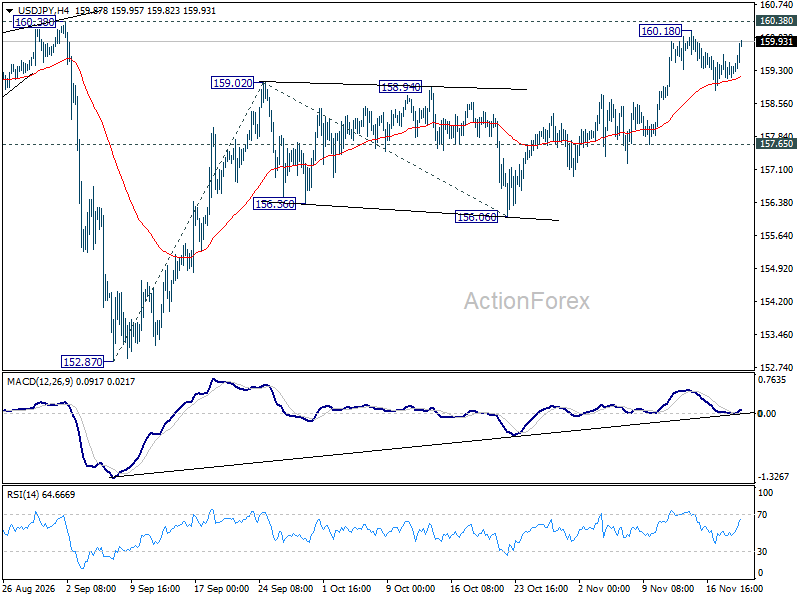
USD/JPY’s rebound has brought the 160 region back into focus, with immediate attention also on resistance at 160.38. The area is particularly sensitive because of the perceived threat of intervention by Japanese authorities.
A decisive break above 160.38 would strengthen the immediate bullish outlook, although the risk of official intervention could complicate further gains. The next development to watch is whether Yen’s broad underperformance persists as USD/JPY tests this resistance zone, and whether Japanese authorities respond to renewed currency weakness.
USD/JPY and Rate Differentials at a Glance
- USD/JPY: up 0.38% to around 159.95
- NZD/JPY: up more than 1%
- Immediate resistance: 160.38
- US 10-year Treasury yield: up around 3bps
- Japanese 10-year government bond yield: down a similar amount to 2.833%, widening the differential by approximately 6bps
- BoJ tightening priced by the December 18 meeting: approximately 21bps
- BoJ tightening priced over the following 12 months: around 65bps
AUD Lags Despite Improving Risk Sentiment
Australian Dollar has also struggled to benefit from Thursday’s equity rebound, reflecting a sharp domestic reassessment of RBA policy expectations following October’s disappointing employment report.
AUD/USD traded around 0.6710, slightly lower on the day, while AUD also underperformed most other major currencies. On the daily FX heat map, it ranked above only Dollar and Yen.
Australia’s unemployment rate climbed from 4.7% to 4.9% in October, while employment contracted by 43.5K. The report prompted markets to abandon their remaining expectations for further RBA tightening, with OIS pricing earlier Thursday implying approximately 31bps of cumulative cuts over the next 12 months.
Australia Jobs Shock at a Glance
- AUD/USD: around 0.6710, slightly lower on the day
- Unemployment rate: up from 4.7% to 4.9% in October
- Employment: contracted by 43.5K
- RBA pricing earlier Thursday: approximately 31bps of cumulative cuts over the next 12 months
The domestic rate shift helps explain why AUD has remained relatively weak even as other risk-sensitive assets recover. The detailed macroeconomic and technical implications are examined in AUD/USD Sinks Toward 0.65 as Jobs Shock Shifts RBA Outlook Toward Rate Cuts.
The immediate focus now returns to whether the equity rebound can sustain itself through the US opening session and Anthropic’s first trade. A renewed equity selloff would challenge the risk-relief narrative supporting Thursday’s Yen and Dollar weakness, while continued gains could extend the unwinding of defensive positions. However, persistent Fed tightening expectations provide a separate source of Dollar support. Japan’s national CPI release later in the day will also test whether the current retreat in Yen can continue without a meaningful change in BoJ rate expectations.
Related Coverage
Australia and New Zealand
- AUD/USD Sinks Toward 0.65 as Jobs Shock Shifts RBA Outlook Toward Rate Cuts: AUD/USD extended its decline toward 0.65 after Australia’s unemployment rate rose from 4.7% to 4.9% and employment unexpectedly fell 43.5K in October. The weak report accelerated a major shift in RBA expectations, with OIS markets moving from a modest hike bias to pricing approximately 31bps of cumulative cuts over the next 12 months. December remains priced as a hold, with easing expectations building from mid-2027. AUD/USD has also broken decisively below 0.6755, strengthening the bearish technical outlook and bringing downside targets at 0.6510 and 0.6434 into focus.
- Australia Unemployment Hits Five-Year High as Employment Falls 43.5K: Australia’s unemployment rate rose from 4.7% to 4.9% in October, its highest since October 2021, while employment contracted by 43.5K against expectations for a 25.2K increase. The decline followed September’s revised 36.4K job loss, marking two consecutive months of falling employment. Part-time positions accounted for most of the latest contraction, dropping 40.6K, while full-time employment fell just 2.9K, and labor force participation slipped from 66.8% to 66.6%. The figures signal clear labor market weakness, although steadier trend estimates suggest the underlying deterioration is more gradual than the headline figures indicate.
- NZ Trade Gap Hits NZD 2.8B as Import Growth Outpaces Exports: New Zealand’s merchandise trade deficit widened from a revised NZD 2,123M to NZD 2,772M in October, significantly worse than expectations of NZD 1,650M. Goods imports surged 21% yoy to NZD 9.7B, outpacing export growth of 7.9% to NZD 7.0B. Large aircraft deliveries added NZD 711M to annual import growth, while petroleum imports increased NZD 445M, together accounting for roughly two-thirds of the increase. Although exports to major trading partners improved, the annual trade deficit widened to NZD 7.5B, highlighting continued pressure on New Zealand’s external merchandise balance.
Federal Reserve
- Fed Minutes Signal More Rate Hikes as AI Fuels Inflation and Financial Risks: Federal Reserve officials broadly supported further interest rate increases at their October meeting, with almost all participants judging additional tightening likely appropriate to restore price stability. The minutes revealed growing concern that inflation was spreading beyond energy and tariffs, while rapid AI infrastructure investment was adding demand and straining supply. Officials also warned that AI-related debt had expanded through complex financing arrangements that could amplify losses if investment returns disappointed. The Fed faces a difficult combination of resilient economic growth, persistent inflation and emerging financial vulnerabilities, with some policymakers raising the possibility of a larger December rate hike.
FAQ
Why did Yen and Dollar fall on Thursday?
Improving equity sentiment ahead of Anthropic’s Nasdaq debut reduced demand for defensive assets, leaving Yen and Dollar at the bottom of the daily FX heat map at 11:55 GMT. Dollar Index edged down 0.06% to 103.749 despite a modest rise in Treasury yields, and Yen weakened against every other major currency as the previous week’s defensive demand unwound. The moves reflect tentative relief rather than a change in Fed or BoJ rate expectations.
Has the Fed outlook changed after the FOMC minutes?
The outlook remains hawkish. The minutes showed that almost all participants considered further rate increases likely appropriate, while a couple believed a move larger than 25bps could warrant consideration in December if inflation proved unfavorable, and Governor Waller argued that 50bps might be needed unless further tightening was clearly signaled early next year. CME FedWatch assigns 90.7% to a 25bps December hike and 9.3% to 50bps.
Will USD/JPY break above 160?
USD/JPY rose 0.38% to around 159.95, bringing 160 and resistance at 160.38 back into focus. A decisive break above 160.38 would strengthen the bullish outlook, but the area is sensitive because of the perceived threat of intervention by Japanese authorities. BoJ tightening expectations have not weakened, with OIS pricing about 21bps by the December 18 meeting, so Japan’s national CPI release later Thursday is another test.
Key Takeaways
- Yen and Dollar led losses among major currencies on Thursday as improving equity sentiment reduced demand for defensive assets, with both at the bottom of the FX heat map at 11:55 GMT.
- Anthropic priced its IPO at USD 83, above the expected range, raising approximately USD 81.3B and surpassing SpaceX’s June record, while Nasdaq-100 futures rose 2.11% and VIX fell nearly 9% to 22.37.
- The rebound remains unproven: the previous session saw S&P 500 and Dow close lower, Hang Seng lost 1.95%, an AI-focused ETF is down 11% this month, and the FOMC minutes flagged AI-related debt as a financial stability risk.
- Dollar Index fell 0.06% to 103.749 despite the US 10-year yield rising around 3bps to 5.099%, after reaching 103.97 earlier in the week, and a firm break below 102.94 would be needed to indicate short-term topping.
- CME FedWatch assigns 90.7% to a 25bps December hike and 9.3% to 50bps, with the FOMC minutes showing almost all participants viewing further hikes as appropriate.
- USD/JPY rose 0.38% to around 159.95 with resistance at 160.38 and intervention risk, while BoJ OIS pricing of about 21bps by the December 18 meeting shows no dovish shift behind Yen’s decline.
- Australian Dollar lagged despite improving risk sentiment because unemployment rose from 4.7% to 4.9% and employment fell 43.5K, leaving OIS pricing about 31bps of RBA cuts over the next 12 months.
What to Watch Next
The immediate test is whether the equity rebound survives the US opening and Anthropic’s first trading session. A renewed selloff would challenge the risk-relief narrative behind Thursday’s Yen and Dollar weakness, while Nasdaq Composite needs a break above 25,649.85 to indicate short-term bottoming.
Japan’s national CPI release later in the day will show whether Yen’s retreat can continue without a change in BoJ expectations, with USD/JPY testing 160.38 amid the risk of official intervention. For Dollar, 102.94 is the level to watch for any sign of short-term topping.
Stay ahead of Anthropic’s market debut, Japan’s CPI release and USD/JPY’s test of 160—join the ActionForex Telegram channel for regular market updates and analysis.