


Two reports. Forty-eight hours. One question. Is the RBA done hiking, or is one final move still waiting in August? Australia’s inflation report on Wednesday and employment data on Thursday could provide the clearest answer yet. After three consecutive rate hikes earlier this year, the RBA hit pause in June at 4.35%. But that pause solved nothing. Inflation is still too high, policymakers remain uneasy, and markets are deeply divided over whether the tightening cycle has truly ended.
Wednesday’s CPI release will be the first battleground. Headline inflation is expected to tick up from 4.2% yoy to 4.3% yoy, but the real story lies beneath the surface. Oil prices have collapsed since the US-Iran ceasefire, reducing pressure on headline measures ahead. If trimmed mean inflation still accelerates from 3.4% yoy to 3.6% yoy, it would send an uncomfortable message to the RBA: domestic inflation is proving more stubborn than hoped.
That is exactly the scenario policymakers fear. A rise in underlying inflation would suggest that services prices and broader domestic cost pressures are offsetting relief from lower oil prices. Instead of validating the June pause, it could strengthen the argument for another rate increase before inflation expectations become more deeply embedded.
Then comes Thursday’s jobs report. Markets expect employment growth of 30k after April’s unexpected loss of -18.6k jobs, while unemployment is forecast to fall from 4.5% to 4.4%. If the labor market rebounds as expected, the message becomes difficult to ignore: inflation is heating up again while employment remains resilient despite interest rates sitting at their highest levels in years.
That combination—sticky inflation and strong jobs—is exactly what would keep August hike expectations alive. It may not be enough to launch AUD/USD into a sustained rally against a broadly stronger US Dollar, but it could be enough to keep the pair comfortably above 0.7000 and force traders to price in one more RBA move.
The opposite outcome would be far more dramatic. If employment contracts again or unemployment climbs beyond 4.5%, markets may start treating the June pause as the end of the tightening cycle. The RBA would not necessarily be finished, but traders would likely front-run a prolonged pause. In that scenario, AUD/USD could quickly lose its grip on 0.7000.
The technical picture suggests the market is already leaning cautiously bearish.
- AUD/USD has been rejected by 61.8% retracement of 0.8006 (2021 high) to 0.5913 (2024 low) at 0.7206.
- Daily MACD bearish divergence remains firmly in place.
- Repeated failures below the falling 55 D EMA, currently at 0.7093.
They reinforce the view that May’s peak at 0.7277 may have marked an important medium-term top.
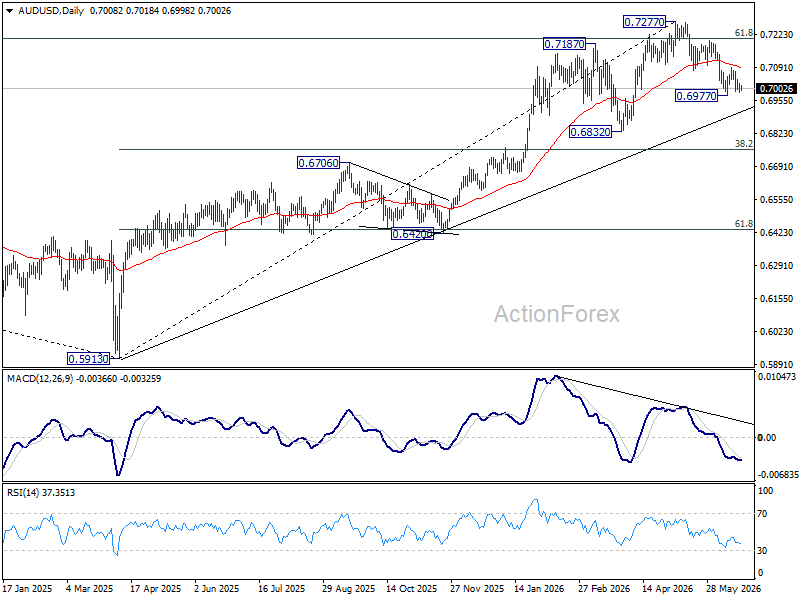
A hotter-than-expected CPI report could trigger a bounce. But unless buyers can force a sustained break above the 55 D EMA, the burden of proof remains on the bulls. The bigger move may not come on Wednesday at all. It may come 24 hours later when the labor market verdict arrives.
On the downside, firm break of 0.6977 will extend the decline from 0.7277 to 0.6832 support or further to 38.2% retracement of 0.5913 to 0.7277 at 0.6756. If the pair breaks decisively above the 55 D EMA, the correction from 0.7277 may already be over, opening the door for a return toward the highs.
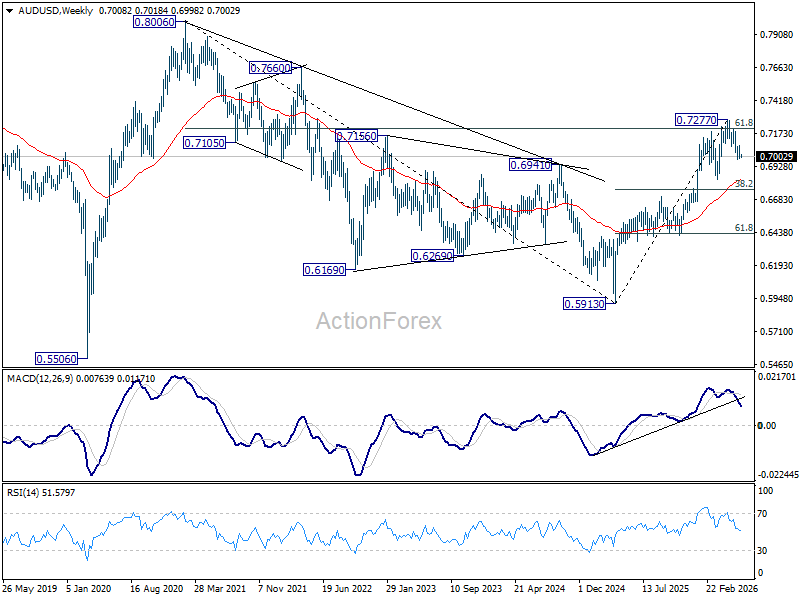
This week’s CPI and employment reports could determine whether August brings one final hike—or confirms that the battle against inflation has entered a new phase. And for AUD/USD, the answer may decide the fate of 0.7000.





