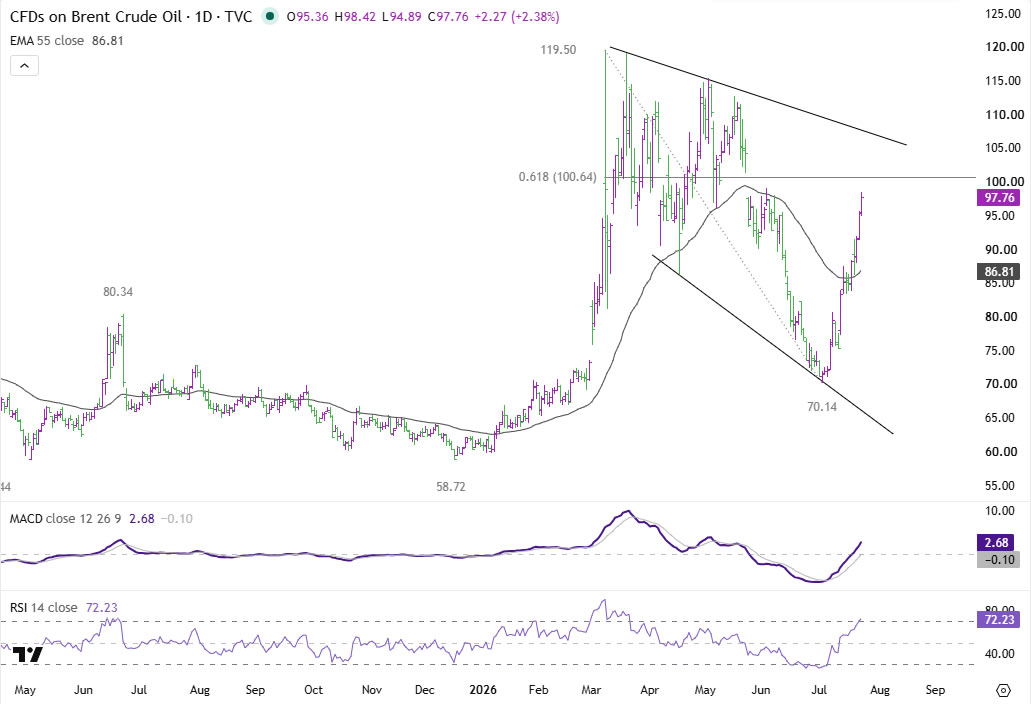
TL;DR: Brent oil has surged from to above $97 on Red Sea attacks and Strait of Hormuz escalation, bringing the psychological $100 level into view. While broader markets (stocks, bonds, currencies) have treated the move as a geopolitical risk premium, a decisive break above $100 could signal investors are pricing genuine supply disruption—a narrative shift that would reshape inflation expectations across asset classes.
Why This Matters to Traders Across All Markets
Oil’s path to $100 isn’t just about energy prices. For currency traders, commodity traders, and equity investors, the $100 level represents a psychological and fundamental turning point. As long as the rally is treated as a geopolitical risk premium, central banks can justify staying patient on rate cuts, inflation expectations remain anchored, and currencies respond modestly. But if $100 signals that supply disruption is real—not just threatened—then Treasury yields could accelerate, equities may reprice growth expectations lower, and central banks face renewed pressure to keep rates higher for longer. Understanding what happens at $100 is essential for positioning across all major asset classes.
Three Catalysts Are Making This Oil Rally More Durable Than Previous Flare-Ups
The latest rally has been driven by three developments that together paint a more bullish picture than previous geopolitical spikes:
- Active Red Sea front: Houthi forces claimed missile and drone strikes on two Saudi tankers (Encelia and Layla), marking an escalation from threats to direct attacks on commercial shipping. Combined with Strait of Hormuz uncertainty, two critical maritime chokepoints now face simultaneous pressure.
- Mechanical US retaliation framework: President Trump outlined an automatic response protocol—every Iranian attack on shipping through Hormuz triggers strikes against specific Iranian infrastructure. This reduces uncertainty over the US response but increases the likelihood that escalation could become self-reinforcing if attacks continue.
- Fading diplomatic prospects: Secretary of State Marco Rubio argued Iran has shown little seriousness after violating last month’s Memorandum of Understanding. Without a credible diplomatic off-ramp, markets are less willing to bet on rapid de-escalation that could reverse gains.
Unlike previous oil spikes, this one has both tactical triggers (actual attacks on shipping) and structural support (no visible path to quick resolution). That combination is why the rally feels more durable than typical geopolitical noise.
The $100 Level: Where Risk Premium Becomes Supply Crisis Narrative
Attention now shifts to the technical and psychological zone around $100. More specifically, a decisive move through 100 and the nearby 61.8% retracement of the 119.50 to 70.15 decline at 100.64 would represent more than another milestone in the rally. It would likely signal that investors are becoming increasingly convinced the current geopolitical premium is evolving into something more durable: the risk of genuine supply disruption.
Here’s the critical distinction: investors have so far treated higher oil prices as an uncomfortable but manageable geopolitical premium. Equities have absorbed the move. Treasury yields have risen only gradually. Currency pairs remain in familiar ranges. That changes if Brent establishes itself above $100 while evidence emerges that Red Sea attacks are materially disrupting Saudi export volumes rather than simply threatening them.
If a simultaneous constraint on both the Red Sea and the Strait of Hormuz unfolds, the conversation shifts from geopolitical uncertainty to confirmed supply losses. That’s the point where Treasury yields could accelerate higher, equity markets may begin pricing a larger growth shock, and central banks could face renewed questions over how long restrictive monetary policy will remain necessary.
Technical Signals Align With Fundamental Story
The technical backdrop reinforces the bullish narrative. Brent’s decline from 119.50 appears to have completed as a three-wave correction ending at 70.14. The subsequent rally has developed characteristics consistent with a new impulsive advance:
- Daily RSI has remained above 70 (strong upside momentum)
- Daily MACD has turned sharply higher (momentum strengthening, not fading)
- Trend structure suggests continuation rather than reversal
Technical and fundamental signals are now pointing in the same direction.
ActionForex’s Technical View on Brent Oil
Short-term pullbacks should not be ruled out. Momentum indicators are already in overbought territory, and profit-taking around $100 would not be surprising. However, unless Brent falls back below the rising 55-day EMA at 86.82, any correction would likely be viewed as a healthy pause rather than evidence that the uptrend has run its course.
Buyers would probably use weakness to rebuild positions if geopolitical tensions remain elevated. If Brent establishes itself above $100.64, the path toward a retest of the prior high at 119.50 becomes considerably more credible. The upside target from there would depend on the pace of escalation and any shifts in geopolitical expectations.