TL;DR: Washington and Tokyo abandoned decades of deliberate ambiguity by confirming their coordinated Yen intervention within hours, turning the confirmation itself into forward guidance for USD/JPY — and this week’s battle to hold 155 will test whether that credibility strategy can work.
An Unusually Fast Confirmation
USD/JPY extended last week’s intervention-driven decline on Monday after both Washington and Tokyo took the highly unusual step of publicly confirming their coordinated yen-buying operation within hours of one another. The pair briefly tested the key 155 support area before recovering, suggesting traders are now weighing not only the intervention itself, but what the unprecedented communication strategy says about the authorities’ intentions.
The intervention was already remarkable as the first coordinated US-Japan currency operation since 2011. Yet the bigger surprise may have come afterward. Japan’s Ministry of Finance has traditionally refused to confirm intervention for days or even weeks, using uncertainty itself as a policy tool. This time, however, US President Donald Trump, Treasury Secretary Scott Bessent, and Japan’s Finance Minister Satsuki Katayama all moved quickly to acknowledge the operation before Asia trading gathered momentum — raising the question of whether they were merely confirming what happened, or deliberately shaping market behavior ahead of a week packed with US data.
Why Fast Confirmation Matters More Than the Intervention Itself
Currency intervention has traditionally been as much about psychology as the actual buying or selling of currencies. For decades, Japan’s Ministry of Finance deliberately cultivated uncertainty by refusing to confirm whether it had intervened, sometimes leaving markets guessing for weeks. That ambiguity forced traders to consider the possibility of further official action at any moment, raising the cost of rebuilding speculative positions against the Yen.
Last week’s operation broke sharply with that playbook. Trump first revealed on Sunday that Japan had sought assistance, saying “they have a weakening yen, and they wanted a little bit of help. And we’re always there for Japan.” Bessent followed shortly afterward with the formal US Treasury confirmation on X, before Katayama provided Tokyo’s definitive confirmation Monday morning. For the first coordinated US-Japan currency intervention since 2011, the speed and clarity of those statements were highly unusual.
That sequence suggests the communication strategy itself was part of the policy response. Rather than preserving uncertainty, Washington and Tokyo appeared intent on eliminating any doubt they had acted together and were prepared to do so again if necessary. A government seeking to reinforce the credibility of future intervention has little incentive to leave markets debating whether the first intervention even occurred.
Why the Timing May Matter Even More Than the Speed
Had officials waited several days or weeks, as Japan has often done in the past, markets would have entered Monday’s Asian session debating whether intervention had actually taken place and whether authorities were willing to act again. That uncertainty could have encouraged investors to rebuild Yen-funded carry trades quickly, particularly if they believed the operation was a one-off rather than the start of a more active intervention strategy.
Instead, Washington and Tokyo effectively closed that window before it opened. By confirming the coordinated operation ahead of the week’s first full trading session, policymakers ensured traders started pricing not only last week’s intervention, but the possibility of another one — reinforced before markets turned to a packed top-tier US data calendar, including ISM surveys, JOLTS job openings, ADP employment, and Friday’s non-farm payrolls.
That sequencing is unlikely to be coincidental. A string of stronger-than-expected US data could quickly revive expectations that the Fed will keep policy restrictive for longer, widening yield differentials in favor of the Dollar and renewing upward pressure on USD/JPY. By establishing the credibility of their intervention before those catalysts arrive, US and Japanese officials may have sought to influence market positioning in advance, rather than being forced to respond after another rapid climb toward 160. Viewed this way, the confirmation functioned as a form of forward guidance for the foreign exchange market.
What the Market Is Actually Pricing Now
Despite Monday’s renewed selloff, price action suggests investors are not yet pricing an official campaign to drive USD/JPY significantly lower. The pair briefly tested the 155 support area before recovering, indicating buyers are still willing to step in around a level that also carries considerable technical significance. That rebound is consistent with the view that the intervention was aimed at preventing another disorderly surge above 160, rather than reversing the broader Dollar-Yen trend altogether.
That distinction matters because intervention can pursue different objectives — defending a specific exchange rate, smoothing excessive volatility, or discouraging speculative momentum. The events of the past few days point more toward the latter. For now, the base case is that both governments are trying to reshape market behavior rather than establish a new exchange-rate target below 155, effectively creating an unofficial trading range between roughly 155 and 160.
That interpretation isn’t beyond challenge, however. If USD/JPY breaks decisively below 155 and officials continue or intensify their intervention rhetoric, markets would have to consider that policymakers are seeking a materially stronger Yen rather than merely limiting excessive weakness — a significant escalation from the current strategy.
What Would Confirm — or Invalidate — This Interpretation
The key question isn’t whether USD/JPY rebounds — that would be natural if US data continues supporting higher Treasury yields — but whether the pair can do so without quickly returning to the 160 area that prompted official action.
A stronger-than-expected run of US data would offer the first meaningful challenge. ISM surveys, JOLTS job openings, ADP employment, weekly jobless claims, and Friday’s non-farm payrolls all have the potential to reinforce expectations the Fed will keep policy restrictive for longer. If the pair nevertheless remains comfortably below 160, it would suggest the authorities’ communication strategy is succeeding in changing market behavior independently of interest-rate expectations.
Conversely, a rapid recovery toward the 160–163 area over the next two or three weeks would weaken the credibility argument considerably. Markets would likely conclude the swift confirmation was little more than a more public version of previous intervention episodes — effective at generating an initial correction, but ultimately unable to alter the broader incentives driving capital flows.
ActionForex’s Technical View on USD/JPY
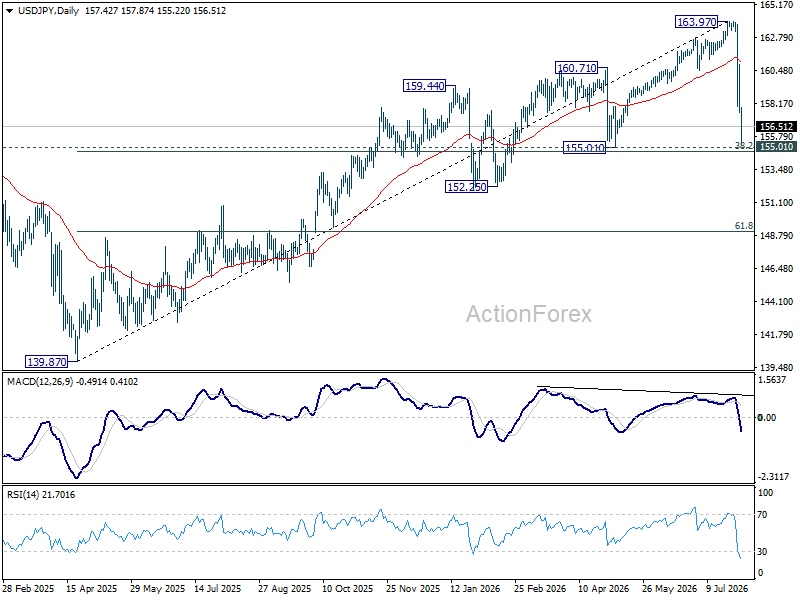
The technical picture reinforces the broader macro narrative. USD/JPY’s decline from 163.97 is still viewed as a correction within the larger uptrend that began at 139.87, rather than the start of a structural reversal. Current focus is on the 155.01 support zone, which closely aligns with the 38.2% retracement of 139.87 to 163.97, at 154.76. This cluster has already attracted buying interest, with the pair rebounding after briefly testing the area Monday.
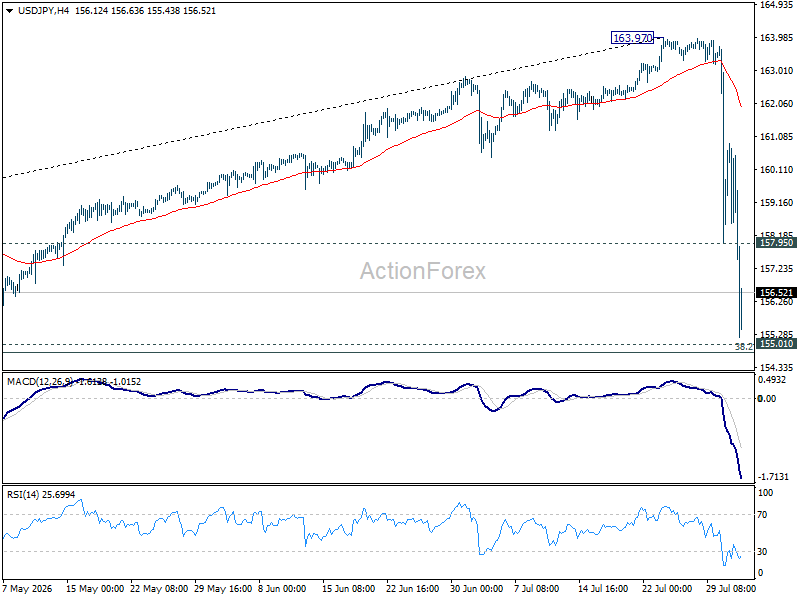
That technical support also fits neatly with the current policy interpretation. If the coordinated intervention and its swift confirmation were primarily intended to prevent another rapid move above 160 rather than engineer a much stronger Yen, holding around the 155 area would be a logical outcome — a period of consolidation between roughly 155 and 160 would suggest policymakers have succeeded in discouraging speculative momentum without fundamentally changing the market’s longer-term Dollar-Yen assessment.
The first technical indication that selling pressure is easing would be a recovery above 157.95 minor resistance, suggesting the corrective decline from 163.97 is losing momentum. The downside scenario is equally important: a decisive break below the 154.76/155.01 support cluster would fundamentally challenge the current thesis, implying markets are pricing a more persistent shift in policy expectations or a more determined official effort to strengthen the Yen. In that case, the correction from 163.97 would likely deepen toward the 61.8% retracement at 149.07.
Conclusion: This Week May Decide Whether Credibility Can Replace Ambiguity
The coordinated intervention itself was always likely to trigger a sharp correction in USD/JPY. The more important question is whether Washington and Tokyo have changed the rules of the game by abandoning ambiguity in favor of an explicit credibility signal.
If a series of strong US economic releases fails to push USD/JPY back toward 160, it would suggest the swift confirmation has successfully altered traders’ risk calculations. If, however, USD/JPY quickly resumes its climb toward 160–163 despite the barrage of official statements, the communication strategy will look less like a new intervention doctrine and more like a more public version of previous operations.
For now, the intervention has created a new variable for markets to price: not just the willingness of authorities to enter the market, but the credibility of their resolve.
Key Takeaways
- Washington and Tokyo confirmed their coordinated Yen intervention within hours, a sharp break from Japan’s traditional strategy of deliberate ambiguity.
- The swift confirmation functions as forward guidance, aiming to raise the perceived cost of rebuilding long USD/JPY positions ahead of a heavy US data week.
- USD/JPY briefly tested 155 before rebounding, suggesting markets see the intervention as capping upside near 160 rather than targeting a much stronger Yen.
- A stronger-than-expected US data run without USD/JPY returning to 160 would confirm the credibility strategy is working; a quick climb back toward 160-163 would undermine it.
- 155.01/154.76 is the key support cluster; a break opens 149.07, while recovery above 157.95 would signal the corrective decline from 163.97 is losing momentum.