


TL;DR: Canada is facing 50% US tariffs after trade talks collapsed, yet USD/CAD’s muted reaction — with oil, bonds, and the Dollar all failing to confirm a Canada-specific stress trade — suggests markets see this as a narrower, contained shock rather than an economy-wide one.
Why Isn’t the Canadian Dollar Falling Harder?
Canada entered the week with two apparently bearish developments already in place. US trade talks had collapsed, new 50% tariffs were in force, and oil was retreating from recent highs. Yet USD/CAD’s response has been restrained rather than disorderly. The pair recovered from 1.3730, but has so far failed to produce the kind of upside acceleration that headline severity might suggest. That muted reaction is important: the FX market appears to be distinguishing an unusually aggressive trade action from an immediate economy-wide shock.
Part of the explanation is scope. The 50% tariff rate is eye-catching, but duties apply to roughly C$28bn, or about US$20bn, of Canadian exports — not the entire Canada-US trade relationship. Timing also matters. US measures took effect Saturday, so Monday’s session is digesting an outcome known since late Friday rather than reacting to a fresh intraday surprise. Canada’s promised dollar-for-dollar retaliation isn’t scheduled to begin until September 8, leaving roughly two weeks before the full two-way tariff confrontation reaches the real economy.
How a Near-Deal Collapsed
The breakdown was nevertheless abrupt. US President Donald Trump temporarily postponed implementation last week as negotiations appeared close, and Canada’s trade minister Dominic LeBlanc held lengthy talks with USTR Jamieson Greer as both sides continued trying to bridge differences. Talks then failed late Friday, allowing 50% duties to take effect shortly after midnight Saturday.
Canadian Prime Minister Mark Carney subsequently called the tariffs a “miscalculation” and said the US side had introduced last-minute changes Canada considered unfair and uneconomic. Washington has framed the dispute differently, focusing in part on Canada’s refusal to remove retaliatory restrictions imposed during earlier tariff rounds, including provincial bans on sales of some US alcohol.
The accounts aren’t necessarily mutually exclusive: what Ottawa describes as a late change could be the same demand Washington viewed as an unresolved condition. Neither side has released the full draft agreement, leaving the exact final sticking point uncertain and giving Canada’s opposition another opening to press Carney for disclosure. The escalation is also notable because Trump used Section 338 of the Tariff Act of 1930, an extraordinary provision that had not previously been used by a US president to impose tariffs.
Oil and Bonds Aren’t Confirming a Canada Stress Trade
Oil adds another nominally bearish input for CAD, but the current decline is weaker as a signal than the headline suggests. Crude retreated after two consecutive weekly gains as traders took profits ahead of Treasury Secretary Scott Bessent’s expected Iran sanctions announcement today. That’s different from an oil selloff driven by collapsing demand expectations or a fresh deterioration in global growth. For a commodity-sensitive currency such as CAD, that distinction matters.
Canadian rates are also not showing a parallel stress signal. Canada’s 10-year yield has stayed firm rather than reflecting a clear growth or capital-flight repricing. More importantly, the USD itself isn’t providing the reinforcing half of the trade. The DXY is flat to slightly softer, while the broader Dollar downtrend over the past month is still intact. USD/CAD tends to move most aggressively when Canada-specific weakness is paired with broad Dollar strength — that combination is missing so far.
ActionForex’s Technical View on USD/CAD
Technically, a temporary low should be in place at 1.3730, and some consolidation above that level is likely first. But upside should be limited by 1.3927, the 38.2% retracement of the decline from 1.4247 to 1.3730. That level now carries added macro significance: a firm break would suggest Canada-specific trade risk is becoming strong enough to overpower the broader bearish Dollar structure, opening a stronger recovery toward 1.4002 support turned resistance.
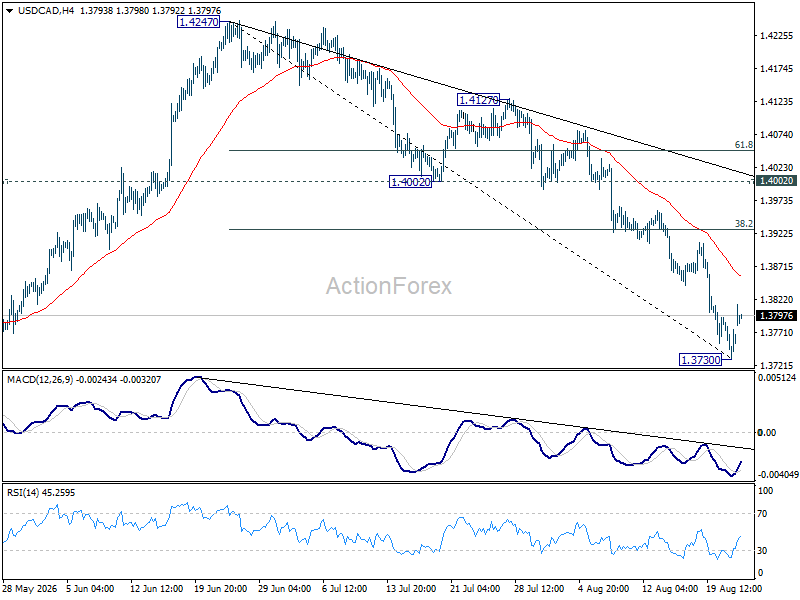
For now, the larger outlook is unchanged. The rebound from 1.3480 appears to have completed as a three-wave corrective move at 1.4247. A break below 1.3730 would resume the decline toward 1.3480.
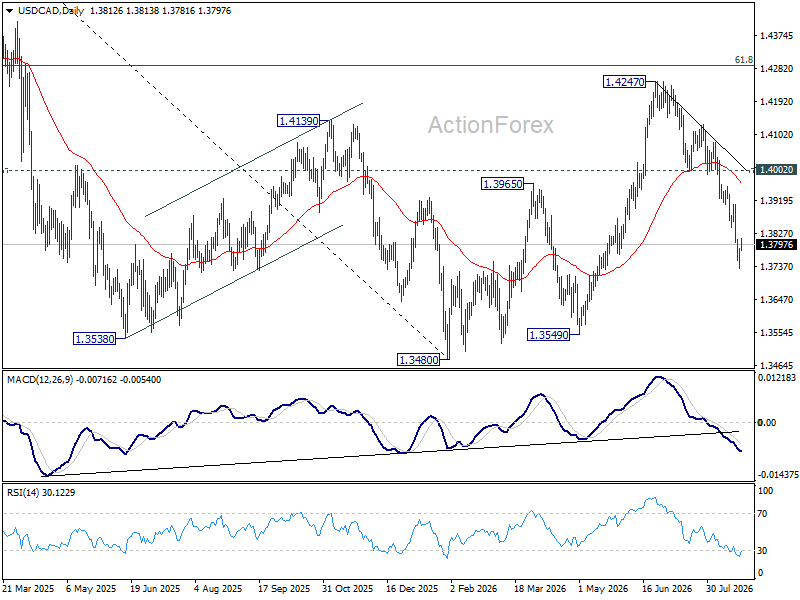
If USD/CAD can’t clear 1.3927 despite 50% tariff headlines and weaker oil, the market’s message would be difficult to ignore: the immediate Canada risk premium is still contained, while the Dollar side of the pair continues to exert greater influence. September 8, when Canada’s retaliation is scheduled to begin, is the next obvious test of whether that judgment holds.
Key Takeaways
- USD/CAD’s recovery from 1.3730 has stayed restrained despite 50% tariffs, signaling markets see this as a contained shock rather than an economy-wide one.
- The tariffs apply to roughly C$28bn of exports, not Canada’s entire trade relationship, and Canada’s retaliation doesn’t begin until September 8, delaying the full economic impact.
- Trump invoked Section 338 of the Tariff Act of 1930, a provision no US president had used before, underscoring how unusual this escalation is even with its narrower economic scope.
- Oil’s decline reflects profit-taking ahead of an Iran sanctions announcement, not a demand-driven selloff, while Canadian yields and the Dollar aren’t confirming a Canada-specific stress trade.
- 1.3927 is the key resistance test; failure to clear it despite the tariff headlines would confirm the Canada risk premium remains contained, while a break would open a run toward 1.4002.





