

Live Comments
US Core PCE Inflation Eases to 3.3% in June, Supporting Fed’s Wait-and-See Stance
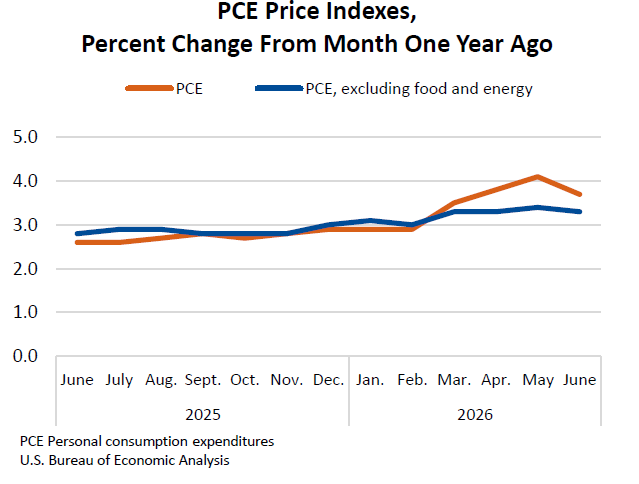
The Federal Reserve's preferred inflation gauge pointed to continued progress on underlying price pressures in June, even as higher energy costs remained a looming risk. The headline PCE price index fell -0.1% mom, matching expectations, while annual inflation slowed from 4.1% yoy to 3.7%. Core PCE, which excludes food and energy, rose just 0.1% mom, below expectations of 0.2%, with the annual rate easing from 3.4% to 3.3%. The figures reinforce the view that underlying inflation continued to moderate before the recent escalation in Middle East tensions began pushing oil prices sharply higher.
The report also suggested consumers remained cautious. Personal income increased 0.2% mom, while personal spending rose 0.3%, both slowing from May's pace but remaining positive. Real personal consumption expenditures increased 0.4%, indicating households continued to support economic growth despite elevated borrowing costs and tighter financial conditions.
For the Federal Reserve, the report provides further evidence that core inflation remains on a disinflationary path. However, policymakers are unlikely to take too much comfort from backward-looking data given the recent rebound in energy prices. The key question now is whether the oil shock proves temporary or begins feeding into wages, services inflation and inflation expectations.
Economic Data
| Indicator | Actual | Expected | Previous |
|---|---|---|---|
| Personal Income mom (Jun) | 0.2% | 0.3% | 0.7% |
| Personal Spending mom (Jun) | 0.3% | 0.4% | 0.7% |
| Real Personal Spending mom (Jun) | 0.4% | — | — |
| PCE Price Index mom (Jun) | -0.1% | -0.1% | 0.4% |
| PCE Price Index yoy (Jun) | 3.7% | 3.7% | 4.1% |
| Core PCE Price Index mom (Jun) | 0.1% | 0.2% | 0.3% |
| Core PCE Price Index yoy (Jun) | 3.3% | 3.3% | 3.4% |
Key Takeaways
- The Fed's preferred inflation gauge cooled. Headline PCE inflation slowed from 4.1% to 3.7% yoy, while core PCE eased from 3.4% to 3.3% yoy, reinforcing the broader disinflation trend.
- Monthly core inflation remained subdued. Core PCE rose just 0.1% mom, below expectations of 0.2%, suggesting underlying price pressures continued to moderate before the recent energy shock.
- Headline prices declined on the month. The PCE price index fell 0.1% mom, matching expectations and reversing May's 0.4% increase.
- Consumer spending moderated but remained positive. Personal spending slowed from 0.7% to 0.3%, while personal income eased from 0.7% to 0.2%, pointing to softer—but still resilient—household demand.
- Real consumption remained healthy. After adjusting for inflation, real PCE increased 0.4%, indicating consumers continued to increase spending in volume terms despite restrictive financial conditions.
- The report supports the Fed's cautious stance. June data show underlying inflation continued to improve, but with oil prices rising sharply after the survey period, policymakers are likely to focus on whether higher energy costs eventually spill over into wages, services inflation and inflation expectations.
US Q2 GDP Growth Cools to 1.5%, Well Below Expectations
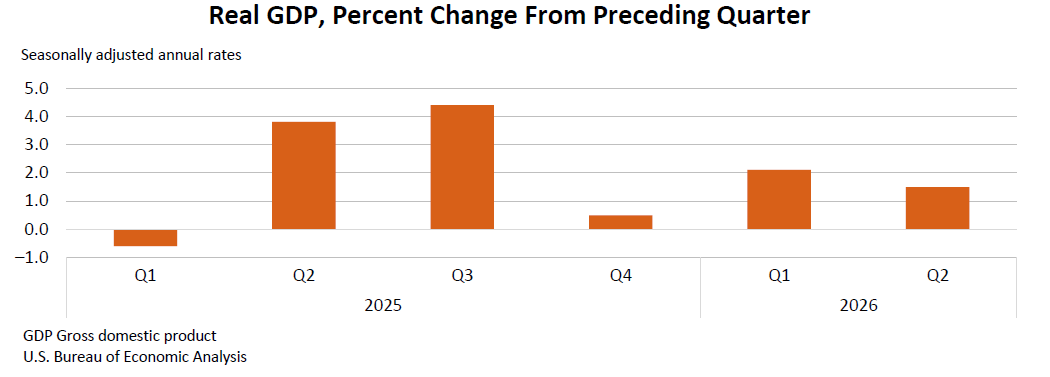
The US economy expanded at an annualized rate of 1.5% in the second quarter, according to the advance estimate from the Bureau of Economic Analysis, slowing from 2.1% in the first quarter and falling short of market expectations of 2.3%. The softer headline reflected a downturn in government spending alongside slower investment and export growth, while a larger increase in imports also weighed on overall GDP. Consumer spending remained the main pillar of growth, accelerating from the previous quarter and helping keep the economy on a positive footing.
Beneath the headline, however, domestic demand remained considerably stronger than the top-line figure suggests. Real final sales to private domestic purchasers—a measure often viewed as a better gauge of underlying economic momentum—accelerated sharply to 3.9% from 1.7% in the first quarter. The improvement indicates that private consumption and business investment continued to hold up well despite restrictive monetary policy and tighter financial conditions, with much of the GDP slowdown driven by more volatile components such as government spending and trade.
Inflation presented a more mixed picture. The gross domestic purchases price index accelerated from 3.6% to 5.7%, while the headline PCE price index rose from 4.6% to 5.1%, reflecting the impact of higher energy prices during the quarter. At the same time, core PCE inflation eased from 4.4% to 3.4%, suggesting underlying price pressures outside food and energy continued to moderate.
Economic Data
| Indicator | Actual | Expected | Previous |
|---|---|---|---|
| GDP Annualized Q2 (Advance) | 1.5% | 2.3% | 2.1% |
| Real Final Sales to Private Domestic Purchasers | 3.9% | — | 1.7% |
| Gross Domestic Purchases Price Index | 5.7% | — | 3.6% |
| PCE Price Index | 5.1% | — | 4.6% |
| Core PCE Price Index | 3.4% | — | 4.4% |
Key Takeaways
- US economic growth slowed more than expected. Real GDP expanded at an annualized 1.5% in Q2, down from 2.1% in Q1 and below the 2.3% consensus, reflecting weaker government spending, slower investment and exports, and a larger drag from imports.
- Underlying private demand strengthened significantly. Real final sales to private domestic purchasers accelerated to 3.9% from 1.7%, suggesting household spending and business investment remained resilient despite restrictive monetary policy.
- Consumer spending remained the key growth engine. Stronger household spending partly offset weakness elsewhere and prevented a sharper slowdown in overall GDP.
- Headline inflation pressures picked up because of energy. The gross domestic purchases price index accelerated from 3.6% to 5.7%, while headline PCE inflation rose from 4.6% to 5.1%, highlighting the impact of higher energy prices during the quarter.
- Underlying inflation continued to improve. Core PCE inflation slowed from 4.4% to 3.4%, indicating broader domestic price pressures continued to moderate despite the energy shock.
BoE Split Widens as Policymakers Debate When—Not Whether—to Fight Inflation
The Bank of England left Bank Rate unchanged at 3.75% in a 6-3 vote today, but the decision masked a Committee that has become increasingly united on the direction of inflation risks while remaining divided over the timing of the policy response. Governor Andrew Bailey, Sarah Breeden, Swati Dhingra, Clare Lombardelli, Dave Ramsden and Alan Taylor voted to hold rates, while Megan Greene, Catherine Mann and Huw Pill preferred an immediate 25 basis point increase to 4.00%.
The meeting made clear that the debate is no longer whether renewed energy shocks pose an inflation risk. All members agreed that repeated Middle East escalations have left risks to energy prices skewed to the upside and that inflation is likely to rise later this year as higher fuel costs feed through to households and businesses. The key disagreement is whether policymakers should wait for evidence that higher energy costs are spilling into wages, services inflation and inflation expectations, or move pre-emptively to prevent those second-round effects from taking hold. The minutes explicitly acknowledged that monetary policy "could need to react before the risks around inflation persistence materialised conclusively," marking a notable shift toward a more proactive risk-management approach.
For the majority, restrictive monetary and financial conditions already provide sufficient insurance while policymakers gather more evidence. They argued that underlying disinflation remains intact, the labour market continues to soften and there is little evidence so far that higher energy prices are becoming embedded in broader inflation dynamics. Bailey summed up the balance by arguing that global conditions have become more inflationary, but domestic conditions remain comparatively benign, justifying a pause while retaining the flexibility to tighten later if needed.
The three dissenters viewed the risks differently. Greene argued that a proactive rate increase would reduce the probability of second-round effects becoming entrenched. Mann said the collapse of the US-Iran ceasefire and renewed volatility in energy markets had materially altered the policy backdrop, while Pill argued that tightening now would send a clear signal of the Bank's determination to keep inflation under control amid prolonged uncertainty over energy prices. Their common theme was that the cost of acting too early is likely to be lower than the cost of waiting until inflation persistence is already evident.
Taken together, the decision reinforces that the MPC has adopted an increasingly hawkish risk-management framework. While a majority judged it appropriate to hold rates this month, the minutes suggest future decisions will depend less on the direct impact of higher oil prices and more on whether evidence begins to emerge that the energy shock is feeding into wage growth and inflation expectations. Until then, markets are likely to interpret the BoE as remaining firmly biased toward tightening rather than easing.
Key Takeaways
- The BoE left Bank Rate unchanged at 3.75% in a 6-3 vote, with Megan Greene, Catherine L. Mann and Huw Pill voting for a 25bp hike to 4.00%.
- The Committee is divided over timing, not direction. All members agreed inflation risks remain skewed to the upside due to higher and more volatile energy prices, but differed on whether to tighten now or wait for more evidence.
- Second-round effects are now the BoE's central focus. Policymakers continue to look through the direct impact of higher energy prices and instead are watching for spillovers into wages, services inflation and inflation expectations.
- The minutes signal a more proactive policy framework. The MPC explicitly stated that monetary policy may need to react before inflation persistence becomes conclusively evident, reflecting a stronger risk-management approach.
- The hold camp believes policy is already restrictive enough. Members pointed to ongoing underlying disinflation, a softer labour market and tighter financial conditions as reasons to wait while monitoring incoming data.
- The hike camp argues the cost of acting early is lower than acting late. The three dissenters favored an immediate hike to reduce the risk that higher energy prices become embedded in inflation expectations and wage-setting.
- Future BoE decisions will hinge on domestic inflation persistence rather than oil prices alone. Wage growth, services inflation and inflation expectations are likely to become the key indicators ahead of the next meeting.