




USD ignores retail sales, surges as 10 year yield hit highest since 2011

    US retail sales rose 0.3% mom in April, in line with expectation. Ex-auto sales rose 0.3% mom, below expectation of 0.5% mom.

    Empire state manufacturing index rose to 20.1, up from 15.8 and beat expectation of 15.0.

    Dollar pays little attention to the data release. Instead, it’s following treasury yields higher. 10 year yield reaches as high as 3.045 so far. It has now breached key resistance of 2013 high at 3.036, hitting highest since 2011.

    Into US session: Dollar back in form, yields watched

      Dollar surges broadly as markets are entering into US session. AUD is trading as the weakest. US treasury yield will be a focus today, on whether 10 year yield could stay above 3% level and challenge 3.035 high.
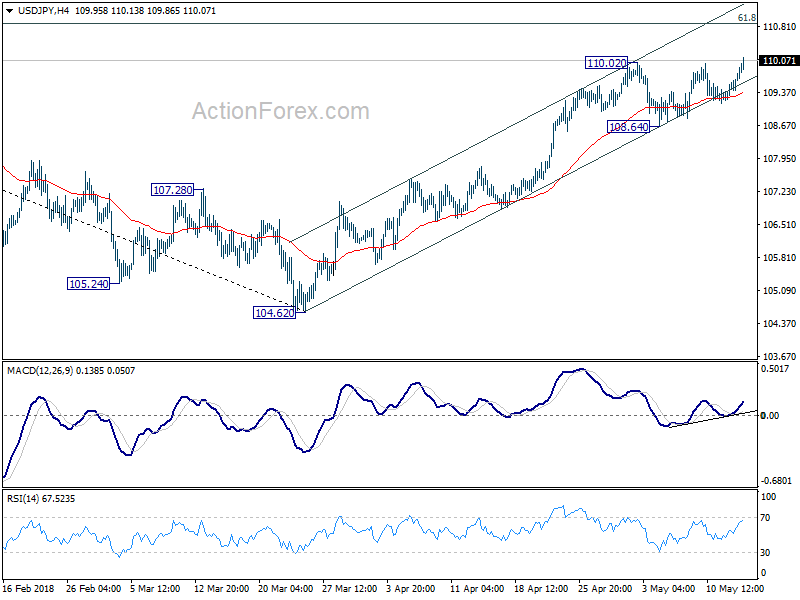
      In particular, USD/JPY breaks through 110.02 resistance to resume recent rally from March low at 104.62. More importantly, it’s holding well within near term rising channel. Next target is 61.8% retracement of 114.73 to 104.62 at 110.86.
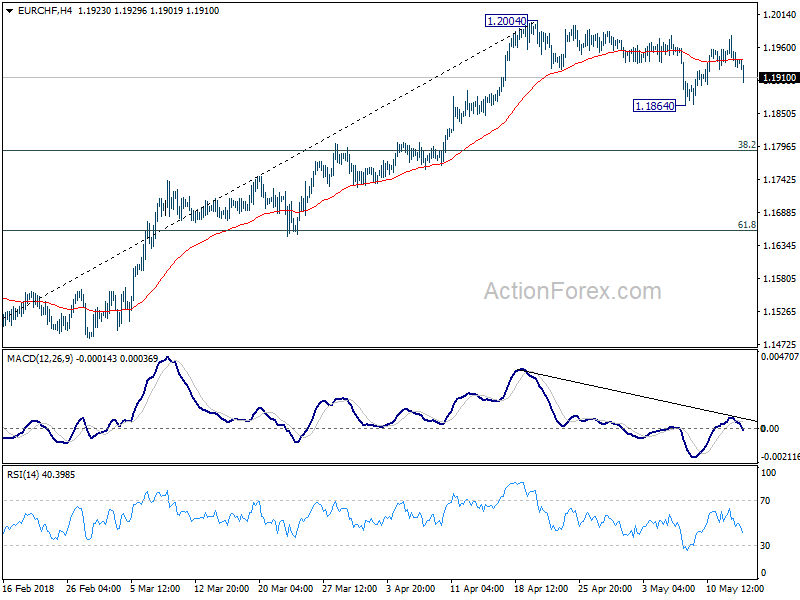
      On development to watch is the sharp fall in EUR/CHF. The consolidation pattern from 1.2004 is set to extend with another falling leg, likely through 1.1864. That could give EUR extra pressure against USD, JPY and GBP.
      IMF forecasts slower Eurozone growth in 2018, 2019. Urges fiscal reforms

        IMF forecasts Eurozone growth to slow to 2.3% this year, from 2017’s 2.4%, and drop further to 2.0% in 2019. IMF noted that “with economic prospects continuing to improve in the short term but medium-term prospects less bright, policymakers should seize the moment to rebuild room for fiscal manoeuvre and push forward with reforms to boost growth potential”

        And it pointed out that “policymakers should strive to bring fiscal deficits within range of balance over the next few years.:” With that ” automatic stabilizers and fiscal stimulus can be deployed again, should downside risks materialize.”

        EU Katainen to US: No concession to get permanent exemption from steel tariffs

          European Commission Vice-President Jyrki Katainen said they’re “open for improving our trade relations” with the US. But he warned that “it’s not a concession in order to get a permanent exemption from higher steel and aluminium tariffs.”

          Katainen emphasized that “there’s no reason for those tariffs… It wouldn’t be logical to give up under pressure that is unjustified. We don’t negotiate under any kind of threat.”

          Iran FM Zarif had “very good and constructive” meeting with EU Mogherini

            Iranian Foreign Minister Mohammad Javad Zarif said the meeting with European Union’s foreign policy chief, Federica Mogherini in Brussels was “very good and constructive”. Zarif also said that both sides were on the “right track” to ensure that the interests of the JCPOA’s “remaining participants, particularly Iran, will be preserved and guaranteed.” Zarif’s comments came before meeting with foreign ministers of Germany, France and the UK, on continuing the JCPOA nuclear agreement after US withdrawal.

            Separately, IRNA news agency quoted Iranian President Hassan Rouhani asking EU to stand against the US’ “illegal and illogical” actions of pulling out from JCPOA.

            German ZEW: US withdrawal from Iran deal, trade conflicts and oil price had negative impact on economic expectations

              German ZEW Economic Sentiment was unchanged at -8.2 in May, in line with expectation. German Assessment of Current Situation dropped -0.5 to 87.4, above expectation of 85.2.

              Eurozone ZEW Economic Sentiment rose 0.5 to 2.4, above expectation of 2.0. Assessment of Current Situation dropped -1.6 to 56.1.

              Quote from the release by ZEW President Achim Wambach:

              “The effects of relatively positive values for German exports and production in March 2018 have been overshadowed in the most recent survey by uncertainty motivated by recent political events. The US decision to back out of the nuclear treaty with Iran and fears of a further escalation of the international trade conflict with the US, as well as a further rise of crude oil prices, have had an overall negative impact on economic expectations in Germany.”

              UK unemployment rate unchanged at 4.2%, earnings grew 2.6%

                UK unemployment stayed unchanged at 4.2% in March, at the lowest level since 1975.

                Average weekly earnings rose 2.9% 3moy excluding bonuses

                Average weekly earnings rose 2.6% 3moy including bonus, met expectations.

                Claimant count rose 31.2k in April versus expectation of 13.3k.

                Sterling is a touch higher after the release.

                NAFTA talks unlikely to have breakthrough before My 17

                  Canadian Prime Minister Justin Trudeau discussed with Trump on phone yesterday on brining NFATA renegotiation to a “prompt conclusion”. But US Commerce Secretary Wilbur Ross side that none of the “big hot topics” were resolved as the May 17 deadline looms. He added hose are “very complex issues”, and are still “a work in progress”.

                  It’s reported that, according to sources”, there is no plan for Mexican Economy Minister Ildefonso Guajardo or Canadian Foreign Minister Chrystia Freeland, and U.S. Trade Representative Robert Lighthizer to meet this week. It’s unlikely for any breakthrough in the negotiation.

                  Currently, Canada and Mexico have their US steel tariffs exemption extended to June 1. Ross said, “depending on where we are on NAFTA on June 1, the president will decide whether or not to extend their situation.” And “it’s unforecastable at the moment.”

                  BoJ Kuroda: “Absolutely no plan” to raise yield target

                    BoJ Governor Kuroda told the parliament today that there is “absolutely no plan” to raise the yield target under the Yield Curve Control for now, as inflation is still distant from 2%. He also explained that removing the time frame to meet the 2% inflation target is not necessarily related to the side effect of monetary policy on bank profits.

                    Regarding YCC, Kuroda said bond purchases are more sustainable under the framework, as the central bank has more flexibility. And, it’s be able to maintain long term year near 0% with smooth operations in JGB purchases.

                    German GDP growth slowed to 0.3% qoq in Q1, Swiss PPI rose to 2.7% yoy in March

                      First batch of data in European session saw German GDP rose 0.3% qoq, 2.3% yoy in Q1, below expectation of 0.4% qoq, 2.4% yoy. That’s also notably slower than Q4’s 0.6% qoq, 2.9% yoy. But nonetheless, the figures are decent.

                      Swiss PPI rose 0.4% mom, 2.7% yoy, in April, up from March’s -0.2% mom, 2.0% yoy.

                      UK employment data are upcoming. In particular, unemployment rate is expected to be unchanged at 4.2% in March. Average weekly earnings are expected to grow 2.6% 3m/y.

                      Eurozone will also release industrial production, GDP. More focus will be on German ZEW economic sentiment.

                      RBA Debelle: 2% is the focal point for wage outcomes now

                        RBA Deputy Governor Guy Debelle delivered a speech titled “The Outlook for the Australian Economy” at the CFO Forum in Sydney today, where he talked about wages.

                        He noted that “the experience of other countries with labour markets closer to full capacity than Australia’s is that wages growth may remain lower than historical experience would suggest.”

                        Currently in Australia “2% seems to have become the focal point for wage outcomes, compared with 3–4% in the past.” Even so, “”there is a risk that it may take a lower unemployment rate than we currently expect to generate a sustained move higher than the 2% focal point evident in many wage outcomes today”.

                        RBA minutes reiterated no strong case for near term hike

                          RBA May meeting minutes reiterated that central bank’s stance that it’s not in rush to lift interest rates.

                          The minuted noted that “stronger growth was expected over the following couple of years, which could reduce spare capacity in the economy and lead to a further gradual decline in the unemployment rate.” But, “the increase in wages growth and inflation was expected to be gradual however because spare capacity in the economy was expected to be reduced only slowly.”

                          And, “as progress in lowering unemployment and having inflation return to the midpoint of the target range was expected to be gradual, members also agreed that there was not a strong case for a near-term adjustment in monetary policy.”

                          Trump’s tweet on ZTE prompted bipartisan criticism

                            Trump’s tweet regarding helping China telecoms company ZTE prompted bipartisan criticism and concerns on his softening stance. Republican Senator Marco Rubio said he hoped “this isn’t the beginning of backing down to China.” Democrat Senator Chuck Schumer said “this leads to the greatest worry, which is that the president will back off on what China fears most – a crackdown on intellectual property theft – in exchange for buying some goods in the short run.”

                            On the other hand, Trump defended with another tweet saying that “ZTE, the large Chinese phone company, buys a big percentage of individual parts from U.S. companies. This is also reflective of the larger trade deal we are negotiating with China and my personal relationship with President Xi”.

                            US Ambassador to China Branstad: Trump wants a “dramatic increase” in food exports to China

                              US Ambassador to China Terry Branstad said in Tokyo today that both countries are still “very far apart” on resolving trade frictions. Branstad, was present at the meeting between Treasury Secretary Steven Mnuchin and Chinese Vice Premier Liu He in Beijing earlier this month. He noted that “there are many areas where China has promised to do but haven’t. We want to see a timetable. We want to see these things happen sooner or later.”

                              He added that Trump would like to see a “dramatic increase” in food exports to China and “we’d like to see China being just as open as the United States.”

                              Trade talks will resume today with Liu arrived in Washington.

                              Dow shrugs off yield rise, heading to 25000

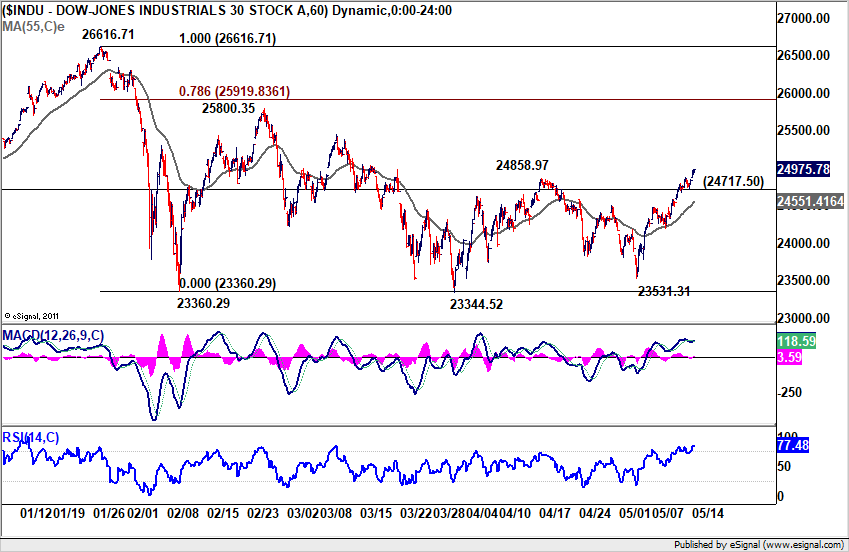
                                DOW opens higher on some optimism over US-China trade talk. Rise in treasury yields is shrugged off by investors. 10 year yield is back above 2.99 and hit at high as 2.997 so far. But there is no impact on stocks so far.

                                For now 25000 is the next handle to overcome. But based on current momentum, the real hurdle is between 25800.35 resistance and 78.6% retracement of 26616.71 to 23360.29 at 25919.83. We’ll keep monitoring the momentum to see if rise from 23531.31 is developing into an impulsive move to resume the larger up trend. For now, it’s early to tell.

                                OPEC raised both supply and demand forecasts, concerned with US trade relations

                                  In May’s Monthly Oil Market Report, OPEC rated both 2018 oil supply and demand forecasts.

                                  For 2018, oil demand growth is forecast to increase by around 1.65mb/d to average 98.85 mb/d. Growth was revised higher from prior month by 25tb/d. China is anticipated to lead oil demand growth in 2018, followed by Other Asia and OECD Americas. Non-OPEC supply growth was revised up by 0.01mbs in 2018 to 1.75mb/d, averaging 59.62mb/d in total. Meanwhile, OPEC production rose 12tb/d to average 31.93mb/d in April.

                                  In the section regarding world economy, OPEC warned of the risk of development in trade relations. In particular, it “the latest rounds of US sanctions on Russia, tariffs on Chinese products in combination with considerable requests by the US in trade negotiations with China, US tariffs on steel and aluminium, prolonged North American Free Trade Agreement (NAFTA) negotiations, as well as the US withdrawal from the Joint Comprehensive Plan of Action (JCPOA) with IR Iran all point to rising uncertainty.

                                  Full report can be found here.

                                  A look at EURJPY and CADJPY as JPY in selloff mode

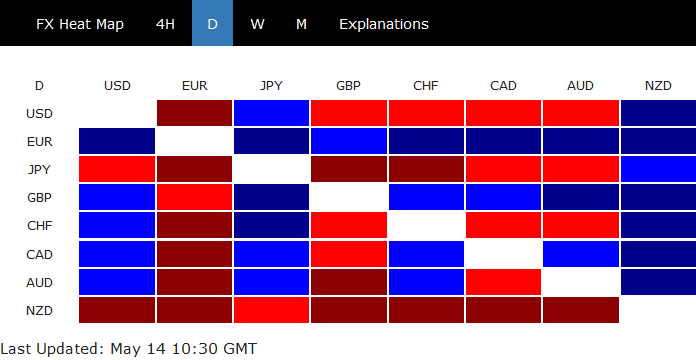
                                    We’d soon enter into US session. JPY continues to trade with one of the weakest, along with NZD.

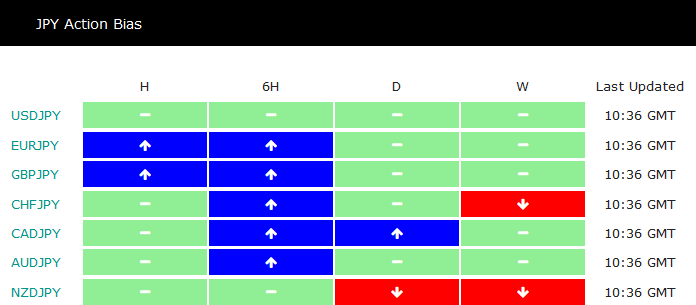
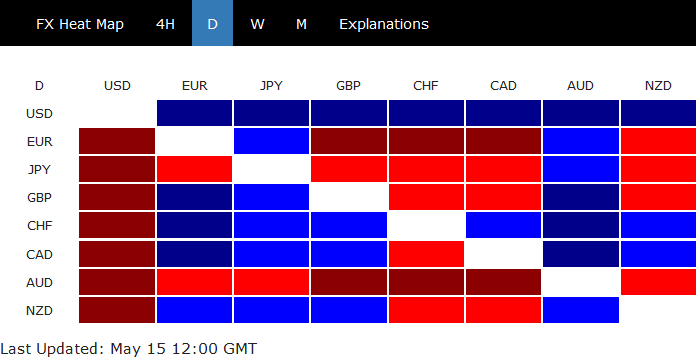
                                    A quick glance at JPY Action Bias table, we can that EURJPY and GBPJPY are the stronger ones intraday. But both D Action Bias are neutral. CADJPY may lack momentum in H Action Bias, but 6H and D Action Bias argue it’s in a trend. That prompts us to have a deeper look.

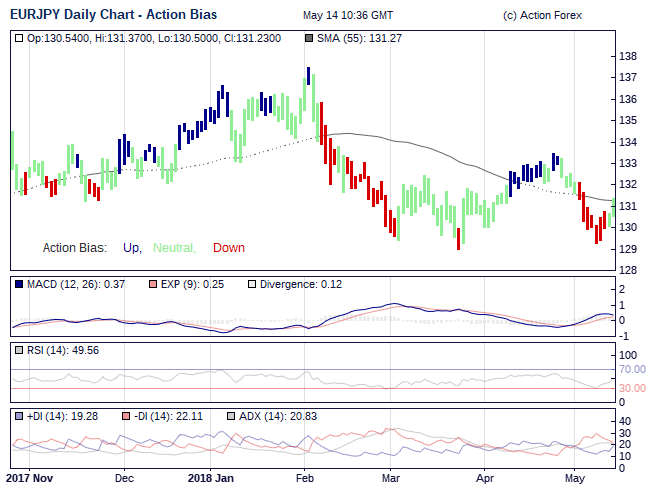
                                    EURJPY D action bias chart clearly shows that it’s rebounding after a prior decline halts ahead of near term support around 129 level. Current rebound, while strong, is not in clearly a trend yet. It could be part of a range consolidation pattern.

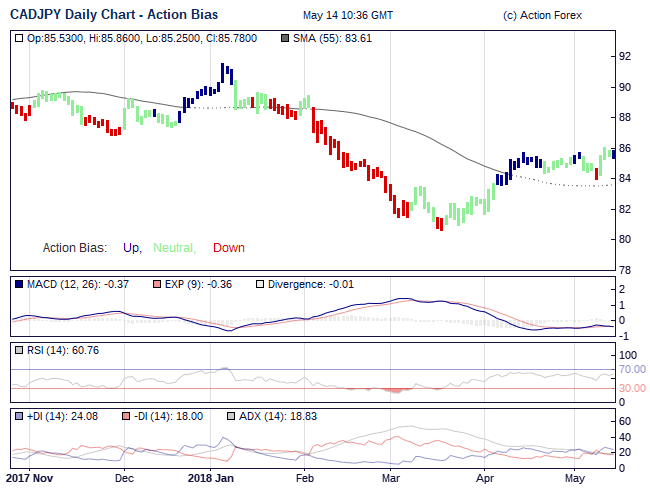
                                    On the other hand, CADJPY D action bias chart showed it’s in a solid up move from around 80 level. The moved turned into consolidation after failing 86. The rally could indeed be resuming with last week’s breakout. So, while EURJPY is stronger today, CADJPY is a better candidate for trend trading.

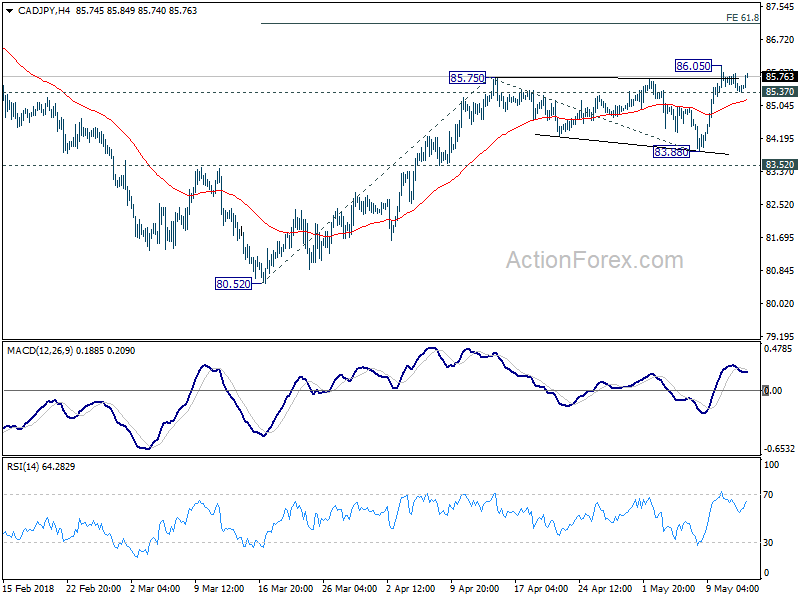
                                    Back at the regular bar chart, for now, intraday bias in CADJPY stays neutral. But break of 86.05 will confirm rise resumption. CADJPY should target 61.8% projection of 80.52 to 85.75 from 83.88 at 87.11. Though, break of 85.13 will delay the bullish case and bring more consolidation first.

                                    Trump offered concession ahead of US-China trade talks, Hong Kong HSI gains 1.35%

                                      China’s Vice Premier Liu He, President Xi Jinping’s top economic adviser is traveling to Washington to start the second round of trade talks tomorrow, with US Treasury Secretary Steven Mnuchin. Liu and his team will stay from May 15 to 19 according to a Foreign Ministry spokesperson.

                                      Ahead of the meeting, Trump said he was working with Xi to help get Chinese telecoms company ZTE back in to business.

                                      https://twitter.com/realDonaldTrump/status/995680316458262533

                                      And he added that

                                      https://twitter.com/realDonaldTrump/status/995746011321597953

                                      White House spokeswoman Lindsay Walters confirmed that US officials were in contact with Beijing about ZTE. And, Commerce Secretary Wilbur Ross is expected to “exercise his independent judgment, consistent with applicable laws and regulations, to resolve the regulatory action involving ZTE based on its facts.”

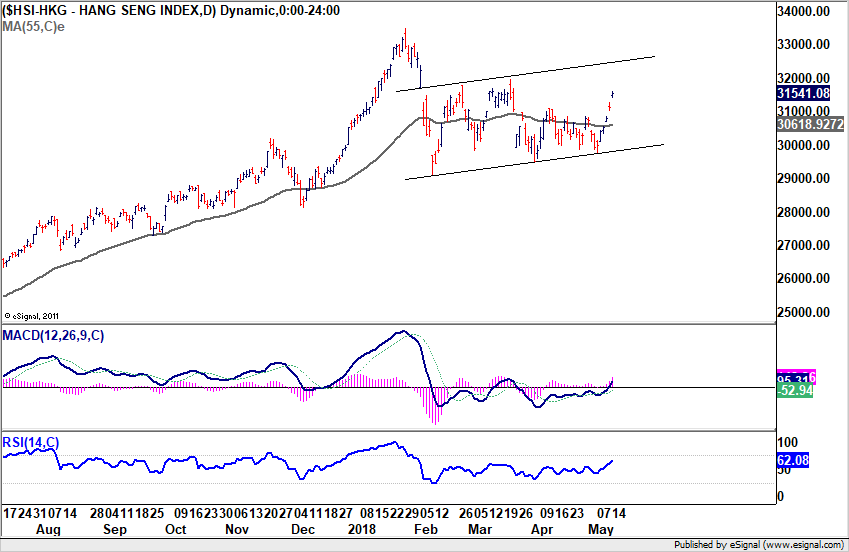
                                      This is seen a concession by Trump ahead of the trade talks. And the news lifted Hong Kong stocks sharply higher. Hong Kong HSI gained 419.02 pts, or 1.35%, to close at 31541.08.

                                      Cleveland Fed Mester: Fed fund rates could overshoot long run level

                                        In a speech titled “Issues for U.S. Monetary Policy“, Cleveland Fed President Loretta Mester expressed her support for further rate hike. She noted that “the medium-run outlook supports the continued gradual removal of policy accommodation; it seems the best strategy for balancing the risks to both of our policy goals and avoiding a build-up of financial stability risks.

                                        Regarding inflation, she noted that it will take a year or two to stabilize around the 2% target. And, she added that “we want to give inflation time to move back to goal … this argues against a steep path” on tightening. But, “as the expansion continues, it could be that in order to maintain our policy goals, we may need to move the fed funds rate, for a time, a bit above the level of the funds rate that is expected to prevail over the longer run”.

                                        She also pointed to Fed’s March economic projections that fed funds rates could move a bit above the longer-run level at 3% by 2020. She noted that “2020 is a long time away and the policy path actually followed will be responsive to changes in the outlook.

                                        ECB Villeroy de Galhau: Ending asset purchase in September or December not “a deep existential question”

                                          ECB Governing Council member, Bank of France Governor Francois Villeroy de Galhau said today that “the time when our net asset purchases will end is approaching”. Currently, ECB’s EUR 30B per month asset purchase program is set to end after September. Villeroy de Galhau said whether it will end in September, or December is not “a deep existential question”.

                                          Regarding interest rates, he added that “we could give additional guidance on its timing–well past meaning at least some quarters but not years–and its contingency on the inflation outlook.”