


Canadian Highlights
- Despite rate cuts from the Bank of Canada and the U.S. Federal Reserve, bond yields rebounded post-Fed press conference, leaving Canadian yields and equities flat for the week.
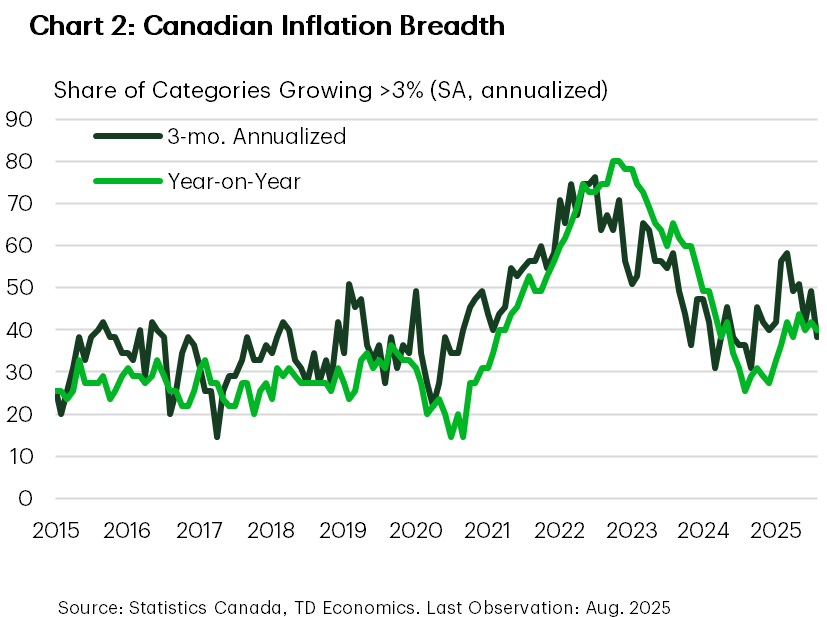
- Core inflation metrics remain elevated on a year-on-year basis, but more recent trends show significant slowing, with fewer CPI categories rising rapidly and both goods and services inflation cooling markedly.
- The upcoming federal budget will be crucial for economic direction and future Bank of Canada rate decisions.
U.S. Highlights
- The Fed resumed rate cuts at this week’s FOMC meeting, lowering the policy rate by 25 basis points to 4.00%-4.25%.
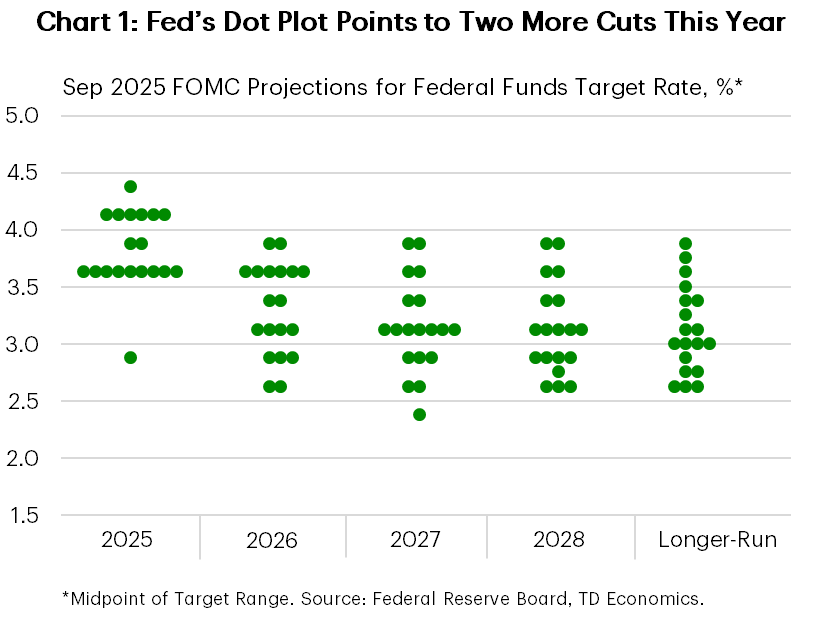
- The Fed’s “dot” plot pointed to two more cuts by the end of this year, but it also showed one member who expects a lot more easing.
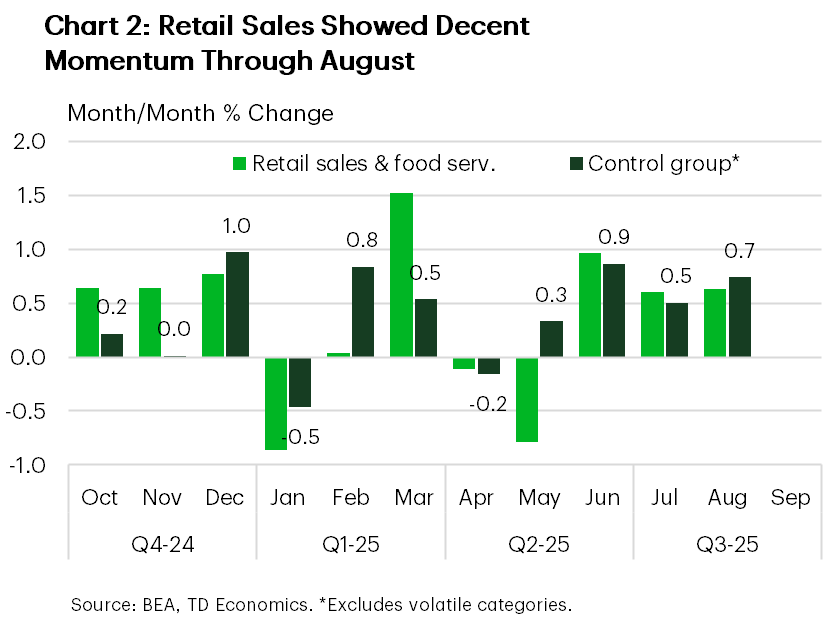
- Retail sales came in better than expected in August, rising 0.6% on the month. Sales in the control group, which strip out volatile categories, rose an even better 0.7%.
Canada – A Cool-Down and a Cut
It was a busy week with updates on inflation and retail sales, along with rate cuts from the Bank of Canada and the U.S. Federal Reserve Bank. Despite the Fed’s rate cut, U.S. bond yields popped, taking global yields with them. For Canada, this now leaves the 10-year bond yield basically unchanged from the start of the week, and the TSX hovering near its record high. For all the ructions in the market, the economic details showcase why we maintain our view that the Bank of Canada was right to cut at this meeting, and that another cut in October is the right way to go.
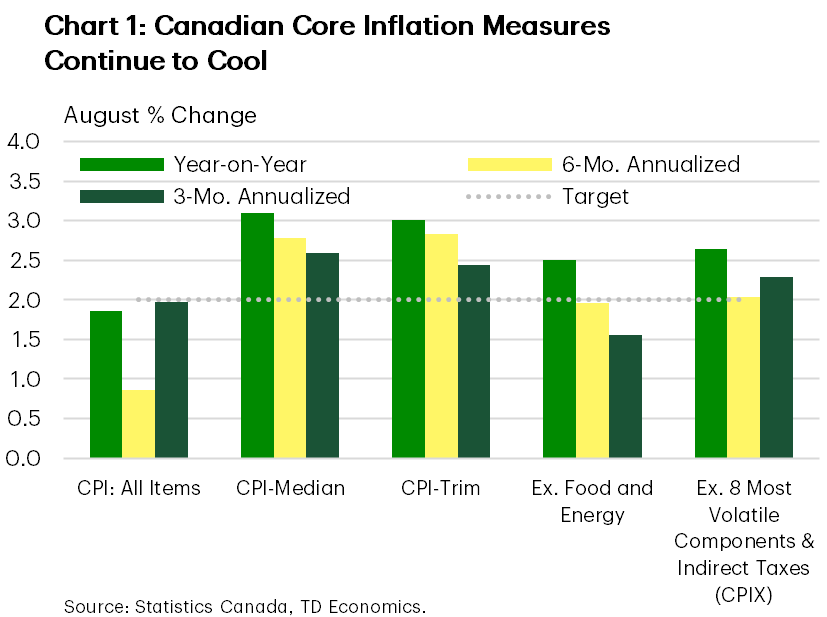
The story starts with inflation. Eliminating the consumer carbon tax has dragged down top line inflation since April, so all eyes have been laser focused on core measures. From that lens things sure seem ugly, with the Bank’s preferred measures still reading around 3.0% year-on-year (y/y), and the old exclusion measures CPI ex-food and energy and CPIX at 2.4% and 2.6% y/y, respectively. But these measures mask what’s been going on in recent months, instead reflecting the spring’s run-up in prices. On a three-month basis (Chart 1) inflation across all core measures has slowed precipitously in the past two months. Moreover, the breadth of inflation has sunk with it. The share of CPI categories rising at more than 3% (annualized) over the past three months has fallen to roughly 38%, sharply lower from the 58% share registered in the spring (Chart 2).
Previously strong prints in core goods prices have faded and it’s now running at 1.2% (3-mo. annualized), and services prices too have cooled to 1.5% (3-mo. annualized). We expect soft momentum in these key categories to continue as domestic demand struggles to gain traction in the wake of the trade shock. This week’s retail data for July bolstered that view. Although the data remain volatile, growth is petering out, and we now expect nominal retail spending in Q3 to register a below-trend 1.6% annualized gain.
Weaker business prospects are expected to push the unemployment rate higher heading into 2026, with restrained population growth limiting the degree of weakness in the labour market. The soft demand backdrop, coupled with the federal government’s removal of most retaliatory tariffs are tempering worries about a possible resurgence of inflation in the back half of 2025.
The wildcard in all of this is what is to come from the Federal government’s budget. We learned this week that it will be released on November 4th, but continue to await details. Five projects have been called out for the Projects of National Significance list, along with planned spending on Build Canada Homes, tariff mitigation measures for affected industries and re-skilling for affected workers. In the coming weeks we will be keenly watching for any news on the structure of proposed savings measures and for signs on the timing of planned (but not yet announced) investment outlays. The scale and timing of the cuts and investments could materially affect the trajectory of the economy and the BoC’s calculus on where the policy rate should be heading into 2026.
U.S. – Powell’s ‘Risk Management’ Cut
The Federal Reserve resumed its easing cycle after a nine-month pause, cutting the policy rate by 25 basis points at this week’s FOMC meeting. The move was widely anticipated, and while bond yields initially dipped, they ultimately rose as markets digested the broader implications. Equities, however, rallied, with the S&P 500 climbing another 1% on the week at time of writing.
The FOMC statement signaled a shift in emphasis from the ‘price stability’ mandate toward ‘full employment’, noting that “downside risks to employment have risen”. This echoed Fed Chair Powell’s remarks at Jackson Hole last month and set the tone for what he later described as a “risk management cut”. In essence, while inflation remains elevated, the Fed deemed it prudent to begin easing the policy rate to help guard against further labor market deterioration.
The decision was accompanied by the latest Summary of Economic Projections (SEP), which offered a mixed picture. Unemployment rate forecasts were largely unchanged, while growth projections for 2025 and 2026 were nudged up 20 basis points (bps) to 1.6% and 1.8%, respectively. Core inflation expectations for next year were also bumped up by 20 bps to 2.6%, with this measure now projected to return to target only by 2028 – which would mark seven consecutive years above the Fed’s 2% goal. The median forecast now calls for three cuts by year-end (including this week’s) up from two, and is in tune with our expectations. But one member projected the equivalent of three jumbo 50 bps cuts total (Chart 1). Stephen Miran, President Trump’s newly appointed Fed governor, is likely the one projecting more aggressive cuts as he was the lone dissent at this week’s meeting, favoring a larger 50 bps cut.
Economic data released this week did little to bolster the case for continued easing. Initial jobless claims fell back last week, following a surge in the week prior. And while housing remained a soft spot, with homebuilding pulling back in August, consumption-related data came in better than anticipated. August retail sales and food services rose 0.6% on the month, matching July’s gain. Sales in the ‘control group’ – which strip out volatile components – rose a solid 0.7%, building on gains in the prior two months (Chart 2). While tariffs are still expected to chip away at spending power and weigh on consumption, this recent data suggests consumers may still have some gas in the tank.
The bottom line is that while the Fed has resumed rate cuts to guard against further labor market weakness, its “risk management” approach means future moves will remain highly data dependent. The Fed will continue to have a hard time balancing the risks with respect to its dual mandate. But ultimately, we believe that the tariff impact on inflation will be temporary, and we expect the central bank to continue to cuts rates to support the economy (see our latest Quarterly Economic Forecast here).

