


Foreign exchange (FX) intervention in Japan is defined by a unique division of labor where the Bank of Japan (BoJ) acts strictly as an agent for the Ministry of Finance (MOF). FX policy is fundamentally a fiscal decision, executed under the authority of the Minister of Finance to “contain excessive fluctuations” and stabilize exchange rates deemed inconsistent with economic fundamentals.
Operational Mechanics
How the Process Works
Who Decides? The Ministry of Finance (MOF) is the boss. They decide if and how to intervene after looking closely at the currency market.
Who Executes? The Bank of Japan (BoJ) handles the actual buying and selling of currency, following the MOF’s specific orders.
Where Does the Money Come From?
To Make the Yen Stronger (Buying Yen): The MOF uses the government’s existing foreign currency reserves (money saved in U.S. dollars, etc.).
To Make the Yen Weaker (Selling Yen): The MOF has to borrow yen by issuing special government debt called Financing Bills (FBs).
Controlling the Money Supply: Even when the BoJ carries out the trade, it makes sure these currency operations don’t mess up its main goal of controlling the country’s money supply. The intervention is factored into its daily financial planning.
Why Interventions Work (or Don’t)
Currency intervention works in two main ways:
Portfolio Balance (Changing the Supply): This involves changing the amount of different assets (like yen vs. dollars) available in the market.
Signaling (Changing Expectations): This is when the government sends a strong message to traders about what future economic policy will be.
The Big Problem for Japan: Japan has had near-zero interest rates (ZIRP) for a very long time.
Normally, actions that change the money supply (unsterilized intervention) are very effective.
However, under ZIRP, cash and short-term government debt are viewed as almost the same thing. This means changing the money supply doesn’t have its usual big impact.
The Key to Success: Because the first method is weakened, the success of Japan’s currency intervention depends almost entirely on the Signaling channel. The government must show strong credibility and commitment to back up its currency trades with future policy action.
The Limit: Intervention cannot permanently overcome powerful economic forces, such as the persistent difference between Japan’s low interest rates and higher rates in other countries. It is only a temporary tool to reduce quick and extreme price swings.
Key Historical Interventions
Japan has historically executed interventions for two distinct purposes:
JPY-Weakening (2003–2004): This phase involved selling JPY and buying vast quantities of USD to prevent the yen’s rapid appreciation, which was perceived as a hinderance to the fledgling economic recovery. The scale was record-breaking, totaling approximately ¥35 trillion (USD 340 billion) over 15 months, an amount equating to roughly 7% of Japanese GDP. This massive, concentrated scale was essential to generate a persistent, temporary impact on the exchange rate by leveraging the signaling channel.
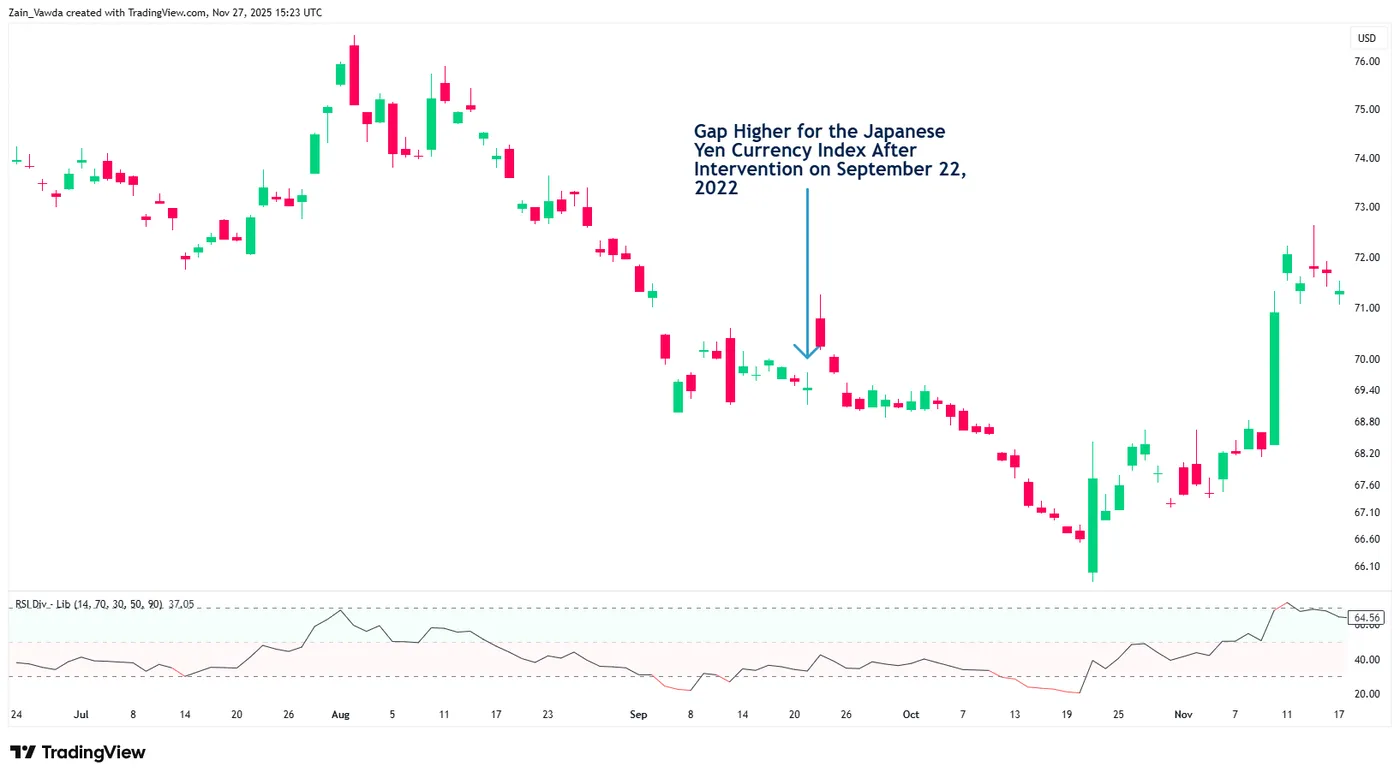
JPY-Strengthening (2022 and 2024): Facing extreme depreciation driven by widening interest rate differentials, the MOF executed its first “buy-yen” intervention since 1998 on September 22, 2022, selling USD and buying JPY worth ¥2,838.2 billion.
Japanese Yen Index, Daily Chart
Source: TradingView
Similar apparent actions were taken in April/May 2024. In this modern context, intervention serves strategically to dampen imported inflation and buy time for the BoJ to execute its cautious, gradual monetary normalization path focused on achieving sustainable, wage-led inflation.
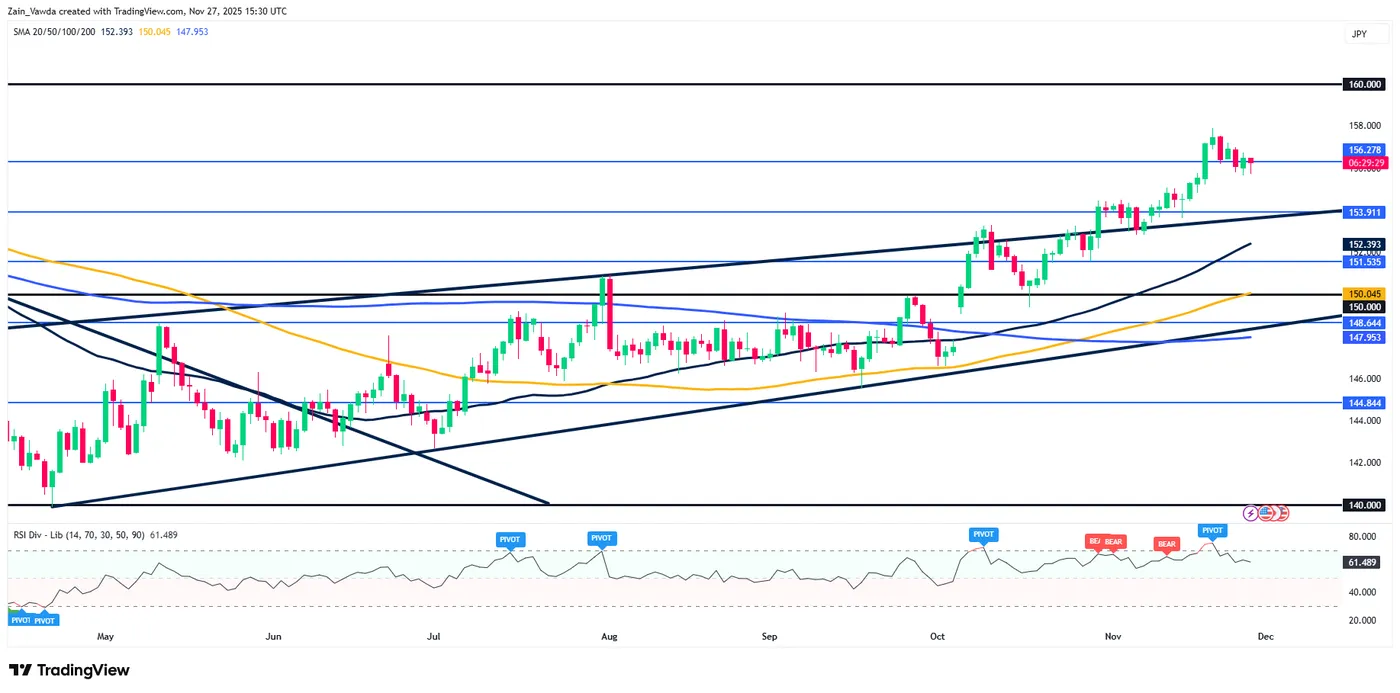
The Current Dynamic, USD/JPY
In recent weeks there has been a lot of chatter around possible FX intervention from Japanese officials. In the past, comments made by officials at times did the job as it served to strengthen the Japanese Yen.
Market participants have gotten wiser over time and nowadays tend to ignore comments. This means only action will suffice if the BoJ are really concerned about the value of the Yen.
USD/JPY Daily Chart, November 27, 2025
Source: TradingView

 intervention in Japan is defined by a unique division of labor where the Bank of Japan (BoJ) acts strictly as an agent for the Ministry of Finance (MOF). FX policy is fundamentally a fiscal decision, executed under the authority of the Minister of Finance to "contain excessive fluctuations" and stabilize exchange rates deemed inconsistent with economic fundamentals.)