


United States:
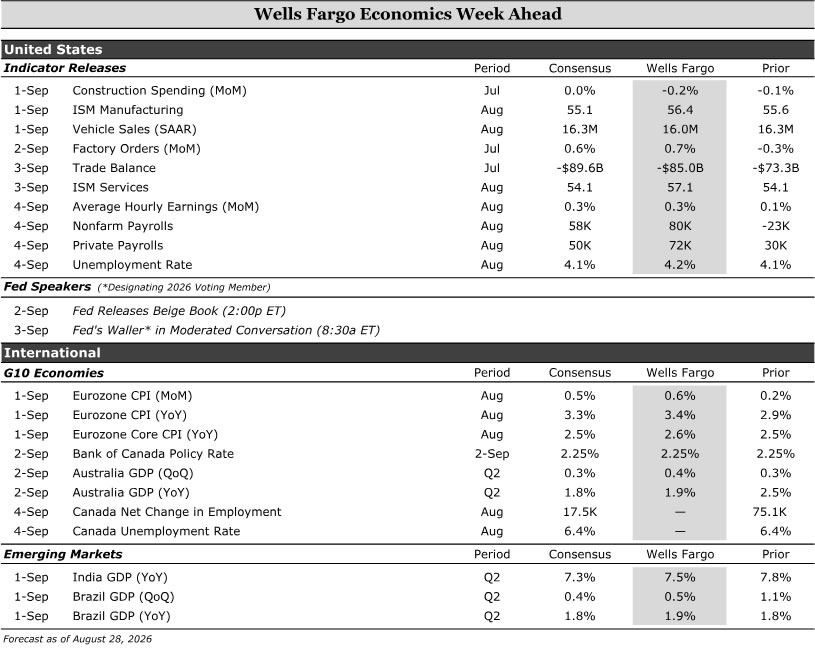
Next week’s focus will be on the August U.S. employment report, where we expect nonfarm payroll growth to rebound to 80K, the unemployment rate to edge up to 4.2%, and average hourly earnings to rise 0.3% month over month, leaving wage growth in the low-3% range year over year. While job growth remains subdued, labor market conditions continue to look broadly balanced, with low layoffs and steady wage growth consistent with a gradual cooling, rather than a sharp deterioration.
Beyond the U.S., a busy international calendar will provide fresh insight into the global growth and inflation outlook. We expect Australia’s economy to remain resilient despite slower growth in Q2, while India should continue to rank among the fastest-growing major economies even as growth moderates from its strong Q1 pace. In Brazil, growth is expected to show a loss of momentum following a robust start to the year. Elsewhere, Eurozone inflation is likely to accelerate, strengthening the case for a September ECB rate hike, while Canada’s employment report and Bank of Canada meeting will offer a timely assessment of how resilient the economy remains amid escalating U.S. trade tensions.
United States:
- Employment (Friday)
Advanced Economies:
- Eurozone CPI (Tuesday), Bank of Canada (Wednesday), Australia GDP (Wednesday), Canada Labor Force Survey (Friday)
Emerging Markets:
- India GDP (Tuesday), Brazil GDP (Tuesday)
U.S. Week Ahead
Employment • Friday
We expect nonfarm payroll growth to rebound to 80K in August. July’s drop in employment overstates the degree of labor market cooling, in our view, with outsized declines in leisure & hospitality and state & local government education accounting for much of the downside surprise. We look for partial reversals in both industries this month. More broadly, alternative indicators suggest job growth has stabilized, rather than continuing to deteriorate. Hiring measures from regional Fed surveys have improved in recent months, small business hiring plans have perked back up, and job openings have leveled off. Meanwhile, initial jobless claims remain near multi-decade lows, underscoring that layoffs are still contained.
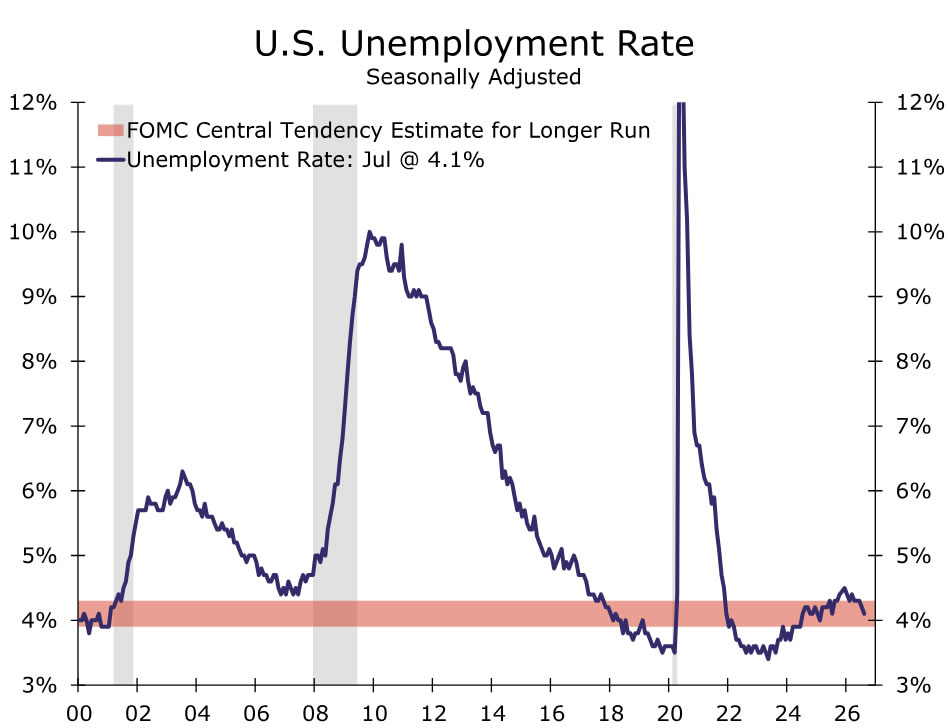
We expect the unemployment rate to edge up to 4.2% in August after dipping to 4.1% in July. The decline in unemployment over the past year has been driven in part by lower labor force participation, yet we believe the recent drop overstates the extent to which labor supply growth is weakening and look for some normalization in the coming months. Additional flows into the labor force should place some upward pressure on the unemployment rate. Even so, an unemployment rate near 4.2% remains low by historical standards and points to a labor market that is broadly in balance.
Wage growth should continue to suggest a labor market that is roughly balanced and generating little upward pressure on inflation. We expect average hourly earnings to rise 0.3% in August following July’s unexpectedly soft reading, leaving the year-over-year pace in the low-3% range. In general, the jobs report should reinforce the view that labor demand is tepid, but remains sufficient to keep layoffs low and support modest job growth.
Source: U.S. Department of Labor and Wells Fargo Economics
Advanced Economies
Eurozone CPI • Tuesday
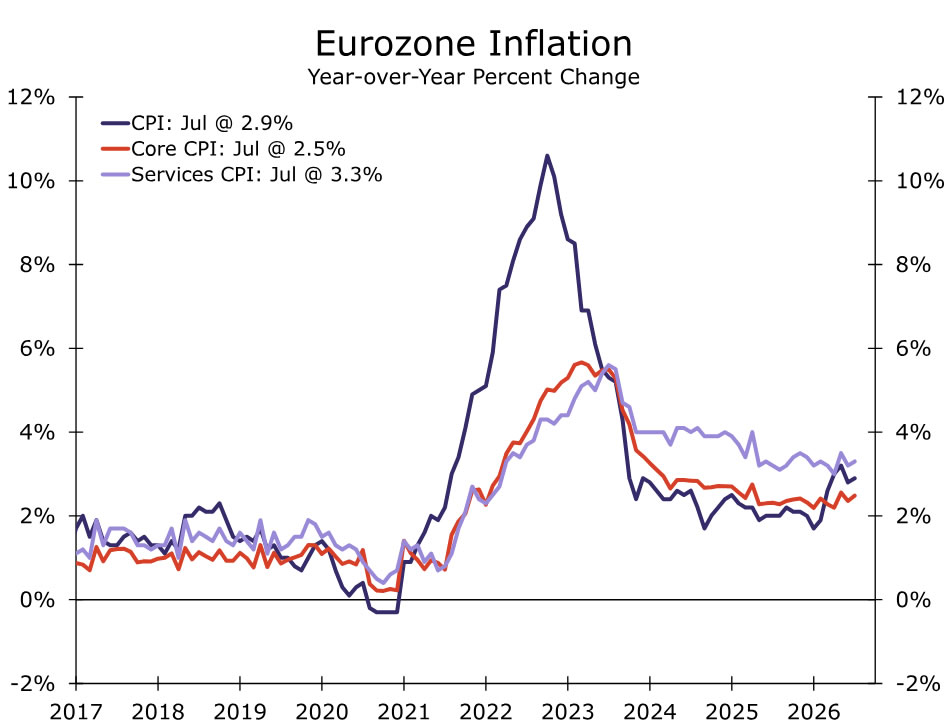
We expect Eurozone inflation to accelerate in August, with headline CPI rising to 3.4% year over year (0.6% month over month) and core CPI edging up to 2.6% year over year. Strong August inflation prints from France and Spain point to a firmer Eurozone reading next week, reinforcing the case for a September European Central Bank rate hike.
July inflation had already reaccelerated, with headline CPI rising to 2.9% year over year, core inflation to 2.5% and services inflation to 3.3% year over year after easing in June. At the same time, ECB consumer inflation expectations continued to moderate, with 1-year-ahead expectations at 2.9% and 3-year-ahead expectations at 2.7% in July. While still above the ECB’s 2% target, expectations have moved lower from the highs seen following the start of the conflict.
We continue to expect the ECB to raise the Deposit Rate by 25 bps to 2.50% in September. Risks remain skewed toward additional tightening if inflation continues to broaden and evidence of second-round effects becomes more apparent. For now, however, we view 2.50% as the terminal rate through 2027.
Source: Bloomberg Finance L.P. and Wells Fargo Economics
Bank of Canada Monetary Policy Meeting • Wednesday
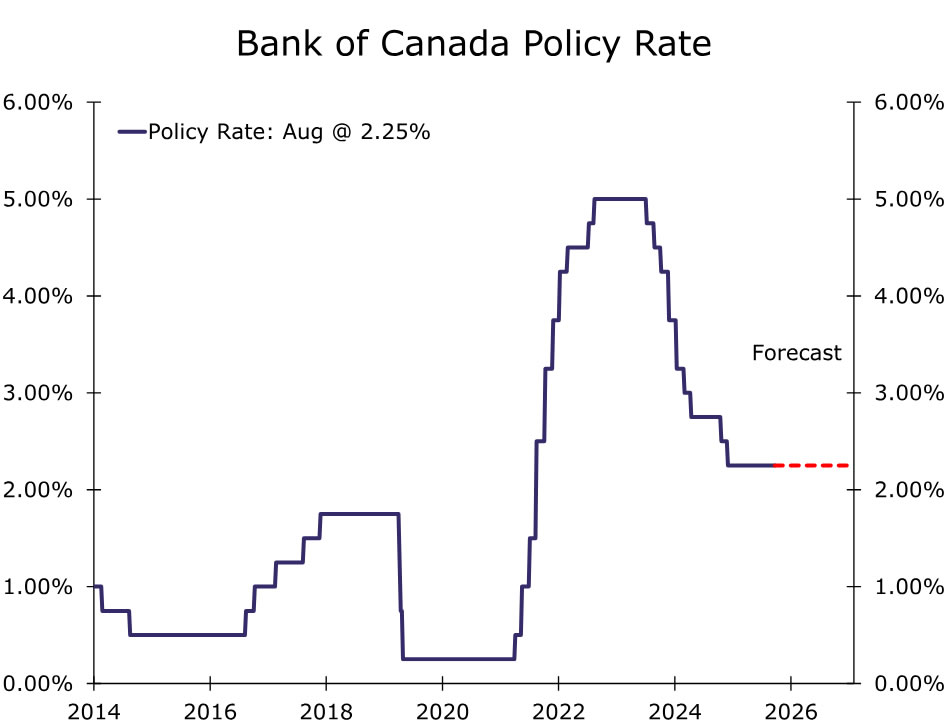
We expect the Bank of Canada (BoC) to leave the policy rate unchanged at 2.25% next week. Since policymakers opted to remain on hold at the previous meeting, incoming data have provided little reason to alter that stance. Core inflation measures have continued to track close to 2%, suggesting underlying price pressures remain well contained despite ongoing uncertainty surrounding the conflict in Iran and trade policy.
The labor market has also held up better than feared. Employment growth has remained positive, and the unemployment rate has stabilized in recent months, supporting the view that economic activity is slowing, but not deteriorating materially. While pockets of weakness remain evident across interest rate-sensitive sectors, economic conditions no longer appear soft enough to warrant additional near-term easing. The economy expanded at a 3.3% annualized clip in the second quarter, marking the strongest quarterly rate of growth in nearly two years.
The data have largely validated the BoC’s decision to pause. Inflation is near target, hiring is holding up, and growth has remained surprisingly resilient. That leaves policymakers comfortably on hold, but the path forward is far less clear. A reacceleration in inflation could reopen the door to rate hikes, while escalating U.S. trade tensions raise the risk of a sharper slowdown that would warrant renewed easing. For now, those risks appear broadly balanced, giving the BoC little reason to move in either direction.
Source: Bloomberg Finance L.P. and Wells Fargo Economics
Australia GDP • Wednesday
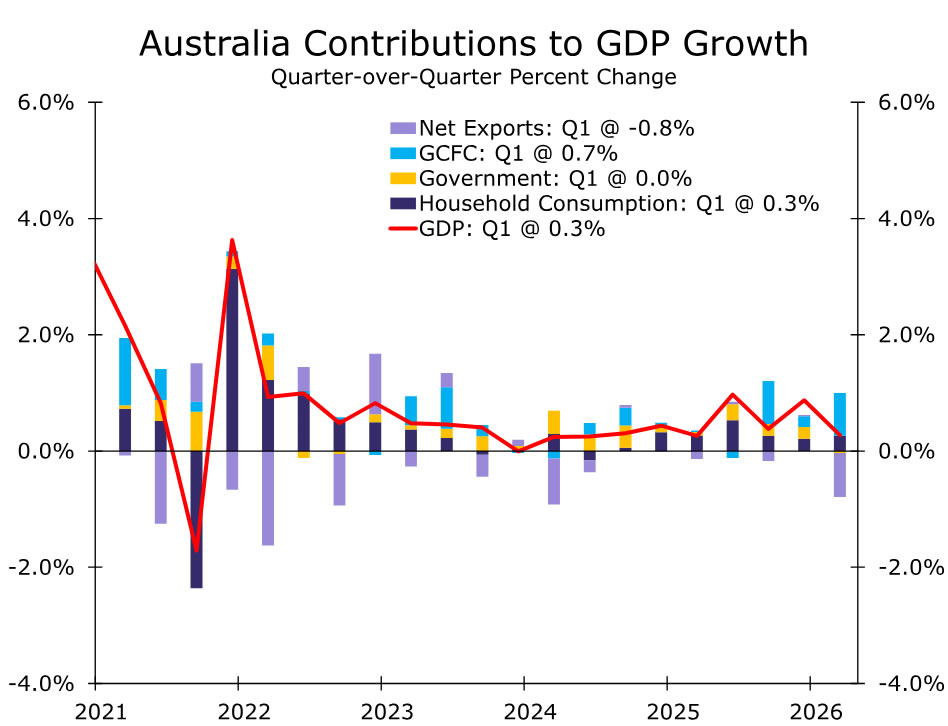
We expect Australia’s Q2 GDP growth to remain resilient at 1.9% year over year (0.4% quarter over quarter) despite headwinds from the war in the Middle East and higher interest rate. Household consumption likely provided a solid contribution to growth, while business investment was more mixed. Private capex softened in Q2, though weakness was concentrated in information media and telecommunications equipment. Excluding that category, machinery and equipment investment remained firm, while total capital expenditure was still up 10.7% year over year. Net exports likely weighed on growth again as import growth continued to outpace exports.
Overall, the economy appears to have held up well despite a challenging backdrop. With July CPI broadly in line with our expectations, but firmer than markets anticipated, a stronger-than-expected GDP print would reinforce our call for one final Reserve Bank of Australia rate hike, taking the Cash Rate to a terminal 4.60% by year-end.
Source: Bloomberg Finance L.P. and Wells Fargo Economics
Canada Labor Force Survey • Friday
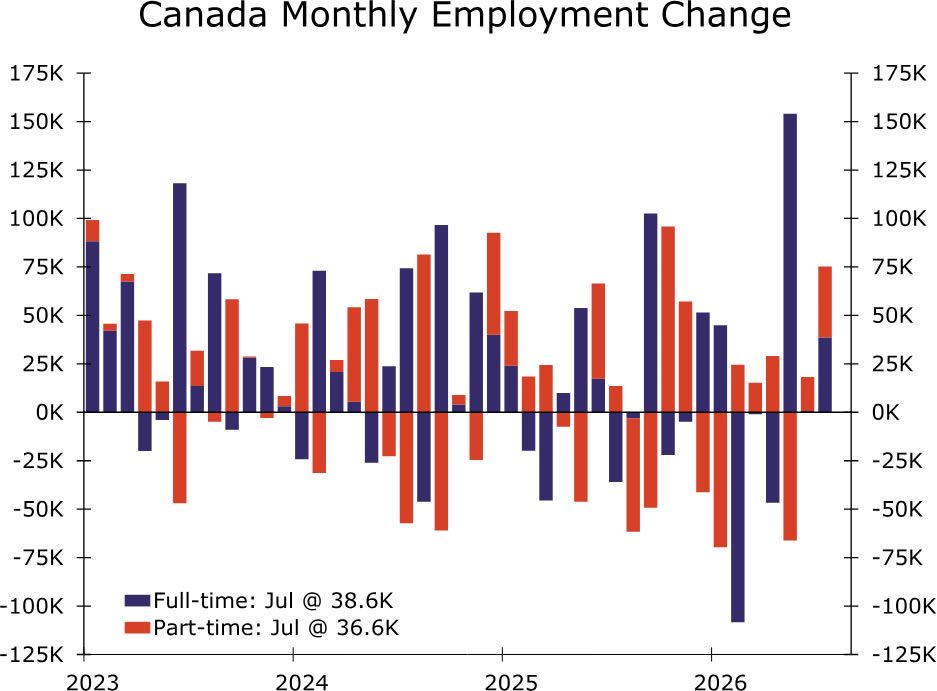
Canada’s labor market has continued to strengthen in recent months. Following modest gains in the spring, employment rose by roughly 75K in July, with hiring split between full-time and part-time positions. The improvement comes alongside a pickup in economic activity, with GDP expanding at its fastest quarterly pace in nearly two years during Q2.
The unemployment rate fell to 6.4%, running near the lower end of its recent range. Slower labor force growth continues to limit upward pressure on unemployment, while hiring has proven more resilient than anticipated earlier in the year. Wage growth and other measures of labor demand continue to moderate gradually, but there is little evidence of a material deterioration in labor market conditions.
The labor market no longer appears to be deteriorating. Employment growth has improved, unemployment has stabilized, and economic growth has regained momentum. While labor demand remains far from booming, the recent data suggest Canada’s economy is proving more resilient than expected and is generating enough jobs to prevent a renewed rise in unemployment. The largest near-term risk factor to watch, of course, stems from the recent escalation in trade tensions with the U.S. and how challenging that proves for domestic hiring.
Source: Bloomberg Finance L.P. and Wells Fargo Economics
Emerging Markets
India GDP • Tuesday
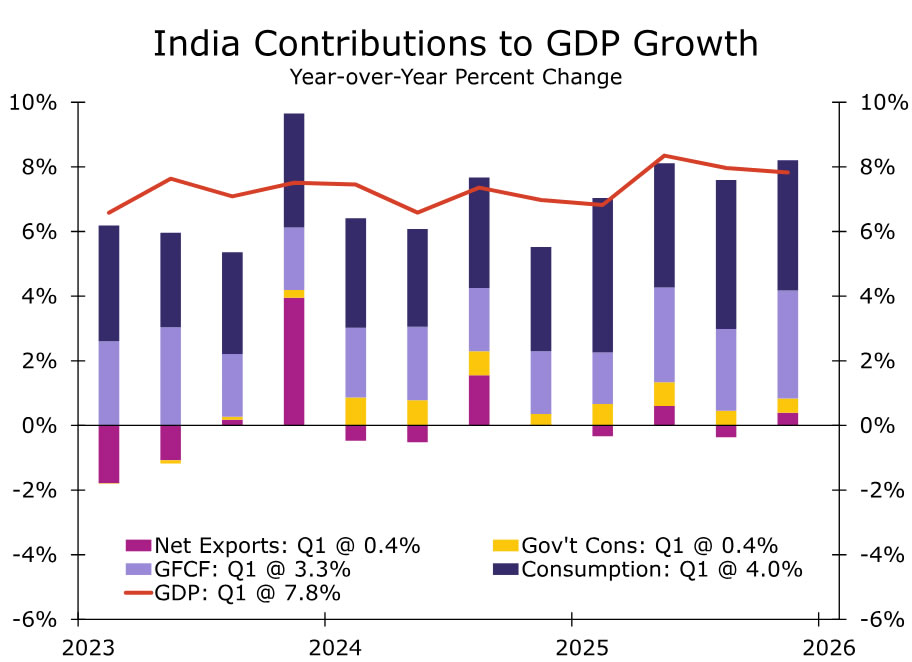
We expect India’s Q2 GDP growth to ease modestly to 7.5% year over year from 7.8% in Q1, though the economy should remain one of the fastest-growing among major economies. Household consumption likely stayed resilient, supported by earlier GST rate reductions and income tax cuts that boosted disposable incomes. Government investment and stronger industrial activity likely supported growth during the quarter. Industrial output accelerated through June, reaching 7.3% year over year, before easing in July. Net foreign purchases of Indian securities also picked up during Q2, pointing to improved investor sentiment. Net exports likely remained a drag on growth. While exports improved from Q1 levels, import growth continued to outpace exports, pushing the trade deficit to a record USD 32 billion in July. A weaker rupee and higher energy costs likely contributed to the deterioration in the trade balance.
Overall, growth remains resilient, though higher oil prices, rupee weakness, and prolonged geopolitical uncertainty pose increasing risks to the outlook. We continue to expect the Reserve Bank of India to raise rates in Q4 to support the currency, and a stronger-than-expected GDP print would further strengthen the case for additional tightening.
Source: Bloomberg Finance L.P. and Wells Fargo Economics
Brazil GDP • Tuesday
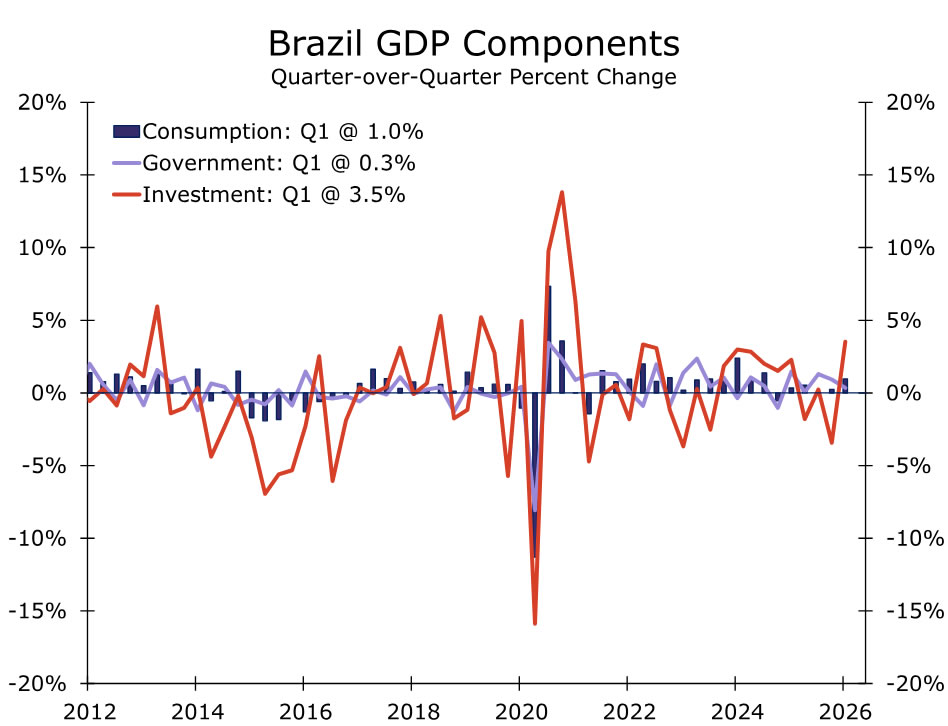
We expect Brazil’s economy to have lost momentum in Q2, with GDP growth slowing to 0.5% quarter over quarter from 1.1% in Q1. High-frequency data point to softer activity, with the Economic Activity Index falling 0.64% month over month in June, though weakness was partly offset by the agricultural sector. Overall, growth appears consistent with a gradual moderation following the strong performance seen earlier in 2026.
Risks to the outlook are increasingly skewed to the downside as credit conditions deteriorate and delinquencies rise. With inflation continuing to ease and growth showing signs of slowing, a weaker-than-expected GDP print would reinforce our call for a Q4 rate cut, bringing the Selic Rate to 13.75% by year-end, with further easing in 2027.
Source: Bloomberg Finance L.P. and Wells Fargo Economics





