Canadian Highlights
- No tricks from the Bank of Canada, which delivered the expected 25-basis-point hike. The Bank also left the door open to further tightening.
- Bond markets were somewhat spooked, with Canadian yields rising in the wake of the announcement. The loonie strengthened later as the U.S. dollar weakened.
- The Bank upgraded its 2027 and 2028 growth forecasts to 2% and now sees overall inflation averaging over 3% next year.
U.S. Highlights
- Consumer spending and AI-led investment powered the strongest GDP growth in a year in Q3.
- Persistent inflation points to further Fed tightening, despite this week’s pause.
- Next week’s jobs report will test labor-market strength, while the midterms will shape the fiscal outlook over the next two years.
Canada – BoC Fears Spectre of Inflation
Just before Halloween, there were no tricks in the Bank of Canada’s bag this week. They did what markets were expecting and hiked their policy rate by 25 basis points. Mind you, they took this step even with slack still haunting the job market. They also raised rates with little proof that persistently elevated energy prices had possessed broader inflation trends. Still, in the Bank’s mind it was only a matter of time before these input cost pressures crept into consumer prices. Indeed, their own surveys suggested that businesses were poised to do just that. And, with their new Prima model projecting inflation to average over 3% in 2027, they judged a hike was necessary to contain price pressures.
Even with the move largely priced in, Canadian bonds still got a bit of a fright, sending yields higher. The Bank’s subsequent press conference also leaned hawkish, with Governor Macklem leaving the door creaking open to further hikes. The benchmark 10-year rate was up about 5 bps after the announcement and conference. The Canadian dollar had a more muted reaction, but then came alive later after the U.S. Federal Reserve held the line on their own policy rate, downwardly pressuring the U.S. dollar.
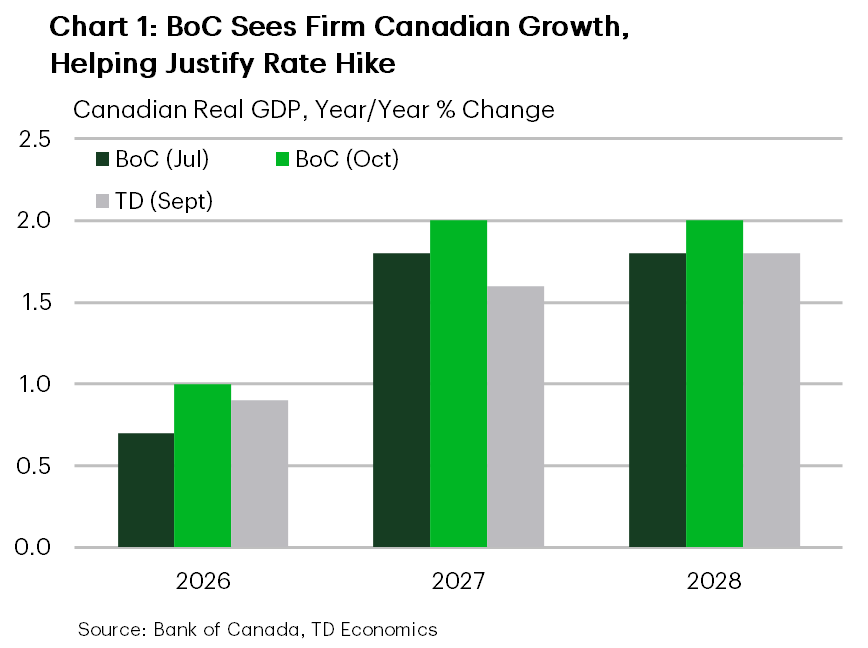
Policymakers wouldn’t have felt comfortable hiking their policy rate if they thought it would overly spook the economy. However, accompanying their rate decision were upgraded economic growth forecasts. The Bank now sees real GDP growth at 2% in 2027 and 2028, up from 1.8% previously and above our own forecasts (Chart 1). Business investment was an important driver of these upgrades, with the Bank expecting a boost from the federal government’s Productivity Mega Deduction, diminished trade uncertainty and other factors. This Mega Deduction allows businesses to deduct the full cost of a wide range of new capital investments immediately. And, in a move that could breathe even more life into investment, the Ontario government paralleled it this week in its fall economic update (see here).
In another potentially growth-supportive development, Canadian and EU policymakers are in Montreal this week with the aim of strengthening ties. The EU could help Canada further diversify its export base while providing investment into the country, potentially ghostbusting some of the demons of trade uncertainty. These are the conclusions we reached in a research report released this week.
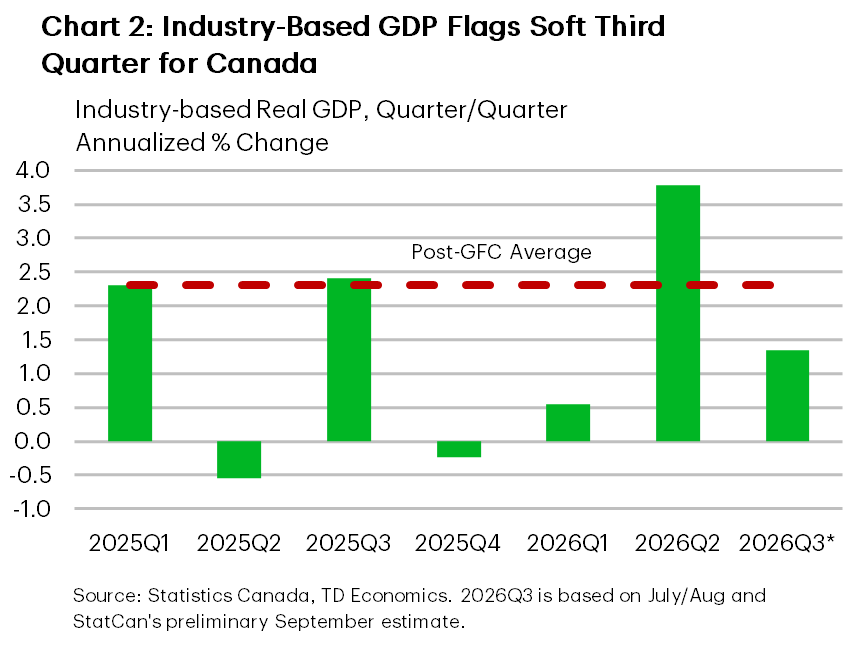
However, growth looks to be losing steam. This week’s GDP report showed that August GDP was flat, and StatCan’s preliminary estimate points to a 0.1% monthly decline in September, leaving industry-based real GDP growth at 1.3% annualized (Chart 2). This spooky showing suggests downside risk to the Bank of Canada’s 2% Q3 forecast. Growth should remain weak in Q4 as U.S. tariffs imposed in August take a bite, but a sizeable miss relative to the Bank’s modest 0.8% forecast would likely be needed to exorcise its hawkish bias. Given the Bank’s inflation forecast, we expect another hike next year, upwardly pressuring yields and the loonie (see Dollars and Sense report).
U.S. – Strong Growth Keeps Further Fed Tightening in Play
Markets navigated a busy week of central bank decisions, economic data and mega-cap earnings, with the underlying message being one of resilient growth but persistent inflation. The Federal Reserve offered no surprises in its policy announcement, electing to hold the fed funds rate steady at 3.75-4.0%, though two officials dissented in favor of a hike, underscoring the FOMC’s hawkish bias. And while big tech earnings remained healthy, the mixed market reaction highlighted the growing importance of demonstrating returns on heavy AI infrastructure spending. Equity markets were mixed on the week, with small-cap stocks (+2%) ending the week higher, the S&P 500 was flat and the Nasdaq (-1%) lower. Meanwhile, ongoing tensions in the Middle East kept oil prices elevated, with WTI remaining above $100 per-barrel for a third consecutive week.
The U.S. economy seemingly shook off headwinds from rising interest rates and elevated oil prices through the third quarter, posting its fastest rate of expansion in a year (Chart 1). Looking under the hood, all the strength was sustained by domestic spending. The consumer remained a solid anchor – accounting for three-quarters of the gain in real GDP – while business investment expanded at its fastest pace since 2011 (outside of the pandemic). Federal spending also chipped in, amid a sharp increase in both defense and non-defense expenditures.
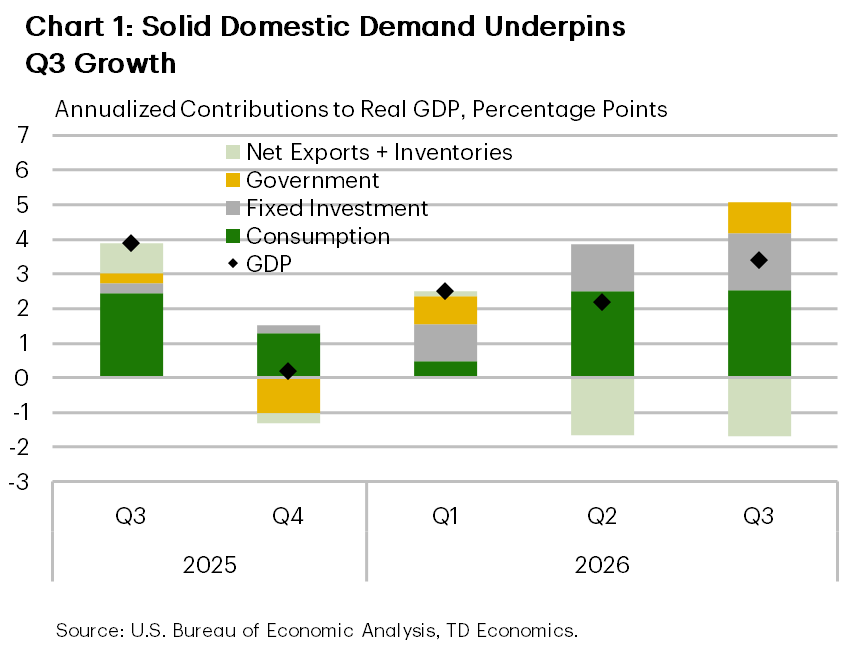
Bigger picture, the central question remains how much of the growth reflects durable private demand versus concentrated investment in technology infrastructure. For Q3, roughly half of the gain in non-residential investment appears to be directly tied to AI. But there are also many indirect effects, including the buildout of power and electricity infrastructure, and the spillovers into other areas of investment like construction and industrial equipment. Nor does it account for the wealth effects that have undoubtedly contributed to some of the strength in consumer spending over the last six months. Suffice to say, the tentacles of the AI buildout are far reaching.
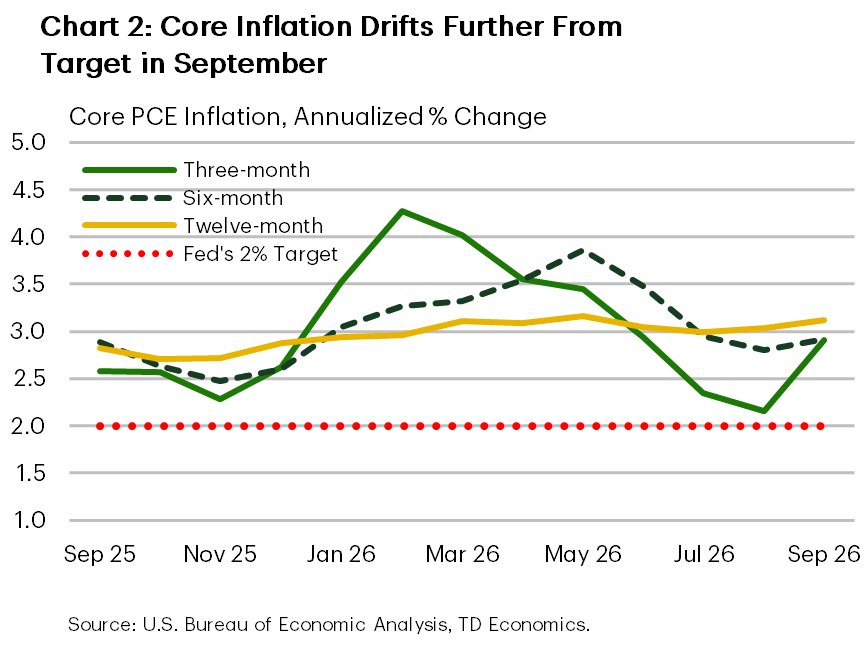
While the AI investment boom may be adding to the economy’s speed limit, it’s also contributing to inflationary pressures. Core PCE inflation was hot in September, with the 3-, 6-, and 12-month rates of change moving further away from the Fed’s 2% inflation target (Chart 2). Against this backdrop, further policy tightening will likely be required to return price stability. Exactly how much more remains to be seen. Should inflation trends loosely follow our forecast, and start to bend towards 2% by year-end, the Fed may be able to get away with only hiking one more time before calling it quits. However, more persistent price pressures will force policymakers to do more.
Looking ahead, next week’s employment report will offer a fresh test of whether the economy’s strong growth is translating into firmer hiring. Resilient job gains and wage growth would reinforce the case for further tightening, while a softer report would give the Fed more reason to proceed cautiously. Meanwhile, Tuesday’s midterm elections will determine the balance of power in Congress, helping to shape the fiscal outlook over the next two years.