

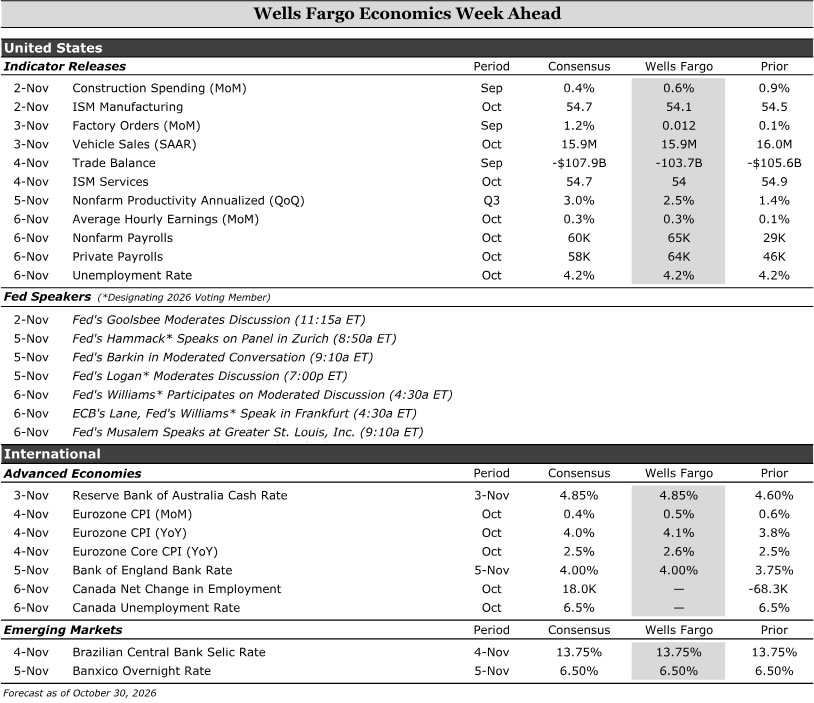
Next week, focus turns first to Election Day, although we do not expect the outcome of the midterms to meaningfully change the U.S. economic outlook. We expect the ISM manufacturing and services indices to ease, but remain in expansion, with market focus on the prices paid components. The week closes with October payrolls on Friday, which we expect to rise by 65K alongside an unemployment rate that remains at 4.2%, consistent with a stable labor market.
Abroad, Canadian employment should rebound modestly in October after two consecutive declines, though hiring will remain subdued. Even so, the increased inflation risk and hawkish-pivot by the Bank of Canada has led us to mark up our expectations for the policy rate in coming months. That shift toward tighter policy extends elsewhere. Alongside expected rate hikes for the RBA and BoE next week, we have marked up our forecasts to include another hike from each in 2027. We expect more patience in emerging markets, with Brazil’s central bank and Banxico both on hold next week.
United States:
- ISM Manufacturing & Services Indices (Mon. & Wed.), Election Day (Tues.), Employment (Fri.)
Advanced Economies:
- Reserve Bank of Australia (Tue.), Bank of England (Thu.), Canada Labor Force Survey (Fri.)
Emerging Markets:
- Brazilian Central Bank (Wed.), Banxico (Thu.)
U.S. Week Ahead
ISM Manufacturing & Services Indices • Monday & Wednesday
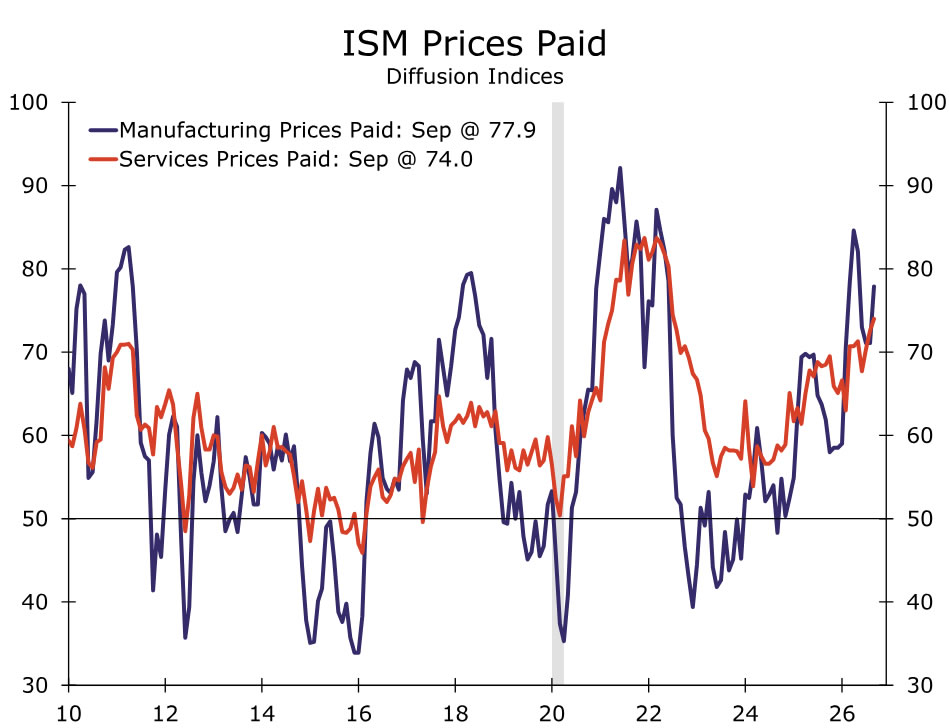
We’ll get the latest read on October activity from the ISM surveys next week. Some softness in the regional Fed surveys points to a modest giveback in the headline indices, though we expect both to remain consistent with solid expansion. For markets, the prices paid components will command particular attention given the continued focus on inflation. The recent pickup in commodity prices suggests input costs could remain under some upward pressure. We’ll also be watching the industry comments, which often provide a useful real-time snapshot on the pressures facing businesses.
For manufacturing, we expect the ISM index to ease modestly to 54.1, while remaining in expansion territory for a tenth straight month. The composition remains important—longer supplier delivery times have accounted for roughly 40% of the movement in the headline index over the past five months. Still, the improvement in the ISM alongside recent durable goods orders suggests activity may be starting to modestly broaden beyond the high-tech areas that have led the manufacturing recovery.
In terms of services, we look for the index to ease to 54.0 from 54.9 last month. Employment could give back some ground after a relatively broad increase last month, even as we continue to expect payrolls to rise 65K in October (more below). Beyond employment, we’ll be watching new orders and business activity for signs of cooling. Here too, prices paid will be key for assessing whether resilient demand is translating into renewed inflation pressure.
Election Day • Tuesday
Our base case is that the 2026 midterm elections will not dramatically alter the outlook for the U.S. economy. The biggest policy drivers, including the Iran conflict, tariffs, and the federal deficit, are unlikely to shift meaningfully, regardless of congressional control. Still, the election could have important implications, with divided government potentially complicating a 2027 debt-limit fight and Senate control shaping the confirmation of future Fed nominees. A Democratic House appears likely, while Democrats hold a slight edge in a still-competitive Senate. Overall, however, we do not expect these outcomes to meaningfully change the economic outlook.
Employment • Friday
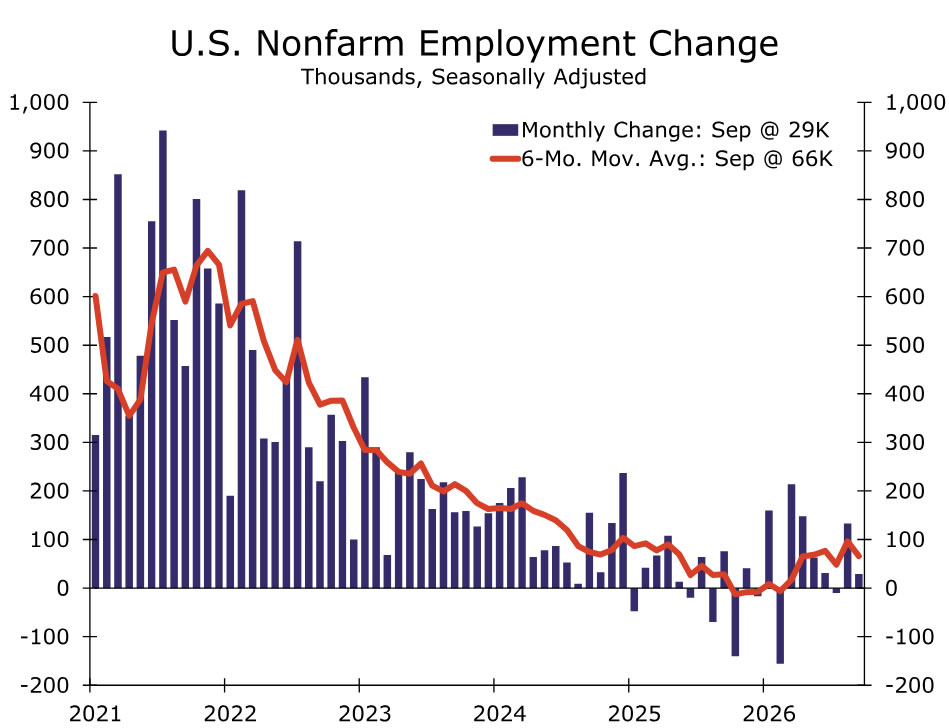
We expect nonfarm payrolls to rise 65K in October, roughly in line with its average pace over the past six months. The theme of the labor market remains one of stability. Initial jobless claims remain historically low, while job openings continue to move sideways. The employment indices from regional Fed surveys pulled back modestly in manufacturing this month, but remain in expansion territory for both goods and services. Taken together, these indicators suggest job growth continues to run near breakeven.
We expect the unemployment rate to hold steady at 4.2%. The rebound in labor force participation over the past few months has been encouraging, but is probably going to peter out soon amid ongoing population aging and low net immigration. With hiring and labor supply growth both likely to remain subdued, we see little scope for the unemployment rate to move meaningfully in October.
Average hourly earnings should bounce back 0.3% after rising just 0.1% in September, putting the year-over-year rate at 2.9% if our forecast is realized. Without an acceleration in hiring, it will be hard to see the kind of sustained acceleration in wages that would convert today’s supply shock inflation into something more worrisome. The labor market remains broadly in balance and is not the source of today’s above-target inflation.
Advanced Economies Week Ahead
Reserve Bank of Australia Cash Rate • Tuesday
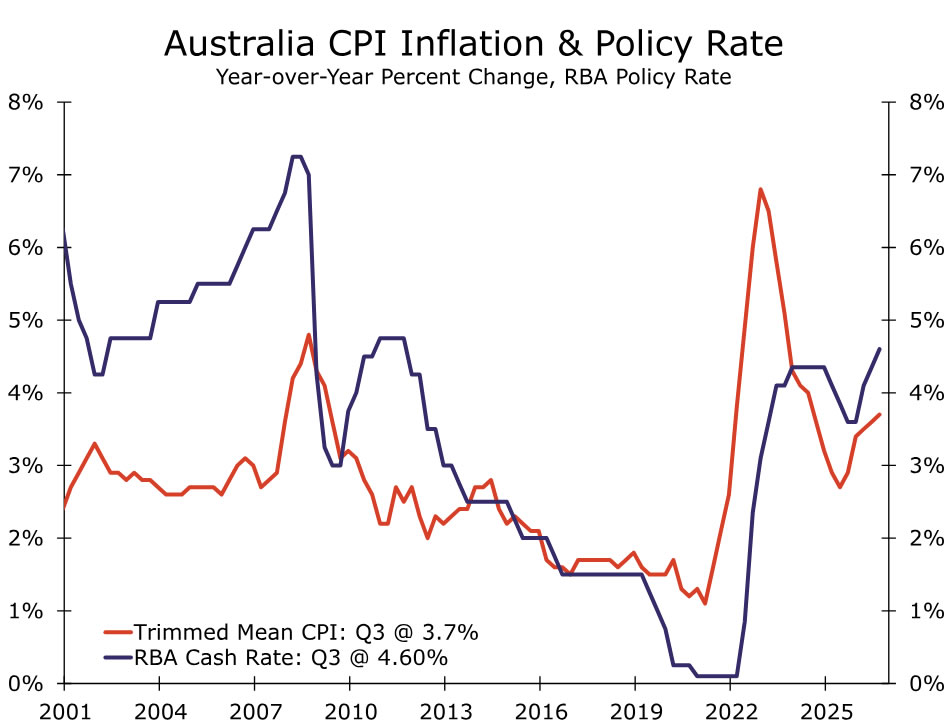
With inflation still too high, we expect the Reserve Bank of Australia (RBA) to raise its Cash Rate by 25 bps to 4.85% next week. And we now see another hike ahead: Q1 2027 is our revised base case. Recent communication has strengthened the case for further tightening. Policymakers continue to see domestic capacity pressures alongside the energy shock, and they warn that inflation is likely to exceed their August forecasts.
The latest quarterly inflation figures reinforce that concern. Headline CPI rose 4.3% year over year and trimmed mean inflation came in at 3.7%, while inflation expectations remain elevated at 5.3%. Slower demand has yet to resolve the imbalance between demand and supply. Policymakers also stress the risk that prolonged above-target inflation becomes embedded in price and wage-setting decisions.
We have therefore added another 25 bp hike to our base case for Q1 2027, potentially in February, to bring the Cash Rate to 5.10%. The RBA has flexibility over how quickly it returns inflation to target, but its recent rhetoric suggests limited tolerance for persistent price pressures. We still see further tightening ahead, even as growth is expected to slow.
Bank of England Bank Rate • Thursday
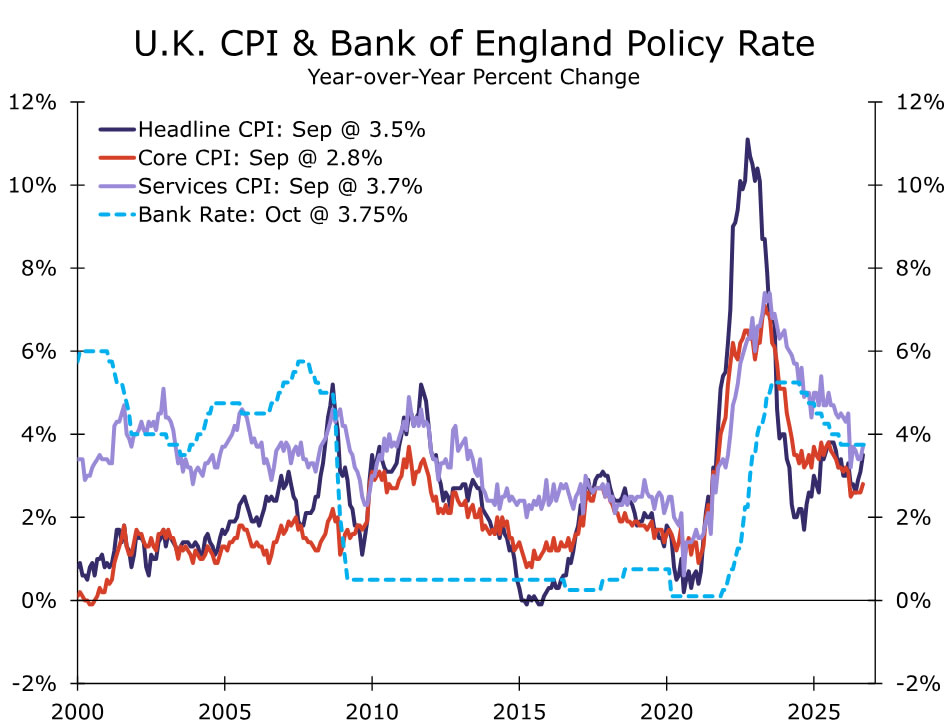
The case for patience is wearing thin at the Bank of England (BoE). We expect a 25 bp hike to 4.00% next week—its first increase in this tightening cycle. Before the war in the Middle East, policymakers were considering cuts from an already restrictive monetary policy stance. Tighter financial conditions, labor-market slack, and limited evidence of second-round inflation effects had supported patience. The backdrop now offers less reassurance. September headline inflation rose to 3.5% year over year, while core and services inflation reached 2.8% and 3.7%, respectively. Growth has exceeded expectations, and October PMIs showed stronger activity and a modest return to employment growth, even as wage pressures remain relatively contained.
We now expect another hike in Q1 2027 to bring Bank Rate to 4.25%. The key risk is that persistent energy costs become embedded in wage and price-setting. September’s minutes showed little evidence of material second-round effects so far, but policymakers warned against waiting too long for definitive evidence. In our view, that favors a precautionary hike now rather than a sharper response later.
Canada Labor Force Survey • Friday
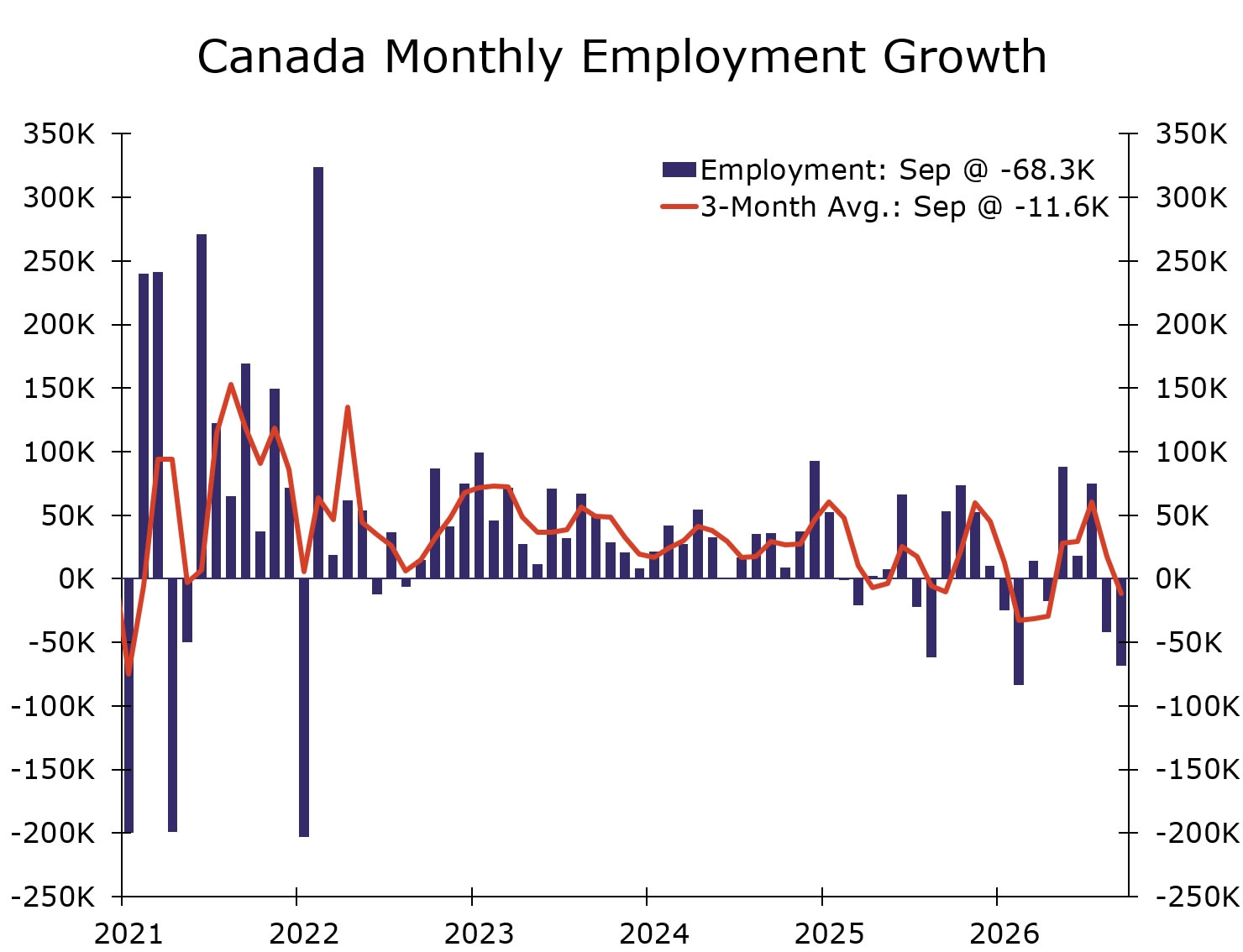
Canada’s labor market weakened further in September, with employment falling 68K after a 42K decline in August. Job losses were broad across full- and part-time positions and extended across both service-providing and goods-producing industries. The unemployment rate edged up a tick to 6.5%. After back-to-back declines, we look for employment to rebound modestly in October, although the broader hiring environment remains subdued.
Monthly employment growth has been volatile. The unemployment rate has continued to fluctuate within a relatively narrow range, while slower labor force growth has helped limit upward pressure on joblessness. At the same time, there is little evidence of renewed strength in labor demand. The Bank of Canada’s business surveys show hiring intentions remain below historical averages, with many firms expecting head counts to remain broadly unchanged. Against that backdrop, an October rebound looks more like some payback from two weak months than the start of a meaningful reacceleration in hiring.
The policy backdrop, however, has shifted more decisively. The Bank of Canada (BoC) raised its policy rate 25 bps to 2.50% this week as officials grew more concerned that the persistent energy shock could eventually spill over into broader consumer prices. The BoC substantially raised its inflation forecast and now expects inflation to remain above 3% through much of 2027, while a somewhat firmer economic backdrop also led to modest upward revisions to its growth outlook. With inflation risks becoming more persistent and economic activity proving resilient, we now expect the BoC to tighten policy further, with another 25 bp hike in December and an additional increase in the first quarter of next year. That would take the policy rate just above the Bank’s current estimate of neutral.
EM Week Ahead
Brazilian Central Bank Selic Rate • Wednesday
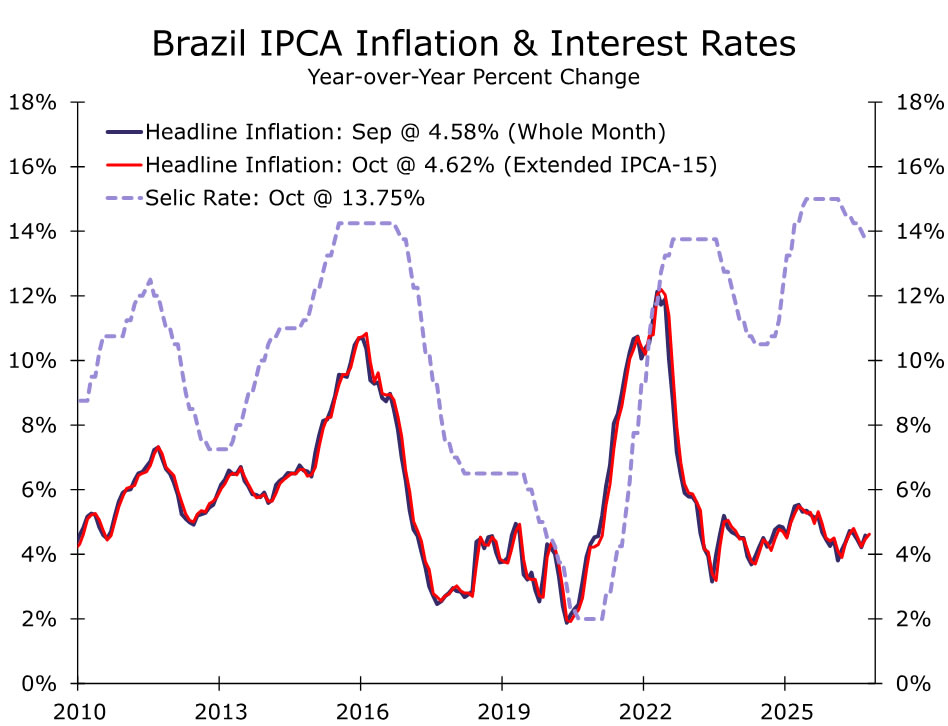
At its first meeting since the elections, we expect the Brazilian Central Bank (BCB) to hold the Selic Rate at 13.75% next week. Lula’s runoff comeback leaves fiscal policy in focus, and we think policymakers will want greater clarity before resuming rate cuts. The economic backdrop also argues for caution. September inflation rose to 4.58% year over year, while average real wages increased 8.1% year over year. A robust labor market suggests domestic price pressures remain persistent. Activity has slowed under restrictive monetary policy, but upside inflation risks leave limited room for faster easing.
For now, we expect rates to remain unchanged through year-end before cuts resume in 2027. The high level of the Selic Rate leaves room for further easing, but we think policymakers will favor patience until the fiscal and inflation outlooks become clearer.
Banxico Overnight Rate • Thursday
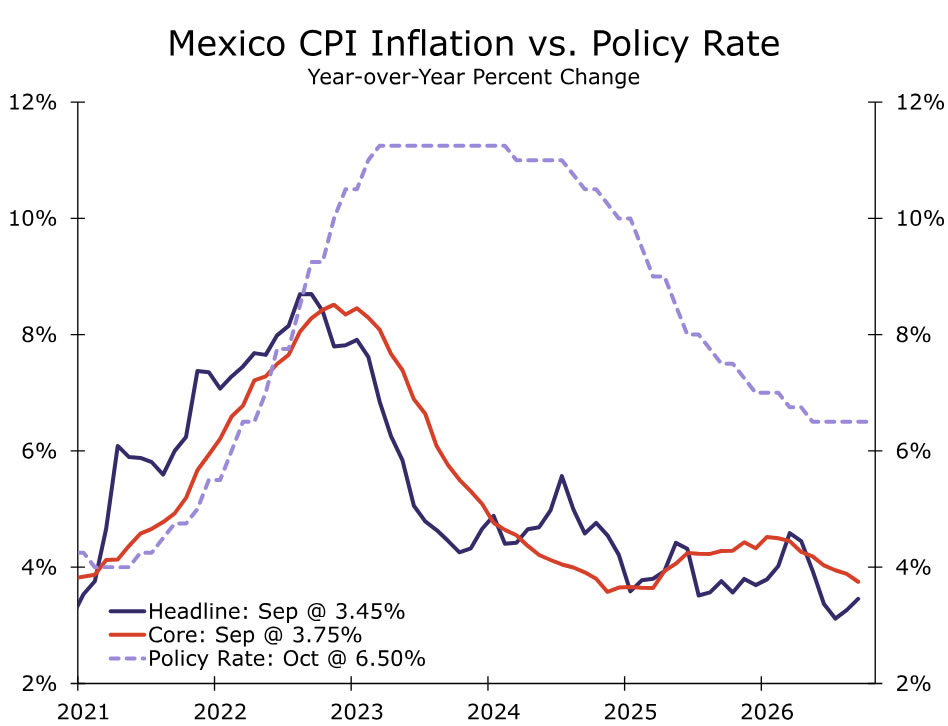
We expect Banxico to leave its policy rate unchanged at 6.50% next week. Mexico’s Q3 GDP rose 3.2% year over year, and in our view, the firmer growth backdrop reduces the urgency to ease. Policymakers remain open to cuts, however. The September minutes showed that several members would consider a reduction if inflation continued to improve, while most expected economic slack to persist despite higher growth forecasts.
Recent inflation data make that case less straightforward. Headline inflation accelerated to 3.62% year over year in the first half of October, while core inflation ticked back up to 3.78% after recent declines. Persistent services inflation remains a concern, and the September minutes highlighted energy and climate-related risks, including a potential intensification of El Niño.
For now, we continue to expect rates to remain at 6.50% through 2026 and 2027. Stronger activity and renewed inflation pressures should favor patience, even with dovish policymakers.