


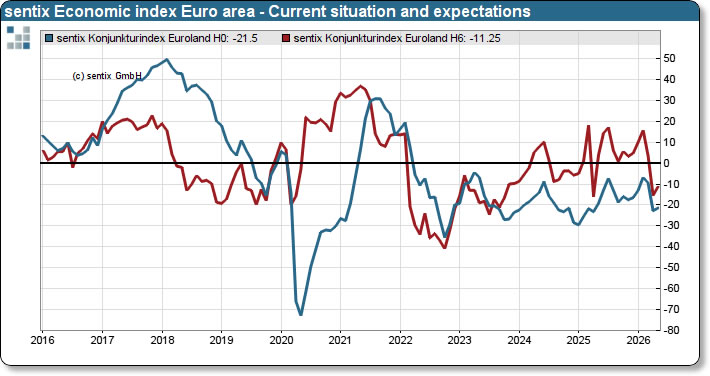
Eurozone Sentix Investor Confidence improved from -19.2 to -16.4 in May, beating expectations of -20.5 and signaling a modest stabilization in sentiment. Both the Current Situation Index and Expectations Index also edged higher, rising from -22.8 to -21.5 and from -15.5 to -11.3 respectively, suggesting that investors are becoming less pessimistic about the near-term outlook.
The improvement appears to reflect easing fears of further escalation in the Middle East conflict, particularly around Iran. However, sentiment remains firmly in negative territory, underscoring that recession risks have not dissipated. At the same time, inflation concerns remain elevated, with Sentix’s inflation barometer still deeply negative, indicating persistent price pressures that continue to weigh on expectations.
This combination of weak growth and ongoing inflation risk highlights a difficult backdrop for the ECB. Fiscal dynamics are adding to the challenge, with the Sentix fiscal barometer at -29.5, pointing to mounting government debt pressures that could push interest rates higher. Rising borrowing costs, in turn, risk exacerbating already fragile economic conditions across the bloc.
| Eurozone | Previous | Latest |
|---|---|---|
| Sentix Investor Confidence | -19.2 | -16.4 |
| Current Situation Index | -22.8 | -21.5 |
| Expectations Index | -15.5 | -11.3 |
| Inflation Barometer | -43 | -42.75 |
| Fiscal Barometer | — | -29.5 |
 Germany stands out as a clear underperformer. In contrast to the broader Eurozone stabilization, Germany’s overall index fell by 3.2 points, with both current conditions and expectations deteriorating further. The decline, coupled with political instability, signals that Europe’s largest economy is diverging onto a weaker path.
| Germany | Previous | Latest | Notes |
|---|---|---|---|
| Overall Sentix Index | -27.7 | -30.9 | Lowest since Jan 2025 |
| Current Situation | -38.0 | -42.3 | Lowest since Feb 2026 |
| Expectations | -16.8 | -18.8 | Lowest since Sep 2024 |





