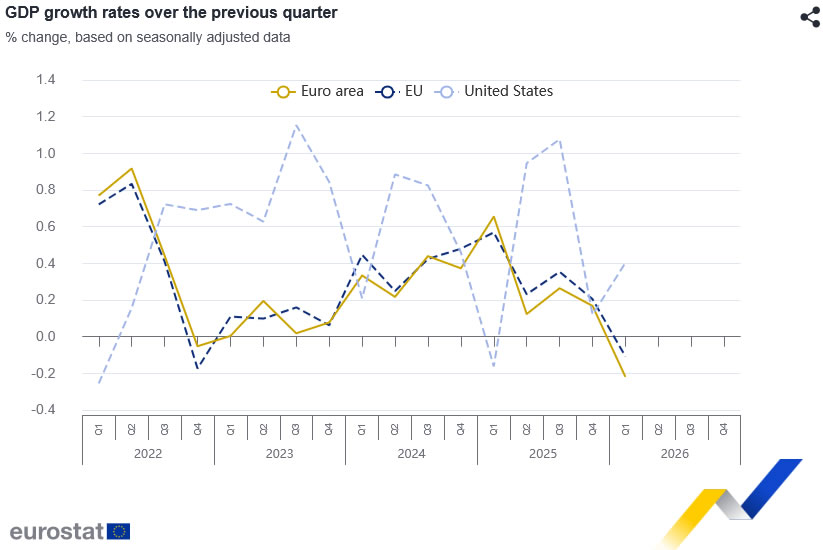
The Eurozone economy contracted in the first quarter of 2026. GDP fell by -0.2% qoq, reversing the 0.2% expansion recorded in the previous quarter, while annual growth slowed sharply to 0.3% yoy from 1.2% yoy. Across the broader EU, GDP declined by -0.1% qoq, with annual growth easing to 0.7% from 1.4%.
The details suggest that domestic demand remained relatively resilient but was not strong enough to offset weakness elsewhere. Household consumption and government spending each contributed 0.1 percentage point to growth in both the Eurozone and EU, indicating that consumers and the public sector continued to provide modest support despite a challenging economic environment.
However, investment activity weakened, with gross fixed capital formation subtracting -0.1 percentage point from growth. Inventories also dragged on Eurozone GDP, while the largest negative contribution came from trade. Net exports reduced growth by -0.3 percentage point in the Eurozone and -0.2 percentage point in the EU, underscoring the impact of softer external demand and a sluggish global trade backdrop.
Performance across member states was highly uneven. Denmark led growth with a 1.9% quarterly expansion, followed by Estonia and Malta at 1.1%. At the other end of the spectrum, Ireland posted a sharp 12.1% contraction, while Lithuania, Sweden, and France also recorded declines.
The broad picture is one of a Eurozone economy losing momentum just as inflation remains elevated, complicating the ECB’s task and reinforcing concerns about a stagflationary environment.
| Indicator | Q1 2026 | Q4 2025 | |
|---|---|---|---|
| Eurozone GDP Q/Q | -0.2% | +0.2% | |
| EU GDP Q/Q | -0.1% | +0.2% | |
| Eurozone GDP Y/Y | +0.3% | +1.2% | |
| EU GDP Y/Y | +0.7% | +1.4% |
| Component | Eurozone Contribution | EU Contribution |
|---|---|---|
| Household Consumption | +0.1 pp | +0.1 pp |
| Government Consumption | +0.1 pp | +0.1 pp |
| Fixed Investment | -0.1 pp | -0.1 pp |
| Inventories | -0.1 pp | 0.0 pp |
| Net Exports | -0.3 pp | -0.2 pp |