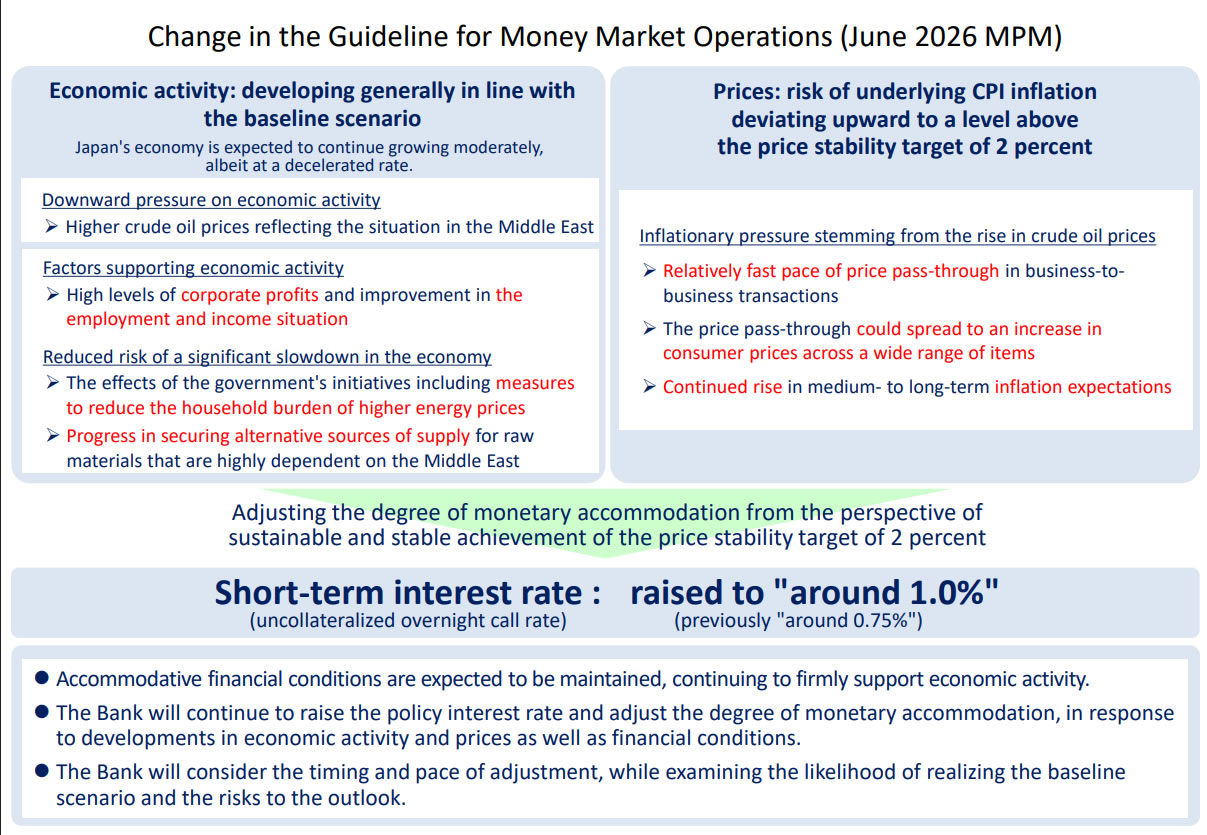
The Bank of Japan raised its policy rate by 25 basis points to 1.00%, as widely expected, marking the highest interest rate level in 31 years and the first time since 1995 that rates have reached 1%. The move follows December’s increase from 0.50% to 0.75% and represents another step in the central bank’s gradual normalization process after decades of ultra-loose monetary policy.
The decision was approved by a 7-1 majority vote. Board member Toichiro Asada dissented, arguing that downside risks to production and employment stemming from the Middle East situation outweighed upside risks to inflation. He therefore favored leaving policy unchanged. The meeting was also notable for the absence of Governor Kazuo Ueda, who is currently hospitalized for treatment of a hepatic cyst infection, leaving other policymakers to guide communications around the decision.
Alongside the rate increase, the BoJ announced adjustments to its government bond purchase program. The central bank will continue reducing Japanese government bond purchases by around JPY 200bn per quarter through March 2027, maintaining its current pace of quantitative tightening. However, from April 2027 onward, it plans to slow the pace of reductions, a move that comes as long-term Japanese bond yields have risen sharply in recent months.
Under the revised plan, monthly bond purchases will decline to around JPY 2.1tn by the January-March quarter of 2027. The combination of a rate hike and a more cautious approach to future balance-sheet reduction suggests the BoJ remains committed to policy normalization, while also seeking to avoid excessive volatility in the government bond market. Markets will now look to July’s updated projections and the eventual return of Ueda for clearer guidance on how far rates could rise from here.