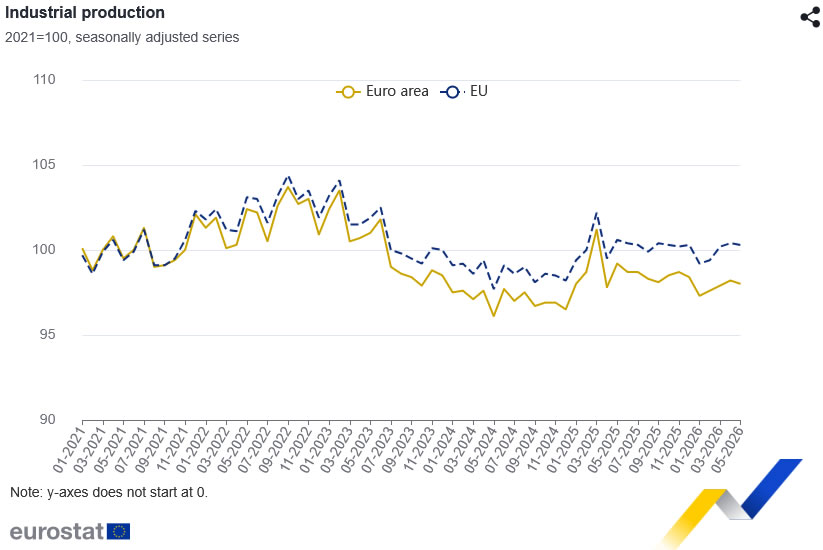
Eurozone industrial production unexpectedly declined in May, falling -0.2% month-on-month after rising 0.3% in April and confounding expectations for a 0.3% increase. The weaker-than-expected reading suggests the region’s manufacturing recovery remains uneven, with strength in some sectors continuing to be offset by weakness elsewhere. Across the broader European Union, industrial production also slipped, edging down -0.1% after a 0.2% gain in April.
The sector breakdown highlighted a mixed picture. Energy output rose 2.2% and capital goods production increased 0.3%, pointing to continued resilience in investment-related activity. Non-durable consumer goods also advanced 0.8%. However, those gains were outweighed by a -0.3% decline in intermediate goods production and a sharper -1.1% fall in durable consumer goods, indicating that manufacturing supply chains and consumer-related industries continue to face subdued demand.
Performance also varied considerably across member states. Ireland posted the largest monthly decline at -5.2%, followed by Malta and Lithuania, while Luxembourg, Hungary and Poland recorded the strongest gains. The data reinforce the view that the Eurozone’s industrial recovery remains fragmented rather than broad-based.
Economic Data
| Indicator | Actual | Expected | Previous |
|---|---|---|---|
| Eurozone Industrial Production (MoM) | -0.2% | 0.3% | 0.3% |
| EU Industrial Production (MoM) | -0.1% | — | 0.2% |
| Energy Output (MoM) | 2.2% | — | — |
| Capital Goods (MoM) | 0.3% | — | — |
| Intermediate Goods (MoM) | -0.3% | — | — |
| Durable Consumer Goods (MoM) | -1.1% | — | — |
| Non-Durable Consumer Goods (MoM) | 0.8% | — | — |
Market Takeaways
- Eurozone industrial production unexpectedly contracted, missing expectations and indicating that the manufacturing recovery remains uneven.
- Growth in energy output and capital goods was outweighed by declines in intermediate goods and durable consumer goods.
- The weakness points to continued softness in manufacturing supply chains and discretionary consumer demand.
- Country-level performance remained highly divergent, highlighting the fragmented nature of the Eurozone’s industrial recovery.