


UK private-sector growth lost momentum in September, with the Flash Composite PMI falling to 51.7 from 52.5, its weakest reading in three months. The Services PMI also slipped to 51.7 from 52.5, while the Manufacturing Output Index eased to 51.4 from 52.1, a six-month low. The headline Manufacturing PMI nevertheless improved to 52.0 from 51.7, a three-month high. S&P Global said the overall pace of expansion was consistent with only around 0.1% q/q GDP growth, highlighting the subdued underlying momentum.
Demand conditions weakened more clearly beneath the headline. Total new work fell fractionally, reversing the marginal increases seen in July and August, mainly due to renewed weakness in services new business. Export sales also contracted at the fastest pace since June, while manufacturing export orders declined for the first time since December 2025. Firms cited weak business and consumer confidence, pressure on discretionary spending and geopolitical uncertainty as restraints on activity. Employment fell again, extending the run of job losses to two years, although the latest decline was only marginal and manufacturing payrolls continued to rise.
At the same time, inflation pressures intensified. Input-cost inflation accelerated for a second consecutive month to a three-month high, with respondents highlighting higher fuel, energy, labour and raw-material costs, including copper and steel. Selling-price inflation also strengthened to its highest since June. S&P Global Chief Business Economist Chris Williamson described the combination as “disappointingly sluggish economic growth and intensifying inflationary pressures,” and said the stronger price gauges were likely to keep the BoE biased hawkish, even as weak growth underlined the risks from higher borrowing costs.
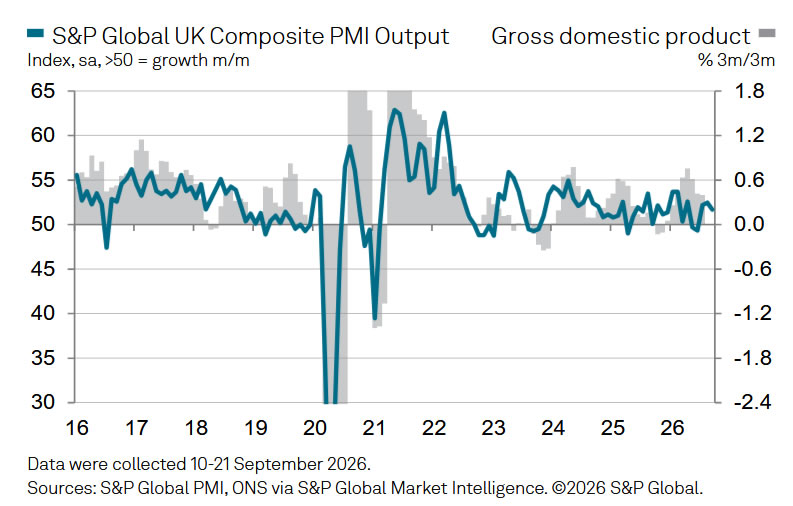
Data Summary
| Indicator | September | August | Trend |
|---|---|---|---|
| Composite PMI | 51.7 | 52.5 | 3-month low |
| Services PMI | 51.7 | 52.5 | 3-month low |
| Manufacturing Output Index | 51.4 | 52.1 | 6-month low |
| Manufacturing PMI | 52.0 | 51.7 | 3-month high |
S&P Global said the combined survey readings were consistent with only around 0.1% q/q GDP growth.
Components
| Component | Trend |
|---|---|
| Total new work | Fell fractionally |
| Services new business | Returned to contraction |
| Export sales | Fell at fastest pace since June |
| Manufacturing export orders | Fell for first time since Dec 2025 |
| Employment | Declined for 24th consecutive month |
| Manufacturing employment | Rose for sixth consecutive month |
| Input prices | Inflation accelerated to 3-month high |
| Output prices | Inflation accelerated to highest since June |
| Business optimism | Unchanged from August’s 6-month high |
Weak business and consumer confidence, geopolitical uncertainty and pressure on discretionary spending weighed on demand, while higher fuel, energy, labour and raw-material costs pushed price pressures higher.
Key Takeaways
- UK Composite PMI fell from 52.5 to 51.7, signalling slower private-sector growth and the weakest expansion in three months.
- Services and manufacturing output both lost momentum, although the headline Manufacturing PMI improved to 52.0.
- New business slipped back into contraction, while export demand weakened further.
- Employment declined again, extending the run of job losses to two years, though the latest reduction was only marginal.
- Inflation pressures intensified, with input-cost inflation at a three-month high and selling-price inflation at its strongest since June.
- The release points to an uncomfortable slower-growth, stronger-inflation mix, which S&P Global said is likely to keep the BoE biased hawkish despite weak activity.





