


US private-sector activity continued expanding strongly in October, with PMI Composite easing from 58.4 to 57.6, but remaining at its second-highest level since March 2022. PMI Services moderated from 58.8 to 57.9, matching expectations, while PMI Manufacturing edged up from 55.9 to 56.0, exceeding the 55.6 consensus and reaching a 53-month high. Manufacturing output growth slowed slightly from 56.2 to 55.8, but remained robust. More significantly, selling-price inflation accelerated to its fastest pace since August 2022, suggesting businesses were passing higher costs on to customers more rapidly despite the modest slowdown in overall activity growth.
Underlying demand remained exceptionally strong, with new orders increasing at their fastest pace in more than four and a half years, led by stronger services demand. Export growth also accelerated to its highest since May 2022, while manufacturing export orders returned to expansion for the first time since June 2025. Employment increased at its second-fastest pace in over four years, with manufacturing hiring reaching its strongest rate since March 2012. Meanwhile, backlogs accumulated at their fastest pace since May 2022, indicating mounting pressure on operating capacity as businesses struggled to keep pace with incoming orders.
The inflation picture was particularly concerning. Selling-price inflation accelerated across both manufacturing and services, while input costs remained elevated amid higher energy, fuel, freight and raw-material prices. Supplier delivery times lengthened to their greatest extent since 2022, reflecting material shortages, shipping disruptions and capacity constraints. Although overall input cost inflation eased slightly from September, businesses raised selling prices more quickly, suggesting that strong demand and rising backlogs were facilitating greater cost pass-through. The survey therefore points to resilient economic growth accompanied by intensifying inflation pressures, with supply constraints adding to the risk that elevated business costs will continue feeding through to consumer prices.
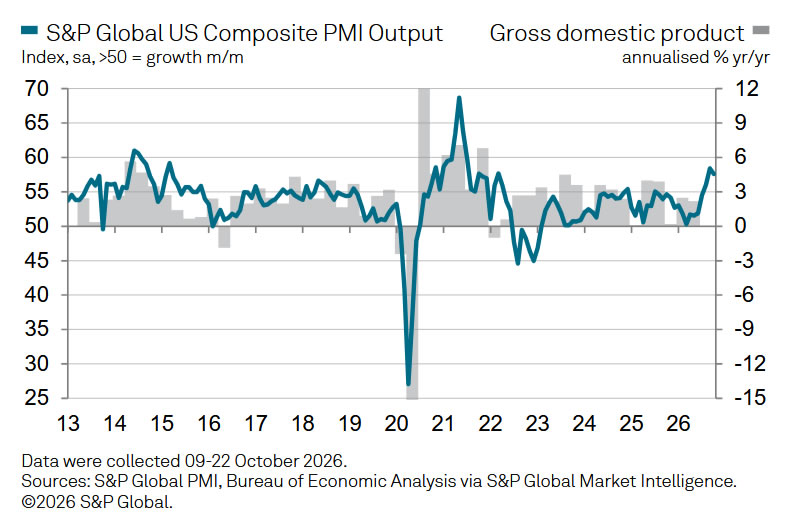
Data Summary
Headline PMI Data
| Indicator | Previous | Expected | Current |
|---|---|---|---|
| PMI Composite | 58.4 | — | 57.6 |
| PMI Services | 58.8 | 57.9 | 57.9 |
| PMI Manufacturing | 55.9 | 55.6 | 56.0 |
| Manufacturing Output | 56.2 | — | 55.8 |
Readings above 50 indicate expansion, while readings below 50 indicate contraction. Survey responses were collected October 9–22.
Additional Survey Details
| Indicator | October Development |
|---|---|
| Private-Sector Output | Second-strongest expansion since March 2022 |
| PMI Manufacturing | Highest in 53 months |
| Overall New Orders | Fastest growth in over four and a half years |
| Services New Business | Fastest growth since March 2022 |
| Manufacturing New Orders | Growth moderated but remained strong |
| Export Orders | Fastest increase since May 2022 |
| Manufacturing Export Orders | First increase since June 2025 |
| Overall Employment | Second-fastest increase in over four years |
| Manufacturing Employment | Fastest growth since March 2012 |
| Backlogs of Work | Fastest accumulation since May 2022 |
| Input Cost Inflation | Second-fastest since November 2022, behind September |
| Selling Price Inflation | Fastest since August 2022 |
| Manufacturing Selling Prices | Fastest inflation since July 2022 |
| Services Selling Prices | Fastest inflation since August 2022 |
| Supplier Delivery Times | Greatest deterioration since 2022 |
| Business Confidence | Eased from September but remained relatively elevated |
Key Takeaways
- Private-sector growth remains exceptionally strong: PMI Composite eased from 58.4 to 57.6, but remained at its second-highest level since March 2022. The modest slowdown reflected slightly softer output growth in both manufacturing and services.
- Manufacturing conditions improve despite slower production growth: PMI Manufacturing edged up from 55.9 to 56.0, reaching a 53-month high, while manufacturing output moderated from 56.2 to 55.8. PMI Services eased from 58.8 to 57.9, matching expectations.
- Underlying demand strengthens further: Overall new orders increased at their fastest pace in more than four and a half years, led by stronger services demand. Export growth also reached its highest since May 2022, supported by improving goods and services orders.
- Employment growth remains robust: Overall hiring recorded its second-fastest increase in over four years, while manufacturing employment expanded at its strongest pace since March 2012. Companies continued recruiting to support rising demand and capacity expansion.
- Backlogs signal mounting capacity pressures: Outstanding work accumulated at its fastest pace since May 2022. Strong order inflows, material shortages and supplier delays suggest that businesses were facing increasing difficulties keeping pace with demand.
- Selling-price inflation accelerates to a four-year high: Prices charged by businesses rose at their fastest rate since August 2022, with accelerating inflation across both manufacturing and services. Strong demand and growing backlogs may have increased firms’ ability to pass higher costs to customers.
- Input costs remain elevated despite slight moderation: Overall input cost inflation eased from September but remained exceptionally strong. Businesses cited higher oil, energy, freight, raw-material, wage and utility costs, while supply-chain disruptions intensified.
- Growth resilience complicates the inflation outlook: Robust demand and hiring suggest continued economic strength, but accelerating selling prices raise concerns about inflation persistence. The PMI price indicators point to inflation risks rather than directly measuring future consumer inflation.