Japan’s manufacturing expansion moderated in October, with S&P Global PMI Manufacturing falling from 54.1 to 53.3, its lowest reading in seven months. Despite the slowdown, the index stayed comfortably above its long-run average of 50.6, indicating continued solid improvement in operating conditions. Both output and new orders expanded at their slowest rates since March, although production increased for a tenth consecutive month. Semiconductor and AI-related demand continued to support new business, including overseas orders, even as overall sales growth lost momentum.
Underlying capacity pressures persisted despite slower growth. Manufacturers maintained a solid pace of hiring, close to the strongest recorded in eight-and-a-half years, while backlogs of work increased at a faster rate. Meanwhile, input cost inflation accelerated for the first time in five months, reflecting higher oil, raw material and component prices. Factory gate prices continued rising at a historically elevated pace, although the rate of increase eased to a six-month low. Concerns about further cost increases also encouraged firms to accumulate stocks of purchases at their fastest pace in almost four years.
The October survey suggests Japan’s manufacturing sector is experiencing slower expansion rather than a broader loss of resilience. Continued hiring, rising backlogs and improving business confidence point to underlying support for activity, despite weaker momentum in production and new orders. Expectations for future output reached an eight-month high, indicating that manufacturers retain a constructive outlook even as cost pressures intensify and growth moderates.
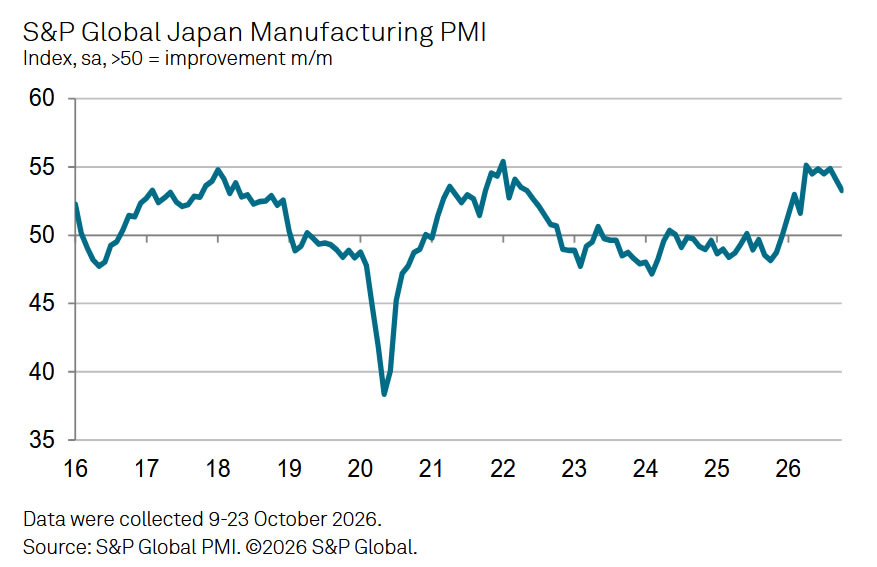
Data Summary
Japan PMI Manufacturing — October 2026
| Indicator | Sep | Oct |
|---|---|---|
| PMI Manufacturing | 54.1 | 53.3 |
Components
| Component | October Trend |
|---|---|
| Output | Slowest growth in seven months |
| New Orders | Slowest growth since Mar |
| Export Orders | Slowest growth since Mar |
| Employment | Strong hiring pace maintained |
| Backlogs | Solid, faster increase |
| Purchasing Activity | Slowest growth in six months |
| Stocks of Purchases | Fastest increase in almost four years |
| Input Prices | Inflation accelerated |
| Output Prices | Inflation eased to six-month low |
| Business Confidence | Eight-month high |
Key Takeaways
- Manufacturing expansion moderated: PMI Manufacturing declined from 54.1 to 53.3, a seven-month low, but stayed above its long-run average of 50.6, indicating continued solid improvement in operating conditions.
- Demand growth slowed despite AI-related support: Output and new orders expanded at their weakest rates in seven months. Semiconductor-related demand continued supporting domestic and overseas orders.
- Capacity pressures persisted: Manufacturers maintained a strong pace of hiring, while backlogs increased more rapidly, suggesting ongoing pressure on operating capacity despite slower new business growth.
- Cost pressures intensified: Input inflation accelerated amid higher oil, raw material and component costs. Manufacturers accumulated stocks of purchases at their fastest pace in almost four years, partly to protect against future price increases.
- Business confidence strengthened: Expectations for future output reached an eight-month high, supporting a constructive assessment of manufacturing prospects despite moderating growth.