

Australia’s NAB Business Confidence Index edged down from -14 to -15 in October, while Business Conditions slipped from -1 to -2, with both indicators remaining well below their long-run averages. The more concerning development was a sharp deterioration in forward orders, which plunged 11 points from -1 to -12, signalling further downside risks to business activity in coming months. Trading conditions weakened from +3 to -1, while profitability declined from -6 to -8, reinforcing evidence that economic momentum slowed further during the second half of 2026. Retail remained the weakest industry in trend terms, reflecting subdued consumer demand, while manufacturing and recreation and personal services also reported weak conditions.
Persistent input cost pressures are compounding the slowdown by squeezing business margins. Purchase cost growth accelerated from 2.3% to 2.4% at a quarterly-equivalent rate, while product price growth eased from 0.8% to 0.6%, indicating that businesses are absorbing rising costs rather than passing them through fully to customers. Labour cost growth moderated from 1.8% to 1.5%, but the continuing gap between input costs and selling prices remains a challenge for profitability and cashflow. Despite weaker trading conditions, the employment index rebounded five points from -1 to +4, moving back above its long-run average. NAB nevertheless warned that sustained margin pressure could eventually weaken labour demand, particularly if forward orders fail to recover.
The survey also highlighted a widening divergence between slowing demand and persistent capacity constraints. Capacity utilisation edged down from 82.2% to 82.1% but remained above its long-run average, suggesting that the economy continues to operate relatively close to its productive limits despite softer activity. Mining and transport and utilities retained comparatively strong conditions, while consumer-facing industries continued to struggle. For the RBA, the combination presents a difficult policy balance: weaker business activity and profitability argue for caution, but elevated input costs and above-average capacity utilisation suggest inflation pressures may prove persistent. The October survey points to an economy losing momentum without a corresponding easing in supply-side pressures, complicating efforts to contain inflation without further undermining growth.
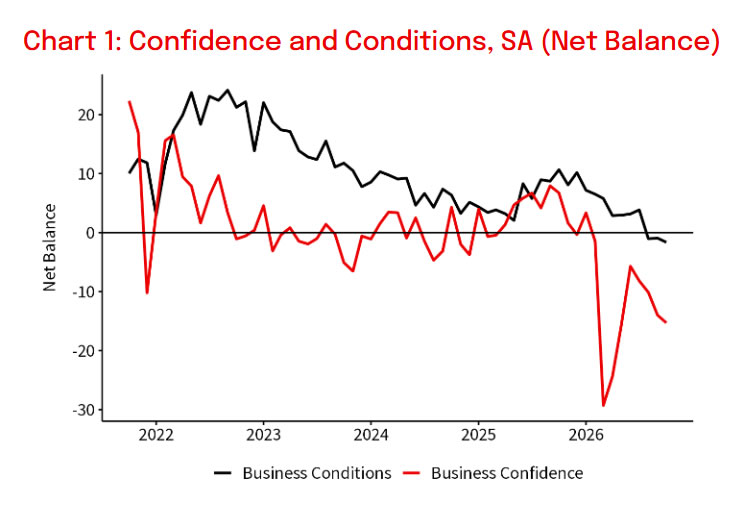
Data Summary — Australia NAB Business Survey, October 2026
| Indicator | Oct | Sep | Change |
|---|---|---|---|
| Business Confidence | -15 | -14 | -1pt |
| Business Conditions | -2 | -1 | -1pt |
| Trading Conditions | -1 | +3 | -4pts |
| Profitability | -8 | -6 | -2pts |
| Employment | +4 | -1 | +5pts |
| Forward Orders | -12 | -1 | -11pts |
| Capacity Utilisation | 82.1% | 82.2% | -0.1ppt |
Cost and Price Pressures
| Indicator | Oct | Sep | Change |
|---|---|---|---|
| Purchase Cost Growth | 2.4% | 2.3% | +0.1ppt |
| Labour Cost Growth | 1.5% | 1.8% | -0.3ppt |
| Product Price Growth | 0.6% | 0.8% | -0.2ppt |
Cost and price growth figures are quarterly-equivalent rates.
Industry Conditions — Trend
| Industry | Conditions | Confidence |
|---|---|---|
| Retail | -18 | -19 |
| Manufacturing | -11 | -10 |
| Recreation and Personal Services | -3 | -14 |
| Construction | +3 | -10 |
| Finance, Business and Property | +8 | -11 |
| Mining | +19 | +4 |
| Transport and Utilities | +10 | -14 |
Key Takeaways
- NAB Business Confidence fell to -15 and Conditions to -2, while forward orders plunged 11 points, signalling further risks to economic activity.
- Purchase cost growth accelerated to 2.4% as product price growth slowed to 0.6%, intensifying margin pressure despite easing labour costs.
- Employment intentions recovered, but weak profitability and above-average capacity utilisation highlight the tension between slowing demand and persistent inflation pressures.