Sample Category Title
USDJPY Remains On The Back Foot
'Before resuming its uptrend in the medium term, we think USD/JPY will likely be capped in the near term.' – Deutsche Bank (based on FXStreet)
Pair's Outlook
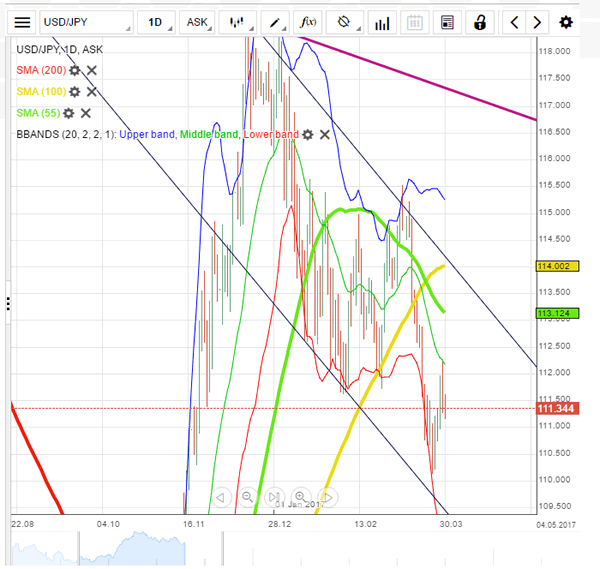
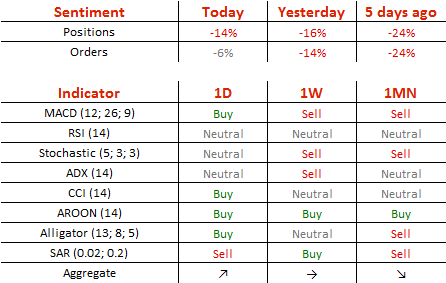
As was anticipated, the USD/JPY currency pair was unable to reclaim the 112.00 mark, resulting in a 53-pip loss on Friday. Nevertheless, more bearish momentum is possible, but unlikely, since the pair rebounded after approaching the descending channel's support line last week. Currently, the Buck is making its way towards the channel's upper border, with the 112.00 handle being one of the main obstacles. However, technical indicators are unable to confirm the possibility of a positive outcome today, as they keep giving bearish signals. Another setback is possible, but the US Dollar is expected to hold above 110.00, therefore, refrain from retesting the lower trend-line any time soon.
Traders' Sentiment
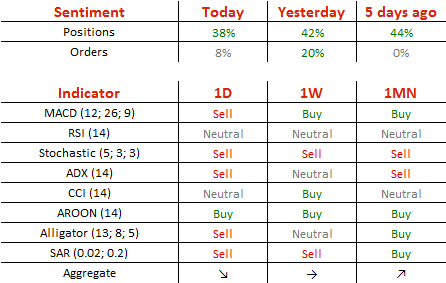
There are 69% of traders holding long positions today (previously 71%), whereas 54% of all pending orders are to acquire the Greenback.
EURUSD Declines Below 1.07 Mark
'If France and Germany are not on the same page anymore, it means that political backing is no longer there, and there's not much the ECB can do.' – Guntram Wolff, Bruegel Institute (based on Bloomberg)
Pair's Outlook
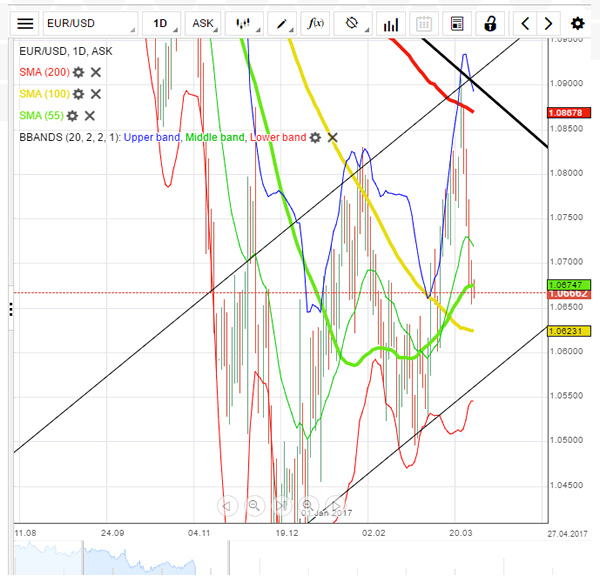
During the early hours of Monday's trading session the common European currency scored slight gains against the US Dollar. However, the currency exchange rate was still positioned for further losses. The pair faced the resistance put up by the 55-day SMA, which was located at the 1.0674 level, and the monthly PP at 1.0685 mark. The fall of the currency pair might be hindered by the 23.60% Fibonacci retracement level, which is located at the 1.0639 level. The retracement level is also supported by the 100-day SMA at the 1.0624 level. However, a hindrance for long is unlikely.
Traders' Sentiment
SWFX traders remain bearish on the pair, as 57% of open positions are short on Monday. Meanwhile, 53% of trader set up orders are to sell the Euro.
XAU/USD Attempts To Break Above 1,250
'The interest rate hike cycle has set in and that might keep gold in a wide range of $1,200-$1,250 as the opportunity cost of holding non-interest rate bearing gold is more.' – Mark To, Wing Fung Financial Group (based on Reuters)
Pair's Outlook
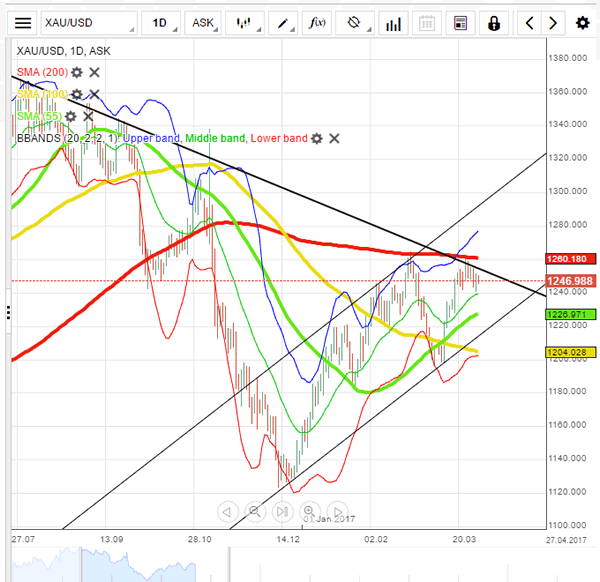
On Monday morning the yellow metal attempted to break above the 1,250 mark, as it faced resistance put up by the weekly PP at 1,249.67 and the 50.00% Fibonacci retracement level, which is located at the 1,248.96 mark. If the bullion succeeds, it will likely jump to the 1,257.02 level, where the 200-day SMA is located at. However, in the case of a failure the commodity price has no support as low as the 1,238.33 level, where the weekly S1 is positioned. The weekly S1 is also supported by the freshly calculated monthly PP at the 1,234.74 level.
Traders' Sentiment
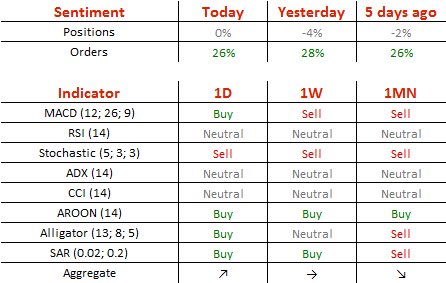
SWFX traders are neutral on the metal, as 50% of open positions are long. However, 63% of trader set up orders are to buy the yellow metal.
Technical Outlook: AUDUSD Returns Into Daily Cloud, Maintains Negative Near-Term Outlook
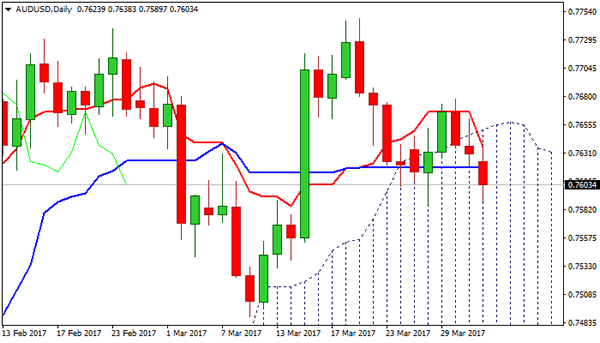
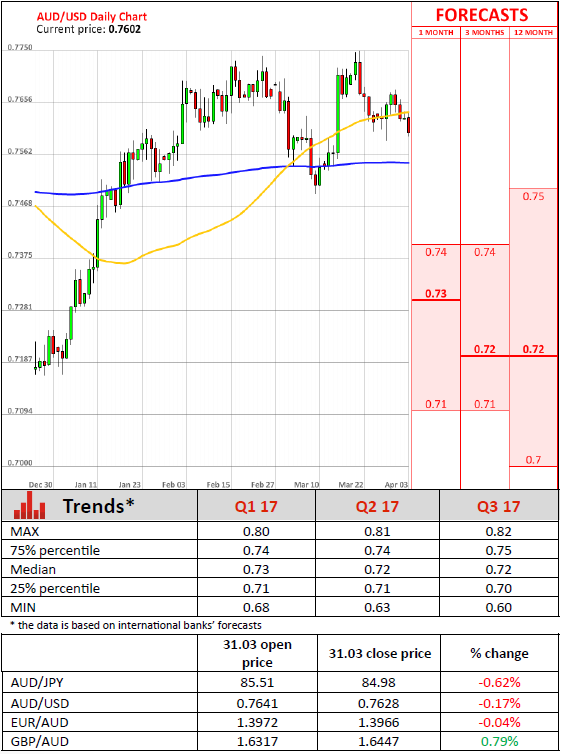
The Aussie stays in red on Monday and extends losses below 0.7600, coming ticks ahead of last week's low at 0.7585.
Larger pullback from 0.7747 was so far contained here (support is formed by Fibo 61.8% of 0.7489/0.7747 rally), with limited recover (capped at 0.7677) and subsequent weakness threatening for firm break below 0.7585 pivot) bearish signal) for retest of another strong support at 0.7547 (200SMA).
The price is back into thick daily cloud (spanned between 0.7448 and 0.7651) after being unable to hold above the cloud.
Daily studies are weakening and supportive for further easing, with 0.7585 seen as key point.
South-turned Tenkan-sen offers solid resistance at 0.7636, guarding upper pivot at 0.7651 (daily cloud top) which is expected to cap extended upticks.
Res: 0.7636, 0.7651, 0.7685, 0.7709
Sup: 0.7585, 0.7547, 0.7506, 0.7489
GBP/USD Intraday View
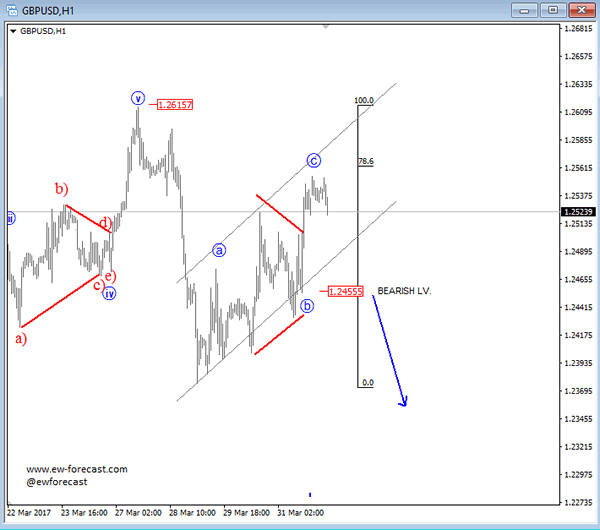
GBPUSD is turning lower at the moment after very slow and overlapping recovery up to 78.6% fib. level which is seen as a three wave move; a correction that is pointing back to march 28 low. However, 1.2455 should be broken to confirm the next bearish wave.
GBPUSD, 1H
Technical Outlook: USDJPY – Near-Term Structure Is Weakening On Fresh Probes Below Weekly Cloud Top
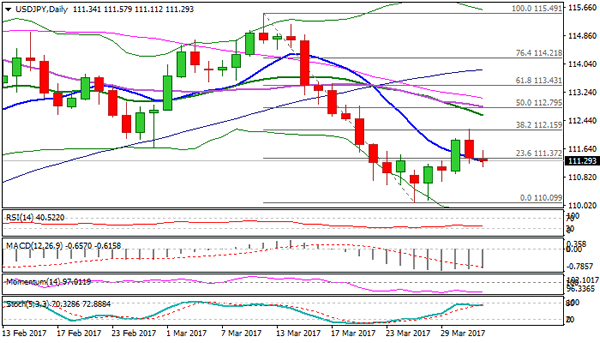
Bullish sentiment that was regained on Thursday's break and closewell above weekly cloud top at 111.36 was offset by Friday's quick pullback after bulls briefly tested next pivot at 112.15 (Fibo 38.2% of 115.49/110.09 downleg), ending day firmly in red and closing at 111.36 level. The pair stands at the back foot on Monday as fresh near-term bears are probing below 111.36 handle (which also marks Fibo 38.2% of 110.09/112.18 upleg) and close below it would generate fresh bearish signal. Hourly studies in negative setup maintain downside pressure, as thick hourly cloud (111.44/74) so far caps recovery attempts. In addition, 4-hr studies are moving from neutral to bearish mode that also weighs on near-term action, as daily technicals maintain firm bearish mode. Sustained break below 111.36 handle would open next pivot at 110.90 (Fibo 61.8%) loss of which is needed to confirm reversal. Conversely, extended consolidation could be anticipated while the price holding around 111.36.
Res: 111.36; 111.57; 111.75; 112.15
Sup: 111.11; 110.90; 110.59; 110.09
Birtish’s Current Account Improves Significantly In Q4 2016, GDP Grows In Line With Experts’ Estimates
'We saw a sharper-than-expected narrowing in the current account deficit which may have helped to ease the margins for the concerns over the potential downside risks for the pound going forward during the upcoming Brexit negotiations.' - Lee Hardman, MUFG
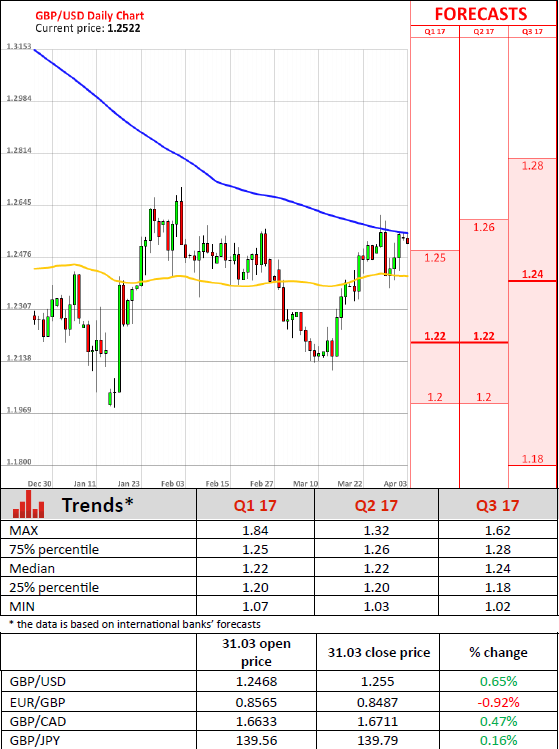
Data released on Friday showed that the UK's current account deficit hit a five-year record low, which surprised many experts. In the Q4 of 2016, the current account advanced from -25.7 billion pounds to -12.1 billion pounds. The country's trade balance with the rest of the world improved dramatically. Thus, in the Q4 of 2016, total trade deficit fell from 14.8 billion pounds to 4.8 billion pounds, due to the notable increase in goods export. In addition, there was also a less significant narrowing in the deficit on primary and secondary income accounts. According to the data, the deficits on secondary income and primary income fell from 4.3 billion pounds to 1.0 billion pounds amid a surge in direct investment. Overall, the UK's current account amounted for 2.4% of GDP, which by itself grew at the pace of 0.7%. This data marked the 16th consecutive quarterly increase and secured country's steady growth. A GDP rise in the last quarter reflects strong consumer spending and satisfactory results in the consumer-related industries. However, experts also recorded a 0.9% decline in business investment that is associated with the Brexit deal uncertainties. Finally, on a year-to-year basis, the UK's GDP lost 0.4%, which was also attributable to the country's decision to leave the EU.
(CA) Canadian Economy Starts 2017 With Solid Growth
'This puts GDP tracking for the first quarter firmly above 3 percent. It is still early, but all in all there is a lot to like in this report. It really makes it hard to imagine the Bank of Canada sounding overly dovish in April.' - Andrew Kelvin, TD Securities
The Canadian economy expanded at a stronger than expected pace in January, suggesting that the economy performed well in the Q1 of 2017. Statistics Canada reported that the country's GDP advanced 0.6% in January, following the preceding month's 0.3%. Canada's goods-producing industries expanded for the seventh time in eight months, growing 1.1% in January. Meanwhile, the country's service-producing industries grew 0.4%, the highest since June 2015. The largest contribution to the January increase was made by the manufacturing sector, which posted a 1.9% expansion. Furthermore, mining, quarrying, and oil and gas extraction grew 1.9% in the reported month, following a 0.5% contraction in December. Wholesale trade climbed 2.4%, the biggest monthly gain since July 2013, while retail sales advanced 1.5%, posting the sixth increase in seven months. Transportation and warehousing expanded 0.8%, whereas the construction sector rose 0.4%. The finance and insurance sector remained unchanged in the reported month, as growth in banking and other depository intermediaries was offset by a fall in financial investment services. Analysts suggest that if the economy maintains the same growth pace going further the BoC will likely increase its key interest rates at the beginning of 2018.
(AU) Australian Retail Sales Post Surprise Drop In February
'Despite sharply rising ‘wealth', today's data suggests Q4's stronger consumer is flagging, both a risk to the 2017 growth outlook, but also possibly signalling little inflation pressure in the Q1 CPI print due at the end of this month.' - UBS
Australian retail sales dropped unexpectedly in February, generating major concerns about the outlook for the economy. According to the Australian Bureau of Statistics, sales fell 0.1% on a seasonally adjusted basis, following the previous month's gain of 0.4% and falling behind analysts' expectations for a 0.3% increase. February's drop marked the second monthly decline in the last three months. The ABS said sales dropped 2.5% in clothing, footwear and personal accessory retailing and 0.4% in household goods retailing. Meanwhile, food and in department store sales advanced 0.3% and 0.8%, accordingly. The retail sales report measures broad consumer spending patterns, which accounts for more than half of Australia's economy. Despite high construction activity, sales of household goods dropped 0.4%, following a 2.5% fall in the furniture, floor coverings, houseware and textile goods subcategory. In regional terms, sales declined 07% in Western Australia, 0.3% in Victoria, 0.2% in Queensland, 0.5% in Tasmania and 0.5% in the Australian Capital Territory, offsetting gains of 0.4% in in New South Wales and the Northern Territory and a 0.1% rise in South Australia. Growth in national sales over the last year dropped to 2.7%, the lowest in almost four years.
EUR/USD Could Be In For More Weaknes
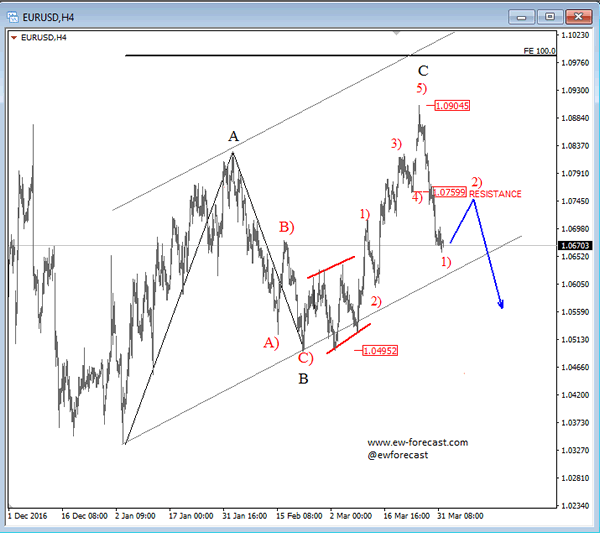
On the updated count of EURUSD we see price trading south following a completed a zig-zag correction, that was in progress since start of the year. Current reversal is strong and clearly impulsive, thus an important sign of a top in place, meaning a minimum three wave reversal to the downside may start to unfold but ideally that's a start of an impulsive drop in wave five of a higher degree. At the moment we see price trading in the first wave 1), probably in late stages, so let's be aware of corrections that may pop up during the process in the next few sessions as wave 2), that may later find resistance around the previous swing low at the 1.0760 level.
EURUSD, 4H