Sample Category Title
Bitcoin Falls Under Pressure
Market picture
The total capitalisation of the cryptocurrency market fell by 2% to $1.14 trillion over the last 24 hours. Over the same period, bitcoin lost 2.6%, Ethereum lost 1.7%, and the top 10 altcoins lost between 1.4% (BNB) and 5% (Polygon).
Bitcoin lost around $1500 on Monday to $28.5K amid rumours of a possible collapse of Binance. The world’s largest cryptocurrency exchange twice suspended BTC withdrawals due to network congestion.
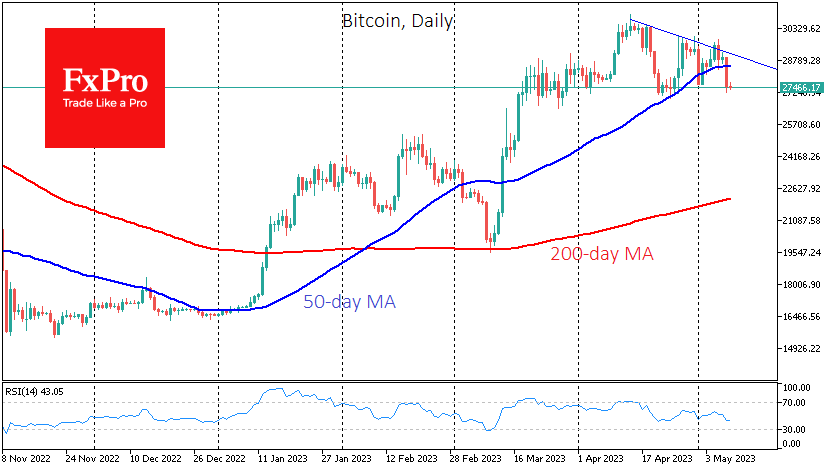
The technical picture shows local victory for the bears, as the sharp drop in price started from the downside resistance that has been in place since the middle of last month. In a strong move, the price broke below the 50-day moving average for the first time since March 13th. The price is testing support near $27K, from which the coin has been rallying for the past two months.
Fees on the Bitcoin network hit a record high on May 8th. In some cases, transaction fees on the BTC blockchain exceeded $10K, with block 788762 setting the record for the day costing $15,834. The BTC network processes around seven transactions per second and cannot quickly confirm payments when users are active, causing queues to form.
According to CryptoQuant, users withdrew over 195,000 BTC (over $5.6 billion) from Binance in one day. In addition, according to Bloomberg, the US Department of Justice has launched an investigation into the exchange, suspecting it of violating sanctions against Russia.
News background
YouTube analyst Jason Pizzino said that negative news failed to stop Bitcoin’s rally after a strong bearish signal after the $20K breakout failed in early March. He believes BTC should soon be in the $32K to $42K range.
According to Validus Power, investment in bitcoin, gold and real estate can protect investors against losses related to the banking crisis.
The prime minister of Liechtenstein said the country would allow citizens to pay for public services using Bitcoin. He also did not rule out the possibility of the state investing some of its reserves in BTC.
Famous investor and head of Berkshire Hathaway, Warren Buffett, said that people’s loss of confidence in the dollar does not mean that Bitcoin will become a global reserve currency.
Argentina’s central bank has banned the sale of cryptocurrencies through payment applications. The regulator said it was trying to reduce the financial risks that transactions in digital assets could pose.
AUD/USD Dips on Soft Retail Sales
- AUD/USD ends 6-day rally
- Australian retail sales decline
- Fed warns that banks are tightening credit
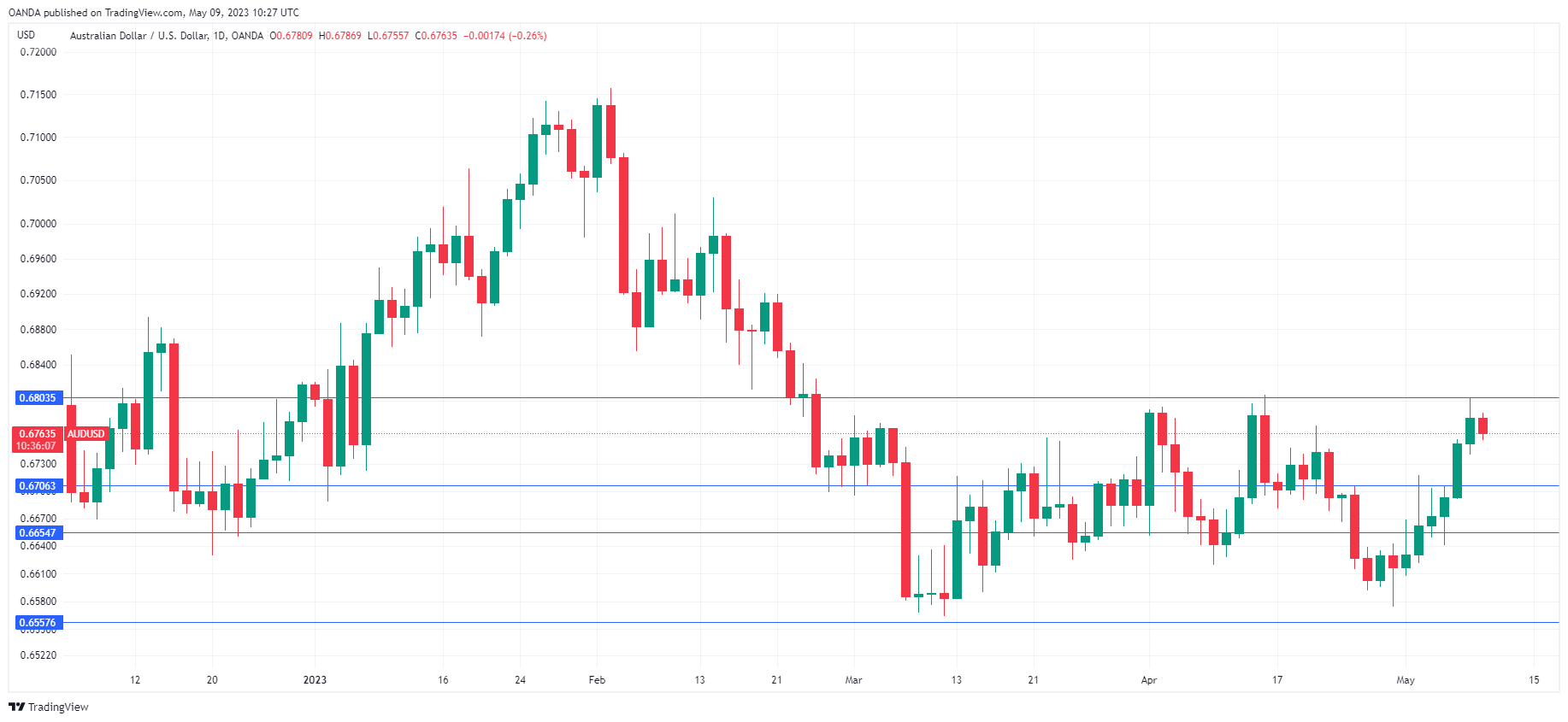
The Australian dollar is in negative territory, ending a rally of close to 200 points. In the European session, AUD/USD is trading at 0.6760, down 0.29% on the day.
Australian retail sales decline
Australian retail sales posted a decline of 0.6% in the first quarter, following a downwardly revised reading of -0.3% in Q4 2022. The reading matched the consensus, but investors were not pleased with a second straight decline and the Aussie has lost ground today. The National Australia Bank responded to the release by warning that a “consumer recession” had arrived.
Australians are holding tight onto their wallets due to the uncertainty in economic conditions. The cost-of-living crisis, driven by high inflation and rising interest rates, has driven down household spending. The new budget may help matters a little, but inflation will have to continue moving lower before consumers increase spending.
Australia will release consumer confidence for May on Wednesday, with the markets braced for a decline of -1.7% after a sharp gain of 9.4% in April.
The Federal Reserve has warned that the turbulence in the banking industry had led to tighter credit conditions which could slow down growth in the US economy. These concerns were highlighted in the Fed’s bi-annual financial stability report. The Fed’s quarterly Senior Loan Officer Opinion Survey noted that banks expected to continue tightening lending requirements and that bank officials expressed concerns about recession and deposit withdrawals.
The Fed isn’t about to pivot on its rate policy due to the stress in the banking sector. The financial stability report said that “a large majority of banks” were able handle the strain from higher rates and noted that banks were “well capitalised”. Still, the Fed will have to keep in mind the danger of contagion and give thought to cutting rates later in the year in order to minimize the chances of a recession.
AUD/USD Technical
- AUD/USD faces resistance at 0.6706 and 0.6803
- 0.6654 and 0.6557 are providing support
Will Bank of England Once Again Fail to Address the Inflation Problem?
Events elsewhere have been stealing the headlines lately, but this week’s focus will almost entirely be on the UK as the BoE is holding its rate setting meeting on Thursday. Will the BoE decision provide another boost to the pound against the euro?
BoE's inflation problem
Banking sector shenanigans in the US, the much-talked Chinese reopening and euro area developments have recently monopolized the market’s interest. But this week the BoE will be in the spotlight. This is the third meeting for 2023 and comes a week after the crucial Fed and ECB meetings. The market is pricing in a very strong probability of a 25bps move. Interestingly, the market is expecting a total of 65 bps of rate hikes (including Thursday’s move) until the November 2, 2023 meeting, contrary to the rate cuts expectations for the Fed.
We understand the reasons behind these market expectations, but we are not confident that the BoE members have taken seriously enough the inflation ravaging the UK economy. It remains the only developed economy with double digit inflation – the March CPI printed at 10.1% year-on-year change – but their rhetoric is less hawkish when compared to other top central banks that face lessened inflationary pressures.
We have commented in the past that the BoE was kind of hoping that a recession in the US would cause a slowdown in the UK and hence push inflation lower aggressively. This has not taken place, up to now, as the US economy continues to grow at a respectable rate.
Could the BoE hike by 50 bps?
The BoE hiked by 25 bps at the March 23 meeting following the 50 bps rate move at the February gathering. While the elevated outright inflation rate means that the BoE has to continue removing accommodation, the MPC members are expected to weigh the pros and cons of hiking rates more aggressively. From one side, the housing sector is clearly suffering from the higher rates, especially when examining the recent mortgage lending figures. On the other hand, the Services PMI figure stands at a 1-year high, and the average earnings are flirting with the 2021 highs.
Should the BoE opt for a stronger move, the focus would then turn to the Monetary Policy Statement (formerly Quarterly Inflation Report) published also on Thursday. At its February edition this Statement was forecasting 3% inflation for the fourth quarter of 2024. A stronger rate hike on Thursday would mean increased inflation projections at the famous Table 1.A.
Data calendar full
The week opened with the BRC retail sales printing stronger than expected and the Halifax House Price index returning to negative territory. On Friday and as the market digests the BoE announcement, we will get the preliminary GDP print for the first quarter of 2023 along with the March industrial and manufacturing industrial data. Following the downside surprise at the US advance GDP print, there is a growing risk for a similar outcome on Friday.
Euro/pound broke through a key area – will the breakout last?
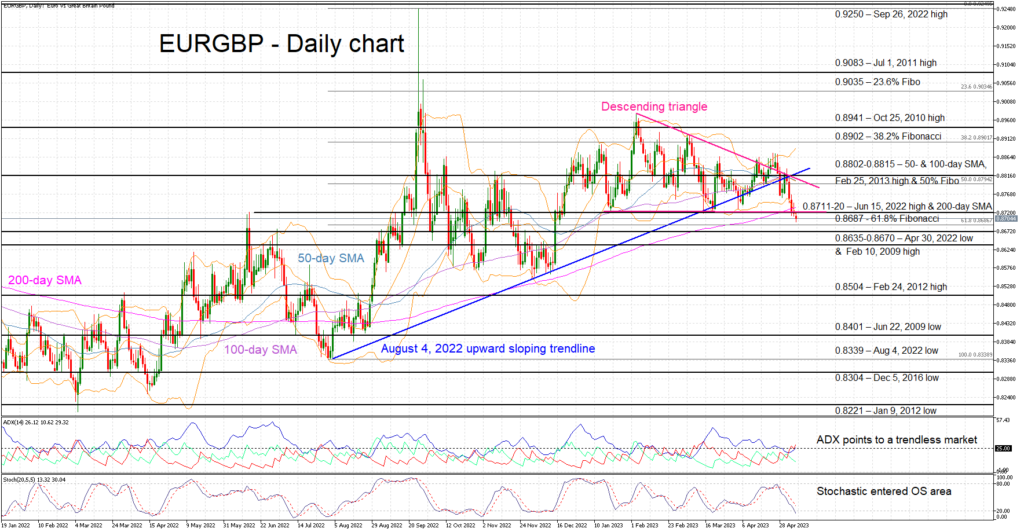
The February high of 0.8978 seems to have energized the pound bulls as the euro/pound pair has been recording a series of lower highs. However, since the eve of 2023 their efforts for a sustainable drop have stopped at the 0.8720 area, forming a descending triangle pattern. Interestingly, the pair has just broken below this level, but it needs a push from the BoE for this move to count.
A stronger than expected rate hike or a 25 bps move accompanied with hawkish rhetoric has the potential to push the euro/pound pair towards the 0.8635 area and test the December 2022 lows. On the other hand, a confirmation of the market expectations and the usual dovish rhetoric from Bailey et al could allow the euro bulls to regain market control and aim for the 0.88 area.
Can US Inflation Data Turn the Tide in the Dollar?
With the Fed's final rate increase now likely in the rear-view mirror and the markets pricing in decent chances for the central bank to cut rates by July, the spotlight will fall squarely on the next round of US inflation data out on Wednesday. Forecasts point to a slowdown in core CPI, although business surveys signaled the opposite. As for the dollar, it has been trading 'heavy' lately and it is doubtful whether even an upside surprise in this dataset can change that.
Sluggish dollar
The dollar has been under intense selling pressure this year, despite mounting signs that the US economy has started to regain momentum. It's been one-way traffic, with FX traders placing more emphasis on negative news and overlooking positive developments. The greenback seems unable to rally on stronger data, but any disappointment tends to inflict damage.
Behind this asymmetric reaction function lies speculation about Fed rate cuts. Even though the Fed has raised rates with incredible speed, market pricing suggests the next move will be a cut. A total of 70bps of rate reductions are priced in by December, which is striking given the persistence of inflationary pressures.
Most likely, this pricing reflects the problems in the banking system. Investors are betting the Fed will ride to the rescue soon by lowering rates, and will be forced to tolerate a period of higher inflation to avoid a cascade of bank failures. Because of this speculation, the dollar has lost some of its interest rate advantage.
Another factor has been the cheerful mood in equity markets. The dollar often acts like a safe-haven, so the stunning rally in stocks has diminished demand for the reserve currency. It is probably not a coincidence that the dollar index topped in late September, a couple of weeks before the stock market bottomed.
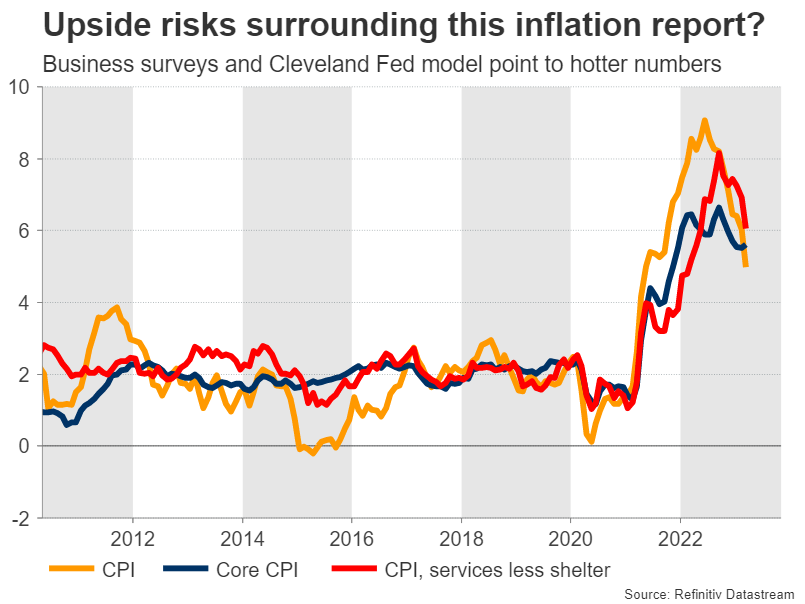
Upside risks from CPI?
Turning to this week's data releases, the ball will get rolling on Wednesday with the latest CPI inflation report. Forecasts suggest the headline CPI rate remained unchanged at 5.0% in April, while the core rate is expected to have ticked down to 5.5%, from 5.6% previously.
As for any surprises, the risks seem tilted towards a hotter-than-expected report. The S&P Global services PMI showed that companies raised their selling prices at the fastest pace since August, taking advantage of stronger demand. Similarly, the Cleveland Fed Inflation Nowcast model points to a CPI rate of 5.19% in April and a core rate of 5.56%, both higher than official forecasts.
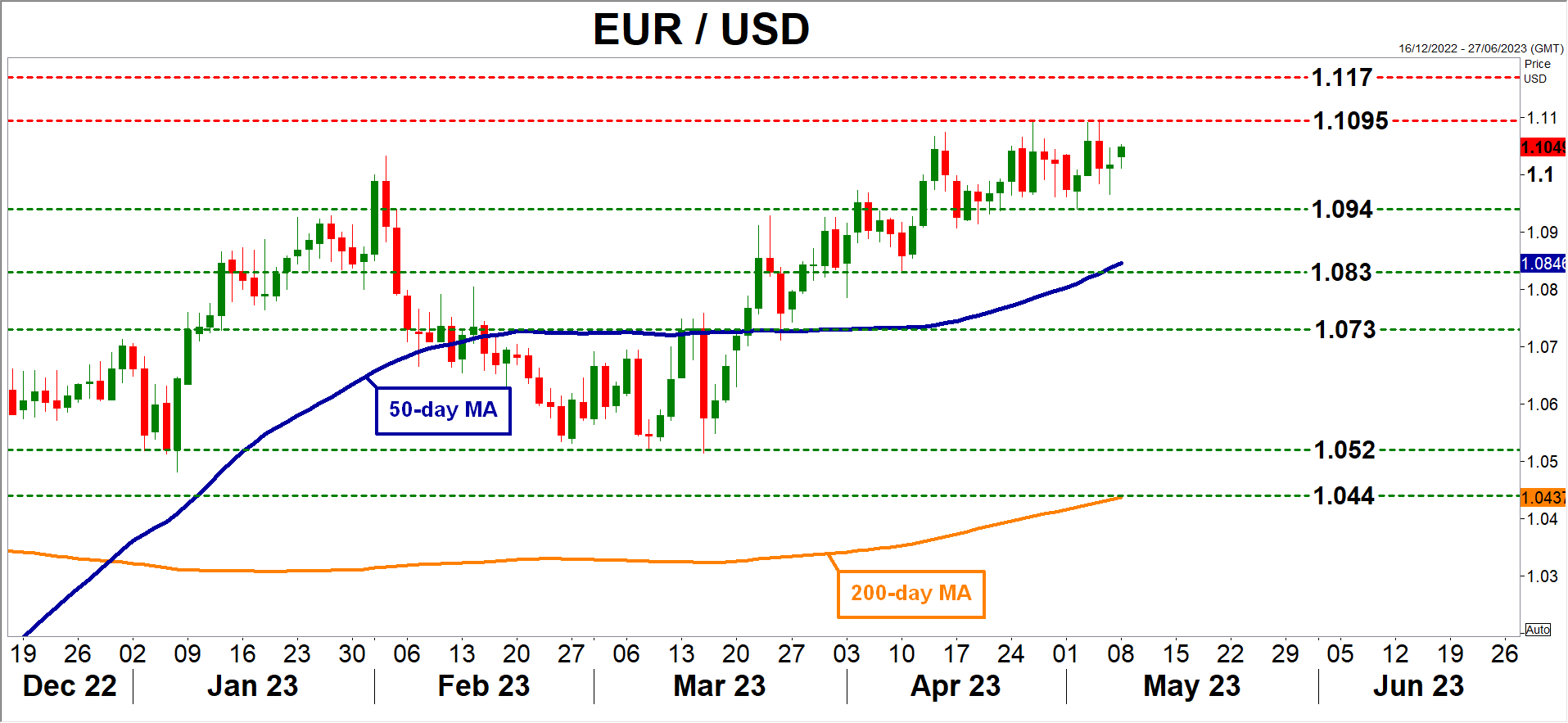
If indeed the report exceeds expectations, investors might unwind some rate cut bets, helping to breathe life back into the dollar. Taking a look at euro/dollar, such an outcome might push the pair lower, with the first obstacle for the bears likely to be the 1.0940 zone.
On the other hand, a surprisingly cold CPI report could propel the pair higher, turning the focus towards the recent highs near 1.1095. Note that data on producer prices will be released on Thursday, ahead of the University of Michigan consumer sentiment report on Friday.
Dollar needs risk aversion to shine
In the big picture, it is doubtful whether even an upside inflation surprise will change the dollar's fortunes. For now, investors seem confident that banking troubles will override inflation concerns at the Fed.
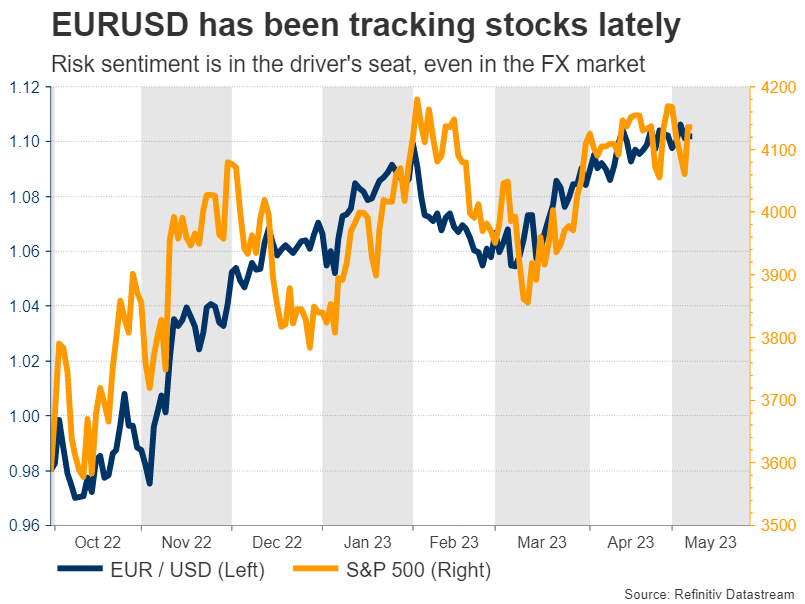
Instead, the dollar's best chance for a sustainable comeback probably lies with risk sentiment. Specifically, a selloff in stock markets could help boost the dollar through the safe-haven channel, considering that pairs like euro/dollar and sterling/dollar have a strong correlation with the S&P 500 this year.
From a chart perspective, the 'line in the sand' in euro/dollar is the 1.1095 level, which rejected a couple of advances recently. If that is violated, it would signal a trend continuation, dashing hopes of an immediate recovery in the dollar.
FTSE 100 Drops 108 Points in 5 Days Despite Strong Pound
If ever there was glaring evidence that the stock of large cap companies which are listed on the London Stock Exchange are completely uninfluenced by the highly liquid currency markets, this week’s FTSE 100 performance is it.
In fact, even a sudden increase in the value of the Pound, Britain’s sovereign currency, has not affected the performance of the basket containing the 100 most prestigious blue-chip companies listed on London’s premier trading venue.
During the past few days, and especially in the advent of the recent coronation of King Charles, the British Pound has been performing very well against its major peer, the US Dollar, rising to its highest point in over a year during the past few days.
The currency in which the 100 well established corporate giants whose stocks make up the FTSE 100 index report their metrics may well be Pounds, but despite the sudden optimism in the British economy, the FTSE 100 has been losing value.
Over the past five days, the FTSE 100 index has dropped by 108 points, resting at 7,765 at 10:00 BST today.
In fact, yesterday during the London trading session, the FTSE 100 dropped as low as 7,702 points, which is its lowest point in more than one month.
The FTSE 100 has languished a bit since the middle of March, when it dropped significantly to 7,335 by March 15, a far cry from the 8,001 points registered on February 20th, which was a euphoric moment for shareholders of British companies and traders alike, as the 8,000-point threshold had been broken.
It was just two years ago when the airwaves were awash with superlatives after the FTSE 100 index broke the 7,000-point mark. To see it go up by another 1,000 points in February 2023 was remarkable to say the least.
For now, those days are gone, and whilst the Pound goes from strength to strength against its transatlantic rival major currency, the British corporations on the FTSE 100 are experiencing a lull.
Some analysts are laying the blame at the door of very generic sets of circumstances such as the potential increase in interest rates that may be implemented by the Bank of England on Thursday this week.
Yes, that would perhaps cause extra costs for corporations which would have to pay more to service their commercial borrowings, but surely that would also affect private individuals, and therefore influence the Pound downwards? The Pound is stronger than it has been for a while, so consumer confidence remains high.
One of the components of the FTSE 100 index is sportswear retailer JD Sports, which is currently a subject of potential acquisition by French giant Groupe Courir for an expected £520 million, however that alone would be unlikely to have this much of a dampening effect on the entire index.
There has been a slight slowdown in the growth of Chinese exports, but that did not stop a healthy trading session take place in the Asia Pacific time zone today, but the strong levels of trading activity did not raise the FTSE 100’s value in the early hours of the London session and later hours of the Asian session.
Perhaps there is some weight behind the conservative approach being assumed in the run up to the Bank of England’s interest rate announcements this Thursday.
WTI Oil: Oil Eases after Steep Recovery on Renewed Demand Concerns
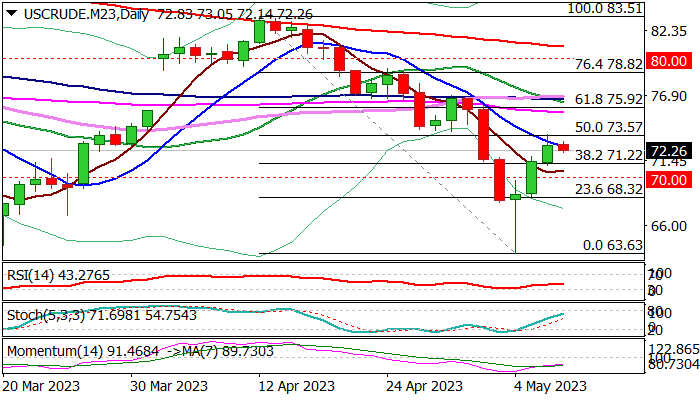
Strong rebound from new lowest since Dec 2021 ($63.63, May 4 low) in past three days is pausing on Tuesday after the action was capped by daily Kijun-sen and 50% retracement of $83.51/$63.63 fall.
Bulls lost traction on weak China’s data, as imports fell much below expectations and exports rose less than previous month, adding weaker economic outlook on concerns that post-Covid recovery may take more time that would sour the demand outlook.
Traders are also focused on US inflation data for April which will be key to the Fed’s next rate decision.
Oil prices could rise further if CPI remains around 5% consensus and core inflation does not ease significantly that would keep the US central bank on track for further tightening despite recent signals that the latest 25 basis points hike would be the last this year.
Technical picture in the daily chart has slightly improved on the latest acceleration higher, but overall picture remains bearish, as negative momentum is still strong and most of moving averages are still above the price.
Also, daily Ichimoku cloud which twists tomorrow and was so far magnetic, is thickening and increasing pressure.
Current easing is still holding within narrowing daily cloud (base lays at $71.96), ahead of Fibo supports at $71.29/22 (23.6% of $63.63/$73.66 upleg/broken Fibo 38.2% of $83.51/$63.63) which should ideally contain and mark a healthy correction ahead of fresh push higher.
Extended dips would face psychological $70 support and a breakpoint, as firm break here would signal an end of recovery phase and shift focus to the downside.
Res: 72.60; 73.66; 74.01; 75.92.
Sup: 71.96; 71.22; 70.00; 69.83.
ECB Kazimir: We will have to keep raising interest rates for longer than anticipated
ECB might need to keep raising interest rates for longer than initially anticipated, according to Governing Council member Peter Kazimir. His comments indicate an evolving stance within ECB as it grapples with stubbornly high inflation in the Eurozone.
"Based on today's data, we will have to keep raising interest rates for longer than anticipated," Kazimir stated. He suggested a slower pace of rate hikes, at 25 basis points increments, as a measured approach that allows for longer-term adjustments, should incoming data warrant it. "So, slowing down the pace to 25 bps is a step that will allow us to go gradually higher for longer, should that be necessary and warranted by incoming data," he explained.
Kazimir pointed to core inflation trends, rising wage pressures, and high-profit margins as factors necessitating vigilance and the continued pursuit of the ECB's current monetary policy trajectory. "The development of core inflation, the continued buildup of wage pressures, and high-profit margins call for vigilance and reconfirm the need to continue on our path," he said.
However, the true effectiveness of the ECB's measures and the trajectory of inflation towards the target will not be fully assessed until the September forecast. "Our September forecast will be the earliest date to answer how effective our measures are and whether inflation is moving towards the target," Kazimir added.
ECB Kazaks asserts need for further rate hikes
In face of high inflation, ECB Governing Council member Martins Kazaks has voiced his belief that further interest rate hikes will be necessary to contain it. His remarks counter market expectations for borrowing costs to be cut as early as next spring, a notion Kazaks has described as "significantly premature."
He outlined a dual strategy to bring the current inflation rate of 7% back to ECB's target of 2%. "The first is raising the rates and of course we don't know where the terminal rate is," he commented. "Another thing is keeping those rates at elevated and sufficiently restrictive levels."
Despite concerns about potential economic risks from higher interest rates, Kazaks emphasized that the risk of doing too little to counter inflation was far greater than the risk of over-tightening. "Persistently high inflation is a bigger problem for society than a relatively short and shallow recession," he warned.
Underlining the importance of effective policy response, Kazaks cautioned, "Failing to contain inflation would be a failure because then the policy response in the second go would then need to be much tighter."
GBPUSD Storms to a Fresh 11-Month High
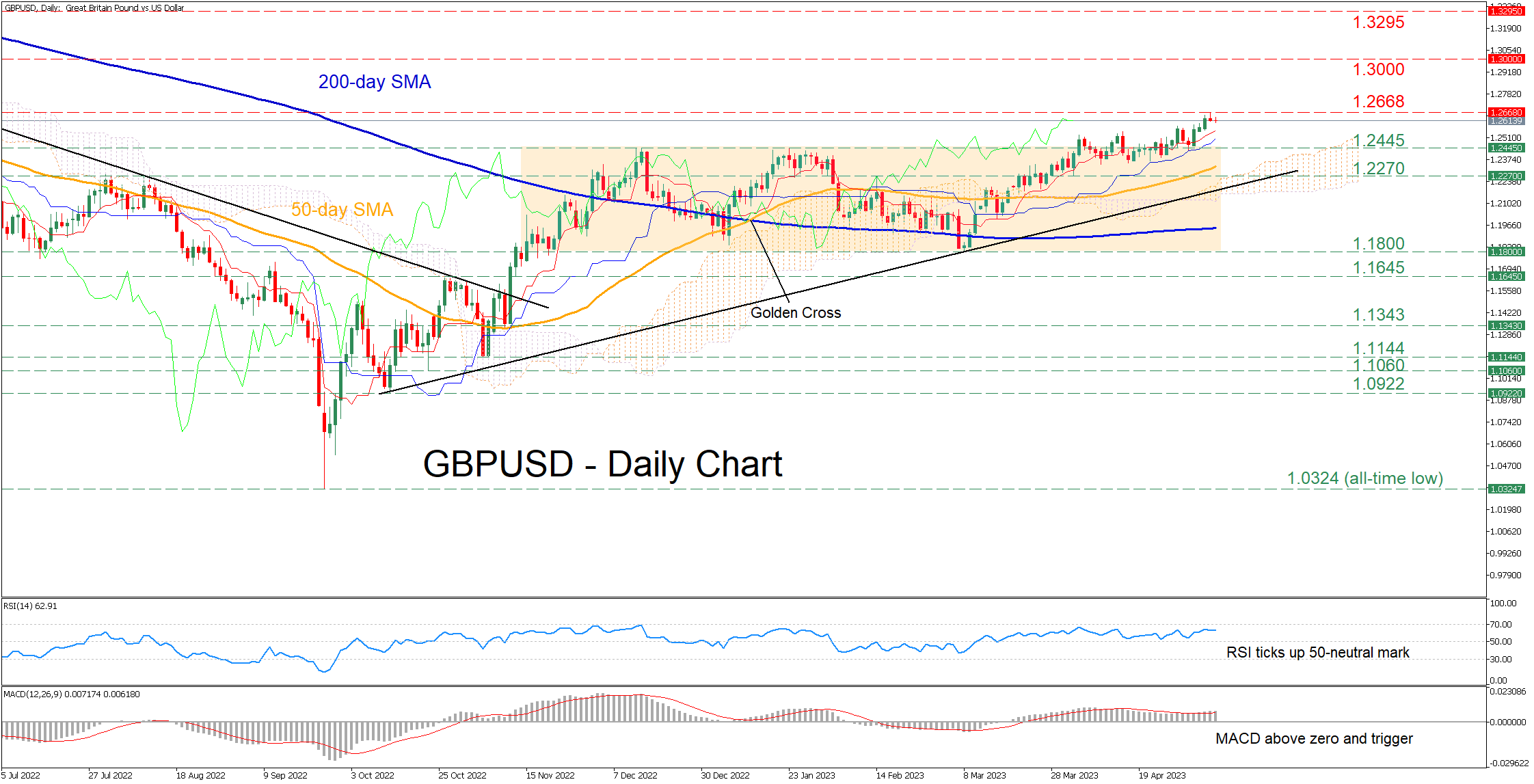
GBPUSD has been in a steady uptrend and recently managed to escape its rectangle pattern, which was in place since November 2022. In the previous daily session, the pair generated a fresh 11-month high of 1.2668 before paring some gains.
The momentum indicators currently suggest that near-term risks are tilted to the upside. Specifically, the RSI has flatlined above its 50-neutral mark, while the MACD histogram is strengthening above both zero and its red signal line.
If bullish pressures intensify, the price could attempt to post a fresh higher high, surpassing the 1.2668 region. Violating that zone, the pair could ascend towards levels not seen in the past year, where the 1.3000 psychological mark could prove to be a tough obstacle for the bulls to overcome. Further advances might then come to a halt at the March 2022 peak of 1.3295.
Alternatively, should the pair experience a pullback, the previous resistance of 1.2445 could serve as initial support. If that floor collapses, the spotlight could turn to 1.2270 before the March low of 1.1800 appears on the radar. Even lower, the 1.1645 hurdle might provide downside protection.
In brief, GBPUSD has been edging higher in the short-term, creating a structure of higher highs and higher lows. However, traders should not rule out a temporary downside correction before the uptrend extends higher.
EURJPY Pauses Bullish Action; Support at 20-SMA
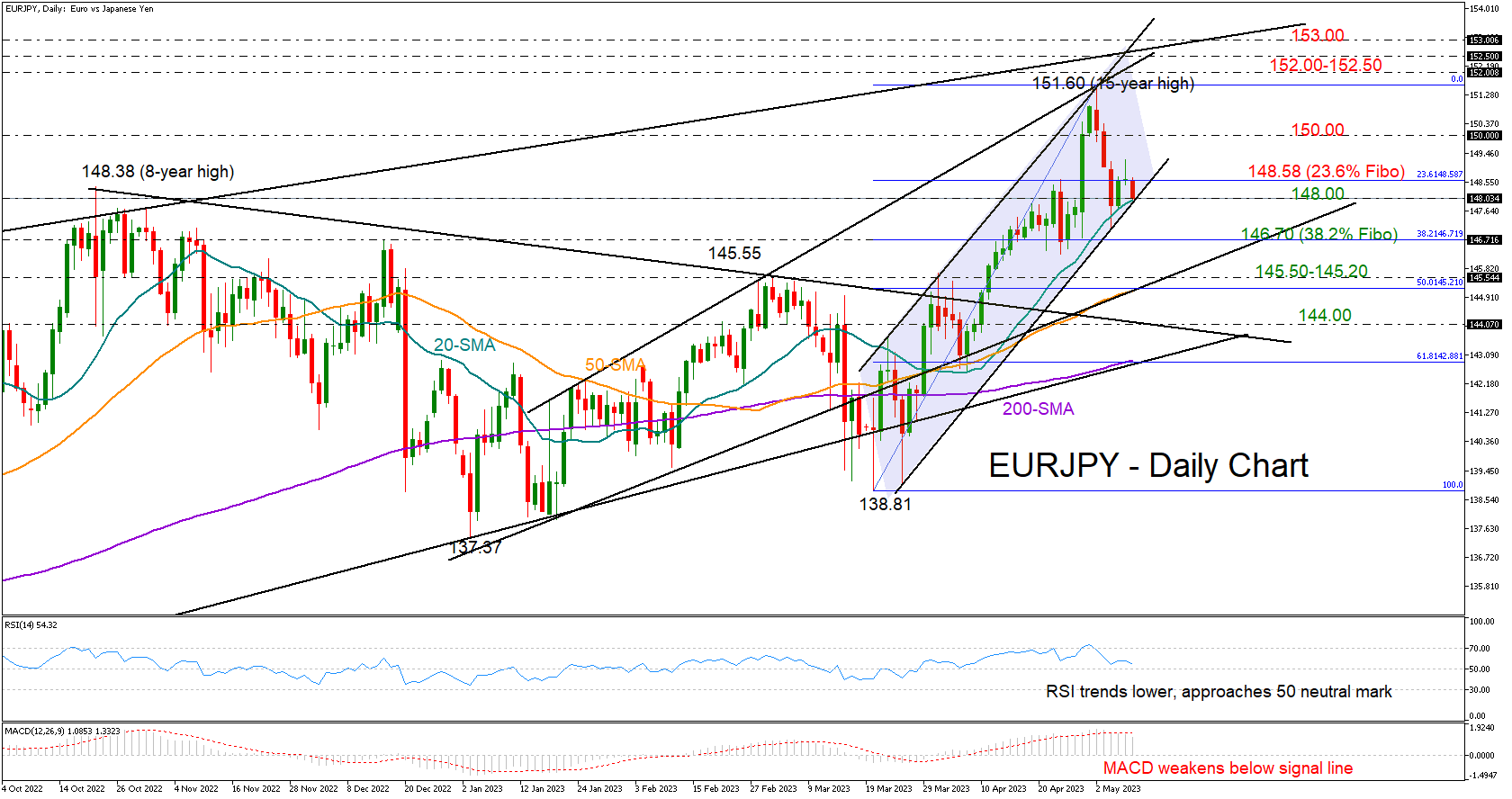
EURJPY pivoted higher after its three-day downfall from the 15-year high of 151.60 paused near the 20-day simple moving average (SMA) at 147.78.
The recovery mode, however, stalled immediately on Monday as the bulls could not preserve strength above the 23.6% Fibonacci retracement of the 138.81-151.60 upleg at 148.58 despite rising as high as 149.25.
With the RSI marking new lower lows in the bullish area, and the MACD easing below its red signal line, the odds are in favor of the bears. Yet only an extension below the upward-sloping channel and the 20-day SMA at 148.00 could activate fresh selling towards the 38.2% Fibonacci of 146.70. Another step lower could press the price aggressively towards the 145.55-145.20 constraining zone formed by the ascending line from January 18 and the 50% Fibonacci of 145.20. A steeper decline could take a halt near the broken resistance trendline from October 2022 at 144.00.
Alternatively, the price may attempt to cross back above the 148.58 border. If efforts prove successful this time, the spotlight will shift to the 150.00 psychological mark and then to the 151.60 top. The resistance line, which blocked the latest rally in the market, could next come into view around 152.00, while slightly higher, the long-term ascending line from August 2020 may attract greater attention near somewhere between 152.50 and 153.00.
In brief, although EURJPY is facing discouraging technical signals at the moment, it may escape a bearish phase if the 20-day SMA sustains a strong footing under the price.