Sample Category Title
GBPUSD: Cable Extends Steep Fall as Exodus into Safety Accelerates
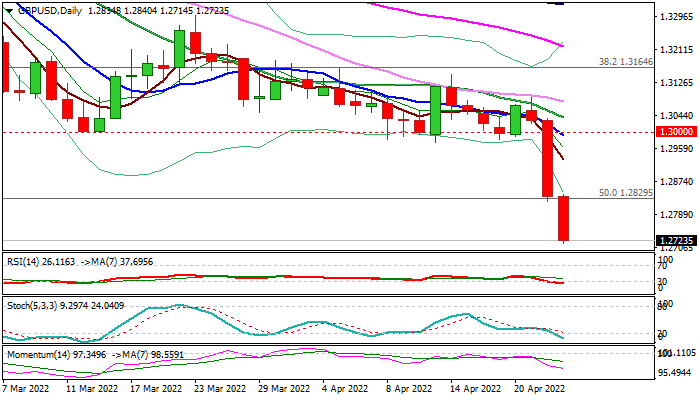
Cable falls further in early Monday, hitting the lowest since Sep 2020, extending Friday’s 1.5% drop (the biggest daily fall since 18 Mar 2020) and last week’s 1.64% loss (the biggest weekly fall since mid-Aug 2021).
Bears gained pace after eventual break of psychological 1.30 support, with sharp fall in global stocks, rising dollar on safe-haven buying and much weaker than expected UK retail sales and PMI data, released last Friday, adding to pound’s negative sentiment.
Steep fall broke below 50% retracement of 1.1409/1.4249 uptrend at 1.2829 (reinforced by monthly Kijun-sen) and emerged below falling monthly Ichimoku cloud, generating additional bearish signals.
Bears focus Sep 2020 low at 1.2675, but could extend towards 1.2494 (Fibo 61.8% of 1409/1.4249).
Bearish studies on daily and weekly charts are supportive, with oversold conditions suggesting bears may take a breather in coming sessions, with limited upticks to offer better levels to re-enter the downtrend.
Broken Fibo 50% level (1.2829) should ideally cap and guard upper pivots at 1.30 zone (former base / falling 10DMA / psychological).
Res: 1.2767; 1.2810; 1.2829; 1.2857
Sup: 1.2700; 1.2675; 1.2615; 1.2545
BOJ Intervention Keeps Yen Steady
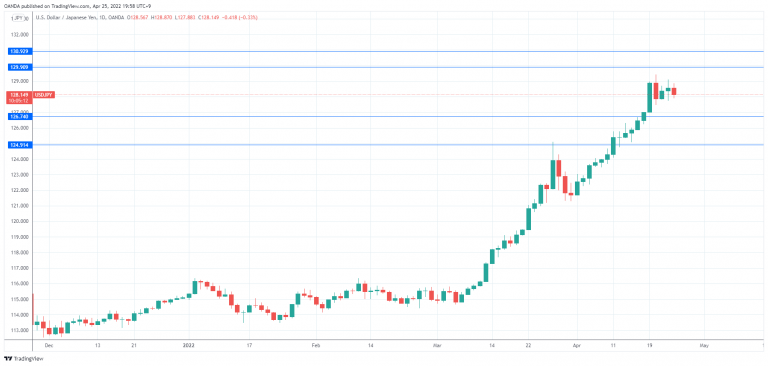
The Japanese yen recorded another losing week, a seventh straight if you’re counting. USD/JPY is slightly lower at the start of the week, trading at 128.26 in the European session.
The Bank of Japan meets on Thursday, but the central bank is keeping busy as it has intervened to cap JGB yields. The Bank has offered to purchase an unlimited amount of 10-year bonds at 0.25%. This is the third time since February that the BoJ has stepped in to defend its ultra-loose yield target. As we’ve seen in recent weeks, any pause in the yen’s slide has been temporary, as the currency trades close to 20-year lows, with the symbolic 130 line lurking close by.
USD/JPY risk remains heavily tilted higher, primarily because of the Federal Reserve, whose hawkishness has widened the US/Japan rate differential, which has sent the yen tumbling. On Thursday, Fed Governor Powell reiterated that a 0.50% hike is on the table for the May meeting, with possibly additional 0.50% increases. Fed member Mester said on Friday that she favors a 0.50% increase in May and “a few more” in order to boost the fed funds rate to 2.5% by the end of the year. The Fed is sending clear signals that it plans to move quickly on rate hikes, which is not surprising, given that US inflation is red-hot, hitting 8.5% in March.
The BoJ appears willing to let the yen fall, at least for now, if that is the price to maintain its ultra-loose monetary policy. We won’t see a shift in policy at the Thursday meeting, although it could tweak guidance in order to help out the ailing yen. Still, with inflation well below the 2% target and the economy limping along, the Bank is determined to persist with its monetary easing, with yield curve control a key element in its policy.
USD/JPY Technical
- There is resistance at 1.2989, followed by 130.93, which is a monthly line
- USD/JPY has support at 1.2674 and 1.2492
Chinese stocks and Yuan dive on fear of lockdown spread
The markets in China were in free fall today on fears on the impact of the spread of coronavirus, and more importantly, imposition of strict covid zero policy and lockdowns. Beijing is the believed to be evolving into the next Shanghai, after the government ordered residents not to leave the Chaoyang district.
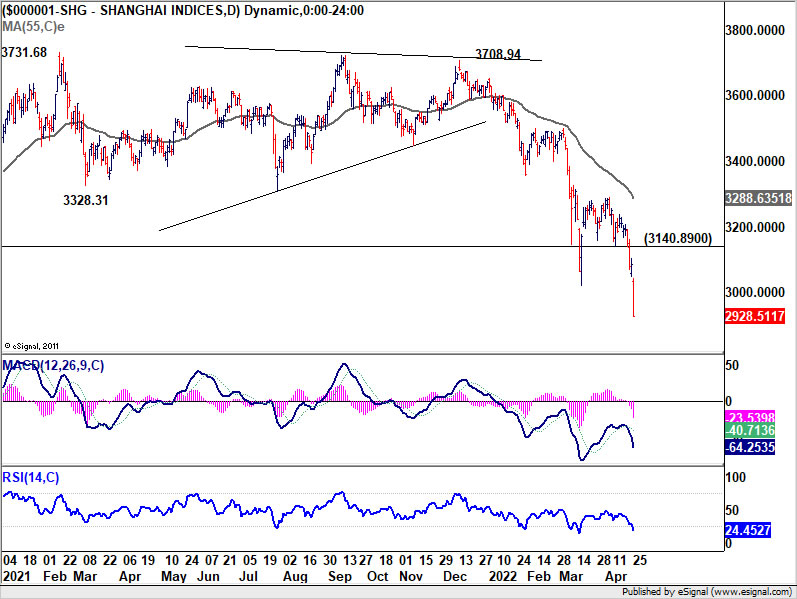
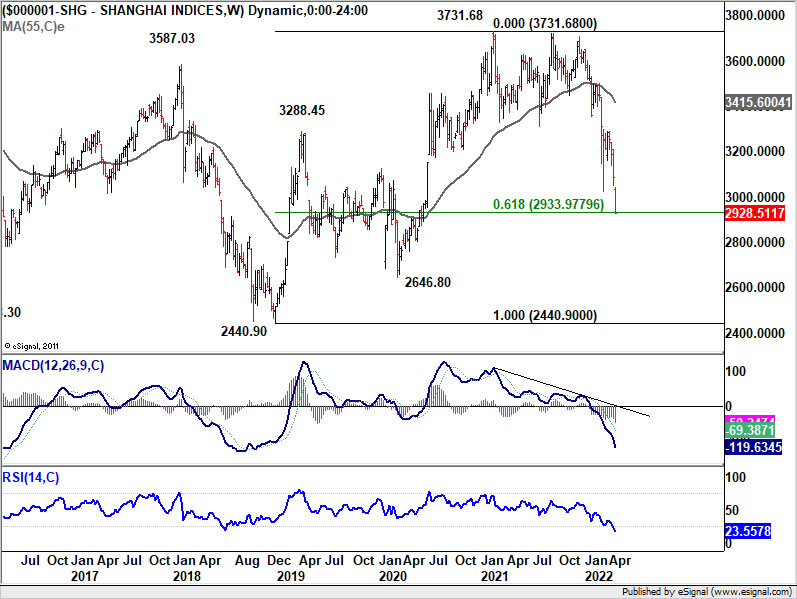
The Shanghai SSE dropped -5.13% to 2928.51, the first close below 3000 handle since 2020. In any case, near term outlook will remain bearish as long as 3140.89 resistance holds. Deeper decline lies ahead.
More importantly, based on current momentum, long term fibonacci support at 61.8% retracement of 2440.90 to 3731.68 at 2933.97 is unlikely to be defended. That is, the whole down trend from 3731.68 could extend in to 2440.90/2646.80 support zone before bottoming
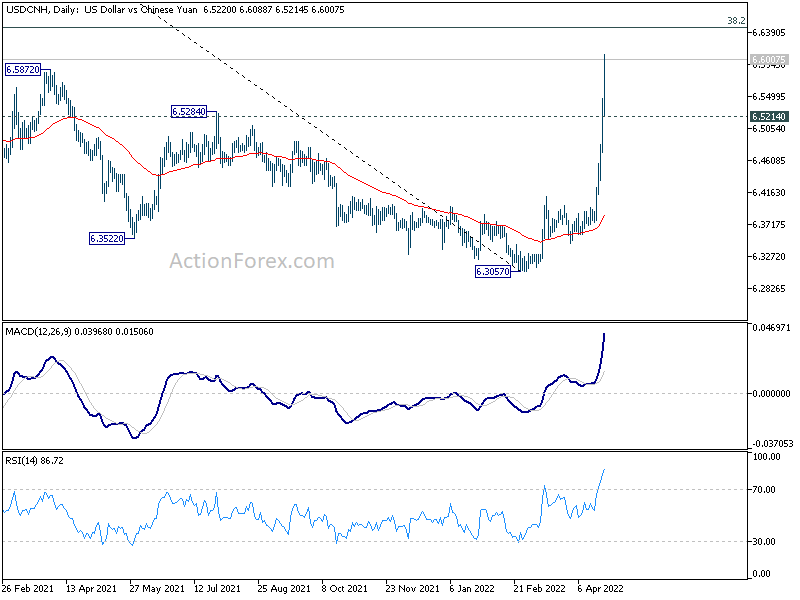
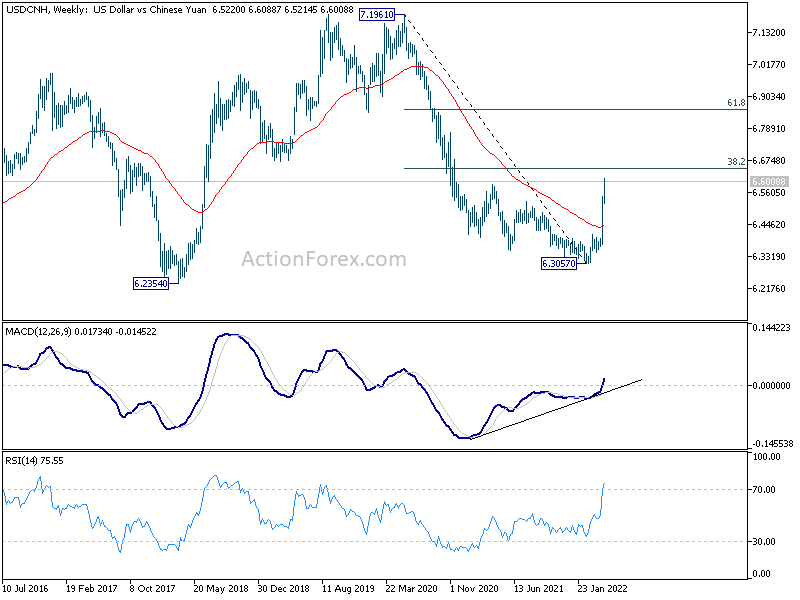
The decline in Chinese Yuan also looks unstoppable, even after the worst week since 2015 last week. USD/CNH (offshore Yuan) surged through 6.6 handle today, breaking through another important medium term resistance at 6.5872 (2021 high).
The next hurdle is long term fibonacci resistance at 38.2% retracement of 7.1961 (2020 high) to 6.3057 (2022 low) at 6.6458. Strong resistance is expected there to cap upside on first attempt. But overall, break of 6.5214 support is needed to indicate short term topping. Otherwise, outlook will stay bullish in case of retreat. That is, there would be more downside in Yuan then not.
Bitcoin Slips to the Lows of the Year
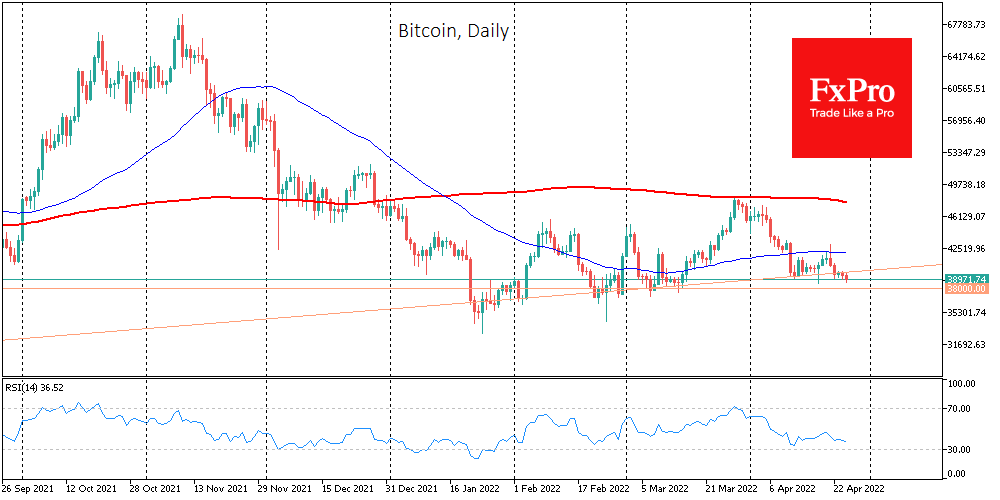
Bitcoin declined by 2.3% over the past week, ending it at around $39.5K. Ethereum lost 3.9%, while other leading altcoins in the top 10 fell from 2.2% (Solana) to 10.5% (XRP). The exception was Terra (+12.9%).
On Monday, the pressure on cryptocurrencies continued, taking another 1.3% off bitcoin to 38.9k, sending it to test March lows.
Total crypto market capitalisation, according to CoinMarketCap, changed little over the week, remaining at 1.8 trillion, as a wave of buying in the first half of the week turned into a strong sell-off in the second. The bitcoin dominance index rose 0.2% to 41.2% over the same period.
Crypto Fear and Greed Index rose from 24 to 27 and returned to its starting point during the week. By Monday, the index had lost another point to 23, remaining in the extreme fear territory.
Bitcoin has declined for the third consecutive week, along with stock indices. In the first half of last week, BTC tried to rise, renewing its highs in a week and a half, around $43,000. Thursday and Friday saw a sharp pullback along with the stock market, and bitcoin fell below the circular $40,000 level.
Changpeng Zhao, the Binance’s chief executive, said the adoption of cryptocurrencies would rise as geopolitical tensions escalate and the use of the dollar as a sanctions tool grows. He believes the US will lose out to the rest of the world if it continues to suppress bitcoin.
A group of US congressmen have spoken out against mining cryptocurrencies using the environmentally damaging Proof-of-Work (PoW) consensus algorithm. They said that cryptocurrencies of particular concern are BTC, ETH, XMR and ZEC.
The EU has discussed banning BTC trading because of its energy and environmental impact. Bitcoin’s energy consumption continues to increase and is attracting the attention of environmental organisations and regulators.
EUR/USD Outlook: Bears Remain Firmly in Play Despite Upbeat German Data
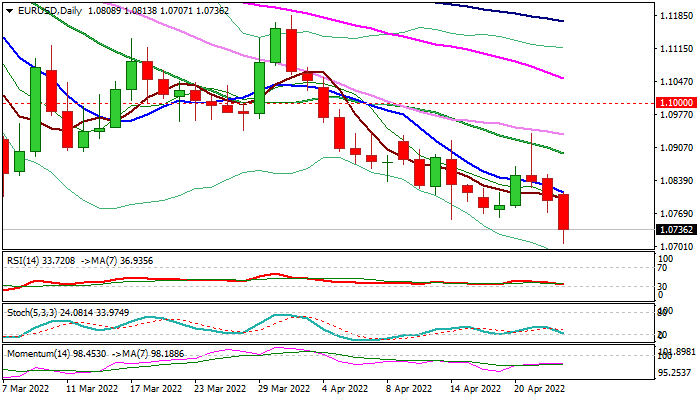
The Euro fell further on Monday, extending weakness below the temporary base that was formed at 1.0757 during past two weeks.
Fresh weakness emerged after last week’s limited recovery was strongly rejected and daily candle with long upper shadow, left on Thursday, weighs on near-term action.
Larger downtrend looks for a final push towards key support at 1.0635 (2020 low), supported by bearish technical studies on all larger timeframes, with the pair being on track for the fourth consecutive bearish month and the biggest monthly drop since June 2021, as strong demand for safe-haven dollar, further deflated the single currency.
Bears were so far mildly impacted by better than expected German data which showed surprise rise in German business morale in April (91.8 from 90.8 in March and 89.1 f/c), as subsequent bounce stalled under initial barrier at 1.0757 (former base).
However, the Euro may find firmer ground on signals that ECB policymakers are ready to end their asset purchase program at the earliest possible time and start raising interest rates as soon as July and not later than
September, prompted by surging inflation, although this could be seen as a speculation, as ECB President Lagarde said last week that bond buying should end early in the third quarter and will be followed by rate hikes.
Res: 1.0757; 1.0813; 1.0858; 1.0895.
Sup: 1.0700; 1.0650; 1.0635; 1.0570.
AUD/USD outlook: Risk aversion pushes Aussie to two-month low
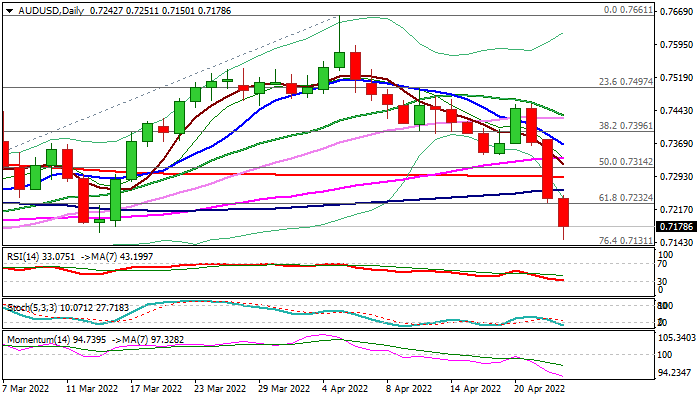
Steep fall off 0.7661 (Apr 5 spike high) extends into fourth consecutive week, following last week’s acceleration that resulted in weekly loss of 2%.
Fresh weakness in early Monday hit the lowest in nine weeks and tested solid support at 0.7148 (200WMA), after emerging below ascending daily cloud (spanned between 0.7204 and 0.7277).
Risk aversion continues to pressure risk-sensitive Aussie dollar as its US counterpart continues to rise on safe-haven buying.
Bears look for further negative signals on close below broken Fibo 61.8% of 0.6967/0.7661 at 0.7232 (minimum requirement) and below daily cloud base (0.7204), while violation of 200WMA (0.7148) and following Fibo 76.4% (0.7131) would further weaken the structure and possibly lead towards full retracement of 0.6967/0.7661 upleg.
Bearish technical studies support the action which might be interrupted by limited upticks (ideally to be capped by broken Fibo level at 0.7232 and not to rise above cloud top at 0.7277), expected to provide better selling opportunities.
Res: 0.7204; 0.7232; 0.7262; 0.7277.
Sup: 0.7148; 0.7131; 0.7086; 0.7033.
Germany Ifo business climate rose to 91.8, shows resilience after initial shock of Russian attack
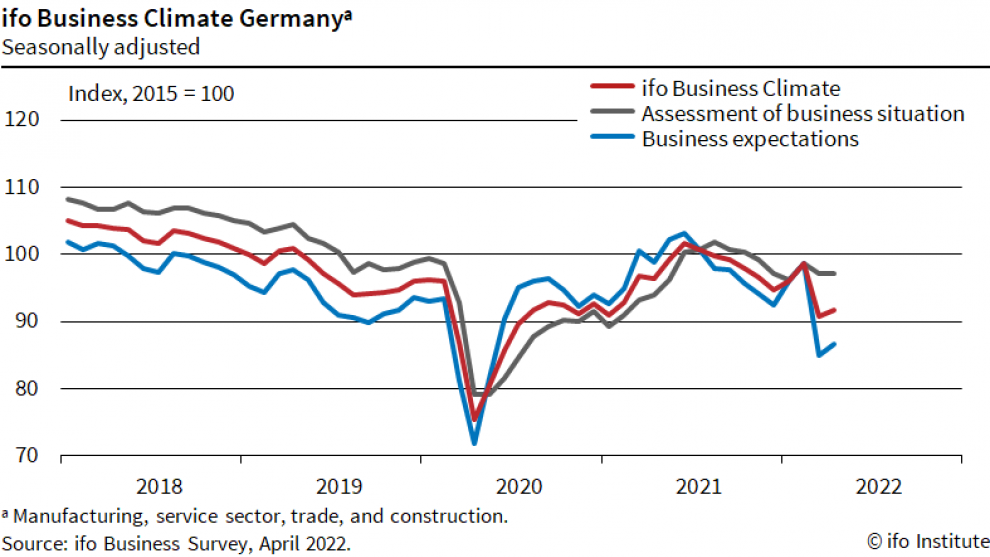
Germany Ifo business climate rose from 90.8 to 91.8 in April, above expectation of 88.1. Current assessment index rose from 97.0 to 97.2, above expectation of 95.0. Expectations index rose from 85.1 to 86.7, above expectation of 82.3.
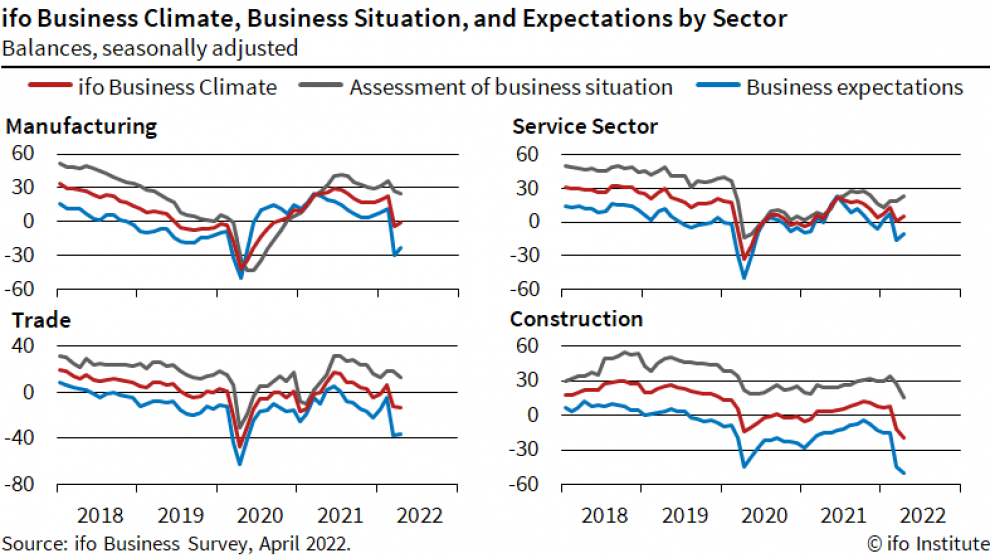
By sector, manufacturing rose from -3.6 to -1.0. Services rose from 0.8 to 5.4. Trade dropped from -12.0 to -13.3. Construction dropped sharply from -12.3 to -20.0.
Ifo said, the improvement was "due primarily to less pessimism in companies' expectations. Their assessments of the current situation are minimally better. After the initial shock of the Russian attack, the German economy has shown its resilience."
Will the US Economy Lead the World into a Global Recession?
The US economy added about half a million jobs in March, while the unemployment rate was at just 3.6%. The Dow Jones index is near its historic highs. Households have saved an additional $2.5 trillion during the pandemic and are spending it now, helping the economy. Despite all this good news, expectations of a recession are very high on Wall Street. Deutsche Bank, Goldman Sachs, and Fed officials all expect the US economy to enter a recession over the next two years.
What are the reasons for such negative forecasts for the US economy?
1. History repeats itself
Current economic conditions resemble the previous pre-recession periods in US history. Over the past 75 years, whenever inflation exceeded 4% and unemployment fell below 5%, the US economy entered a recession in two years. Today, US inflation is approaching 8%, and unemployment has fallen to 3.6% in March.
2. Inversion of the yield curve
The jump in commodity prices, the Fed's decision to raise interest rates, and the war in Ukraine have all pushed the yield curve to flatten in the past weeks. When the yield curve inverts, recession fears grow. The curve's inversion occurs when the 2-year Treasury yields are higher than the 10-year yields. That means investors don't trust the economy's strength in the long term and prefer to bet on the short term because they believe that the economy will slow down.
The curve inversion has predicted every recession since 1955, with only one wrong prediction. A recession occurs after yield curve inversion over a 6-24 month period, so we see all recession predictions by 2023.
3. High inflation will eat up savings
High inflation will force consumers to reduce spending so much that it will push the economy into recession. Due to higher prices, inflation will eat away household savings and consumers spending. That will force them to spend less, which will slow demand and growth even more. The IMF cut its forecast for US economic growth to 3.7% this year.
4. Too tight, too quickly
The Federal Reserve has denied the threat of inflation from the start, reacted too late, and now a sharp tightening cycle could push the US economy, and the global economy with it, into recession.
Indeed, the rapid shift from ultra easing, pumping cheap money, ignoring inflation to aggressive tightening, hiking rates, and withdrawing liquidity from the markets will cause a brutal shock to the US economy. The Fed, which will press the brakes hard to fight the highest inflation in 40 years, could, without noticing, undo the fragile recovery from the COVID-19 recession two years ago.
5. Demand overpasses supply and growth slows
Consumer spending increases and demand for services, goods, homes, and cars rises again. However, due to rapid inflation, higher oil prices, and global instability, supply chain problems already affected by COVID-19 have increased. That widened the spread between demand and supply, which led to higher prices rising more and more.
The Fed began a series of rate hikes last March to curb inflation and slow consumer spending. It's expected to raise rates at each of its remaining six meetings in 2022 to ease US spending so that demand matches supply. So a bit slower growth might be helpful to reduce inflation, but slowing too much could push the economy into recession. If there's a recession in the US this year or next, it will most likely be because of the Fed's aggressive efforts to fight inflation.
The United States may avoid a recession, but the road will not be smooth and easy. The Fed should reduce inflation while maintaining low unemployment and stable economic growth. Will the US central bank be able to do that?
AUD/USD Pair Entered a Bearish Zone Below the $0.7400 Support
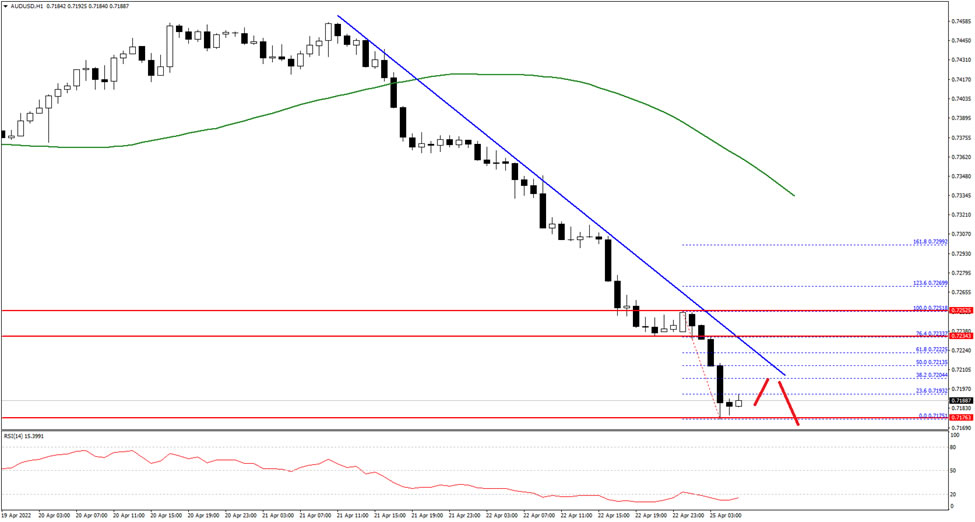
The Aussie Dollar started a fresh decline from well above the 0.7450 level against the US Dollar. The AUD/USD pair traded below the 0.7400 support to enter a bearish zone.
The pair even traded below the 0.7300 level and the 50 hourly simple moving average. It traded as low as 0.7175 and is currently consolidating losses. It is facing hurdle near a key trend line at 0.7200 on the hourly chart. The next key resistance on the upside is near the 0.7230 level.
If there is an upside break above the 0.7230 level, the pair could rise steadily towards the 0.7270 level in the near term. Any more gains could send the pair towards 0.7300 on FXOpen.
An immediate support on the downside is near the 0.7175 level. The next key support is near the 0.7150 level. A downside break below the 0.7150 support could lead the pair towards the 0.7065 support.
Euro Retreats as Emmanuel Macron Beats Le Pen in France
American equities dropped sharply on Friday as concerns about the Federal Reserve escalated. The Dow Jones and S&P 500 indices had one of the worst days this year after Jerome Powell warned that the bank will continue its aggressive rate hike policy. This will involve more rate hikes and even quantitative tightening. Investors are also worried about margin pressure as the ongoing earnings season continued. Data compiled by FactSet showed that 20% of all companies have published. Of these firms, 79% have reported a positive EPS surprise while 69% have published a positive revenue surprise. The 12-month forward PE ratio of the S&P 500 has moved to 18.6.
The British pound retreated to the lowest level since 2020 over concerns about the next actions of the Bank of England. Investors believe that the BOE will pause its rate hikes and embrace a more dovish tone considering that the economy is slowing. This was evidenced by the fact that consumer confidence has crashed to the lowest level since 2008. According to Gfk, confidence crashed minus 7 points to -38 in April as concerns about inflation rose. Further data showed that revealed that retail sales crashed hard in March.
The euro declined on Monday morning as investors focused on the outcome of the French election. Results between Marine Le Pen and Emmanuel Macron showed that the incumbent took a strong lead. He won 58% of the total vote even as voter turnout remained weak. He also becomes the first French president to be reelected in 20 years. Therefore, this means fears of France being led by a far-right leader. As a result, analysts expect that status quo in Europe will continue. The key data to watch will be the latest German current assessment and business climate data. Their impact on the euro will be relatively minimal.
NAS100
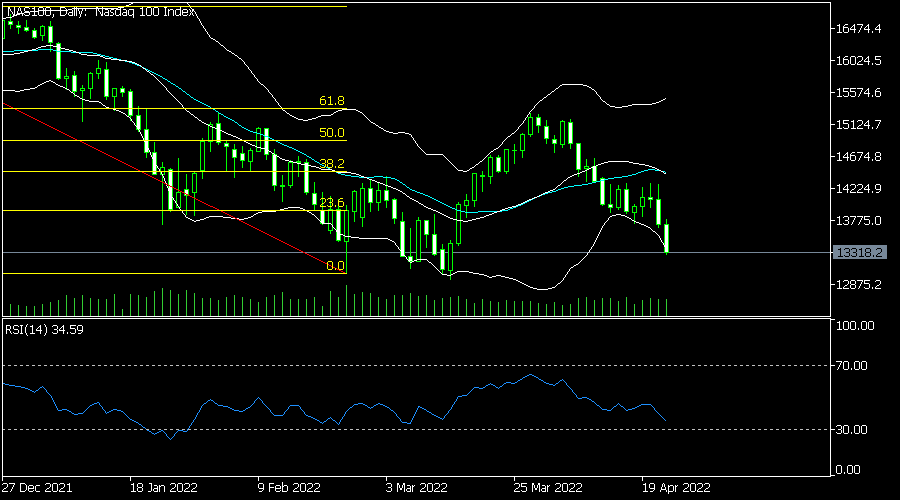
The Nasdaq 100 index declined sharply over concerns about rising interest rates. It dropped to a low of $13,318, which was the lowest level since March 21st. It has moved to the lower side of the Bollinger Bands and below the 23.6% Fibonacci retracement level. It has also moved below the 23.6% Fibonacci retracement level and while the Relative Strength Index (RSI) has pointed downwards. Therefore, the index will likely keep falling in the near term.
GBPUSD
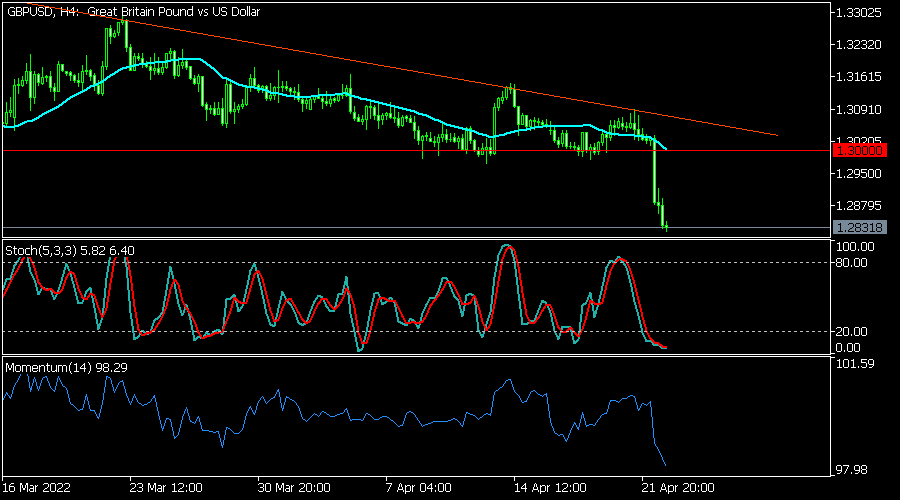
The GBPUSD pair continued the bearish trend after the weak economic data from the UK. The pair is trading at 1.2831, which is significantly lower than the key resistance at 1.300. On the four-hour chart, it moved below the descending triangle pattern. It has also moved below the 25-day and 50-day moving averages while the Stochastic oscillator and the momentum have pointed lower. The pair will likely have a relief rally today.
EURUSD
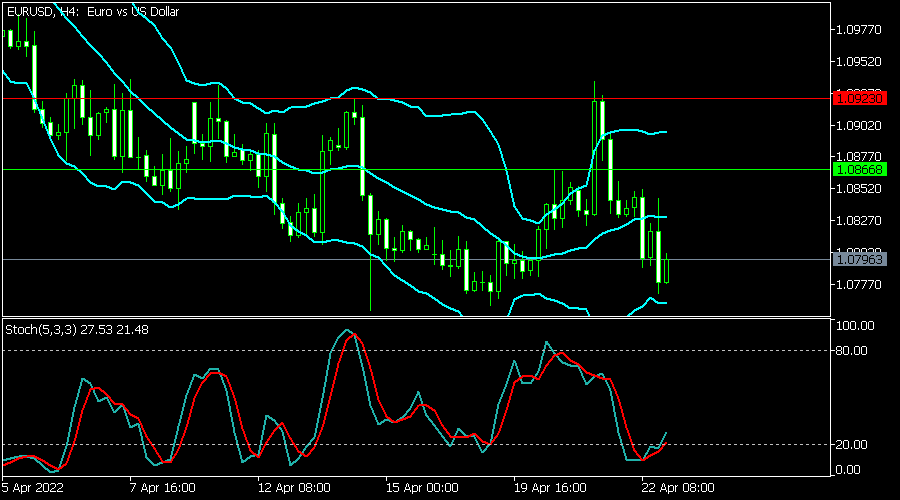
The EURUSD pair remained under pressure as investors reflected on the French election. It is trading at 1.0796, which is between the middle and lower lines of the Bollinger Bands while the Stochastic oscillator has moved above the oversold level. The pair is also below the 25-day moving average. The pair will likely remain in this range today.