

Sample Category Title
Dollar Recovers ahead of Fed Minutes and Retail Sales
Traders are betting the Fed will take a sledgehammer to crush inflation, but that wasn’t enough to really boost the dollar until fears of armed conflict in Ukraine sent investors into the reserve currency’s safety. The latest retail sales data will hit the markets on Wednesday alongside the minutes of the most recent Fed meeting, and how the dollar reacts could reveal whether the rally is truly exhausted.
Lackluster dollar
With US inflation continuing to accelerate, markets are betting the Fed will be forced to respond with aggressive rate increases. Six and a half rate increases have now been priced in for this year and speculation about a 50 basis points move at the next meeting in March is running wild.
The worrisome part is that the dollar couldn’t properly capitalize on all this. This has been a consistent pattern in recent weeks, with strong US data releases sparking huge moves in bond markets but unable to boost the dollar much.
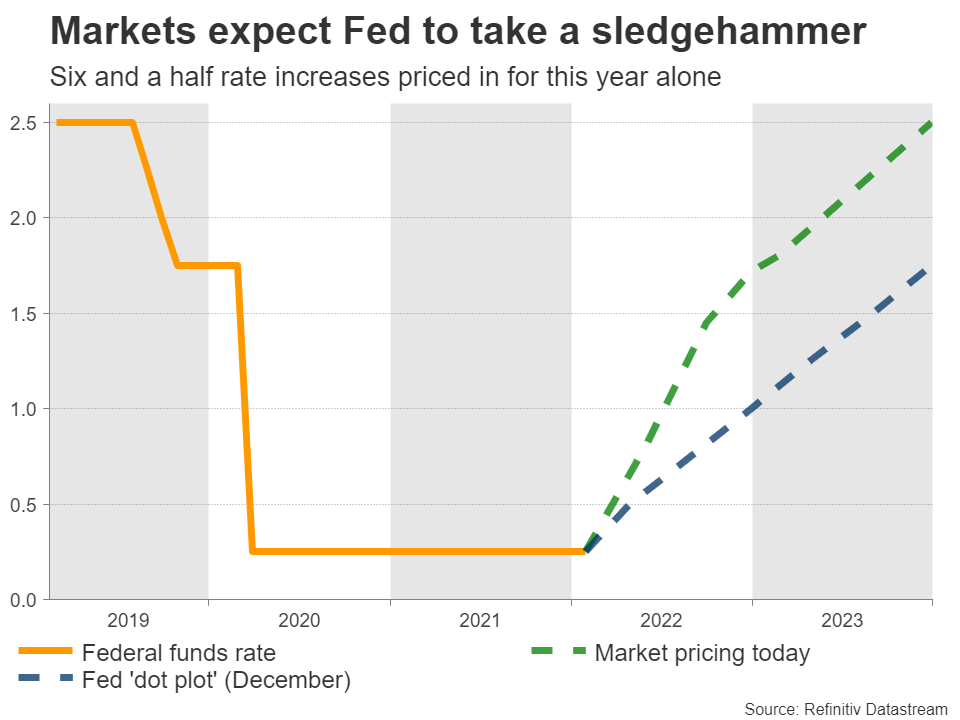
Take last week’s inflation numbers. One extra rate hike was priced into bonds in a matter of hours, yet the dollar barely rose. It did rally eventually, but most of that came down to safe-haven flows after headlines that an invasion of Ukraine may be imminent.
When a currency cannot rally on good news, that’s usually a sign of exhaustion in the trend.
Big test coming up
We’ll get a clearer sense of whether that’s true this week. The minutes of the latest Fed meeting will be released at 19:00 GMT on Wednesday. Traders will look for details around the quantitative tightening process and how the various officials feel about a 50 basis points move in March to kick off the tightening cycle.
Markets usually react to this release, but this time, the minutes will likely be outdated. This meeting took place before the latest jobs report, where wage growth fired up, and before the latest inflation stats that also exceeded expectations. This means that the argument for tightening policy quickly has become stronger since then.
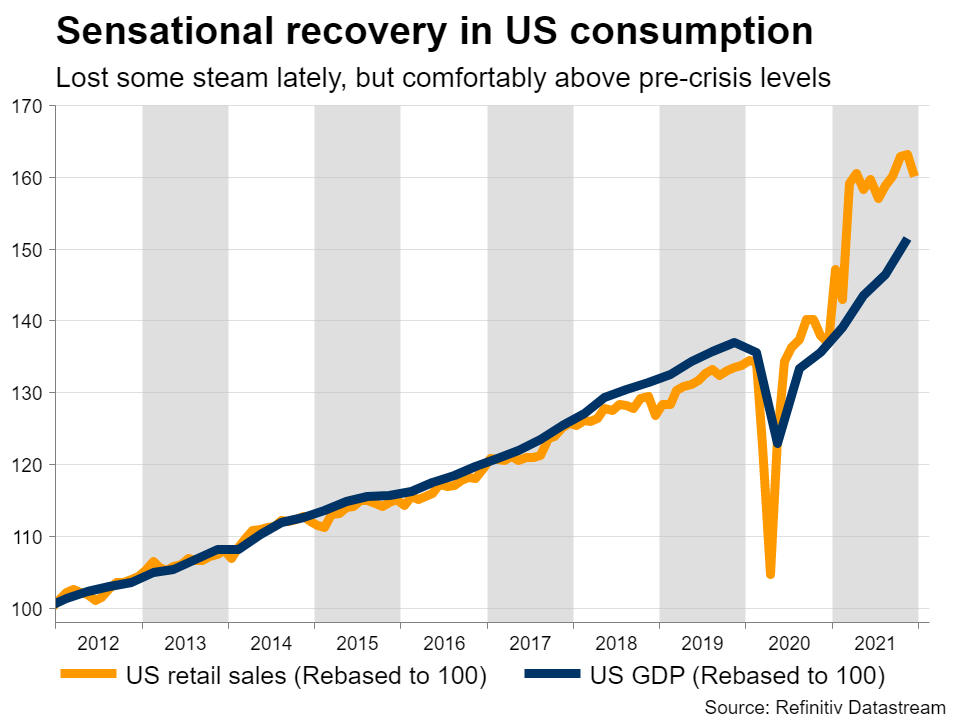
Instead, the spotlight could fall on retail sales, which will be released a few hours earlier at 13:30 GMT. Forecasts point to a powerful rebound of 2% in January, following a drop of 1.9% the previous month. However, the retail control group that is used in GDP calculations is expected to have risen by only 1% after falling 3.1% in December.
If retail sales exceed expectations and the dollar cannot rally powerfully in response, that would be another sign that the uptrend is running on fumes.
Taking a technical look at euro/dollar, a potential decline could encounter immediate support near the 1.1280 zone, where a violation would turn the focus towards 1.1230.
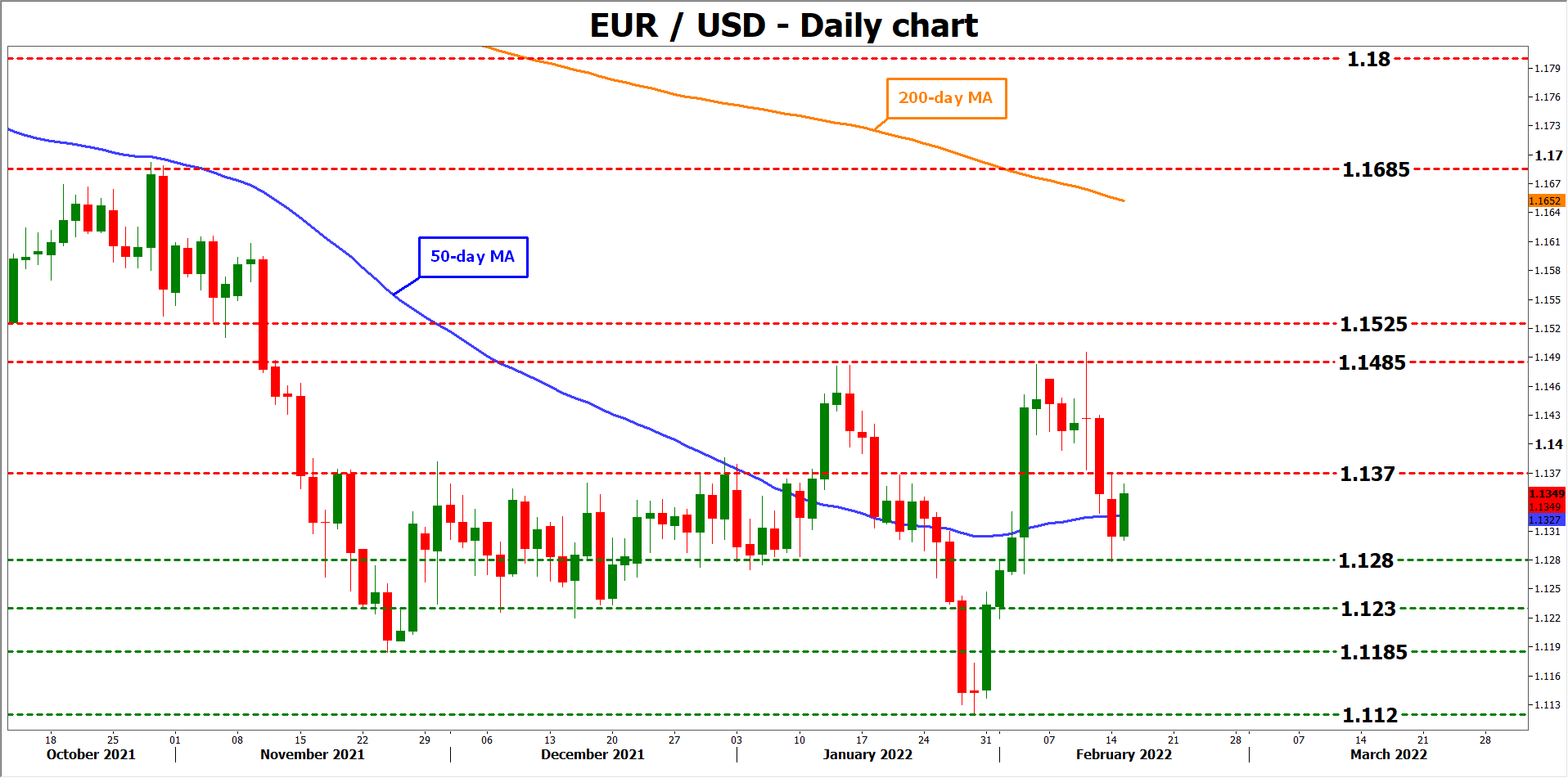
On the other hand, in case of a disappointment the pair could edge higher. A clear break above the 1.1370 region could open the door towards 1.1485.
One last push?
Overall, the dollar can be broken down into a short-term and longer-term outlook. In the near term, there might be another push by the bulls. Markets can still price in a seventh rate hike for the year, while geopolitical worries and the volatile environment in stock markets could continue to drive safe-haven flows into the reserve currency.
In the longer term though, the picture seems to be turning. Inflation might peak over the coming months and once that happens, traders could dial back bets for aggressive Fed rate increases. That could have a tremendous FX impact because the Fed is no longer the only game in town - other major central banks including the European one are also moving towards higher rates.
In short, it’s just difficult to see a ton of upside here with the Fed already priced so aggressively, although any trend reversal might be a story for the second half of the year.
Where Next for Canada’s CPI Inflation?
Canada will be next to report its January CPI inflation readings on Wednesday at 13:30 GMT. Forecasts point to some stabilization but given the upside surprise in other major economies, Canada may not be an exception. Investors are certain the central bank will take its tightening phase to the next level of rate hikes in the coming months, though how aggressively it could respond is still unknown and the new inflation update may add new information to the puzzle, likely helping the loonie to steal some ground against its US cousin. Retail sales will be the next highlight on Friday at the same time.
Not a rate hike but multiple rate hikes
The Bank of Canada surprisingly held its benchmark interest rate stable during its January meeting in the face of omicron infections but removed its commitment to hold borrowing costs at the effective lower boundary following the termination of its bond program in October and the switch to the reinvestment phase. Traders are now blindly convinced that the central bank will deliver 25-bps rate hikes at each of its six meetings to drive rates up to 1.75% by October 2022. Besides, BoC governor Tiff Macklem came to confirm last week that “the rising path in rates is not one increase, it’s multiple increases”.
Can CPI data break the loonie's range-bound trading?
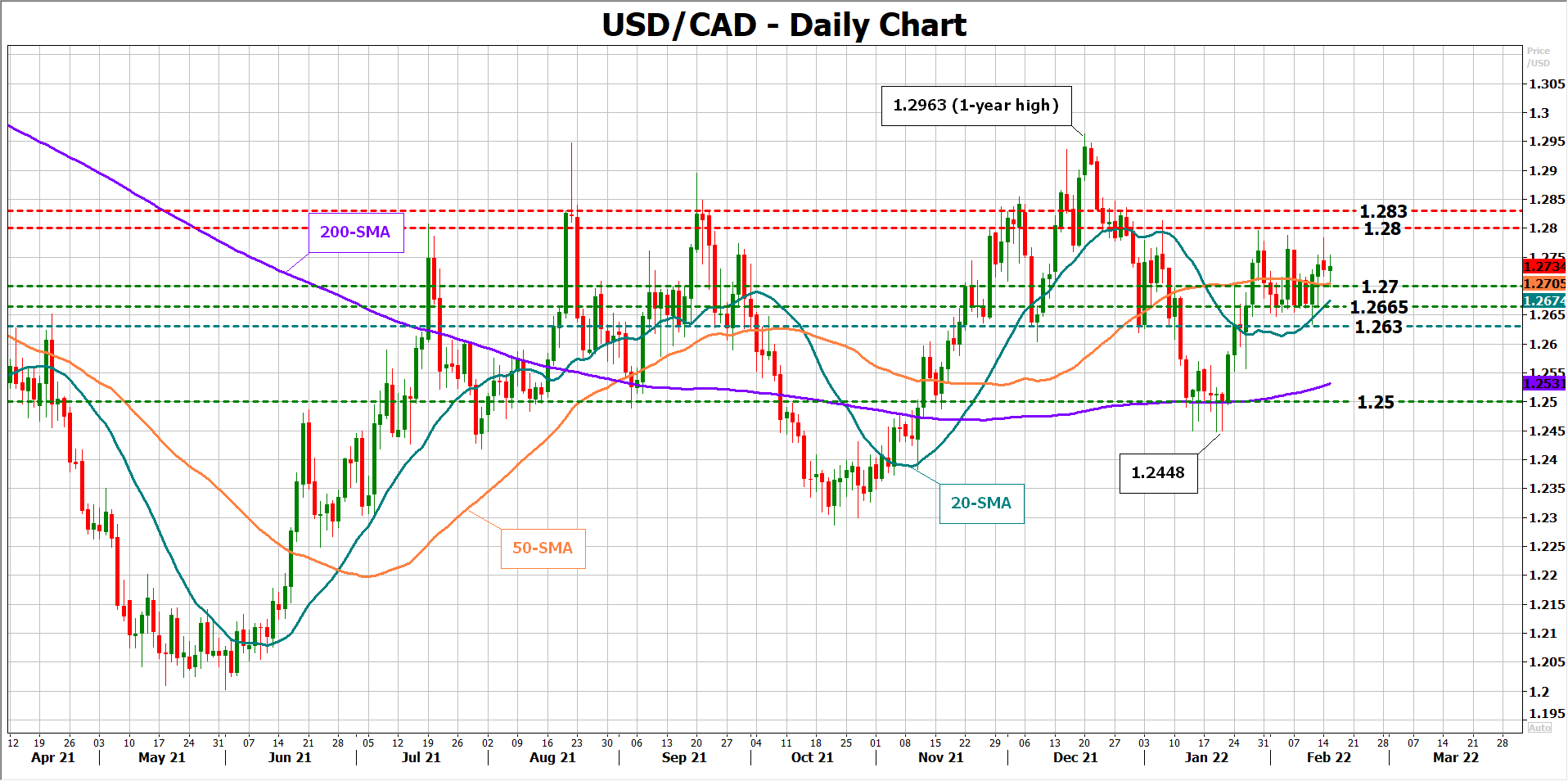
With investors already set up for the tightening phase, the question now comes down to Wednesday’s CPI inflation readings and how they could affect market expectations and therefore the Canadian dollar, which has been trapped within the 1.2800 – 1.2665 region so far this month despite the spike in oil prices.
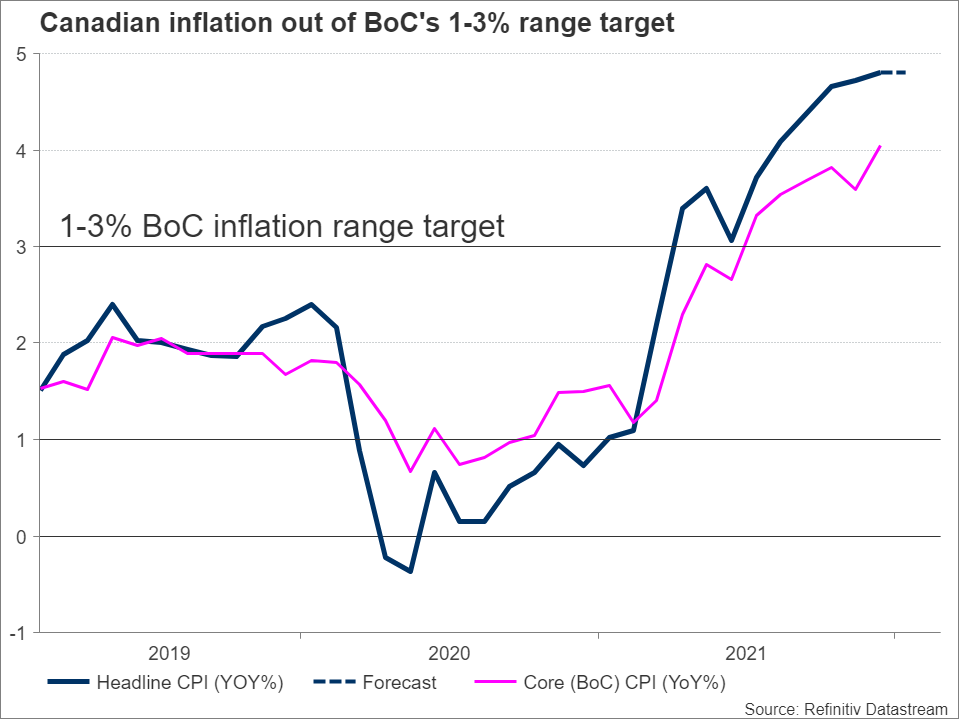
Expectations are for the headline CPI rate to keep a steady pace at the three-decade high of 4.8% year-on-year, while the monthly figure is projected to return to growth, rising by 0.6% after contracting by 0.1% in the preceding month. If the data match forecasts, the loonie could barely react even if the rate hike scenario still remains on the table. On the other hand, an upside surprise similar to what the US and the Eurozone have experienced could bode well for the currency if traders start to bake in more aggressive rate hike increases as in the case of the Fed.
Of course, unlike January’s US jobs data, the Canadian employment report was a disappointment, showing a job loss of 200k and a higher unemployment rate at 6.5%. Friday’s retail sales data for December could be bleak as well, showing the largest decline since July 2021. Yet the Canadian economy and particularly the labor market has proved that any slowdown following previous pandemic waves was only a bump in the road with some inflationary consequences.
USD/CAD
Therefore, traders may not easily dash their rate hike expectations, but they will probably wait to see whether the upcoming CPI inflation figures can support steeper rate increases before they drive dollar/loonie below the 1.2700 level and towards the range’s lower boundary of 1.2665. If the latter fails to hold, the next stop could be around 1.2630, where any violation is expected to trigger a sharper decline towards the 1.2500 handle.
In the event the data come in below expectations, the pair could face little volatility. Nevertheless, traders would keep a close eye for any bullish breakouts above the 1.2800 - 1.2830 resistance band.
WTI Oil Outlook: Oil Dips Over 3% as Tensions over Ukraine Ease
WTI oil price pulls back from new 7-year high on Tuesday, as geopolitical tensions ease on news that Russia returns some military units to their bases after exercises near Ukrainian border.
Optimistic news prompt traders to collect some profits from strong bullish acceleration in past two days after the situation became overheated on signals from the western media that Russia could attack Ukraine these days.
The oil price eased over 3% since opening on Tuesday, with possibility for a deeper drop if the situation in Ukraine cools down further that would ease concerns over strong supply disruption, expected on escalation of conflict.
Revived nuclear talks between Iran and the United States also boost optimism. If two countries reach an agreement that would allow for higher Iranian oil exports and increase pressure on oil prices.
The geopoliticals are expected to remain key driver of oil prices, with easing in tensions to push the price significantly lower.
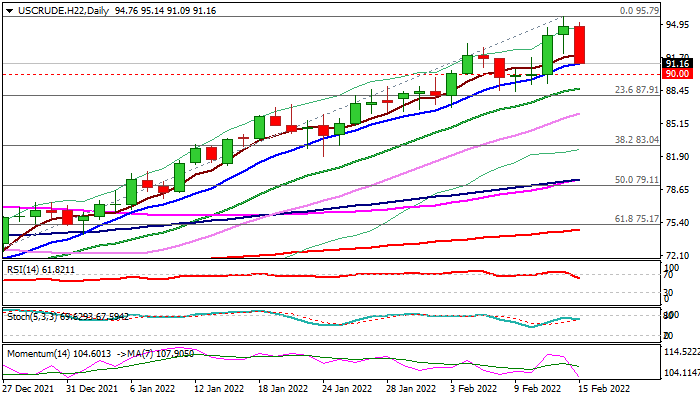
Technical studies on daily chart started to weaken and develop an initial negative signal, with today’s strong bearish close to complete reversal pattern and weaken near-term structure.
South-heading 14- momentum indicator and RSI reversal from overbought territory, add to negative signals, which wood look for confirmation on break below psychological $90 support.
Fresh bears pressure rising 10DMA ($91.14), which guards $90 support and other pivotal levels at $88.64 and $87.91 (ascending 20DMA/Fibo 23.6% of $62.42/$95.79 rally). Break of these supports would signal deeper pullback and expose key Fibo support at $83.04 (Fibo 38.2% of $62.42/$95.79 rally).
Res: 91.96; 93.14; 95.14; 95.79.
Sup: 91.14; 90.00; 88.64; 87.91.
Jump in US PPI Has Revived Interest in the Dollar
US producer prices rose 1% in January, double analysts’ forecasts. The annual growth rate slowed from 9.8% to 9.7% for the first time after nearly two years of gains, but analysts had been bracing for a sharper decline, expecting to see a slowdown to 9.1%. The core producer price index (excluding food and energy) slowed from 8.5% to 8.3%, against an expected 7.9%.
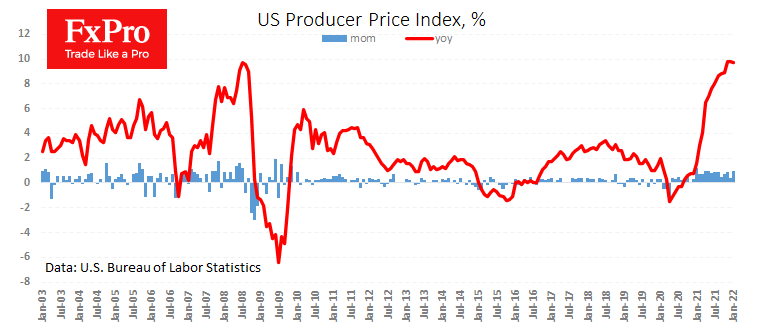
This is a new batch of bullish news for the dollar. The continued high rate of price growth continues to feed the ultimate inflationary spiral, demanding a more hawkish response from the Fed. The CME FedWatch Tool shows that markets are laying down a 62% chance of a 50-point rate hike in mid-March, a much higher rate than we can see from other G7 central banks, which makes Treasury short-term bills more profitable and feeds interest in dollar purchases.
Potentially, only the Bank of England was close to a radical move as a 50-point hike last month. But the markets are now expecting a 25-point rate hike from the Bank of England at the next meeting and do not expect any hikes from other central banks in the coming months. It is not surprising to see an interest in the USD and DXY growth in this environment.
WTI oil and gold pare gains on Russia-Ukraine de-escalation
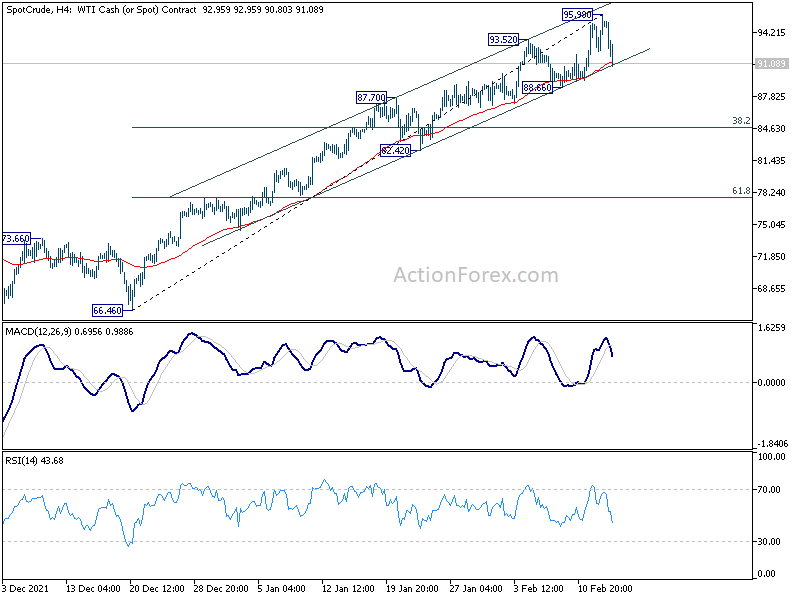
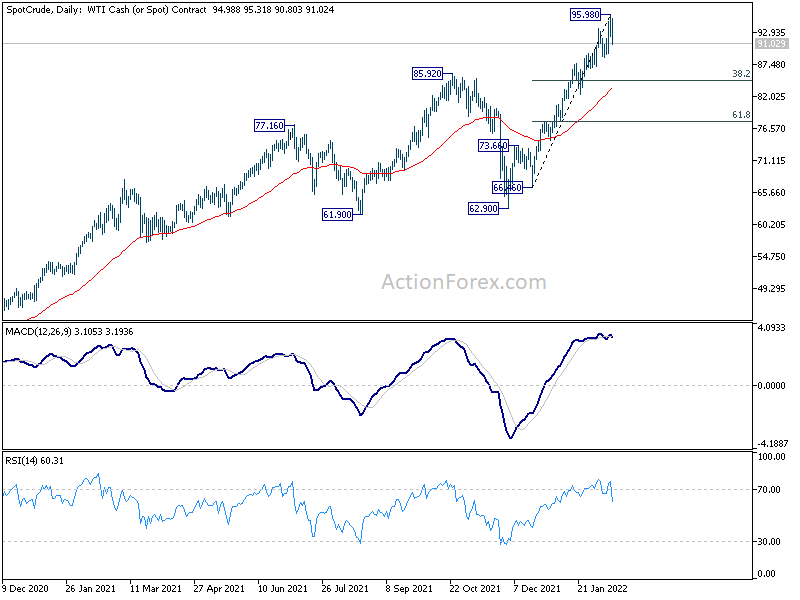
WTI crude oil tumbles sharply today on de-escalation in Russia-Ukraine situation. Technically, a short term top should be in place at 95.98. Immediate focus is now on 55 day EMA (now at 91.18). Sustained trading below this level will argue that WTI is already in correction to whole rally from 66.46. In this case, deeper correction would be seen through 88.66 support to 38.2% retracement of 66.46 to 95.98 at 84.70, which is inside 82.42/87.70 support zone, and then be close to 55 day EMA.
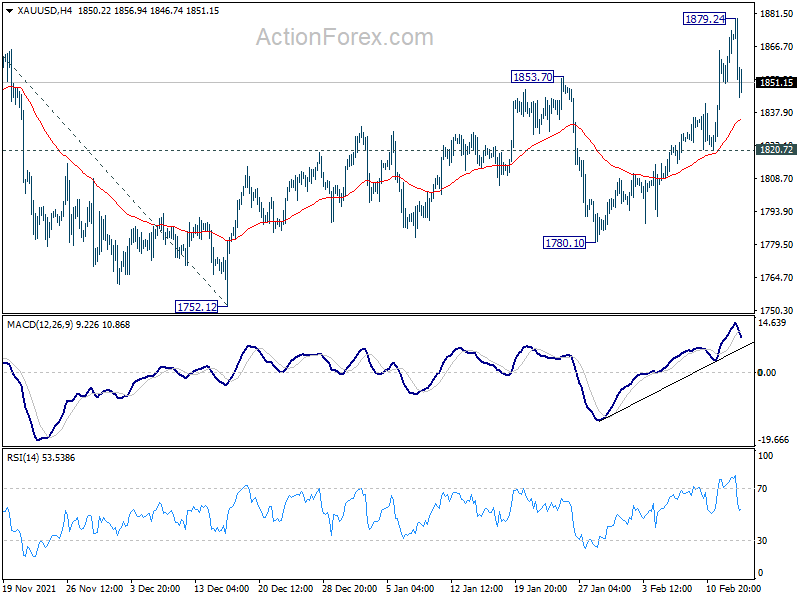
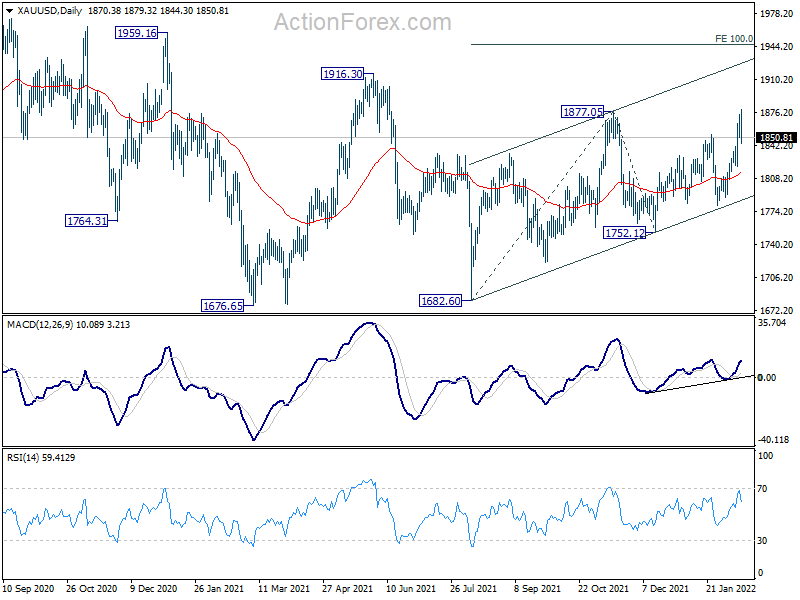
Gold of also retreated sharply from 1879.24, after failing to sustain above 1877.05 resistance. The development dampened the immediate bullish case, and some consolidations could be seen first. But further rally will remain in favor as long as 1820.72 support holds. Break of 1879.24 will resume the rise from 1752.12, and that from 1682.60. Next target is 1916.30 resistance, and then 100% projection of 1682.60 to 1877.05 from 1752.12 at 1946.57.
Canadian Dollar Flat, CPI Next
It has been a quiet week for the Canadian dollar, despite the crisis between Ukraine and Russia, which has captivated the world’s attention. The lack of movement could change on Wednesday, as Canada releases the inflation report for February.
Canada CPI expected to rise
Canada’s CPI looked weak in December, with a reading of -0.1% m/m. However, inflation is expected to have jumped in January, with a consensus of a strong gain of 0.6%. A reading within expectations would indicate that high inflation remains alive and well and will put pressure on the Bank of Canada to take aggressive action in order to curb inflation.
BoC Governor Tiff Macklem has said that more rate hikes are coming in order to lower inflation to the central bank’s 2% target, but other than that hasn’t provided any guidance. Macklem has maintained that inflation is transitory and will ease in the second half of the year but he may have to adjust his stance, as we saw with Fed Chair Powell, if inflation continues to accelerate.
The crisis on the Ukraine/Russia border remains a powder keg that could explode at any time. Somewhat surprisingly, this major geopolitical development has not affected the Canadian dollar, which is a minor currency that is sensitive to risk sentiment. That could change if there are dramatic moves in the next few days, such as a Russian invasion, which could see the currency tumble, or a Russian troop withdrawal from the border, which would be bullish for the Canadian dollar.
There are still hopes that a diplomatic solution can be reached and there have been reports of some Russian troops withdrawing from the border. The solution to the crisis is firmly in the hands of Russian President Vladimir Putin. The West has no intention of supporting Ukraine militarily, so the key question is whether the threat of sanctions is enough to dissuade Putin from starting a war in central Europe.
USD/CAD Technical
- USD/CAD faces resistance at 1.2818 and 1.2873
- 1.2679 is being tested in support for a second straight day. Below, there is support at 1.2595
Sunset Market Commentary
Markets
More headlines about a Russian pullback hit the wires. Momentum started shifting yesterday after Russian defense minister Shoigu told president Putin that some of the country’s military drills have already ended and others were coming to a close. Foreign Minister Lavrov simultaneously received the go ahead to extend negotiations. NATO is still awaiting official evidence, but risk sentiment on markets nonetheless started improving. Moves accelerated as the US session got started. Brent crude falls from a cycle high of $96/b to $93/b. Main European stock markets rebound up to 1.5%. Core bonds cede ground with both the German Bund and the US Note future again approaching last week’s post-CPI sell-off low. The US yield curve bear steepens with daily changes ranging between +1.5 bps (2-yr) and +6.1 bps (30-yr). The US 10-yr yield moves back at the 2.05% recovery top. The German curve shifts in similar fashion with yields adding 2.8 bps (2-yr) to 5.8 bps (30-yr). The German 10-yr yield sets a new high above 0.3%. The EU 10y swap rate does the same at 0.9%. 10-yr yield spreads vs Germany narrow by up to 3 bps for Italy. The Japanese yen and Swiss franc return part of past session’s gains. EUR/USD trades with an upward bias, changing hands at 1.1354 compared with an 1.1307 open. Eco data included a slightly smaller than expected increase in Germen ZEW investor sentiment, accelerating US producer price inflation (1% M/M & 9.7% Y/Y for headline) and only a small bounce higher in the Empire Manufacturing Survey (coming from the weakest level since May 2020). Details showed relentless price pressure, slightly rising new orders and shipments, higher employment, but a more downbeat assessment on the future (6 months ahead). Markets didn’t respond to the data. EUR/GBP trading is still a proxy of EUR/USD action with the pair rising to 0.8388.
The Kingdom of Belgium launched a new long 30-yr benchmark via syndication (OLO 95 Jun2053). The order book was above €36bn with the debt agency printing a slightly larger than usual size for the very long end: €5bn. Like with last week’s 30-yr Spanish deal, debt agencies seem aware the extremely beneficial financing conditions are drawing to an end as even the ECB is preparing a policy normalization turn to battle persistently high inflation. The deal was priced at 12 bps over the own OLO-curve, compared to initial guidance of +14 bps. Together with an earlier €5bn 10-yr benchmark, the Belgian debt agency now raised €10bn YTD of this year’s €41.2bn OLO funding need. A New Green OLO remains in the pipeline for later this year.
News Headlines
Hungarian Q4 GDP printed at 2.1% Q/Q and 7.2% Y/Y, beating 5.7% Y/Y forecast. The growth composition isn’t available yet, but the statistical office indicated that market services were an important driver. Over the entire year 2021 the Hungarian Economy grew by 7.1%, following a -4.7% contraction due to the pandemic in 2020. Already before the publication of the preliminary growth data, MNB vice governor Virag said that the MNB will continue tightening policy in a predictable manner as inflation continues to surprise in the upside. Virag warned that economic participants should prepare for a period of sustained higher rates as the MNB will keep a restrictive policy approach even when inflation decelerates later as it wants to anchor inflation expectations. After modest losses over the previous days, the forint today rebounded to the EUR/HUF 355.25 area from opening levels near 357.5.
Polish economic activity in Q4 rose 1.7% Q/Q to reach a level of 7.3% Y/Y, slightly higher than expected. Details on the composition will be published on February 28. Polish January CPI rose 1.9% M/M to be up 9.2% Y/Y (was 8.6% in December). The figure was marginally softer than expected but still marks the highest reading since November 2000. Prices of food and drinks rose 2.6% M/M while prices related to dwellings rose 4.4% M/M, with the latter mainly due to higher electricity and gas prices (8.0% M/M). Transport related costs eased 2.7% M/M but were still 17.5% higher compared to the same period last year. The combination of solid eco data and a better risk sentiment propelled the zloty from an opening level near EUR/PLN 4.5475 to currently 4.5050.
USDCAD stays rangebound as MAs mute the negative pullback
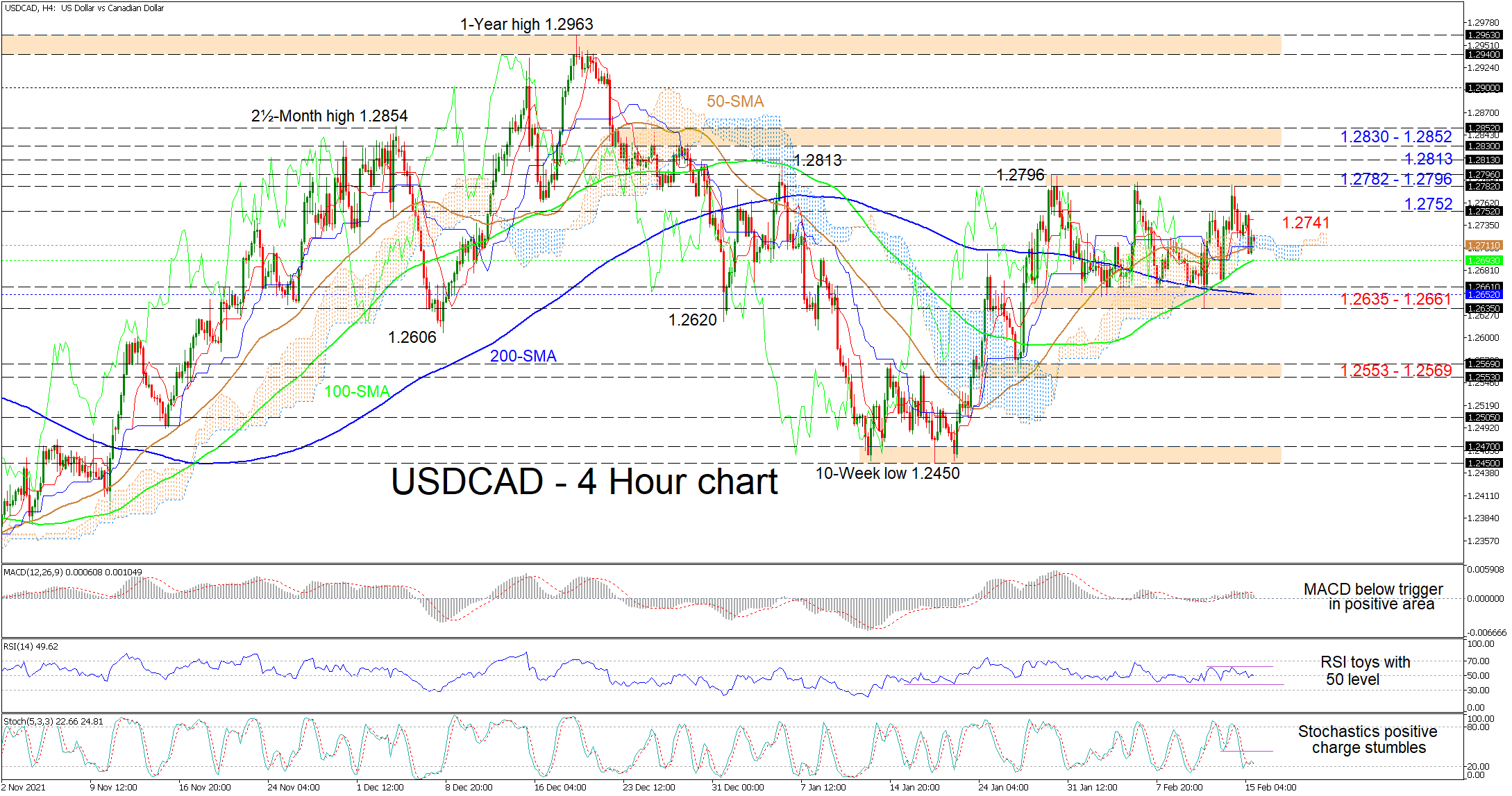
USDCAD is trading around the 50- and 100-period simple moving averages (SMAs), which appear to have hindered the decline from the 1.2800 handle from diving towards the lower regions of the two-week sideways market. The 50- and 100-period SMAs are endorsing an upside trend in the pair.
The Ichimoku lines confirm the neutral bearing and currently do not offer convincing directional forces in the pair, while the short-term oscillators suggest that driving momentum is weak. The MACD is below its red trigger line but slightly north of the zero mark, while the RSI is flirting with the 50 neutral level. The stochastic %K line has bounced a tad higher off the 20 level, but the positive charge is still looking feeble.
If the price climbs above the cloud, initial upside friction could unfold around the red Tenkan-sen line at 1.2741 and the 1.2752 high. In the event the price persists northbound of the 1.2782-1.2796 ceiling, which consists of the recent rally peaks in the last two weeks, the bears may attempt to curb advances of price action between the 1.2635 and 1.2796 barriers. However, should a positive breakout of the range unfold, bullish impetus could stumble around the 1.2813 obstacle before buyers jump to challenge the 1.2830-1.2852 resistance section, moulded by the highs over the second half of December 2021.
Now, the latest bearish trajectory of the pair is presently tackling an area of support between the 50- and 100-period SMAs at 1.2711 and 1.2693 respectively. If the price fails to produce a foothold in this zone, the retreat in the pair may remain heavy with sellers then diving to defy the fortified 1.2635-1.2661 floor of the consolidation. Should this hardened foundation give way, the short-term picture in the pair may start to reclaim its prior negative tilt with the price sinking towards the 1.2553-1.2569 support band.
Summarizing, USDCAD is confined in a sideways trend with a lower limit of 1.2635-1.2661 and an upper limit of 1.2782-1.2796. A decisive bearish or bullish breakout of these boundaries may reveal a clearer price direction.
Risk Sentiment Improves on Russia-Ukraine De-escalation Signs
Dollar retreats but risk-sensitive currencies shine on geopolitics
The latest geopolitical developments seem to be the main market-moving factor in today’s trading session. Specifically, Russia announced that several military drills near the Ukrainian border have ended and some troops have already returned to their military bases on the mainland. This headline relieved investors’ fears about a severe military confrontation and triggered a solid rebound in risky assets while causing a sell-off in traditional safe havens.
Following that news, the dollar started losing ground versus more risk-sensitive currencies but surging US Treasury yields are limiting its downside. Moreover, the Japanese yen and the Swiss franc are also trading lower in the current trading session.
On the other hand, the euro and pound are stronger on the day, benefiting from the risk-on sentiment in the markets. Furthermore, the commodity-linked currencies are also appreciating despite the retreating oil prices.
Nevertheless, NATO secretary-general Jens Stoltenberg stated that although there are grounds for cautious optimism, Russia remains in the position to launch an attack. Therefore, volatility is expected to remain elevated as the rebound in investors’ sentiment could prove to be short-lived.
US stocks head north as war fears fade
Wall Street is set to open higher today despite the rallying Treasury yields as investors are starting to downplay the possibility of a large-scale Russian invasion in Ukraine. More specifically, the Nasdaq, S&P 500 and Dow Jones futures are up 2%,1.5% and 1.1% in pre-market trade, respectively. In addition, most major European indices are in the green today capitalizing on the increasing risk appetite.
In individual stock news, problems seem to pile up for Facebook as the Texas attorney-general sued its parent company Meta over claims that it violated state privacy protections with facial-recognition technology and exploited the biometric data of millions of Texans without their consent. This scandal could both inflict financial and reputational damage on the company.
Oil and gold suffer from easing tensions but for different reasons
WTI futures are down almost 3% in the current trading session as the positive news from the Ukraine-Russia front have relieved worries over further supply disruptions. Additionally, soaring Treasury yields, alongside the improving risk sentiment in the markets are significantly weighing on gold’s safe haven demand.
In the cryptocurrency space, Bitcoin is gaining 5% on the day, currently trading at $44.3k, while Ethereum is up 7%.
Gold Could Top $2,000
Since the end of last week, the price of gold has risen by more than 3%. With a high of $1879, it was temporarily rose to highs since last June.
Biden’s warning that Russia could invade Ukraine “at any moment” triggered a broad sell-off in Europe and several emerging markets and tangentially affected the US equity market. Recent events have brought back interest in assets that have benefited from decades of tension: gold has risen as insurance against currency destabilisation, and oil has risen on fears of a surge in demand and a shortage of supply.
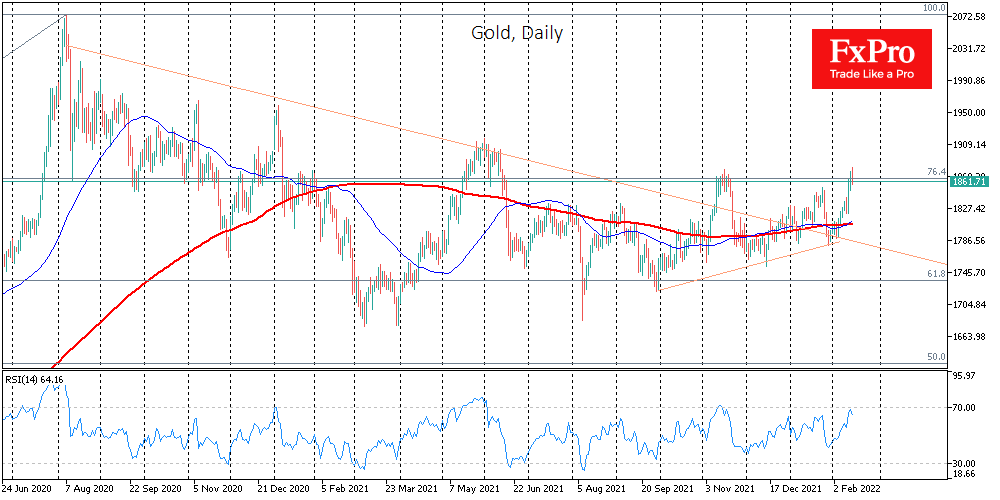
Geopolitics give a shaky ground behind this growth, so investors should be wary of joining gold’s rise. It is impossible to predict whether the next move will escalate or de-escalate. Now, there are far more signs that the peak of tension is behind us, yet gold continues to gain today.
Likely, the fundamental demand for gold is now driven by a desire to preserve the purchasing value of capital amid inflation and ongoing price shocks across a range of commodities.
Also, tech analysis is now on the side of the bulls. A trend of higher local lows has formed since the end of September, with the last anchor point in late January. In addition, the 50-day moving average is again above the 200-day moving average, giving a bullish “golden cross” signal. This signal coincided with a solid upward momentum on Friday, strengthening the bullish signal. In January, the former retracement resistance line became support, indicating a break in the trend.
If gold stays above $1865 – the area of the November peaks- despite the reduction of the geopolitical premium – we can speak of a bullish momentum development. In this case, the nearest target of this impulse will be the area of $1900-1910.
In general, we can say that the long period of correction and sluggish dynamics of gold is over, and then its price can move from one local top to another, potentially exceeding $2000 by August.