

Sample Category Title
Gold Higher As Global Risk Rises
Gold rose on Tuesday ahead of the U.S. Federal Reserve kicked off its March FOMC meeting. The US central bank is expected to remain dovish as it keeps its benchmark rate unchanged. The focus will be on the language on the statement and the words from Fed Chair Jerome Powell.
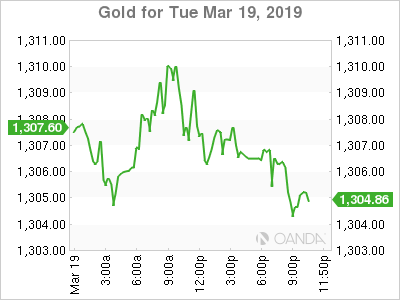
The Fed quickly put the brakes on its path to rate normalization and will remain patient awaiting better economic performance. US indicators have been mixed and with macro headwinds rising in March the yellow metal is well positioned to be the beneficiary if investors seek the safety of gold if Brexit negotiations take a volatile turn.
US-China trade negotiations hit a rough patch and with Chinese pushback could come further delays to a full agreement. Trade Representative Lighthizer and Treasury Secretary Mnuchin will fly to Beijing Next week hoping to get negotiations back on track.
Uncertainty of the negotiations have made the greenback rise as risk aversion boosted the dollar.
Australia: Leading Index Growth Rate Firmly in Negative Territory
The six month annualised growth rate in the Westpac– Melbourne Institute Leading Index, which indicates the likely pace of economic activity relative to trend three to nine months into the future, fell from –0.37% in January to –0.56% in February.
The Index has now registered three consecutive months in which the growth rate has been negative. This is a strengthening signal that growth through the first two to three quarters of 2019 is likely to be below trend.
The signal from the Index is certainly consistent with the weak momentum in the second half of 2018 revealed in the print of the December quarter national accounts. In the second half of 2018 growth momentum slowed to an annualised pace of 1% from a 4% pace in the first half of the year.
Westpac expects growth in the Australian economy in 2019 to be around 2.2% – significantly below trend which is generally assessed as 2.75%.
Key to the ongoing slow growth will be a challenged consumer as households adjust to much slower wages growth than anticipated and falling house prices. That will be supplemented by a continuation of the contraction in residential house building activity that appears to have begun in the September quarter of 2018.
We have consistently highlighted these risks which are likely to coincide with a slowdown in jobs growth and investment spending as both political uncertainty and global volatility weigh on firms’ employment and investment decisions.
The Index growth rate has shown a significant deterioration over the last six months, declining from +0.47% in September to –0.56% in February. Five components have driven the deterioration: US industrial production (–0.31ppts); the S&P/ASX200 (–0.30ppts); the Westpac-MI Unemployment Expectations index (–0.22ppts); the yield spread (–0.19ppts); and dwelling approvals (–0.10ppts).
The only component providing a partially offset is the commodity prices in Australian dollar terms (+0.12ppts). The contribution from the remaining components – monthly hours worked and the Westpac MI CSI expectations index – has been largely unchanged.
The Reserve Bank Board next meets on April 2. The minutes of the March Board meeting highlight the importance of data releases going forward with the key issue being the “tension” between soft activity indicators and strong labour market data. It will take time for the Bank to resolve those tensions but we expect that by the August meeting the case for lower rates will be clear.
At present the Bank is forecasting growth of 3% in 2019 and 2.75% in 2020. The signals, some of which are discussed in this release, are pointing to much slower growth. We expect the Bank’s growth forecasts to be lowered in both May and August with the forecasts in August being consistent with the need for easier policy.
Westpac expects rate cuts of 25 basis points in both August and November.
Canada Federal Budget 2019: Spending the Windfalls, Again
Highlights
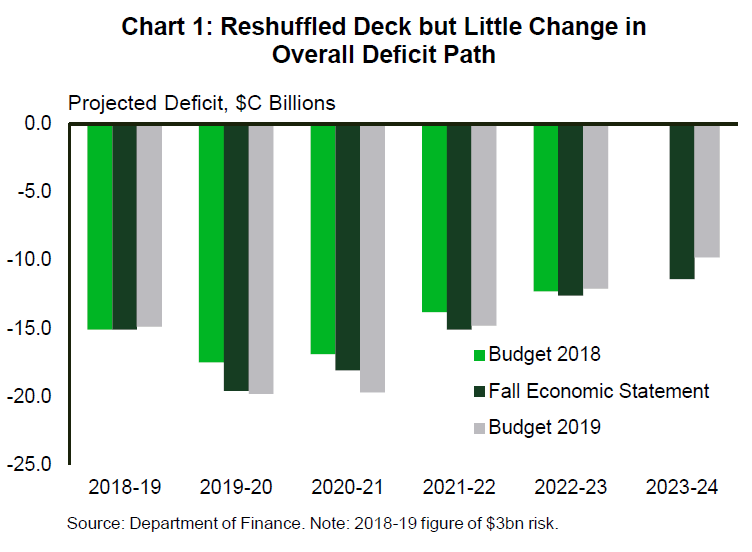
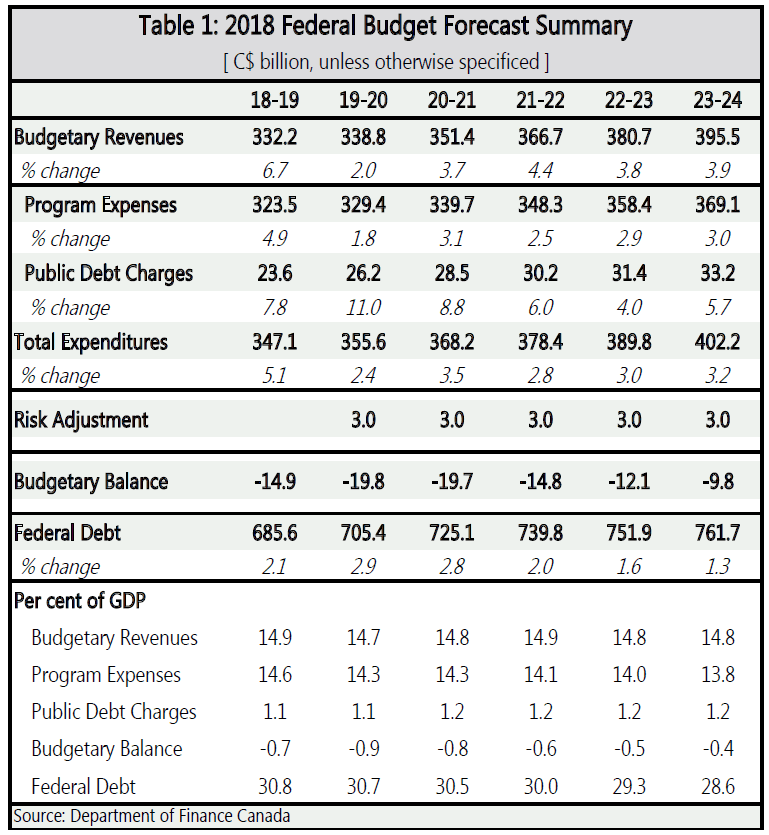
- Given another improvement in the fiscal starting point, the federal government has chosen to spend the windfall, leaving the deficit profile unchanged relative to the Fall Economic Statement at about $15bn to $20bn per year.
- These anticipated deficits are less than 1% of GDP. Given the modest relative size, the debt-to-GDP ratio should trend gradually lower.
- New spending measures total approximately $26.7bn over the coming five years.
- Among new initiatives are: a skills training account to help defray the cost of courses and tweaks to EI to allow time off for training, a new equity mortgage-type arrangement to help first time home buyers, and longer-term initiatives to help address supply.
- Disappointingly, the government has again ignored calls for a long-term, in depth review of the tax system. There was also little near-term relief for businesses.
Today's Federal budget hewed closely to the political balloons that were floated in recent weeks. There was no single headline measure, but a number of initiatives that will impact would-be homebuyers, indebted students, workforce engagement among the older segment of the population and so forth. Likewise, there weren't any measures that will prompt us to alter our near-term economic projections. Many of today's proposals have the potential to be productivity-enhancing, but will need to judged with the test of time.
Goosing near term housing demand, with supply to lag
Housing initiatives had a place of prominence, as Budget 2019 sought to address both the demand and supply of the affordability challenge. On the demand side, the key new measure is the Canada Mortgage and Housing Corporation (CMHC) First-Time Home Buyer Incentive. This program will provide first time buyers a shared equity mortgage equal to 5% of the cost of an existing home, or 10% for new builds. The program is limited to households with incomes under $120k per year, and with a mortgage amount that is a maximum of four times household income (i.e. homes priced around $500k). On the latter point, last month's national average home price was near the cap ($460k), while average sale prices in Toronto and Vancouver were well above the cap ($765k and $925k, respectively). Details of the exact functioning of the program are not yet available, such as what happens if a home is sold at a loss, in the event of death, etc.
Also driving the demand side was a widely anticipated increase in the Home Buyers' Plan (HBP) tax free RRSP withdrawal limit, from $25k to $35k. The HBP will also be made available to Canadians who have experienced the breakdown of a marriage or common-law relationship, even if they would not otherwise qualify.
In terms of the cost of these measures to government coffers: CMHC will provide up to $1.25 billion over three years for the First-Time Buyer Incentive, but the cost to the government is minimal, estimated to be $30 million per year. The HBP price-tag is similar in magnitude.
In terms of the economy, these measures are not game-changers, but they will have a modest impact on markets. Early analysis suggests that sales could be pushed up by 2% to 5% through end-2020, with prices rising by a similar amount given an unchanged supply path in the near-term.
On this front, the government expanded on previous housing supply-side measures, but these will take a much longer timeframe to impact the market. The Rental Construction Financing Initiative will be given an additional $10 billion over nine years, and extended to 2027-28. The expanded program is expected to now support 42,500 units across Canada (a net addition of 28,500 units relative to the 2018 Budget). The supply focus will be on areas of low rental supply. This is a well-received initiative, but there will be a gap between near-term upward demand pressures created by today's announcements versus the slower moving change in supply. This is already evidenced in the status report provided today: the initiative was introduced in 2017 and has so far resulted in the announcement of a total of only 500 rental units (with 50 projects being prioritized to receive a loan, i.e. still in the pipeline). Put differently, over a five-fiscal year horizon, the government expects to spend just $385 million of the anticipated $10 billion.
Finally, the government announced additional funding for the enforcement of compliance in real estate transactions, further expanding the funding for the Canada Revenue Agency's successful focus on tax compliance more broadly.
All aspects of the working life examined
Budget 2019 took a three-pronged approach to skills and labour markets, aligned with age groups. For younger Canadians, the cost of education, at least for those who take Canada Student Loans, will be reduced. The interest rate on these loans will now be set at the prime rate, a reduction of 2.5 percentage points, and a six month no-interest grace period was also introduced.
For those aged 25 to 64, the government is introducing a Canada Training Credit, a refundable tax credit available to those earning between $10k and $150k. The credit works via an account, which has $250 added per year, to a lifetime of limit of $5000. Individual balances will be communicated as part of the annual income tax filing process. The balance can be applied against half of the cost of training fees at colleges, universities or other institutions, starting in 2020. Coming alongside the credit is a new EI Training Support Benefit, which provides income support (at 55% replacement). This allows for up to four weeks of leave for training, every four years. These measures come with an approximate $500 million per year price tag.
For Canadians aged 65 years and older, the focus appears to be on extending engagement within the workforce. The Guaranteed Income Supplement for lower-income Canadians will see its earnings exemption expanded from its current limit of $3500 per year. The full exemption will rise to $5000 per year, with a 50% exemption for the next $10,000 of earnings. Seniors will be automatically enrolled to receive CPP benefits at age 70. The government estimates that there are about 40,000 Canadians who are eligible for but not receiving their CPP benefits.
A few more green incentives
If you're thinking about buying an electric vehicle, you're in luck. The government will introduce a $5000 credit for electric and fuel cell vehicles up to a sticker price of $45,000, starting in fiscal 2019-20 (hybrid vehicles are not included in this credit). An expanded capital cost deduction for business purchases of these vehicles is also coming, up to a limit of $55,000. This is $25,000 higher than the current limit on vehicle purchases. The government is also transferring $1 billion to the Federation of Canadian Municipalities to be used to support the greening of community buildings, home energy efficiency retrofits, and improving energy efficiency in affordable housing developments. Municipalities will also benefit from a further, immediate $2.2 billion transfer to be spent on infrastructure needs more generally.
Stock option compensation in the crosshairs
Keeping with the Liberal government's agenda towards the redistribution of income and wealth, there will now be a $200,000 annual cap on employee stock option grants that receive the current tax-preferred treatment (i.e. the same tax rate as capital gains). This applies to fair market value. Thereafter, the amount will be taxed as regular income. This change will apply only on a go-forward basis, and an exemption will be made for small, fast growing firms. Further details, including what qualifies a firm for exemptions, are due this summer.
There were little other changes, particularly from an investor's perspective. The oft-rumoured change to the capital gains inclusion rate was nowhere to be found.
Little on the business front
Canadian businesses will need to be content with the accelerated capital depreciation introduced in the Fall Economic Statement. Skills training will be a long term boon for firms, but there was otherwise little new in today's budget to address international competitiveness issues. There was again no mention of a longer-term tax system review (both corporate and personal) to address how the economic reality has changed since the Carter Commission's report more than 40 years ago.
Paying the bills with more short-term debt
The government anticipates little change to their debt management strategy. Total market debt is set to rise by $31 billion in the coming fiscal year, to hit a total of $754 billion. This new financing need comes alongside $250 billion of maturing debt that will need to be refinanced. The government plans to address this via expanded issuance of treasury bills, intended in part to address shortages in this market that have sent these borrowing costs below the Bank of Canada's overnight interest rate. On the bond side, more supply in the 3 to 5 year range is planned. Despite the current low interest rate environment, the debt management strategy did not include any discussion of ultra-long maturity debt issuance.
Bottom line
Déjà vu. Last year's budget was a grab bag of initiatives that ate up the growth dividend. This year was a repeat, with the added provision that details are forthcoming for many of the new initiatives. Looking at the major items, developments to address housing supply are welcomed, but demand initiatives are likely to add upward pressure to these markets in the near-term. Measures to improve lifelong skills, expand access to education, and ease late-life earnings are also well received, but the knock-on effects will only be observable over the longer-term. Overall, this is a marginally growth positive budget, however, we don't anticipate any material change our economic forecast as a result. On that note, today may mark the last 'grab bag' budget, as our Quarterly Economic Forecast sees a more muted outlook that may generate negative growth dividends. Ultimately, with only modest budget deficits on the horizon, there is little here to keep us up at night, or get our blood pumping.
Eco Data 3/20/19
[php_everywhere instance="1"]
EU Barnier: Concrete plan needed to asssess reason and usefulness of Brexit extension
EU chief Brexit negotiator Michel Barnier demands concrete plan from the UK so that EU leaders can make a decision on approving an extension.
He said "Does an extension increase the chances of ratification of Withdrawal Agreement? What would be the purpose and outcome? How can we ensure that, at the end of a possible extension, we are not back in the same situation as today?"
"If Theresa May requests an extension before the European Council on Thursday, it will be for the 27 leaders to assess the reason and usefulness... EU leaders will need a concrete plan from the UK in order to be able to make an informed decision," he added.
Fed to Clarify How Patient it Could Get With Rate Hikes
The Federal Open Market Committee (FOMC) has two main things to clarify at the end of its two-day policy meeting on Wednesday at 1800 GMT. First is the course of rate hikes that the central bank hinted it will pause until later this year. Then is the size of the balance sheet and particularly policymakers’ willingness to continue winding down asset holdings at a time when risks to the global economy are skewed to the downside. New economic projections released on the same day could reflect the Fed’s appetite for further monetary tightening in coming months.
The last time the central bank gathered in late January, policymakers decided to leave interest rates steady and adopt a patient approach on future changes, explaining that, while economic conditions in the homeland are still healthy, there is no rush to move forward with hike plans yet as rising uncertainty in US-Sino trade relations, Brexit, and China’s and Europe’s growth slowdown could drain expansion in the US. Note that GDP growth weakened further to six-month lows in the fourth quarter as expected.
Following the GDP release, subsequent data showed a mixed picture for the US economy. On the demand side, the figures backed stronger inflation pressures for the coming months as wages reached their highest growth since 2009 in February and the unemployment rate returned below 4.0% despite a minimal increase in job positions. On the supply front, though, the sentiment remained negative with industrial production easing, ISM Manufacturing PMI slipping to the lowest in almost three years, and trade deficit widening the most in a decade.
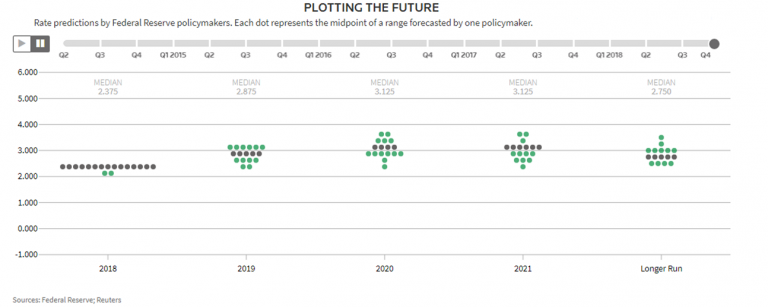
The evidence combined with elevated external risks could potentially keep policymakers cautious when revising their growth and inflation forecasts on Wednesday, probably pushing some of them lower on the famous dot plot chart that presents the number of rate hikes foreseen by FOMC members in the future. In such a case, the Fed would likely signal one rate hike for 2019, from two penciled in December, or none at all, as some FOMC members have already suggested, urging the need for more patience until further notice. Meanwhile in the markets, investors have a different opinion as they see no rate increases until early 2020. Instead they have translated the Fed’s “wait-and-see” new behavior into a rate cut, pricing a probability of 42% for such an action by January 2020.
Besides rates, comments on the balance sheet could also play a significant role on investors’ sentiment after the Fed chief Jerome Powell said that the $50 billion monthly rundown in Treasuries and mortgage-backed securities will end this year, increasing speculation that a timetable could be announced as soon as this week. The Fed started the reduction process in October 2017 when the balance sheet stood at more than $4.5 trillion and the economy was in better shape. But the Fed is now in a dilemma on how far it could go with trimming or otherwise where it should end it (in $2 trillion or $1.5 trillion?), as any aggressive decline could disrupt the financial system and cut growth while money go out of the market.
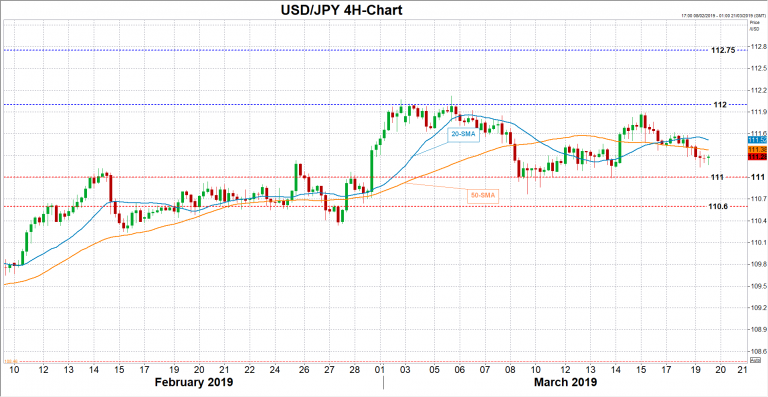
Turning to FX markets, investors wouldn’t be very surprised if the dot plot shows one rate hike or none for 2019 as the gap in rate expectations between the FOMC board and market players would narrow. But still would react depending on how dovish the language in the rate statement would be and how cautious Powell sounds at his press conference. If the tone turns unexpectedly more negative, then USDJPY could bottom within the 111-110.60 area. Negative momentum could appear even stronger if the Fed decides to stop reducing its balance sheet.
Alternatively, if policymakers appear optimistic that the economy is still resilient enough to afford two rate increases this year and one in 2020, then USDJPY would rebound with scope to test the congested area between 111.60-112. Higher, the rally could also pause at 112.75.
Fed chief Jerome Powell’s press conference is scheduled to start at 1830 GMT on Wednesday.
Sunset Market Commentary
Markets
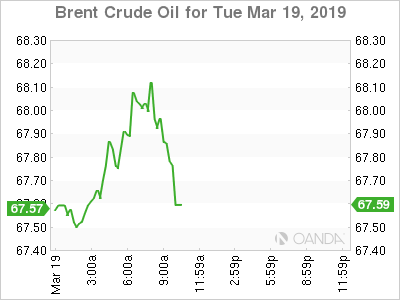
Global core bonds lost ground today. German Bunds underperform US Treasuries. The downleg started around European noon when China Central Television reported that the country would firmly implement major reforms and deepen supply-side structural reform. Economic data were mixed. German ZEW investor sentiment dropped more than expected, from 15 to 11.1, but expectations for medium-term economic developments are less pessimistic (-3.6 from -13.4). Final January US durable goods orders faced a minor downward revision. Positive risk sentiment on stock markets and rising oil prices weighed somewhat on core bonds as well. Brent crude tested the $68/barrel cycle high. OPEC yesterday cancelled its April meeting, thereby extending production cuts at least until June. The US yield curve bear steepens at the time of writing with yields adding 1.2 bps (2-yr) to 2.8 bps (30-yr). German yields shift 0.7 bps (2-yr) to 3.6 bps (10-yr) higher. 10-yr yield spread changes vs Germany are close to flat.
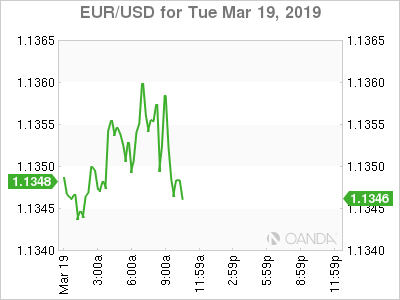
EUR/USD maintained the tentative upward bias from last week and earlier this week. The ingredients for the rise were little changed. Investors are avoiding excessive USD long exposure as they expect the Fed to stay cautious to engage on further policy normalization at tomorrow’s policy meeting. A higher oil price and new up-leg on equity markets also weighed on the dollar and supported the single currency. ZEW economic confidence was mixed, but an upward surprise in the expectations component of the report supported investor hopes that the worse might be over for the German (and EMU economy). German bunds slightly underperformed US Treasuries, narrowing interest rate differentials in favour of the single currency. EUR/USD retested yesterday’s correction top in the 1.1360 area, but no sustained break higher occurred. The pair is currently changing hands in the 1.1345/50 area. In Asia and early in Europe, USD/JPY didn’t find a clear trend as Asian investors took a wait-and-see approach. Throughout the day, the combination of higher core yields and renewed equity buying finally weighed on the yen. USD/JPY returned to the mid 111.50 area.
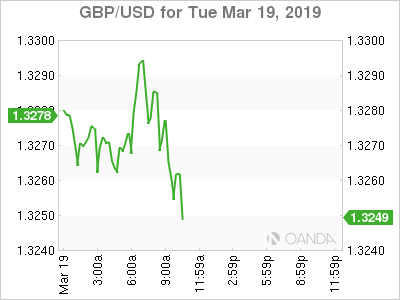
The sterling trading experienced a calm before a potential next Brexit storm after Thursday’s EU summit, probably marking the final countdown to the March 29 deadline. There were all kinds of rumours/headlines of talks behind the scene that should give the UK a last opportunity to vote a deal next week. However, the exact content of the proposals and their chances to get approval from the EU and/or the UK parliament remain highly uncertain. EUR/GBP hovered in a rather tight sideways consolidation pattern roughly between 0.8535/0.8570. UK January labour data were remarkably strong (3M/3M net job creation at 222 000). However, (GBP) traders clearly don’t want to draw big conclusions for BoE policy as long as uncertainty on Brexit remains as elevated as it is right now. EUR/GBP is trading in the 0.8565 area. Cable filled offers north of 1.33 but dropped back to the mid 1.32 area.
News Headlines
It has never been the Riksbank’s aim to weaken the Swedish krona, Deputy Governor Skingsley reiterated today, speaking to reporters. Her remarks add to the recent flurry of Riksbank talk signaling that the current krona weakness probably has gone far enough. The Swedish krona strengthened on the comments to EUR/SEK 10.43.
Germany’s ZEW confidence indicator showed investors were less pessimistic about future economic developments in March (climbing from -13.4 to -3.6 vs. -11 expected) as US/Sino trade talks are making progress and UK’s chances of crashing out were deemed diminishing. The current conditions series declined further however, from 15.0 to 11.1. A smaller decrease to 13.0 was expected.
EU Katainen: Trump’s selfishness approach on trade is not sustainable
European Commission Vice President Jyrki Katainen criticized that the "selfish" approach of Trump's to trade is not sustainable. And he emphasized to maintain rule-base trade with WTO reforms.
Katainen said "Japan, China and the EU are willing to reform the WTO, the U.S. has not been that interested, but they are willing to cooperate: He added: "Even though the U.S. authorities may think that selfishness is better than cooperation, it is not a sustainable way of thinking. We need better, rules-based trade in the future where the international community sets the rules".
On trade negotiation with the US, he said "there are discussions going on on several levels and ... we can end up having some sort of an agreement with the U.S. on trade, but let's not go deeper than this". He emphasized "it is too early to say that our trade discussions are doomed to fail."
EU Tusk and Irish Varadkar await proposals, UK May to seek Brexit extension
European Council President Donald Tusk met Irish Taoiseach Leo Varadkar in Dublin today to "confirm full EU unity on Brexit". After that they issued a joint statement emphasizing that "we must now see what proposals emerge from London" in advance of the summit in Brussels on Thursday. Also, they noted "preparations continue in Ireland and across the European Union for a no deal scenario, which would have serious consequences for all concerned.
Meanwhile, UK Prime Minister Theresa May's spokesman said she is going to writing a letter to Tusk asking for Brexit delay. But it's not clear that how long a delay she'd seek. Some Eurosceptics in May's Cabinet emphasized that that they're rather leave without a deal than have a long Article 50 extension. But there seems to be no agreement in the Cabinet meeting yet.
Markets Remain Choppy ahead of Fed
- USD – Dollar maintains soft tone as dovish Fed firmly priced in
- Brexit – EU to offer conditional extension
- Stocks – Risks are growing
- Oil – Delaying the April OPEC meeting should be bearish
- Gold – Higher as dovish Fed firmly priced in
Tight trading conditions persist as the FOMC begins their two-day meeting. Volatility is falling sharply as currencies await the Fed’s assessment of the economy and the update of their dot plot forecasts.
USD
The US dollar remains under pressure as expectations remain high that the Fed will maintain the dovish stance they poorly delivered in January. The market expects the Fed to downgrade their 2019 rate hike forecast from two to one. Economic forecasts are also expected to come down.
Price action across all asset classes have firmly priced in Fed dovishness to remain in place over the rest of year and many expect the next move to be a rate cut. Powell is going to want avoid any flipflops and exercise caution on being to quick to react if we get a string of better than expected economic prints. The risks for a hawkish surprise is growing as the markets seem fixed on the Fed remaining dovish and overly confident the Fed will avoid any optimism shifts on improving data.
If the Fed the remains on course and the outlook for the economy is strong enough to warrant no cuts in the immediate future, we could see emerging market currencies have their day in the sun.
Brexit
House of Commons Speaker Bercow decision to prevent PM May from delivering a slightly tweaked Brexit plan gave PM May added ammunition for her to go back to EU to seek concessions. The EU is expected to offer a conditional Brexit extension that will give May what might be her last attempt of getting a meaningful vote done.
Cable remains supported as no-deal Brexit risks have been alleviated and the data remains strong for the UK economy. The UK jobless rate fell to a 44-monthy low and wage growth remains strong as the January reading came in at 3.4% and the prior month was revised higher to 3.5%, the highest reading since mid-2008.
The BOE remains the only major central bank that is expected to deliver a rate hike as their next move. If May can pull off an upset and deliver a short extension along with a Brexit deal, the British pound could see much more upside.
Stocks
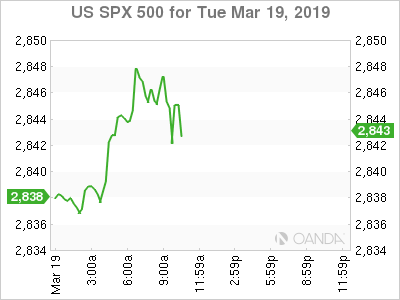
US stocks remain bid as the Fed begins their two-day policy meeting. Wall Street widely expects Powell to deliver a cautious tone on the economy and possibly signal rate hikes are off the table for the foreseeable future. Recent data remains mixed and the patient approach is likely to remain in place all throughout 2019. Current expectations are for the Fed to downgrade their 2019 dot plot forecasts from two to one, but if we do see both hikes taken off the table, that would mean the Fed has a worse outlook on the economy and that could be negative for risk appetite in the long-term.
Oil
OPEC + has been successful in stabilizing prices as supply curbs took Brent crude over 25% higher, but that theme could be ending in the summer. Last year, the two de facto leaders of OPEC +, Saudi Arabia and Russia agreed oil needed to go higher. But Russia would be happy with oil at current levels and would prefer to normalize their production in June versus trying to see further cuts try to drive oil prices higher.
The potential delay with the April meeting works in favor for the Russians. Expectations were high for cuts to be extended and now, OPEC + will monitor the sanctions on Venezuelan and Iranian crude, rising demand from warmer April weather, and how effective Saudi Arabia’s export squeeze is on US stockpiles.
Brent may have difficulty sustaining a significant move higher even it captures the $70 level.
Gold
Gold prices continue to rise as expectations remain high for the Fed to remain dovish. Gold may be the best asset class that can benefit on a policy mistake by the Fed. If the Fed maintains the possibility of tightening if conditions improve, we could see the initial move be dollar positive (initially negative for gold), but ultimately positive for gold as expectations will return for the Fed to invert yield curve sometime early next year.