Sat, Apr 04, 2026 04:21 GMT
More

    Sample Category Title

    Eco Data 4/3/26

    GMT Ccy Events Act Cons Prev Rev
    00:30 JPY Services PMI Mar F 53.4 52.8 52.8
    01:45 CNY RatingDog Services PMI Mar 52.1 53.7 56.7
    12:30 USD Nonfarm Payrolls Mar 178K 48K -92K -133K
    12:30 USD Unemployment Rate Mar 4.30% 4.40% 4.40%
    12:30 USD Average Hourly Earnings M/M Mar 0.20% 0.30% 0.40%
    13:45 USD Services PMI Mar F 49.8 51.1 51.1
    00:30 JPY
    Services PMI Mar F
    Actual 53.4
    Consensus 52.8
    Previous 52.8
    01:45 CNY
    RatingDog Services PMI Mar
    Actual 52.1
    Consensus 53.7
    Previous 56.7
    12:30 USD
    Nonfarm Payrolls Mar
    Actual 178K
    Consensus 48K
    Previous -92K
    Revised -133K
    12:30 USD
    Unemployment Rate Mar
    Actual 4.30%
    Consensus 4.40%
    Previous 4.40%
    12:30 USD
    Average Hourly Earnings M/M Mar
    Actual 0.20%
    Consensus 0.30%
    Previous 0.40%
    13:45 USD
    Services PMI Mar F
    Actual 49.8
    Consensus 51.1
    Previous 51.1

    Sunset Market Commentary

    Markets

    Crude oil is at the front and center once again. Brent rises sharply to $109/b, coming from levels around $100 and even temporarily below that amid optimism that the Middle East conflict could end soon. US president Trump upended any hopes during his 19 minute speech yesterday during which he vowed to hit Iran “extremely hard” in the coming weeks. And if Iran doesn’t strike a deal, the US will begin targeting its electricity and oil facilities. The speech is an escalation, not a hoped-for clear timeline for US withdrawal. Trump’s strong language use reveals a growing frustration, including vis-à-vis the blocked Strait of Hormuz. Being a net energy exporter helps cushion the economic blow but since oil is a globally priced commodity it does not make the US immune to price rises. Joe Sixpack is already paying $5.5 per gallon for diesel, the highest since mid-2022. Gasoline currently stands at $4.08, a similar near-four-year high. Sharply rising pump prices leave consumers with a nasty taste going into the November mid-terms. Europe meanwhile is facing outright shortages (eg. French gasoline stations running dry). Diesel prices have pushed to a barrel equivalent of $210. Prices peaked at around $220 shortly after the Russian invasion.

    Surging oil prices have their now-familiar impact on other core market areas. Yield curves bear flatten with central bank hiking bets raising the short end of the curve, increased risk premia do the same for the long end. German rates add between 5.7 and 7 bps. UST Treasury yields add 2.6-3 bps across the curve. Gilts hugely underperform after doing the opposite yesterday – amongst others thanks to governor Bailey pushing back against “markets that get ahead of themselves”. UK yields rally 7.3-9.3 bps. King dollar rules with investors being cautious for the long Easter weekend. Both US and European markets close tomorrow and the US administration has often used non-trading days as an opportunity for big moves (geopolitically, trade-related or otherwise). DXY bounces back to north of the 100 barrier. EUR/USD in a mirror move slides towards but remains above the 1.15 handle. The yen nears USD/JPY 160 again and cable (GBP/USD) risks breaking below 1.32 support. Risk off pushes equities down more than 2% in Europe and between 1.25-1.75% on Wall Street.

    News & Views

    Swiss inflation in March rose 0.2% M/M and 0.3% Y/Y (0.6% M/M and 0.1% Y/Y in February), falling below expectations (0.5% M/M). The Swiss Statistical Office noted the rise was due to several factors including rising prices for heating oil and international package holidays. Prices for air transport also recorded an increase, as did those for petrol and diesel. Core inflation (ex. fresh & seasonal products, energy and fuel) was unchanged (0.4% Y/Y). Prices for domestic goods declined 0.2% M/M but were 0.5% higher Y/Y. Prices of imported goods rose 1.8% M/M but were 0.3% lower Y/Y. The report for now only shows a ‘modest’ direct price increase following the Middle East conflict. The broader impact still has to become apparent later. With inflation still in the lower part of the 0%-2% price stability band, the Swiss National bank for now has room to wait and see. Markets discount about 75% chance of a rate hike in September. This room for the SNB to wait and strong verbal warnings on the SNB’s determination to address unwarranted CHF strength for now might bring the franc in somewhat of a more neutral position. EUR/CHF recently rebounded from the 0.90 area mid last month to currently 0.9215.

    The Bank of England today published its March Decision Maker Panel data. This CFO survey was conducted between 6-20 March. Firms reported realised annual own-price growth at 3.7% in the three months to March (from 3.8%). Year-ahead own-price inflation was expected at 3.5% in the three months to March, but single month data increased from 3.4% to 3.7%, pointing to firms adjusting expectations due to recent increases in energy prices. Expectations for year-ahead CPI inflation accelerated by 0.5ppts to 3.5%. Overall uncertainty rose with 57% of firms reporting that the overall level of uncertainty facing their business was high or very high (+10 ppts from Feb.). Firms realised annual employment growth at -0.3%, down from -0.2%. Expectations for employment growth over the next year were unchanged at 0.1%.

    EUR/USD Mid-Day Outlook

    Daily Pivots: (S1) 1.1479; (P) 1.1521; (R1) 1.1596; More….

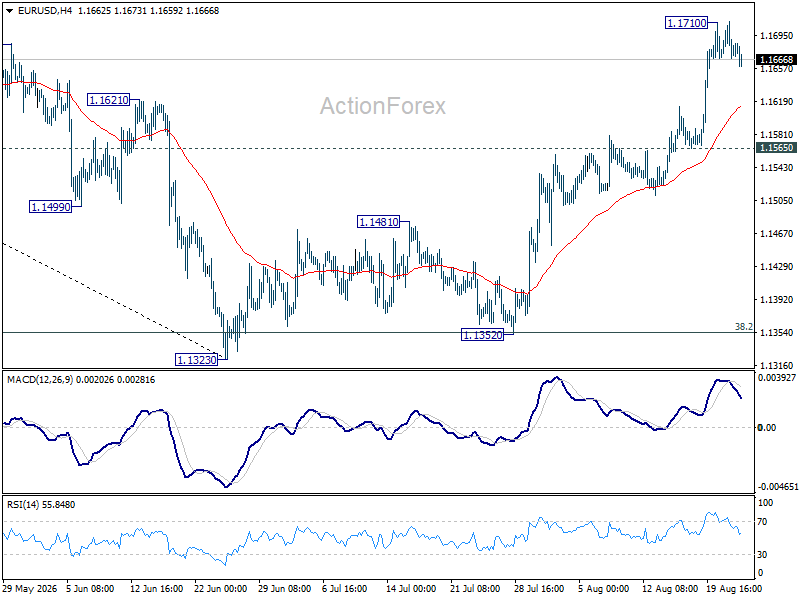
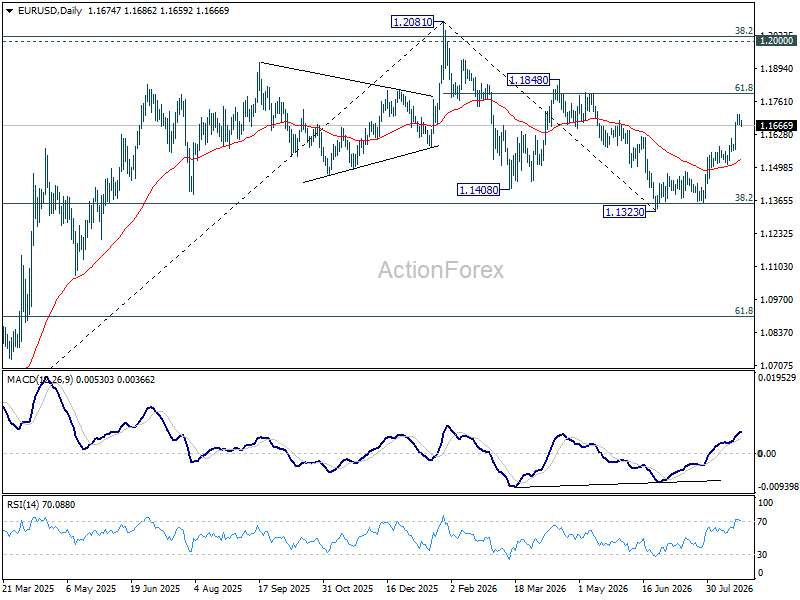
    Intraday bias in EUR/USD remains neutral and more consolidations would be seen above 1.1408. With 1.1666 cluster resistance (38.2% retracement of 1.2081 to 1.1408 at 1.1665) intact, further decline is expected. On the downside, firm break of 1.1408 will resume the fall from 1.2081 to 38.2% retracement of 1.0176 to 1.2081 at 1.1353. However, decisive break of 1.1666 will argue that the fall from 1.2081 has completed, and turn bias back to the upside for 61.8% retracement of 1.2081 to 1.1408 at 1.1824.

    In the bigger picture, prior break of 55 W EMA (now at 1.1497) should confirm rejection by 1.2 key cluster resistance level. The whole up trend from 0.9534 (2022 low) might have completed as a three wave corrective rise too. Deeper fall is expected to long term channel support (now at 1.0535). Meanwhile, risk will stay on the downside as long as 1.2081 holds, even in case of strong rebound.

    GBP/USD Mid-Day Outlook

    Daily Pivots: (S1) 1.3235; (P) 1.3290; (R1) 1.3362; More...

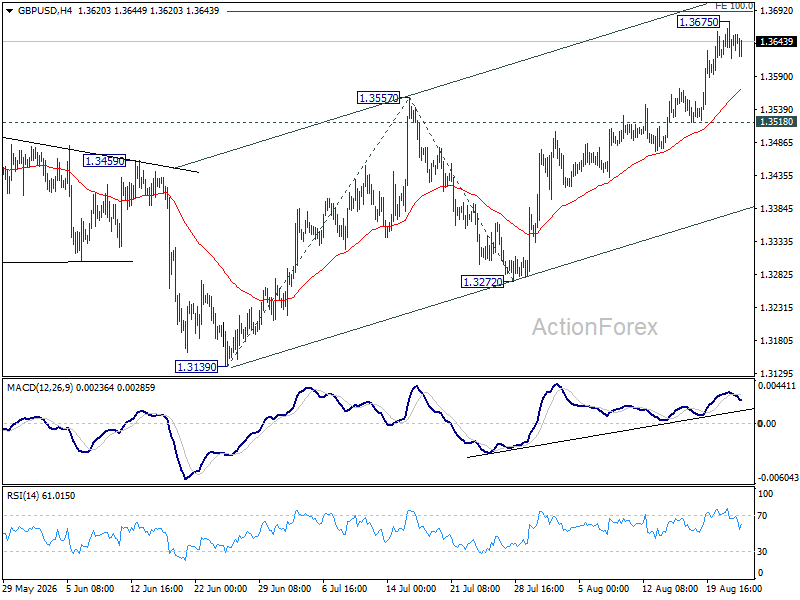
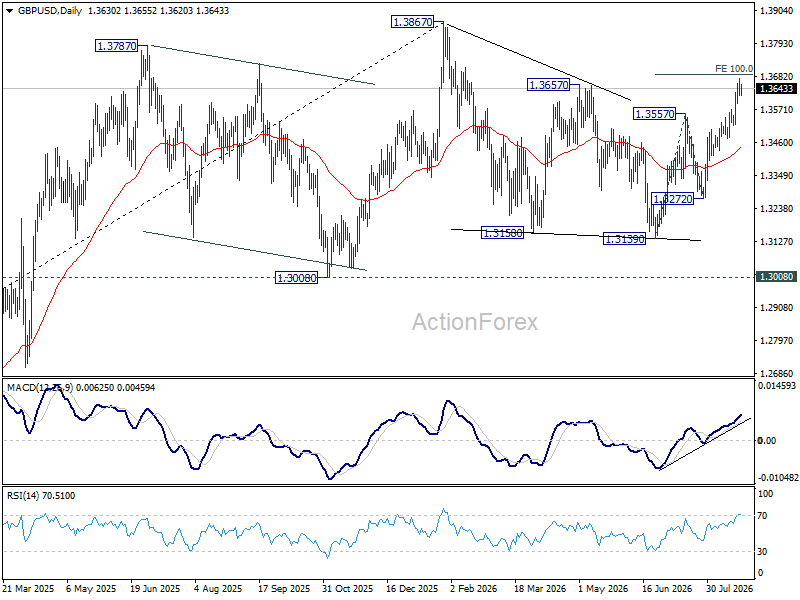
    Intraday bias in GBP/USD remains neutral and more consolidations could be seen above 1.3158 temporary low. Further decline is still in favor. Below 1.3158 will resume the fall from 1.3867 to 1.3008 structural support. However, firm break of 1.3479 will indicate that the fall from 1.3867 has completed, and turn bias back to the upside for stronger rally.

    In the bigger picture, considering bearish divergence condition in both D and W MACD, a medium term top should be in place at 1.3867. Firm break of 1.3008 support will argue that fall from 1.3867 is at least correcting the rise from 1.0351 (2022 low) with risk of bearish reversal. That would open up further decline to 38.2% retracement of 1.0351 to 1.3867 at 1.2524. For now, medium term outlook will be neutral at best as long as 1.3867 resistance holds, or until further development.

    USD/JPY Mid-Day Outlook

    Daily Pivots: (S1) 158.33; (P) 158.67; (R1) 159.12; More...

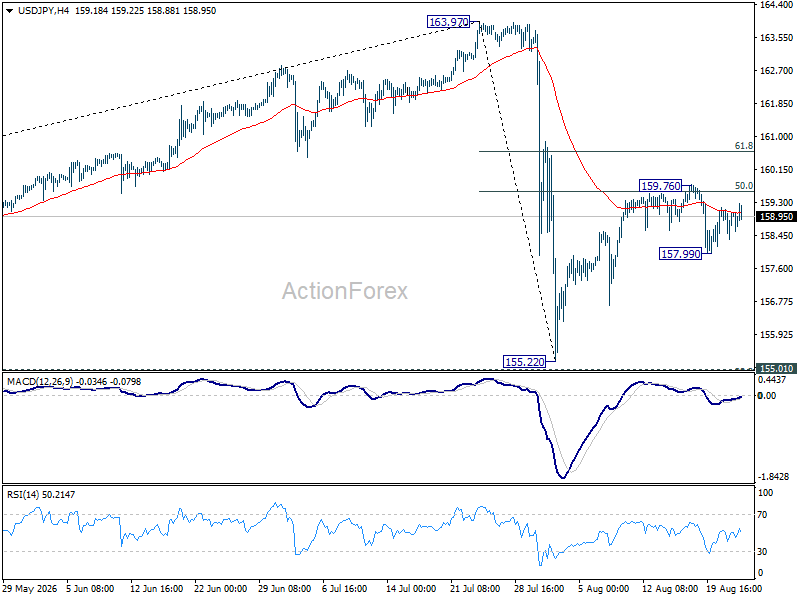
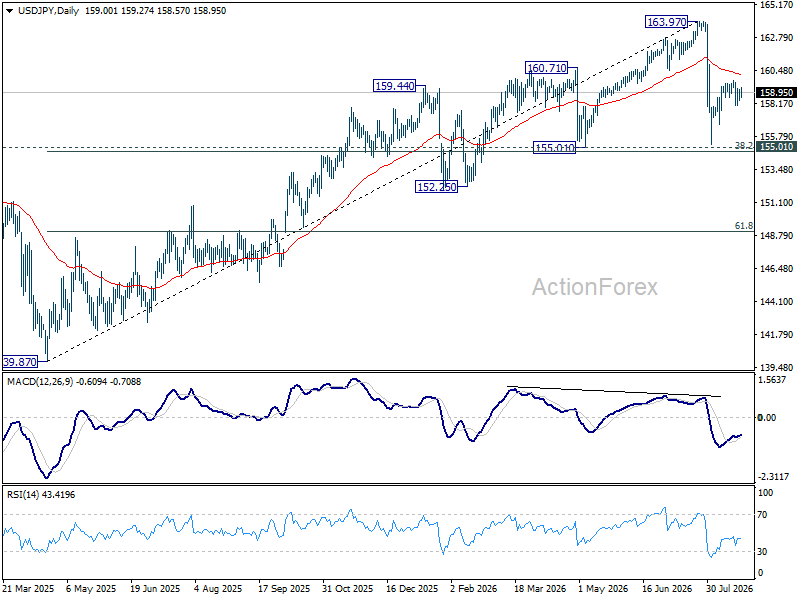
    Range trading continues in USD/JPY and intraday bias remains neutral .Consolidations from 160.45 could extend further with another falling leg. But overall outlook will remain bullish as long as 157.49 cluster support (38.2% retracement of 152.25 to 160.45 at 157.31) holds. Firm break of 160.45 will resume the rise from 152.25 to retest 161.94 high.

    In the bigger picture, outlook is unchanged that corrective pattern from 161.94 (2024 high) should have completed with three waves at 139.87. Larger up trend from 102.58 (2021 low) could be ready to resume through 161.94. This will remain the favored case as long as 55 W EMA (now at 152.97) holds. Firm break of 161.94 will pave the way to 61.8% projection of 102.58 to 161.94 from 139.87 at 176.75.

    USD/CHF Mid-Day Outlook

    Daily Pivots: (S1) 0.7895; (P) 0.7953; (R1) 0.8001; More….

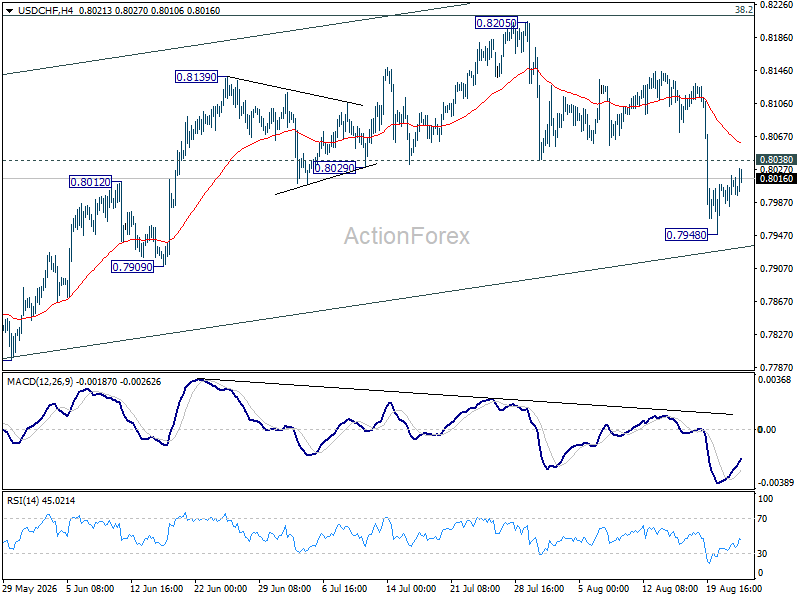
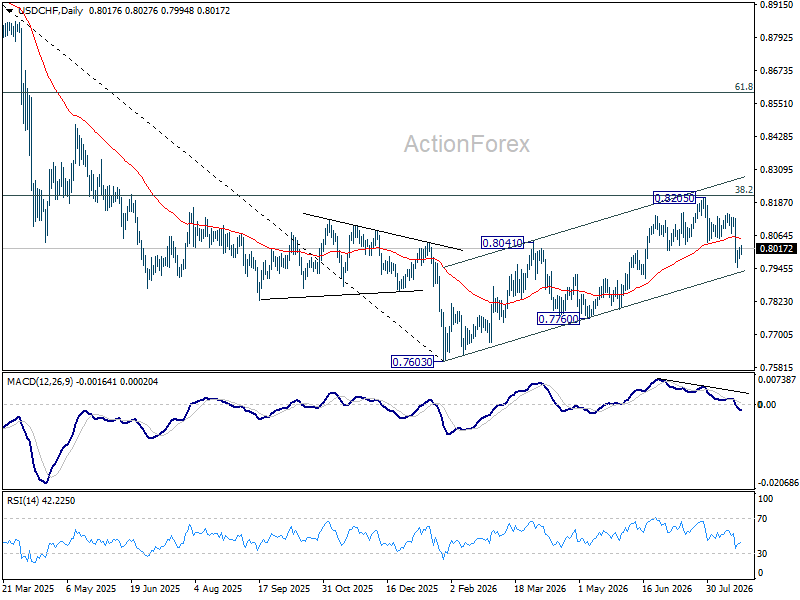
    Range trading continues in USD/CHF below 0.8041 temporary top and intraday bias stays neutral. Further rally is expected with 0.7833 support intact. On the upside, break of 0.8041 will resume the whole rally from 0.7603, and target 38.2% retracement of 0.9200 to 0.7603 at 0.8213. However, decisive break of 0.7833 support will argue that the rebound has completed, and turn bias back to the downside for deeper fall.

    In the bigger picture, a medium term bottom should be in place at 0.7603 on bullish convergence condition in D MACD. Rebound from there is seen as correcting the fall from 0.9200 only. However, decisive break of 55 W EMA (now at 0.8088) will suggest that it's probably correcting the larger scale down trend from 1.0146 (2022 high). On the other hand, rejection by the 55 W EMA will setup down trend resumption to 100% projection of 1.0146 (2022 high) to 0.8332 from 0.9200 at 0.7382 at a later stage.

    Brent-WTI Spread Collapse Signals Shift from War Premium to Supply Breakdown

    Risk aversion has returned to global markets following US President Donald Trump’s escalation signals on the Iran war, but a more important shift is unfolding in oil markets. While oil prices surged after the address, the internal dynamics are far more telling: Brent is struggling below key resistance at $113.93, while WTI has broken through $107.29 and pushed above $110, driving a sharp collapse in the Brent-WTI spread into what can be described as a "stress signal" zone.

    This development suggests that the market could now be pricing a "supply shift", not just a price spike. For the past month, Brent has carried the "war premium" as a regional benchmark for the Middle East conflict. However, the current catch-up play in WTI indicates that traders are beginning to discount the availability of waterborne crude entirely. This is no longer about the cost of oil; it is about the deliverability risk associated with barrels that must transit increasingly contested maritime corridors.

    In the past decade, Brent maintains a $3–$6 premium over WTI, reflecting transportation costs and its role as the global seaborne benchmark. This spread has only briefly flipped or hit parity during periods of acute disruption—such as the 2011 US shale bottlenecks and isolated logistical dislocations.

    What makes the current episode different is the underlying driver. This is not a demand shock or pipeline bottleneck—it is a "deliverability crisis" in the making. The spread compression is acting as a "stress signal" that markets are beginning to prioritize access and security of supply over geographic benchmarks.

    At the core is what can be described as the “safety of the barrel” theory. Brent represents waterborne crude, much of it tied to supply routes vulnerable to disruption in the Strait of Hormuz. In a scenario involving tanker attacks or a full blockade, the value of Brent as a tradable asset becomes uncertain—not just in price, but in physical delivery. Traders holding Brent are not just exposed to price volatility but to the possibility that cargoes cannot be delivered safely or on time. This is fundamentally different from traditional war premium pricing.

    By contrast, WTI could be increasing treated as the "safe supply" benchmark. US crude, produced and stored domestically, is insulated from direct geopolitical disruption in the Middle East. As a result, traders are rotating into WTI as triggered by positioning ahead of potential weekend escalation. With Trump signaling an intensified campaign that would bring Iran back to "Stone Age", and markets heading into a long weekend, traders are front-running massive weekend disruption. The logic is straightforward: if supply routes are hit while markets are closed, the scramble for alternative supply will begin immediately.

    In such a scenario, global buyers—particularly in Asia—would pivot toward US exports, driving demand for WTI-linked barrels. The result would be further spread compression, and potentially a full inversion where WTI trades above Brent. If that flip on spread occurs, it would mark a profound shift in market structure. It would signal that oil is no longer being priced based on origin, but on security and deliverability. In effect, WTI would replace Brent as the global reference for “reliable” supply.

    An even more extreme scenario cannot be ruled out. If WTI were to break above 120 ahead of Brent, it would indicate that the crisis has moved beyond regional disruption into a global supply breakdown. This would suggest that US spare capacity—the world’s safety valve—is being overwhelmed too. In that case, the implications would be severe. The global oil market would lose its stabilizing anchor, raising the risk of a systemic energy shock reminiscent of past crises. The current spread compression may therefore be more than a technical move—it may be an early warning of deeper structural stress.

    In the currency markets, Dollar is currently the best performer for the day so far, followed by Loonie, and then Yen. Aussie is the worst, followed by Kiwi, and then Sterling. Euro and Swiss Franc are positioning in the middle.

    In Europe, at the time of writing, FTSE is down -0.72%. DAX is down -2.59%. CAC is down -1.54%. UK 10-year yield is up 0.083 at 4.859. Germany 10-year yield is up 0.060 at 3.049. Earlier in Asia, Nikkei fell -2.38%. Hong Kong HSI fell -0.70%. China Shanghai SSE fell -0.74%. Singapore Strait Times fell -0.57%. Japan 10-year JGB yield rose 0.091 to 2.395.

    US Jobless Claims Fall to 202k, Labor Market Remains Tight

    US jobless claims fell to 202k, beating expectations and signaling a still-tight labor market. While continuing claims edged higher, the broader trend remains stable, pointing to resilience in employment conditions. Read more.

    Swiss CPI Rises to 0.3% yoy, But Underlying Inflation Stays Soft

    Swiss inflation remained subdued in March, with CPI missing expectations and core prices flat. While imported costs rose on higher energy prices, weak domestic inflation continues to cap overall price pressures. Read more.

    USD/CHF Mid-Day Outlook

    Daily Pivots: (S1) 0.7895; (P) 0.7953; (R1) 0.8001; More….

    Range trading continues in USD/CHF below 0.8041 temporary top and intraday bias stays neutral. Further rally is expected with 0.7833 support intact. On the upside, break of 0.8041 will resume the whole rally from 0.7603, and target 38.2% retracement of 0.9200 to 0.7603 at 0.8213. However, decisive break of 0.7833 support will argue that the rebound has completed, and turn bias back to the downside for deeper fall.

    In the bigger picture, a medium term bottom should be in place at 0.7603 on bullish convergence condition in D MACD. Rebound from there is seen as correcting the fall from 0.9200 only. However, decisive break of 55 W EMA (now at 0.8088) will suggest that it's probably correcting the larger scale down trend from 1.0146 (2022 high). On the other hand, rejection by the 55 W EMA will setup down trend resumption to 100% projection of 1.0146 (2022 high) to 0.8332 from 0.9200 at 0.7382 at a later stage.


    Economic Indicators Update

    GMT CCY EVENTS Act Cons Prev Rev
    23:50 JPY Monetary Base Y/Y Mar -11.60% -10.40% -10.60%
    00:30 AUD Trade Balance (AUD) Feb 5.69B 2.55B 2.63B 2.26B
    06:30 CHF CPI M/M Mar 0.20% 0.50% 0.60%
    06:30 CHF CPI Y/Y Mar 0.30% 0.50% 0.10%
    12:30 USD Initial Jobless Claims (Mar 27) 202K 215K 210K 211K
    12:30 USD Trade Balance (USD) Feb -57.3B -59.2B -54.5B -54.7B
    12:30 CAD Trade Balance (CAD) Feb -5.7B -1.8B -3.65B
    14:30 USD Natural Gas Storage (Mar 27) 38B -54B


    US Jobless Claims Fall to 202k, Labor Market Remains Tight

    US initial jobless claims fell -9k to 202k in the week ending March 27, coming in below expectations of 215k and reinforcing the picture of a still-tight labor market. The four-week moving average also declined -3k to 207.75k.

    However, continuing claims painted a slightly softer picture, rising 25k to 1.841m in the week ending March 21. This suggests that while layoffs remain limited, it is taking slightly longer for displaced workers to find new employment.

    Still, the broader trend remains constructive. The four-week average of continuing claims fell -7.5k to 1.839m, the lowest level since late September 2024.

    Full US jobless claims release here.

    USD/JPY – Yen Weakens Amid Geopolitical Uncertainty

    USD/JPY rose to 159.39 on Thursday, as the yen weakened amid conflicting signals from Donald Trump on a possible de-escalation of the Middle East conflict. The situation continues to support the US dollar while weighing on the yen.

    The US currency strengthened following reports that the operation in Iran is “close to completion” and could achieve its goals in the coming weeks. However, these statements were accompanied by warnings of a potential escalation in hostilities. At the same time, Trump emphasised that diplomatic contacts are ongoing, keeping investors cautious and maintaining heightened attention to geopolitical risks.

    For Japan, the situation remains sensitive: the country relies heavily on oil imports from the Middle East, and fuel prices reached record levels in March, although they have since eased slightly supported by government subsidies.

    New Bank of Japan board member Toichiro Asada has signalled a preference for a cautious, data-driven approach. He joins the council ahead of the 27–28 April meeting, where markets currently price in a probability of a rate hike at approximately 70%.

    Technical Analysis

    On the H4 chart, USD/JPY is forming a consolidation range around 159.10. The range is expected to expand to 159.50 today, followed by a decline to 157.70. An upside breakout could lead to a correction to 160.40, after which a new downward impulse to 157.70 is anticipated, with the prospect of a continued move towards 156.00. The MACD indicator confirms this scenario, with its signal line below zero and pointing firmly downwards, supporting the potential for the downtrend to continue.

    On the H1 chart, the market is forming an advance towards 159.50 and is likely to reach the target today. Following this, a downward wave to 157.70 (testing from below) is possible. The Stochastic oscillator confirms this structure, with its signal line above 80 and pointing firmly downwards, indicating continued short-term downside potential.

    Conclusion

    USD/JPY remains in positive territory, with conflicting signals from the US over Middle East de-escalation creating an uncertain backdrop that favours the dollar over the yen. While reports of progress in the Iran operation have supported the greenback, ongoing diplomatic contacts and warnings of escalation keep markets on edge. Japan's sensitivity to oil price fluctuations adds to yen pressure, although government subsidies provide partial relief. With a new BoJ board member advocating a cautious approach and markets pricing in a 70% probability of a rate hike at the April meeting, the yen's near-term trajectory will likely depend on both geopolitical developments and upcoming policy signals from Tokyo. Technical indicators point to a possible short-term correction lower.

    Dollar Has Regained Upper Hand

    • Following Trump’s speech, markets are bracing for an escalation over Iran.
    • Japan’s failure with currency interventions could push USDJPY to 175.

    The US dollar quickly recouped its losses thanks to Donald Trump’s comments. He threatened Iran with air strikes on its energy infrastructure if the Strait of Hormuz is not opened. The promise to send Iran back to the Stone Age contrasted with his previous statement about ending the conflict within 2–3 weeks amid successful negotiations. This caused EURUSD to plummet after the rally of the previous two days.

    Polymarket participants estimate the chances of the war between the US and Iran ending by the end of June at 65%. A closure of the Strait of Hormuz before then would be a real disaster for the global economy. The IEA warns that the oil market deficit will continue to widen. In March, the market remained stable due to the supply from February. However, in April, conditions risk deteriorating rapidly, suggesting that additional releases from strategic reserves may be required.

    The euro is gradually losing its key support from expectations of aggressive monetary tightening. Investors are beginning to question the ECB’s past decisions. Was the biggest mistake in 2022, when it underestimated the inflationary impact of the energy crisis, or in 2011, when it raised rates in response to rising prices? That earlier tightening weakened the eurozone economy and ultimately forced the ECB to cut rates more aggressively than before.

    Growing risks of a conflict escalation in the Middle East have halted the USDJPY correction and handed the initiative to the bulls. UBS forecasts that the US dollar will rise to ¥175 by the end of the year. A surge in Brent to $150 per barrel will render Japan’s currency interventions ineffective. The Ministry of Finance’s spending will merely create more favourable entry points for speculators to sell the yen. As a result, Sanae Takaichi will begin to curb inflation through fiscal measures. This will signal to hedge funds that the government is no longer concerned about USDJPY. They will step up their purchases of the pair.

    Gold took a hit following disappointment with Donald Trump’s rhetoric. The precious metal failed to hold $4,800 and is set to return to March lows amid central banks, led by the Fed, keeping interest rates at high levels for an extended period. India has begun to defend its currency against depreciation by selling US Treasury bonds and continuing to accumulate gold. At the very least, this provides some support for gold. However, India may very soon follow Turkey’s lead by selling off its metal reserves.