

Sample Category Title
US to Launch Economic “D-Day”
In focus today
- Today is quiet in terms of data releases. Focus remains on the fixed income market after a very volatile week. Potentially another round of trade war between the US and Canada will also receive attention after negotiations collapsed last Friday. Furthermore, the US is set to announce new economic sanctions on Iran and their trading partners today. Both events could result in fresh economic blows.
- For the rest of the week, the main data releases include Germany's Ifo Business Climate Index on Tuesday, followed by US core PCE, personal spending and durable goods orders on Wednesday. The latter is a key indicator of investment activity and offers insight into the AI investment boom. In addition, the Fed's annual Jackson Hole conference takes place on Thursday and Friday, with the Fed Chair's speech scheduled for Friday. Markets will be watching closely for any signals on monetary policy ahead of September.
Economic and market news
What happened overnight
In geopolitics, tensions between the US and Iran remain a key focus as Washington prepares to announce new sanctions targeting Iran's trade partners, with US Treasury Secretary Scott Bessent set to hold a press conference today. The measures have been described by the US Treasury Secretary Scott Bessent as an "Economic D-Day", while Iran has warned that no oil will flow from the Gulf if the "economic war" continues. Although direct military strikes have eased in recent weeks, the lack of meaningful negotiations means the prospects for any deal are slim in the short term.
In commodities, Brent crude oil dropped to around USD93/bbl following a sharp weekly rally, as investors took profits ahead of an expected US announcement on tougher sanctions against Iran. Bessent said Washington would impose the "toughest" sanctions in history, describing the measures as an unprecedented campaign of economic isolation designed to pressure Iran and its trading partners into compliance.
What happened over the weekend
In Canada, Prime Minister Mark Carney announced dollar-for-dollar retaliatory tariffs on selected US imports on Saturday after trade talks with the US collapsed Friday, raising uncertainty around the US-Mexico-Canada trade pact. The measures are set to take effect on 8 September and respond to new 50% US duties on selected exports from Canada worth around USD20bn.
In the US, PMIs were mixed but generally strong, with the composite index indicating the fastest pace of growth since March 2022. Manufacturing weakened to 53.2 (prior: 53.9), while the order-inventory balance declined from July, potentially signalling that growth momentum is levelling off, though the data is volatile month to month and regional Fed surveys have been more positive. Services business activity picked up sharply to 56.8 (prior: 54.6), but both input and output price indices declined. Overall, the release does not provide a clear directional signal.
In the euro area, PMIs surprised positively in August with manufacturing rising to 52.8 (cons: 51.8, prior: 51.9) and services rising to 51.7 (cons: 51.5, prior: 51.7), leaving the composite index at 52.1 (cons: 51.7, prior: 52.0). The weakness in German and French services was thus countered by strength in Southern Europe, and growth in the third quarter is thereby looking rather solid amid the negative supply shocks from the war in Iran and warm weather. Euro area negotiated wages rose 2.44% y/y in Q2 (cons: 2.4%), down from 2.56% y/y in Q1. This was as expected and as hinted by the ECB's wage tracker.
In the UK, PMIs were stronger than expected, with the composite index rising to 52.5 (cons: 51.6, prior: 52.2), driven by a solid services reading at 52.8 (cons: 51.8, prior: 52.1), while manufacturing was in line with expectations at 51.5 (cons: 51.5, prior: 51.9). Price pressures also picked up, with the composite output price index rising to 57.1 from 56.1 and input prices also higher, making the release somewhat hawkish for the Bank of England. However, this follows softer labour market data and inflation figures that were not especially concerning. Markets continue to price one further BoE hike by year-end and two in total.
In Sweden, the labour market print was strong, with unemployment declining to 8.6% in July from 8.9% in June, slightly below expectations and in line with our forecast. The labour force increased by 0.5% m/m, suggesting the fall in unemployment rate was genuine, while employment rose by 0.8% m/m. The details were even better, with U4 unemployment falling more than the headline rate, although the monthly LFS data is notoriously volatile. Still, given that the Riksbank highlighted high LFS unemployment, Friday's outcome is more noteworthy than usual and broadly erases that negative narrative.
In Denmark, consumer confidence improved in August, rising to -13.1 from -14.7 in July, the highest level since February, although still very low by historical standards. The improvement was mainly driven by households' assessment of their current financial situation, while expectations for the domestic economy one year ahead remained a drag. Business confidence also strengthened, rising to 106.7 in August from 105.3 in July, the highest level since April 2022. The improvement was driven by services and retail, pointing to stronger private consumption ahead. Construction and industrial production remain around the neutral 100 level but appear resilient and still hold potential for further improvement.
Equities: Equities closed higher on Friday, but that does not change the fact that several markets ended the week lower, most notably in the US. The Nordics stood out as one of the strongest regions last week.
The overarching story has not changed much. Four forces are currently shaping equity markets: the oil story around the Strait of Hormuz, the durability of the AI capex buildout, the recently added fear of dollar debasement and, most importantly, exceptionally strong macro data.
The latter remains the key factor keeping equities afloat, as demonstrated again last week and particularly by Friday's PMIs.
The sector performance is revealing in this context. Materials was the best performing sector last week, while Utilities was the worst. In other words, we have not seen a genuine defensive rotation, which is exactly what we would normally expect when macro (and capex) are solid market.
Volatility also remains generally low. The VIX hovered around 15.5 through last week but ultimately ended broadly unchanged.
With macro and earnings data this strong, the resilience of equities should not be underestimated.
Asian markets are mostly lower again this morning, with South Korea again seeing the greatest volatility. US and European equity futures are trading close to Friday's closing levels.
FI and FX: Last week it was all about US Treasuries and Bessent's announcement on increased long-end buyback, prompting a mid-week rally. But as markets digested this and concluded that the structural drivers remain the same, the initial move was reversed and long-dated yields closed the week broadly unchanged. The Dollar weakened on the back of Bessent's announcement but has since then traded more or less unchanged, with EUR/USD currently sitting just below 1.17. In Scandie markets, a dovish Riksbank prompted Swedish rates to outperform EUR dittos and the SEK to weaken. Looking ahead to this week, the key event is the Jackson Hole symposium with Fed Chair Kevin Warsh is set to speak on Friday, whereas in Sweden we look ahead to the Riksbank Minutes and GDP data later in the week.
Canada’s 50% Tariff Shock Looks Huge. USD/CAD Is Treating It Differently.
TL;DR: Canada is facing 50% US tariffs after trade talks collapsed, yet USD/CAD's muted reaction — with oil, bonds, and the Dollar all failing to confirm a Canada-specific stress trade — suggests markets see this as a narrower, contained shock rather than an economy-wide one.
Why Isn't the Canadian Dollar Falling Harder?
Canada entered the week with two apparently bearish developments already in place. US trade talks had collapsed, new 50% tariffs were in force, and oil was retreating from recent highs. Yet USD/CAD's response has been restrained rather than disorderly. The pair recovered from 1.3730, but has so far failed to produce the kind of upside acceleration that headline severity might suggest. That muted reaction is important: the FX market appears to be distinguishing an unusually aggressive trade action from an immediate economy-wide shock.
Part of the explanation is scope. The 50% tariff rate is eye-catching, but duties apply to roughly C$28bn, or about US$20bn, of Canadian exports — not the entire Canada-US trade relationship. Timing also matters. US measures took effect Saturday, so Monday's session is digesting an outcome known since late Friday rather than reacting to a fresh intraday surprise. Canada's promised dollar-for-dollar retaliation isn't scheduled to begin until September 8, leaving roughly two weeks before the full two-way tariff confrontation reaches the real economy.
How a Near-Deal Collapsed
The breakdown was nevertheless abrupt. US President Donald Trump temporarily postponed implementation last week as negotiations appeared close, and Canada's trade minister Dominic LeBlanc held lengthy talks with USTR Jamieson Greer as both sides continued trying to bridge differences. Talks then failed late Friday, allowing 50% duties to take effect shortly after midnight Saturday.
Canadian Prime Minister Mark Carney subsequently called the tariffs a "miscalculation" and said the US side had introduced last-minute changes Canada considered unfair and uneconomic. Washington has framed the dispute differently, focusing in part on Canada's refusal to remove retaliatory restrictions imposed during earlier tariff rounds, including provincial bans on sales of some US alcohol.
The accounts aren't necessarily mutually exclusive: what Ottawa describes as a late change could be the same demand Washington viewed as an unresolved condition. Neither side has released the full draft agreement, leaving the exact final sticking point uncertain and giving Canada's opposition another opening to press Carney for disclosure. The escalation is also notable because Trump used Section 338 of the Tariff Act of 1930, an extraordinary provision that had not previously been used by a US president to impose tariffs.
Oil and Bonds Aren't Confirming a Canada Stress Trade
Oil adds another nominally bearish input for CAD, but the current decline is weaker as a signal than the headline suggests. Crude retreated after two consecutive weekly gains as traders took profits ahead of Treasury Secretary Scott Bessent's expected Iran sanctions announcement today. That's different from an oil selloff driven by collapsing demand expectations or a fresh deterioration in global growth. For a commodity-sensitive currency such as CAD, that distinction matters.
Canadian rates are also not showing a parallel stress signal. Canada's 10-year yield has stayed firm rather than reflecting a clear growth or capital-flight repricing. More importantly, the USD itself isn't providing the reinforcing half of the trade. The DXY is flat to slightly softer, while the broader Dollar downtrend over the past month is still intact. USD/CAD tends to move most aggressively when Canada-specific weakness is paired with broad Dollar strength — that combination is missing so far.
ActionForex's Technical View on USD/CAD
Technically, a temporary low should be in place at 1.3730, and some consolidation above that level is likely first. But upside should be limited by 1.3927, the 38.2% retracement of the decline from 1.4247 to 1.3730. That level now carries added macro significance: a firm break would suggest Canada-specific trade risk is becoming strong enough to overpower the broader bearish Dollar structure, opening a stronger recovery toward 1.4002 support turned resistance.
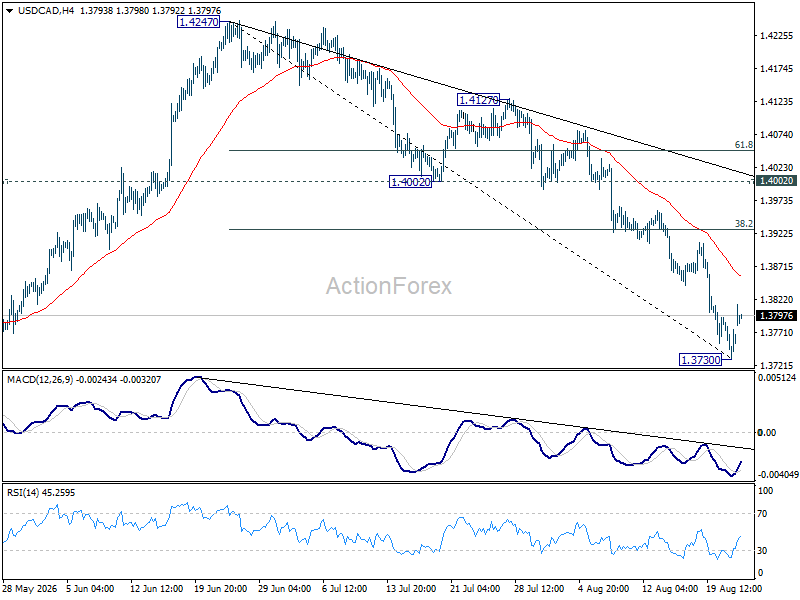
For now, the larger outlook is unchanged. The rebound from 1.3480 appears to have completed as a three-wave corrective move at 1.4247. A break below 1.3730 would resume the decline toward 1.3480.
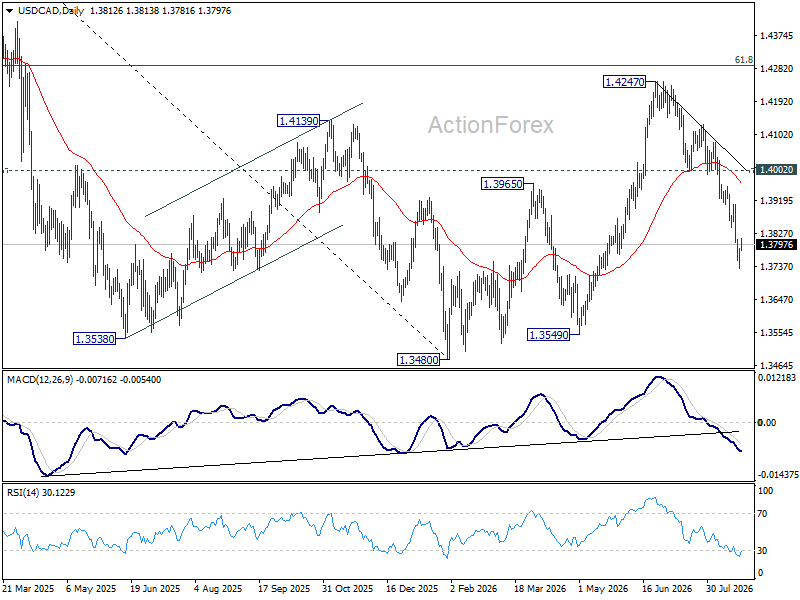
If USD/CAD can't clear 1.3927 despite 50% tariff headlines and weaker oil, the market's message would be difficult to ignore: the immediate Canada risk premium is still contained, while the Dollar side of the pair continues to exert greater influence. September 8, when Canada's retaliation is scheduled to begin, is the next obvious test of whether that judgment holds.
Key Takeaways
- USD/CAD's recovery from 1.3730 has stayed restrained despite 50% tariffs, signaling markets see this as a contained shock rather than an economy-wide one.
- The tariffs apply to roughly C$28bn of exports, not Canada's entire trade relationship, and Canada's retaliation doesn't begin until September 8, delaying the full economic impact.
- Trump invoked Section 338 of the Tariff Act of 1930, a provision no US president had used before, underscoring how unusual this escalation is even with its narrower economic scope.
- Oil's decline reflects profit-taking ahead of an Iran sanctions announcement, not a demand-driven selloff, while Canadian yields and the Dollar aren't confirming a Canada-specific stress trade.
- 1.3927 is the key resistance test; failure to clear it despite the tariff headlines would confirm the Canada risk premium remains contained, while a break would open a run toward 1.4002.
New Zealand Retail Sales Fall -0.35% Q/Q as Fuel Price Surge Masks Weaker Volumes
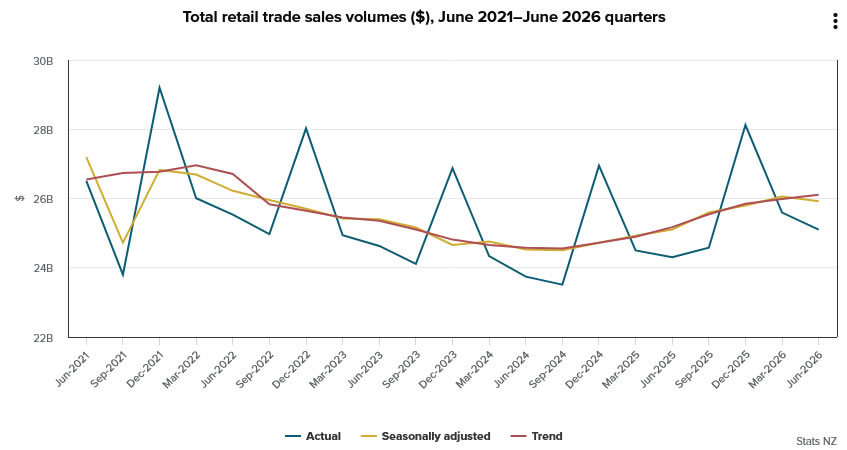
New Zealand retail sales volumes fell -0.5% q/q in Q2, reversing a revised 1.0% rise in Q1 and missing expectations for a 0.1% increase. Excluding autos, however, sales rose 0.7%, slowing from a revised 1.1% but comfortably beating consensus of 0.3%. Eight of 15 industries recorded lower sales volumes, pointing to a mixed rather than uniformly weak quarter.
Fuel retailing was by far the largest drag, with volumes plunging -13%, while accommodation fell -8.0%, food and beverage services dropped -2.8%, and motor vehicle and parts retailing declined -2.3%. Electrical and electronic goods retailing provided a notable offset, rising 9.2%. Weakness therefore extended beyond autos, but sharp fall in fuel volumes had an outsized impact on headline result.
Price effects created a striking contrast with volume data. Seasonally adjusted retail sales values rose 0.9% q/q to NZD 33bn, even as real volumes contracted. Fuel retailing values surged 12% despite -13% fall in volumes, with Stats NZ attributing increase to higher fuel prices. Divergence suggests households paid considerably more for fuel while buying less, leaving headline nominal spending looking much firmer than underlying consumption volumes.
Data Summary
| Indicator | Actual | Expected | Previous |
|---|---|---|---|
| Retail Sales q/q Q2 | -0.5% | +0.1% | +1.0% |
| Retail Sales ex Autos q/q Q2 | +0.7% | +0.3% | +1.1% |
Key Takeaways
- New Zealand retail sales volumes fell 0.5% q/q in Q2, reversing 1.0% growth in Q1 and missing expectations for a 0.1% increase.
- Underlying picture was firmer than headline suggested, with ex-auto sales rising 0.7%, beating 0.3% consensus despite slowing from 1.1%.
- Fuel was biggest drag on real activity, with sales volumes plunging 13%, while accommodation fell 8.0%, food and beverage services declined 2.8%, and motor vehicle and parts sales dropped 2.3%.
- Higher prices sharply distorted nominal figures. Fuel retailing values jumped 12% even as volumes fell 13%, helping total retail sales values rise 0.9% q/q.
- Report therefore points to softer real consumption at headline level, but not broad-based spending weakness, with price effects—particularly fuel—masking decline in physical purchases.
XAUUSD Climbs as Elliott Wave Analysis Predicts Upside
XAUUSD Climbs as Technical Wave Analysis Predicts Upside
Hello Traders, in today’s blog, we’re reviewing the XAUUSD wave count shared with our members, which pointed to a strong bullish outlook. The Elliott Wave pattern confirmed the move, sending the precious metal surging over 2000 points.
Technical Outlook After Gold Completes Major Correction from All‑Time Highs
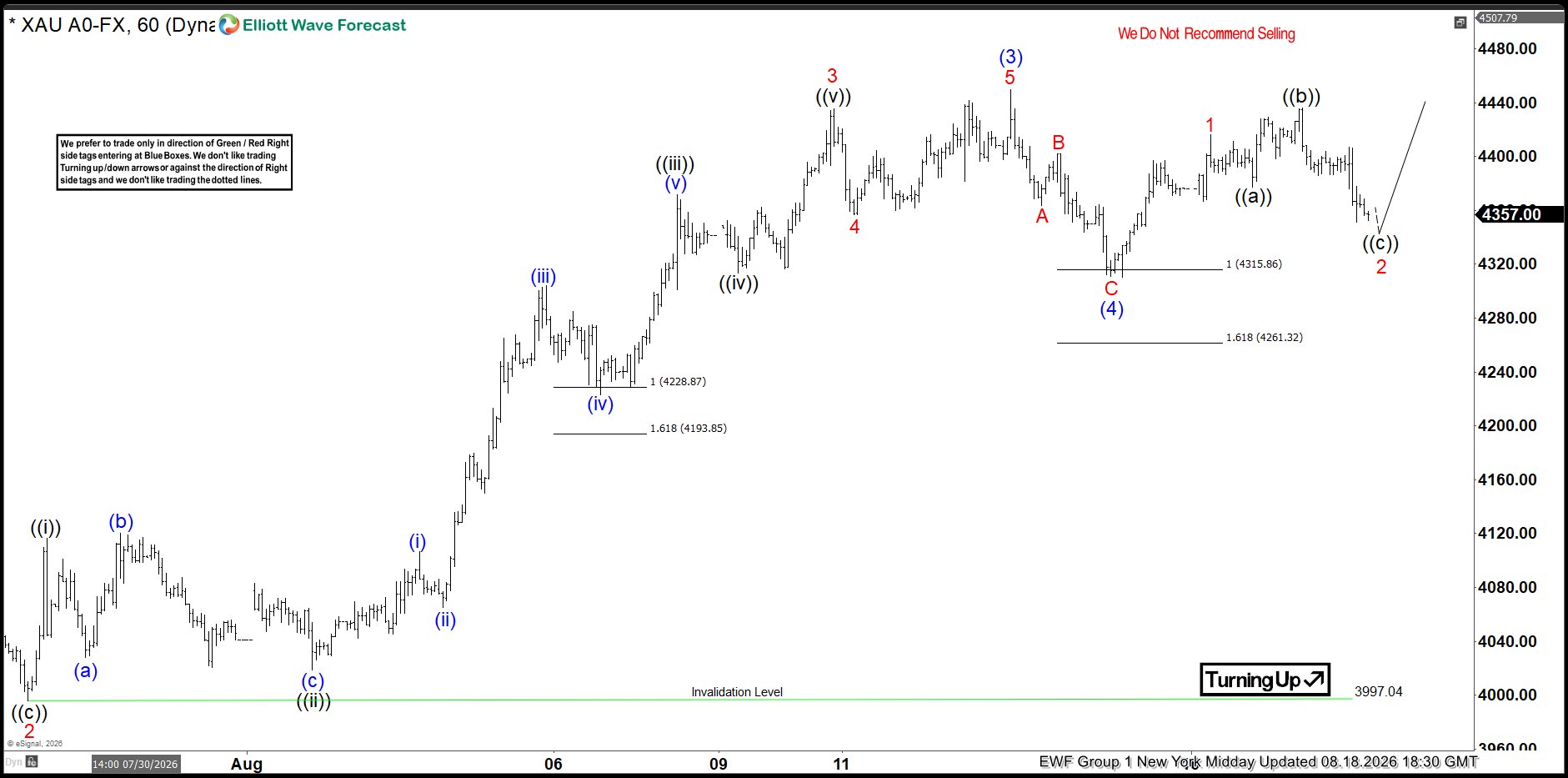
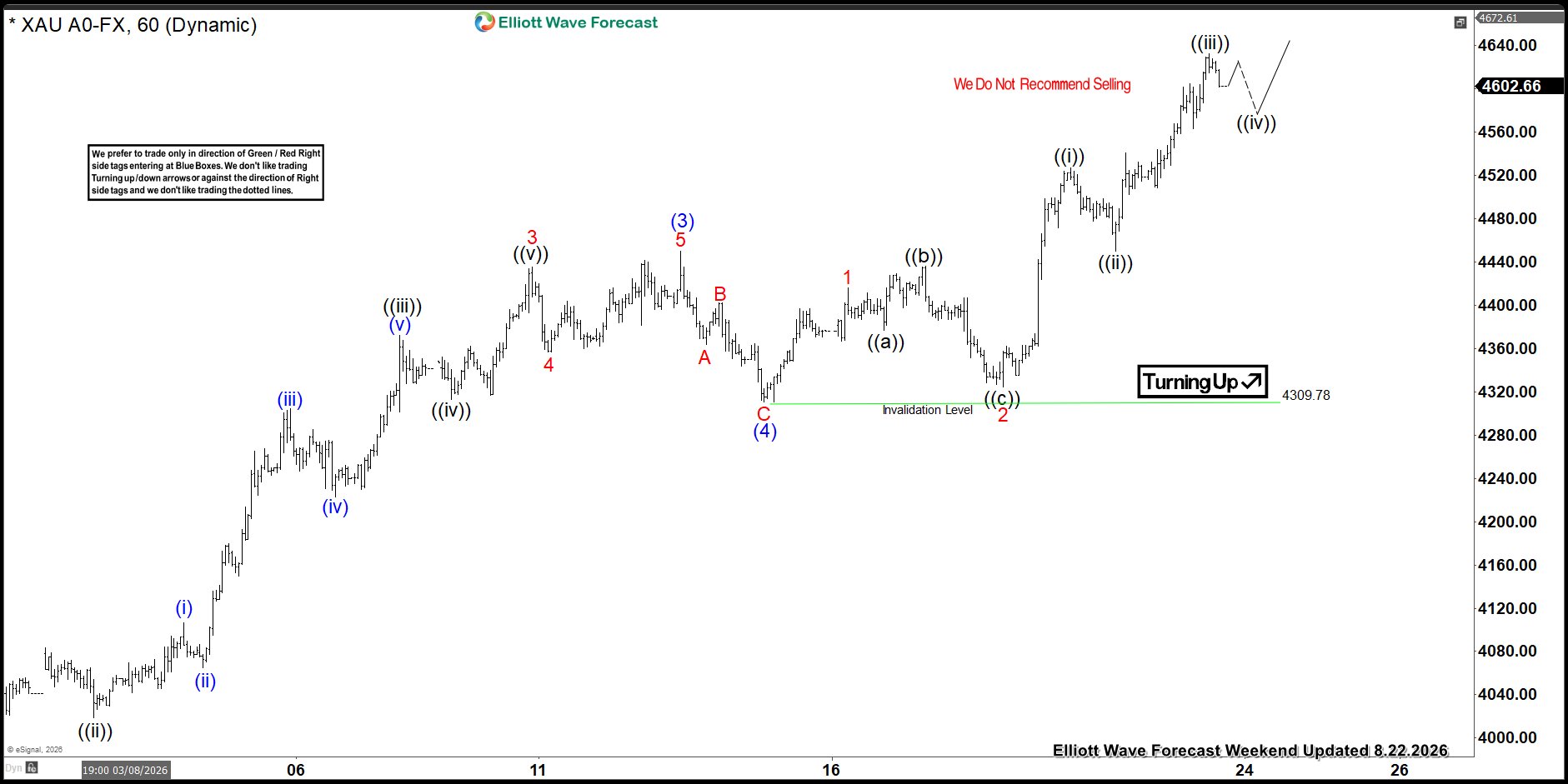
The precious metal peaked earlier this year at 5589.97 on 01.29.2026, and subsequently underwent a six-month corrective phase, wrapping up at 3940.68 on June 30, 2026. Since hitting that low, Gold rallied to complete wave (4) at 4309.78. It then turned higher, completed wave 1 of the new nest, and pulled back in a proposed wave 2 flat correction against 4309.78.
The Forecast: Completion of Wave 2 Correction
Our initial analysis focused on Gold completing a corrective structure, labelled as wave ((c)) of 2. Because corrective phases present prime opportunities to align with the primary trend, we monitored support closely. The setup held firmly above our established Invalidation Level at 3997.04—and most importantly, above the wave (4) low (4309.78)—confirming the end of the correction and the start of a new bullish wave. See chart below
The Result: Impulsive Rally Hits 4630.22
Following the completion of wave ((c)) of 2, price action accelerated rapidly in an impulsive wave pattern. Gold broke above the wave (3) peak to confirm the next leg higher, surging over 2,000 points toward the 4630.22 level. Driven by this strong upside momentum, the invalidation level was adjusted higher to 4309.78 to align with the new market structure. See chart below
What’s Next for Gold in the Coming Weeks?
According to our latest chart update, the short-term outlook favors a minor wave ((iv)) pullback before a final push higher in wave ((v)). This move will complete wave 3 from the August 19, 2026 low, setting the stage for a broader wave 4 correction that should hold above the wave 2 invalidation point. Once wave 4 finishes, price should resume the main uptrend to complete the full impulsive cycle from the June 2026 lows before entering a larger correction.
Why choose EWF ?
At Elliottwave Forecast (EWF), we deliver consistent market updates through regular charts update. Our analysts update 1‑hour charts four times daily and 4‑hour charts once per day across all 78 instruments. In addition, we host five live sessions each day and maintain a 24‑hour chatroom, providing clients with real‑time market guidance and answers to any questions they may have.
EUR/USD Uptrend Pauses as Buyers Digest Strong Gains
Key Highlights
- EUR/USD started a major increase and climbed above 1.1620.
- A bullish trend line is forming with support near 1.1610 on the 4-hour chart.
- Bitcoin and Ethereum rallied over 20% before they started a consolidation phase.
- USD/JPY might start a fresh increase if it settles above 159.60.
EUR/USD Technical Analysis
The Euro found support near 1.1520 against the US Dollar. EUR/USD started another increase above the 1.1580 resistance zone.
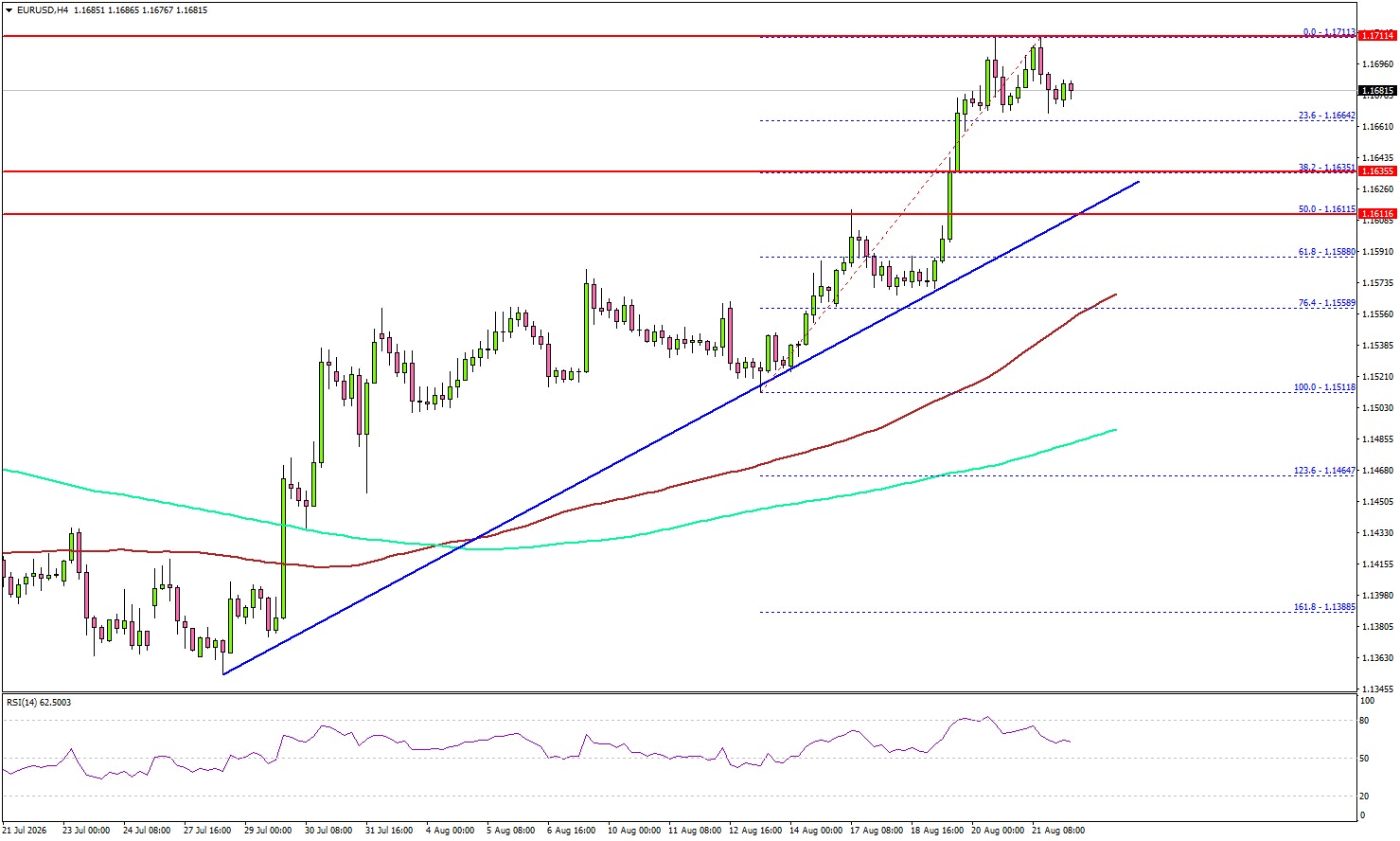
Looking at the 4-hour chart, the pair settled above 1.1600, the 100 simple moving average (red, 4-hour), and the 200 simple moving average (green, 4-hour). The pair climbed above 1.1700 and traded as high as 1.1711 on TitanFX before it started a consolidation phase.
If there is a downside correction, the pair might find bids near 1.1635. The first major support could be near 1.1610 and the 50% Fib retracement level of the upward move from the 1.1511 swing low to the 1.1711 high.
There is also a bullish trend line forming with support at 1.1610. The next major support could be near 1.1560 and the 100 simple moving average (red, 4-hour).
The main support might be 1.1500 and the 200 simple moving average (green, 4-hour). A downside break and close below 1.1500 might send the pair toward 1.1420. Any more losses could open the door for a test of 1.1350.
On the upside, the pair is now facing a major hurdle at 1.1700. The next major resistance might be 1.1725. A close above 1.1725 could start another steady increase. In the stated case, the bulls could aim for a move to 1.1800. Any further gains might open the door for a test of 1.1880.
Looking at Bitcoin, the price rallied over 20%, tested the $80,000 resistance zone, and might start a downside correction.
Upcoming Key Economic Events:
- US 3-Month Bill Auction.
- US 6-Month Bill Auction.
Gold and Bitcoin Surge as U.S. Bond Buybacks Surprise Markets
Gold and Bitcoin surged after the U.S. Treasury announced it would double the size of its long-term bond buybacks from $2 billion to at least $4 billion per operation. This was important because the move pushed bond prices higher and weakened the U.S. dollar. Gold jumped sharply, while Bitcoin broke out of its recent range and rose around 20%.
Major U.S. and Japanese stock indexes finished the week lower as investors became more cautious. High bond yields, U.S.-Iran tensions, and weakness in AI and semiconductor stocks hurt sentiment. Higher WTI crude oil prices were also negative for Japan, as more expensive energy can increase costs for Japanese businesses.
WTI crude oil rose as U.S.-Iran tensions increased, including the possibility of new U.S. economic sanctions on Iran. Meanwhile, the Fed’s July meeting minutes showed that officials expect inflation to slow, but another rate hike could be needed if inflation remains high.
Markets This Week
U.S. Stocks
The Dow started the week below the 10-day moving average, encouraging further selling throughout the week. Higher WTI crude oil prices and concerns about the U.S. bond market added to the weakness. The market is now in a short-term downtrend, so selling strength around the 10-day moving average could be the preferred strategy this week. Resistance levels are at 53,500, 54,000, 54,500, 55,000 and 56,000. Support is seen at 52,500, 51,500, 51,000 and 50,000.
Japanese Stocks
The Nikkei lost all of the previous week’s gains as higher WTI crude oil prices worried investors, while weaker-than-expected Japanese GDP added to the negative sentiment. The market is likely to trade sideways to lower this week, with the 10-day moving average flattening and prices near the middle of the Bollinger Bands. Traders will also focus on the possibility of a Bank of Japan interest rate hike next month. Resistance is at 67,500, 69,500, 70,000 and 71,000. Support is at 65,000, 64,000, 63,000 and 62,000.
USD/JPY
USD/JPY moved higher early last week as WTI crude oil prices rose, but the surprise increase in U.S. government bond purchases weakened the U.S. dollar midweek and pushed the pair lower for the week. With resistance near the upper Bollinger Band and the market closing below the 10-day moving average, USD/JPY could trade sideways to lower ahead of important U.S. data on Wednesday, which will likely provide direction for the rest of the week. Resistance is at 159.50, 160.00, 161.00, 162.00, 164.00 and 165.00, while support is at 158.50, 158.00, 157.00, 156.00, 155.00 and 154.00.
Gold
Profit-taking pushed gold lower at the start of last week, before the surprise increase in U.S. government bond purchases led to strong buying from longer-term investors worried about the future value of the U.S. dollar. Buying continued into the end of the week, keeping the medium-term uptrend very strong. The upper Bollinger Band is now acting as short-term resistance, so short-term traders could look to sell if prices start to weaken. Medium-term traders may prefer to follow the uptrend and wait for a move closer to the 10-day moving average before buying. Resistance is at $4,650, $4,700, $4,775, $4,900 and $5,000, while support is at $4,450, $4,350, $4,300, $4,225, $4,200, $4,125 and $4,100.
Crude Oil
WTI crude oil moved higher throughout last week as the U.S. threatened new economic sanctions against Iran and discussed taking control of the Strait of Hormuz. Oil largely ignored weaker U.S. economic data, which could reduce demand. News headlines can still quickly change the market direction, but for now, higher prices look more likely this week. Resistance is at $90, $95 and $100, while support is at $80, $75, $67.50, $65 and $60.
Bitcoin
Bitcoin finally came back to life last Wednesday after the U.S. Treasury announced plans to increase its long-term bond buybacks. This weakened confidence in the U.S. dollar and increased interest in alternative assets such as Bitcoin. President Donald Trump also called for faster progress on crypto legislation, adding to the buying. While the outlook has improved, Bitcoin looks overbought in the short term and could move lower this week. A pullback toward $67,500–$70,000 could offer a medium-term buying opportunity. Resistance is at $80,000, $85,000, $90,000, $95,000 and $100,000, while support is at $65,000, $62,000, $60,000, $55,000 and $50,000.
This Week’s Focus
- Monday: None
- Tuesday: Australia RBA Meeting Minutes, Japan BoJ Core CPI, U.S. Building Permits, CB Consumer Confidence and New Home Sales
- Wednesday: U.S. Core PCE Price Index, GDP and Durable Goods Orders
- Thursday: Australia Private New Capital Expenditure, E.U. ECB Publishes Account of Monetary Policy Meeting, U.S. Jackson Hole Symposium
- Friday: Japan Tokyo Core CPI, Unemployment Rate, U.S. Michigan Consumer Sentiment
WTI crude oil will remain in focus early in the week as the U.S. increases pressure on Iran. Markets will also watch whether gold and Bitcoin can continue their recent strong rises and whether selling pressure on stock markets continues. Attention will then shift to major U.S. data on Wednesday, followed by the Jackson Hole meeting from Thursday, where comments from Fed officials on inflation and interest rates could move markets.
Platinum Wave Analysis
Platinum: ⬆️ Buy
– Platinum broke resistance zone
– Likely to rise to resistance level 2000.00
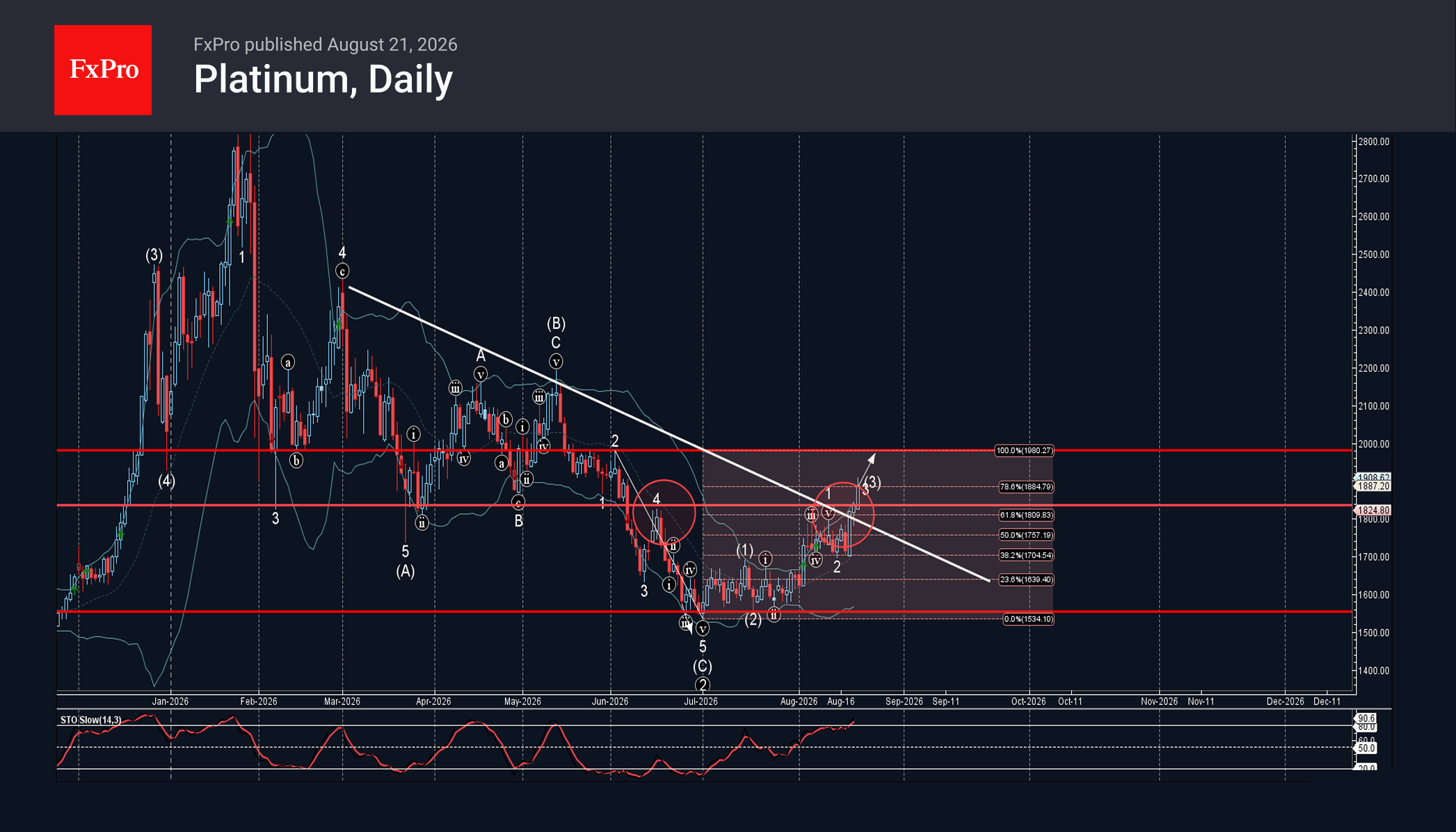
Platinum recently broke the resistance zone between the resistance level 1835.00 (which has been reversing the price from June), resistance trendline from March and the 61.8% Fibonacci correction of the downward impulse from June.
The breakout of this resistance zone accelerated the active intermediate impulse wave (3).
Platinum can be expected to rise further to the next round resistance level 2000.00 – former top of wave 2 from the start of June – and the target for the completion of the active wave 3.
DAX Index Wave Analysis
DAX Index: ⬆️ Buy
– DAX reversed from pivotal support level 25875.00
– Likely to rise to resistance level 26500.00
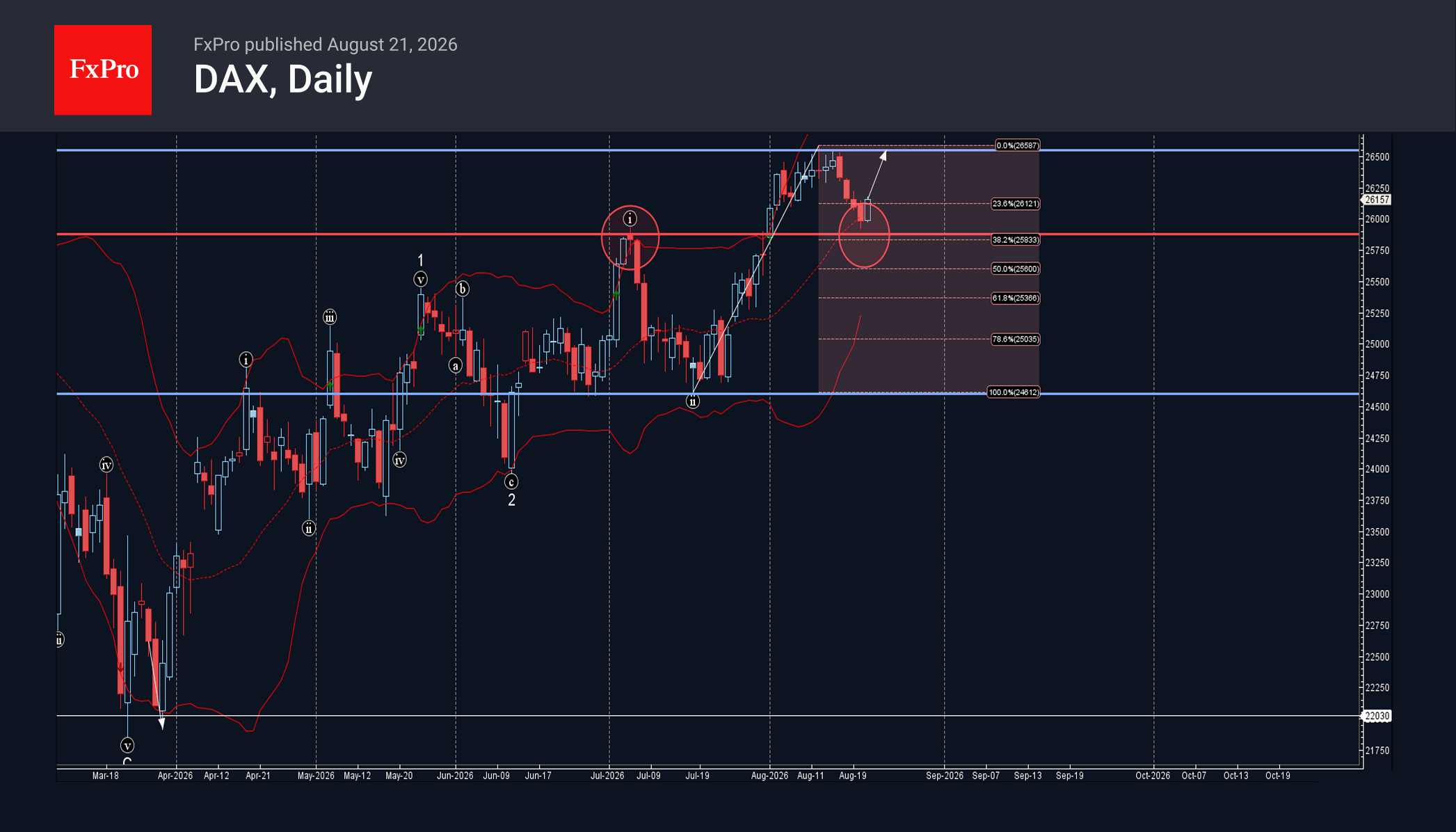
DAX index recently reversed up from the support zone between the pivotal support level 25875.00 (former resistance from the start of July), 20-day moving average and the 38.2% Fibonacci correction of the upward impulse from June.
The upward reversal from this support zone started the short-term impulse wave 5, that belongs to the long-term impulse wave (3) from March.
Given the clear daily uptrend, DAX index can be expected to rise further to the next round resistance level 26500.00, which reversed the price earlier this month.
Eco Data 8/24/26
| GMT | Ccy | Events | Act | Cons | Prev | Rev |
|---|---|---|---|---|---|---|
| 22:45 | NZD | Retail Sales Q/Q Q2 | -0.50% | 0.10% | 0.90% | 1.00% |
| 22:45 | NZD | Retail Sales ex Autos Q/Q Q2 | 0.70% | 0.30% | 1.00% | 1.10% |
| 22:45 | NZD |
| Retail Sales Q/Q Q2 | |
| Actual | -0.50% |
| Consensus | 0.10% |
| Previous | 0.90% |
| Revised | 1.00% |
| 22:45 | NZD |
| Retail Sales ex Autos Q/Q Q2 | |
| Actual | 0.70% |
| Consensus | 0.30% |
| Previous | 1.00% |
| Revised | 1.10% |
Next chapter of U.S.-Canada Trade War: What We Know and Don’t About Section 338 Tariffs
With no last-minute deal to avoid new section 338 tariffs, new tariffs have now officially taken effect on another subset of U.S. imports from Canada.
As we noted previously, the measures apply a 50% tariff rate on U.S. imports accounting for about 5% of Canadian exports to the United States – adding to existing tariffs on products like steel and aluminum, lumber, and motor vehicles.
As we argued a month ago when the tariffs were initially announced, the size of the tariffs is likely not large enough to derail Canada’s economic growth backdrop. The Canadian value added content of newly tariffed U.S. imports adds up to ~0.4% of Canadian GDP and jobs. More than 80% of exports would remain duty free under CUSMA exemptions.
Still, the measures mark a re-intensification of U.S. tariff threats/measures, and concentrated specifically on Canada. Here we outline what we know, and what we don’t know, about new measures and key questions that will need to be answered in the days ahead.
What we know:
For specific sectors targeted, the impact will be significant
These tariffs are different than previous measures in that, at least on paper, it appears that U.S. importers would have a significantly easier time than Canadian exporters diversifying to alternative markets.
By our earlier count, about 3.7% of total U.S. imports of products targeted come from Canada in 2025 while the U.S. accounted for 81% of Canadian exports of those products.
Plastic products, electrical machinery, furniture and wood product sectors are among the most significantly impacted by the new measures – and regionally that means a higher concentration of economic impact in Quebec, BC, and Ontario.
Because the tariff rate is so high and applies only to Canada, purchases of these products from Canada would be prohibitively expensive.
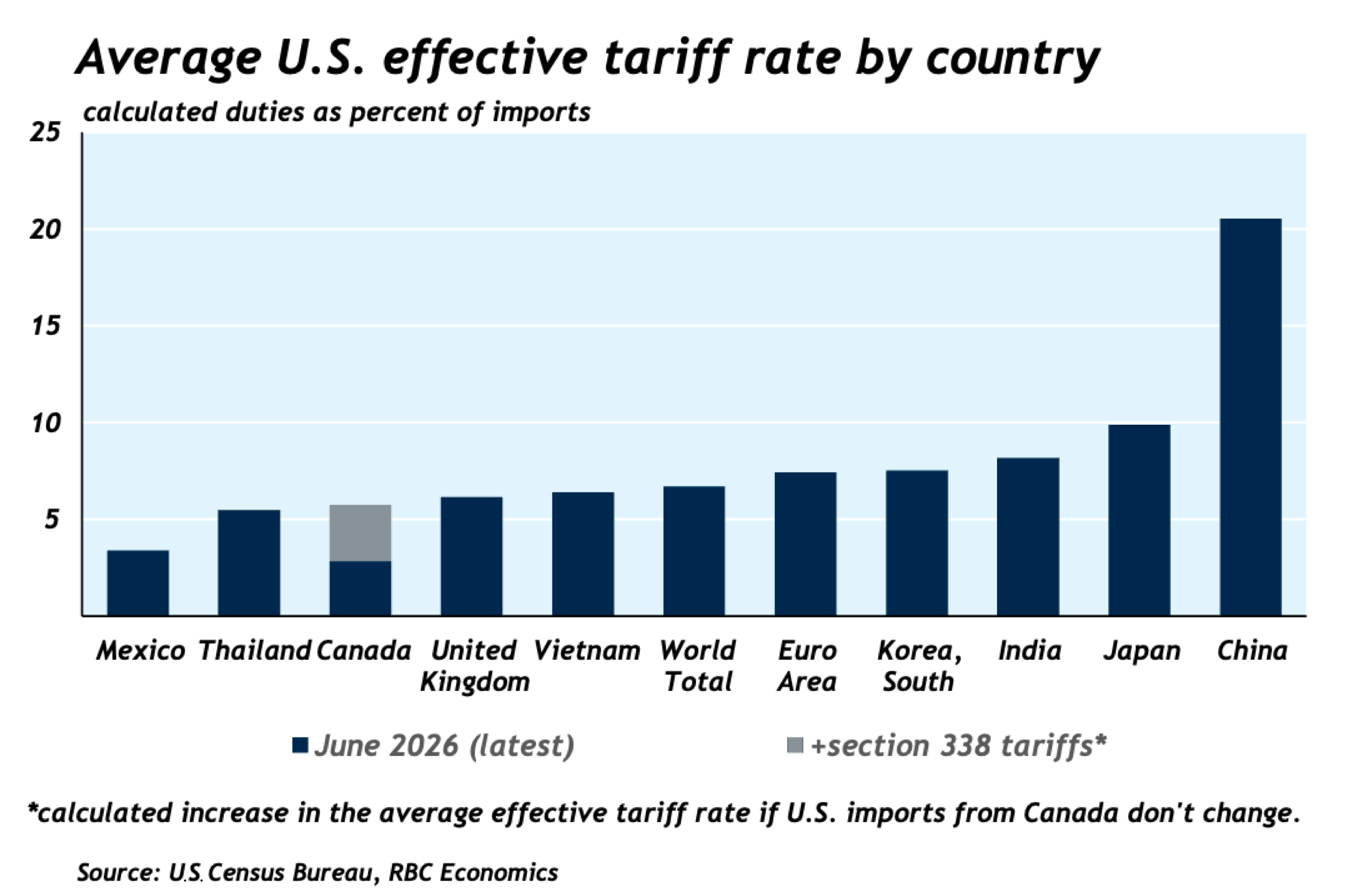
Canada’s average effective tariff rate mechanically would rise to around 6% from around 3%—no longer the lowest among major U.S. trade partners, but still below the average U.S. tariff rate on imports from all countries (close to 7%). In practice, the observed tariff rate will not increase that much, because many of these highly tariffed products will simply not be traded. But the economic cost of the increase is real nonetheless.
What we don’t know yet
How long will the tariffs be in place?
Prior tariffs imposed by the U.S. administration have been modified or dropped in the weeks following the initial imposition of measures.
That includes briefly imposed blanket tariffs on imports from Canada imposed in March 2025 before the CUSMA exemption that has since protected the bulk of Canadian exports from tariffs was imposed days later.
And an exemption list from broader U.S. tariffs imposed on all trade partners (the current section 301 tariff regime that replaced the section 122 measures that temporarily replaced the IEEPA tariffs struck down by the U.S. supreme court in February) has grown to cover more than half U.S. imports.
But the U.S. and Canadian sides have reportedly cut off negotiations, leaving the path to end the current additional tariffs highly uncertain.
What will Canada’s response be?
At time of writing Canada has not yet announced a specific response to the new U.S. tariffs but has signaled plans to impose retaliatory measures.
In general, retaliatory measures typically add costs to domestic (Canadian) imports rather than hurting foreign country exporters.
But a nuance in this case is that Canada is actually a net importer of products on the new section 338 tariff list from the United States – Canada imported about $23 billion USD of the products targeted from the U.S. in 2025 compared to about $20 billion USD of exports.
On paper, that means that redirecting imports of these specific products to instead purchase from Canadian sellers that otherwise would have been shipping to the United States mechanically could actually fully replace lost U.S. exports.
The reality is that would not be so simple – supply chains are heavily integrated so there are exporters/importers on both sides of the border that will see a significant increase in costs as a result of new tariffs.
But there is likely more potential for trade flows to reorient within North America to avoid increased tariff costs with these measures than some of the other sector specific tariffs imposed to-date.
Will business sentiment/investment falter?
Most (more than 80%) of Canadian exports to the U.S. would remain tariff free under new tariffs – but the unpredictability of U.S. administration tariff policy means it is not possible for businesses to predict which sectors might be next. And that unpredictability is a weight on business confidence across all trade exposed industries, not just those directly targeted with tariffs.
Still, businesses have been showing signs of adapting to living under uncertainty after a year and a half of tariff threats with measures of business confidence and investment perking up to-date in 2026.
Policy support to the rescue?
We do not expect the broader macroeconomic impact of these new tariffs to be enough to push the Bank of Canada to seriously consider pivoting to interest rate cuts.
Tariff economic growth headwinds are still relatively narrowly based in a smaller number of highly impacted industries and fiscal (government tax and spending) policy is still better suited to provide targeted relief than blanket changes in interest rates from the central bank – and there are reports that fiscal supports will follow the imposition of this latest tariff round.
Still, the intensification of trade uncertainty and recent moderation in underlying (excluding energy products) inflation trends also has increased the likelihood that the BoC will not hike interest rates this year.
What does it mean for broader CUSMA negotiations?
The section 338 tariff measures imposed further erode the share of Canadian exports protected by CUSMA, but more than 80% of Canadian exports should continue to cross the border duty free under current rules.
CUSMA itself does not expire for a decade, and the agreement requires negotiations in the mean-time to try and extend the deal before then. But the threat of additional tariffs will remain.
Still, the broader CUSMA exemption has held through multiple forms of broader U.S. tariff policies, including the current section 301 global tariff measures. U.S. average tariff rates globally have been drifting lower rather than higher with the list of broader products exempt from those section 301 tariffs rising to cover the bulk of overall U.S. imports.
While the future of U.S. trade policy is highly uncertain, we continue to argue that trade across the Canada and U.S. border is mutually beneficial, and that argues for the bulk of trade to remain tariff free under CUSMA.