Sample Category Title
GBP/USD Extends Gains as Bulls Keep the Pressure on
Key Highlights
- GBP/USD started a steady increase and climbed above 1.3650.
- A bullish trend line is forming with support near 1.3580 on the 4-hour chart.
- Gold surged and broke the $4,620 resistance zone.
- Bitcoin remained elevated, and the bulls could aim for a close above $80,000.
GBP/USD Technical Analysis
The British Pound found support near 1.3450 against the US Dollar. GBP/USD started another increase above the 1.3580 resistance zone.
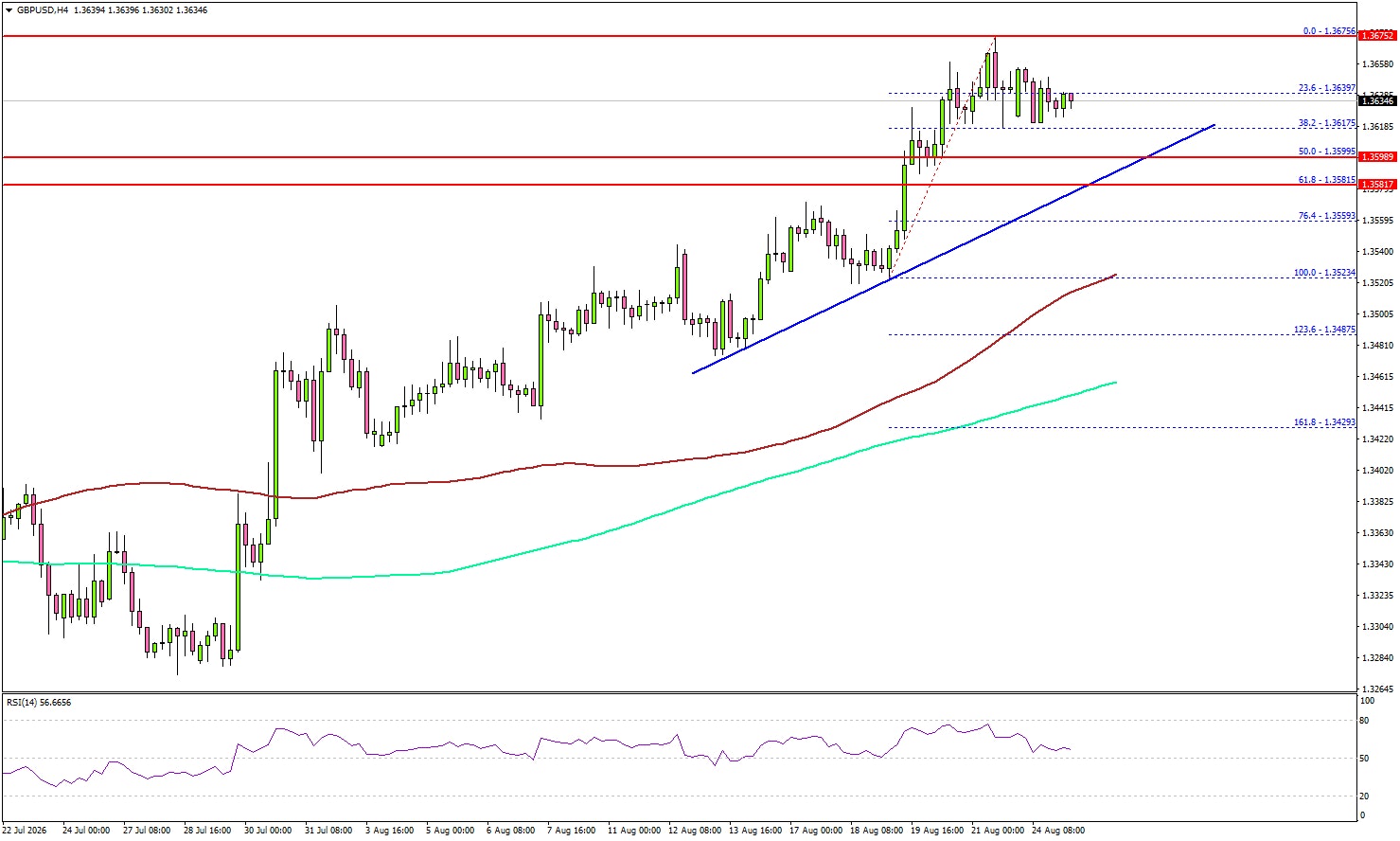
Looking at the 4-hour chart, the pair settled above 1.3600, the 100 simple moving average (red, 4-hour), and the 200 simple moving average (green, 4-hour). The pair climbed above 1.3650 and traded as high as 1.3675 on TitanFX before it started a consolidation phase.
On the downside, an immediate support could be near 1.3600 and the 50% Fib retracement level of the upward move from the 1.3524 swing low to the 1.3675 high.
The first major support could be near 1.3580. There is also a bullish trend line forming with support at 1.3580. The next major support could be near 1.3525 and the 100 simple moving average (red, 4-hour).
The main support might be 1.3450 and the 200 simple moving average (green, 4-hour). A downside break and close below 1.3450 might send the pair toward 1.3320. Any more losses could open the door for a test of 1.3250.
On the upside, the pair could face resistance near the 1.3675 level. The next major resistance might be 1.3720. A close above 1.3720 could start another steady increase. In the stated case, the bulls could aim for a move to 1.3800. Any further gains might open the door for a test of 1.3865.
Looking at Gold, the bulls seem to be back, and they might aim for a move above the $4,720 resistance level.
Upcoming Key Economic Events:
- US Housing Price Index for June 2026 (MoM) - Forecast +0.2%, versus +0.3% previous.
- S&P/Case-Shiller Home Price Indices for June 2026 (YoY) - Forecast +1.7%, versus +1.6% previous.
- Richmond Fed Manufacturing Index for August 2026 – Forecast 7.0, versus 5.0 previous.
RBA Minutes: Waits for More Evidence, but Pre-Emptive Hike Stays on Table
Minutes of RBA’s Aug. 10–11 meeting confirmed that August hold at 4.35% was a genuine choice between tightening immediately and waiting for more evidence. Board acknowledged inflation had eased and labour-market tightness had moderated, but stressed that “inflation was still too high” and economy “continued to operate with excess demand.” Members explicitly considered a 25bp hike, arguing that if inflation risks were sufficiently skewed upward, it “may be appropriate to mitigate those risks somewhat by tightening monetary policy pre-emptively.”
Upside risks ranged from a prolonged Middle East conflict driving oil prices sharply higher to stronger cost pass-through, larger AI and data-centre investment, resilient domestic demand and weaker productivity. Members also noted that “some spare capacity may be necessary to bring inflation back to target” when economy faces capacity constraints and adverse supply shocks. Still, Board judged current policy “appeared sufficiently restrictive to bring inflation back to target within a reasonable timeframe,” while allowing more time to assess incoming inflation, labour-market and activity data.
That leaves RBA with a clear conditional tightening bias rather than a completed hiking cycle. Minutes said “several members judged that it was quite possible that the upside risks to the inflation forecast would crystallise, requiring some further tightening.” Board also warned that more progress was needed before it could be confident inflation would return to target with current policy setting. August hold was therefore less a decision that 4.35% is definitively enough than a decision that RBA could afford to wait for stronger evidence before acting again.
Key Takeaways
- RBA’s Aug. 10–11 minutes confirmed Board actively considered a 25bp hike before unanimously holding cash rate at 4.35%.
- Policymakers said inflation was still too high, economy continued to operate with excess demand, and risks to inflation outlook were “tilted to the upside.”
- Board discussed whether upside risks justified “tightening monetary policy pre-emptively,” with oil, cost pass-through, AI investment, resilient demand and weak productivity among key concerns.
- RBA also acknowledged that “some spare capacity may be necessary to bring inflation back to target” under current supply-shock conditions.
- Hold reflected a decision to wait for more evidence, not confidence that tightening cycle is finished. Several members thought further tightening was quite possible if upside risks materialised.
Minutes of the Monetary Policy Board Meeting
Sydney – 10 and 11 August 2026
Members present
Michele Bullock (Governor and Chair), Andrew Hauser (Deputy Governor and Deputy Chair), Marnie Baker AM, Renée Fry-McKibbin, Ian Harper AO, Carolyn Hewson AO, Bruce Preston, Iain Ross AO, Jenny Wilkinson PSM
Others present
Sarah Hunter (Assistant Governor, Economic), Christopher Kent (Assistant Governor, Financial Markets)
Anthony Dickman (Secretary), David Norman (Deputy Secretary)
Meredith Beechey Osterholm (Head, Monetary Policy Strategy Department), Sally Cray (Chief Communications Officer), David Jacobs (Head, Domestic Markets Department), Michael Plumb (Head, Economic Analysis Department)
Brad Jones (Assistant Governor, Financial System), Andrea Brischetto (Head, Financial Stability Department) and Richie Evans (Acting Senior Manager, Financial Stability Department), for discussion of the item on macroprudential policy advice
Financial conditions
Members commenced their discussion by considering the outlook for central bank policy rates globally. Market participants expected policy rates in many advanced economies to rise over the coming 18 months, although by differing amounts. This reflected concerns about persistent underlying inflationary pressures, notwithstanding recent inflation outcomes generally having been a little lower than expected. Several central banks had already tightened policy during 2026. Members noted that expected increases in policy rates were larger where monetary policy was more accommodative, such as in New Zealand, Canada and Japan, and smaller elsewhere, such as in Australia, the United States and the United Kingdom. In the United States, resilient demand and persistent inflation had supported a higher expected path for policy rates over time, although the most recent Federal Reserve communication had been interpreted by market participants as reducing the likelihood of a policy rate increase in the near term.
Yields on long-term bonds issued by governments of most advanced economies had risen since the start of the year. The rise in yields on Australian government securities had been smaller than for some other sovereign bonds. Members noted that longer term yields had risen most noticeably in the United States and Japan, reflecting a larger increase in both policy rate expectations and implied risk premia. Measures of near-term inflation compensation from shorter term bonds had eased in most countries, including Australia, as oil prices had retraced from their earlier peaks. Measures of longer term inflation compensation in Australia were still consistent with the inflation target.
Members noted that aggregate volatility and risk premia in financial markets remained low, despite uncertainty associated with the conflict in the Middle East. Global equity prices had generally risen and corporate bond spreads had remained low over preceding months, supported by strong earnings and apparently limited concern among market participants about the effects of the conflict on global economic activity. Nonetheless, the equity prices of companies linked to the provision of artificial intelligence (AI) had been volatile and spreads on bonds issued by some of these companies had widened. This reflected significant fundraising for investment in AI, a reassessment of the prospective returns from investment in data centres (given broader developments in the market for AI services) and the unwinding of some highly leveraged positions in certain AI-related equities. In Australia, equity price indices had risen since May, despite a modest decline in expected earnings, though had underperformed many other markets over 2026.
In China, weakness in household consumption and the property market continued to weigh on aggregate private demand. Property market weakness and slower growth in investment had also weighed on demand for steel. This had been offset by increases in public infrastructure spending and exports. The focus of authorities’ support continued to be bond-funded fiscal spending and policies directed towards advanced manufacturing, AI, robotics and green technologies. Monetary policy in China was judged to be playing a limited role in stimulating economic activity.
The Australian dollar had depreciated by around 1 per cent on a trade-weighted basis since the May meeting, in response to a narrowing in yield differentials and lower commodity prices. However, it was still around 5 per cent higher than at the start of 2026. The nominal trade-weighted index remained broadly consistent with estimates of its long-run equilibrium level. As a result, it did not appear to be providing a source of variation that was additional to the standard transmission of monetary policy.
Against this backdrop, members turned to consider the stance of monetary policy in Australia.
Members noted that financial conditions in Australia had tightened in response to three increases in the cash rate in 2026 and were now judged by the staff to be somewhat restrictive. Banks had passed through these cash rate increases to deposit and lending rates. The current cash rate target was at the top of the range of model- and market-based central estimates of the nominal neutral rate. Medium- and long-term real interest rates derived from inflation-linked bonds were also around their highest level in over 15 years, though short-term real yields were significantly lower than long-term yields because of higher short-term inflation expectations. Members discussed the role of term premia, policy expectations and the real neutral interest rate in driving real interest rates. They concluded by noting that assessments of the neutral rate are inherently uncertain and do not provide a direct guide for monetary policy.
Other indicators were also consistent with financial conditions being somewhat restrictive. Demand for new housing loans had declined significantly, particularly from investors, though liaison suggested that competition among lenders for high-quality borrowers remained strong. Housing prices were also falling after an extended period of strong growth, though this reflected a range of factors beyond monetary policy transmission alone. By contrast, business debt had continued to grow strongly despite higher borrowing costs. Business funding was still readily available from banks and capital markets. Growth in business credit had been broadly based across the business sector.
Scheduled mortgage payments, as a share of household disposable income, had risen to near their 2024 peak and were expected to increase a little further as earlier increases in the cash rate flowed through. Members noted that many households with mortgages tended to have sizeable pre-payment buffers they could potentially draw upon if needed to help smooth consumption. Extra mortgage payments had eased but were still around their long-run average (as a share of disposable income).
Members noted that, since May, financial markets had reduced their expectations for further monetary policy tightening, which, other things equal, would have eased financial conditions marginally. That decline followed weaker-than-expected domestic data and declines in global oil prices. Pricing implied that market participants saw little prospect of an increase in the cash rate target in August and around half a chance of a further 25 basis point increase by the end of 2026. Most market economists expected no further increase in the cash rate target, though a small number still expected another increase would be needed to stem persistent domestic inflation pressures. Some market economists expected the cash rate target to be lowered over the first half of 2027.
Economic conditions
Members’ discussion moved to the global economy. They began by considering developments surrounding the Middle East conflict, for which there had been some prospect of normalisation at the time of the June meeting (following the announcement of an interim peace agreement between the United States and Iran). However, the conflict was ongoing and continued to disrupt energy production and shipping in the region. Oil and most related commodity prices remained above pre-conflict levels, although they had been volatile over preceding months. Looking through this volatility, oil prices at the time of the meeting were broadly in line with the staff’s assumption in their May forecasts. However, members noted that global inventories of oil and oil products were much lower than at the start of the conflict, creating an upside risk to energy prices if supply disruptions continued.
Overall GDP growth in Australia’s major trading partners had continued to be stronger than expected. For some of Australia’s Asian trading partners, the boost to manufacturing activity from global AI-related investment had been particularly pronounced and had outweighed the negative effects of the Middle East conflict and changes in US trade policy since early 2025.
Members noted that higher energy prices and strong demand for goods used to develop AI services were adding to inflationary pressures in some economies. While core measures of consumer price inflation had not yet risen significantly following the onset of the Middle East conflict, members discussed the potential for these and other global developments to generate a more pronounced inflationary impulse. If so, this could push up Australian import prices and, in turn, consumer prices.
Turning to the domestic economy, members noted that inflation in Australia remained well above target, even after easing unexpectedly in year-ended terms in the June quarter. The largest undershoot of expectations was in headline inflation, due to lower-than-expected retail fuel and travel prices. By contrast, underlying inflation, as measured by the trimmed mean, had increased to 3.6 per cent in the quarter, only slightly lower than expected. Members noted that the strength in underlying inflation likely reflected a combination of broad capacity pressures – as evidenced by ongoing elevated inflation for categories such as market services – and some pass-through of cost increases related to the Middle East conflict.
Members noted that evidence of the pass-through of cost pressures from the Middle East conflict had been mixed. Higher input costs had contributed to increases in the prices of new dwellings in the June quarter. Elsewhere, pass-through appeared to have been a little lower in the quarter than assumed in the May forecasts. The staff continued to expect broader pass-through over coming months, reflecting prevailing capacity pressures and still-elevated short-term inflation expectations (despite some easing since the previous meeting). The potential for a more prolonged conflict in the Middle East posed upside risks to this expectation. However, the extent of pass-through would depend on the degree to which firms were constrained by customers’ price sensitivity and therefore absorbed margin pressures.
Overall demand growth looked to have moderated a little since the start of the year, broadly as anticipated. As expected, underlying momentum in household consumption appeared to be easing only gradually. This was despite very weak consumer sentiment, but consistent with most households’ balance sheets remaining in good shape. Business investment had increased very strongly in the March quarter, driven by growth in data centre fit-outs, and surveyed business conditions had declined only modestly since then. By contrast, conditions in the established housing market had eased by more than anticipated in May and national housing prices had declined by around 1½ per cent from their March peak. Members noted that this easing appeared to reflect the combined effect of increases in the cash rate, tax changes announced in the Federal Budget and weaker sentiment (with the relative importance of each difficult to discern precisely). They also observed that the recent easing in housing prices followed a period of very significant increases; housing prices were still around 50 per cent higher than at the onset of the pandemic and 5 per cent higher than a year earlier.
In the labour market, conditions had eased by a little more over preceding months than had been expected. However, the unemployment rate remained low and conditions were still considered a little tight. Leading indicators were consistent with only limited easing in labour market conditions in the near term.
Members considered the implications of these developments for spare capacity. Slower growth in aggregate demand was helping to bring potential supply and aggregate demand back into balance, but members assessed that some capacity pressures remained in the labour market and economy more broadly. That also reflected weak productivity growth, which continued to constrain the capacity of the Australian economy to supply goods and services. Model-based assessments of capacity pressures were consistent with recent information from liaison and evidence from business surveys. Firms across a range of industries reported continued labour and non-labour cost pressures and challenges sourcing suitable staff.
Economic outlook
Members turned to the outlook for economic activity and inflation.
The outlook for near-term growth in Australia’s major trading partners had again been revised higher, the latest in a sequence of quarterly upgrades to forecasts for trading partner growth over the prior year. Those upgrades reflected both greater-than-anticipated resilience in global trade flows and a run of upside surprises in AI-related activity, which continued to drive growth in a range of high-income east Asian economies. For economies outside east Asia, growth forecasts were broadly unchanged since May, with the effects of the Middle East conflict on activity evolving largely as expected. Members noted that a combination of AI-related upside growth surprises and broader economic developments suggested that headline inflation in many economies would remain above central bank targets into 2027. This also posed an upside risk to global goods prices and, in turn, Australian import prices.
The staff’s forecasts for the Australian economy were conditioned on financial market pricing for global oil prices and the cash rate. Under these assumptions, year-ended GDP growth was expected to slow over 2026 before recovering gradually over 2027 and 2028. Members noted that the subdued path for GDP growth over the forecast period was driven by both softer demand (reflecting the impact of high inflation on real incomes, easing conditions in the established housing market and the recent tightening of monetary policy) and limited growth in the supply potential of the economy. Members discussed the various interactions between housing prices and economic activity, including through dwelling investment and consumption. They also discussed the stronger outlook for business investment arising from recent and anticipated strength in investment in data centres.
The forecast was for GDP growth to be below its potential rate over the forecast period. This was expected to bring the levels of aggregate demand and potential supply into balance in 2027, a little earlier than previously expected, after which some spare capacity was expected to emerge. Members noted that the forecast future level of productivity had again been revised down, reflecting productivity outcomes that had consistently been even weaker than assumed for some time and an unchanged assumption for medium-term productivity growth.
Subdued GDP growth was expected to weigh on future labour demand. The unemployment rate was forecast to increase gradually to 4.8 per cent by end-2028, a little higher than forecast in May because of a higher starting point. Members noted that these forecasts suggested spare capacity in the labour market would begin to emerge from late 2027. This was expected to constrain wages growth over time, although the near-term wage forecast profile had been slightly upgraded due to a range of recent wage decisions and agreements.
Headline and underlying inflation were both forecast to remain elevated in the near term. Members noted that this reflected assumptions about capacity pressures in the economy and the pass-through to consumer prices of fuel and other costs affected by the Middle East conflict. For trimmed mean inflation, the central projection was very similar to that in May. Trimmed mean inflation was forecast to remain above 3 per cent until mid-2027 and then reach around 2½ per cent in late 2027 as capacity pressures and conflict-related cost pressures ease. Members noted a range of upside risks to this projection, including: global oil prices could move even higher if the conflict in the Middle East persists or escalates; pass-through to consumer prices of cost pressures related to the conflict could be more pronounced; and domestic capacity pressures could be more enduring if the global or Australian economies receive more support from AI-related investment than anticipated or growth in domestic supply capacity proves even weaker than assumed. Members also noted potential downside risks: the labour market may be easing more quickly than assessed; activity could slow more rapidly than assumed (perhaps in response to the housing market downturn); there could be further adverse changes to global trade policy; and expected returns from AI investment could be revised down sharply. Members noted that, on balance, the staff judged the risks to be skewed to the upside.
Considerations for monetary policy
Turning to considerations for the monetary policy decision, members noted that data received since the previous meeting indicated that the economy was progressing towards the Board’s objectives. Inflation had eased from its peak in March and the quarterly rate of underlying inflation was slightly lower than it had been in late 2025. A little more of the tightness in the labour market had abated and the output gap was forecast to close slightly earlier than envisaged in May. On some metrics, this progress had occurred a touch more rapidly than had been expected. Nonetheless, members observed that inflation was still too high and that the economy continued to operate with excess demand.
Members judged that financial conditions were somewhat restrictive, following increases in the cash rate target earlier in the year. They observed that momentum in the housing market had shifted over preceding months. Housing prices were falling in some capital cities, though this followed a long period of strong housing price growth and was being driven by factors other than monetary policy. The softening in housing demand had flowed into weaker demand for new housing loans, although growth in business credit continued to be strong.
Members noted the staff forecast that inflation would decline only gradually, returning to around the midpoint of the target range by late 2027. They observed that the risks to this projection were tilted to the upside. Members acknowledged that it was difficult to incorporate some of these risks into the central forecasts, given the potentially extreme nature of their associated outcomes, but that these remained relevant to their policy decisions. They also discussed various downside risks that might provide some offset.
In light of these observations, members considered whether to raise the cash rate target by 25 basis points at this meeting or to leave it unchanged for the time being.
One argument to raise the cash rate target by 25 basis points at this meeting was founded on an assessment of the risks to the inflation forecast. Members noted that if the risks around the inflation forecast were judged to be significantly skewed to the upside, it may be appropriate to mitigate those risks somewhat by tightening monetary policy pre-emptively. In that regard, members discussed various upside risks, including: a prolonged conflict in the Middle East could cause oil reserves to dwindle to very low levels and oil prices to rise sharply; widespread cost pressures reported in liaison could be passed into consumer prices more fully than assumed; the AI and data centre investment boom could prove to be larger than anticipated, globally and/or in Australia; aggregate demand in Australia more generally could be more resilient than forecast; and productivity growth might not pick up as assumed in the forecasts. Members noted that the case to raise the cash rate target to mitigate some of these risks would be further strengthened if they placed greater importance on returning inflation to target no later than the extended timeframe already envisaged in the forecast profile. Members observed that the central forecast was for inflation to return only gradually to target, adding to the already prolonged period over which it had been above target.
The case to raise the cash rate target at this meeting could also be further strengthened if members judged that the trade-off involved in bringing inflation down faster – namely, a sharper-than-forecast easing of labour market conditions – was perhaps gentler than in some other historical episodes, given the state of the economy and the nature of current shocks. In considering this, members noted findings from recent staff research that relatively significant movements in inflation can be associated with quite small changes in capacity utilisation when the economy is operating with limited spare capacity. Members also noted staff research that indicates short-term inflation expectations matter for inflation dynamics even when longer term expectations are anchored. They observed that both findings imply that a more pre-emptive approach to monetary policy might be appropriate when the economy is subject to capacity constraints and adverse supply shocks. In applying this to the current circumstances, members acknowledged that the global cost shock generated by the conflict in the Middle East meant some spare capacity may be necessary to bring inflation back to target.
The case to leave the cash rate target unchanged at this meeting relied on forming a judgement that, following the increases in the cash target earlier in the year, monetary policy appeared sufficiently restrictive to bring inflation back to target within a reasonable timeframe, and that there was still some time to assess the accuracy of that judgement.
Members noted that one argument in support of the current setting of monetary policy already being sufficiently restrictive was that the data received since the previous meeting had signalled that the economy was moving steadily towards the inflation and full employment objectives. Indeed, inflation had been a little lower than forecast (though still well above target) and the unemployment rate had risen by slightly more than expected in May. Members observed that the staff’s central forecast for inflation had it returning to around the midpoint of the target range in late 2027, under the technical assumption that the cash rate target ended the forecast period at around its current level. It was acknowledged that inflationary pressures might turn out somewhat stronger than this central case if some of the upside risks crystallised. However, this was judged to be uncertain and the near-term evolution of the economy afforded some time to leave monetary policy unchanged while assessing what incoming data reveal about these risks. Members noted that, by the following meeting, they would have received additional monthly reports on inflation and the labour market and the June quarter national accounts, while also gaining additional information about trends in the housing market and the course of the conflict in the Middle East.
Another reason to leave the cash rate target unchanged at this meeting was that members might judge the risks around the inflation forecast to be balanced rather than tilted to the upside. Risks to the downside included the potential for: the labour market to be easing more rapidly than assessed; a more material adverse impact on activity from the conflict in the Middle East; a larger impact on aggregate demand from weak consumer confidence and/or the downturn in the housing market; and greater constraints on firms passing on cost pressures into final prices than expected.
Having considered these various arguments, members judged it appropriate to leave the cash rate target unchanged at this meeting, while remaining alert to the upside risks to the inflation outlook and being ready to act should they materialise. Members agreed that the prevailing cash rate appeared to be working to bring the economy gradually back into balance and that the data received since the previous meeting had been consistent with this observation. The Board concluded that, in this light, there was time to assess the incoming data for signs of the risks to the inflation forecast materialising.
Several members judged that it was quite possible that the upside risks to the inflation forecast would crystallise, requiring some further tightening. Other members noted the potential for downside risks to offset them. All members agreed that, given prevailing uncertainties, upcoming decisions would benefit from additional information that could strengthen their conviction about the outlook for inflation. Members agreed that further progress in delivering the outcomes envisaged in the central projection would be needed before they could be confident that inflation would return to target with the current monetary policy setting. They re-confirmed their commitment to returning inflation to target in a timely way.
In finalising its statement, the Board agreed to remain attentive to the data and the evolving assessment of the outlook and risks when making its decisions. The Board will remain focused on its mandate to deliver price stability and full employment and will continue to do what it considers necessary to achieve that outcome, including increasing the cash rate target if upside risks materialise.
The decision
The Board decided unanimously to leave the cash rate target unchanged at 4.35 per cent.
Financial stability advice to the CFR and APRA
Members discussed and approved financial stability advice that the staff had prepared for the RBA to provide to the Council of Financial Regulators (CFR) and the Australian Prudential Regulation Authority (APRA) at the next CFR meeting. This was in keeping with commitments made by the RBA in the CFR Charter and the Memorandum of Understanding between the RBA and APRA.
Members noted that financial stability considerations were not constraining the Board’s ability to set monetary policy. While members remained alert to financial stability risks, particularly those emanating from offshore, the strong financial positions of domestic banks and most Australian households and businesses meant they are well placed to manage increased financial pressures over the period ahead.
In light of the current environment and outlook, members supported APRA’s recent position to keep macroprudential policy settings unchanged. This recognised these settings’ important role in guarding against a material build-up of vulnerabilities and supporting the resilience of the Australian financial system.
Eco Data 8/25/26
| GMT | Ccy | Events | Act | Cons | Prev | Rev |
|---|---|---|---|---|---|---|
| 01:30 | AUD | RBA Meeting Minutes | ||||
| 06:00 | EUR | Germany GDP Q/Q Q2 F | 0.30% | 0.20% | 0.20% | |
| 08:00 | EUR | Germany IFO Expectations Aug | 88.8 | 87.5 | 86.7 | |
| 08:00 | EUR | Germany IFO Business Climate Aug | 88.5 | 87.3 | 86.6 | |
| 08:00 | EUR | Germany IFO Current Assessment Aug | 89.1 | 87 | 86.5 | |
| 13:00 | USD | Housing Price Index M/M Jun | 0.20% | 0.30% | ||
| 14:00 | USD | Consumer Confidence Aug | 90.3 | 90.8 | ||
| 14:00 | USD | New Home Sales M/M Jul | 620K | 628K |
| 01:30 | AUD |
| RBA Meeting Minutes | |
| Actual | |
| Consensus | |
| Previous | |
| 06:00 | EUR |
| Germany GDP Q/Q Q2 F | |
| Actual | 0.30% |
| Consensus | 0.20% |
| Previous | 0.20% |
| 08:00 | EUR |
| Germany IFO Expectations Aug | |
| Actual | 88.8 |
| Consensus | 87.5 |
| Previous | 86.7 |
| 08:00 | EUR |
| Germany IFO Business Climate Aug | |
| Actual | 88.5 |
| Consensus | 87.3 |
| Previous | 86.6 |
| 08:00 | EUR |
| Germany IFO Current Assessment Aug | |
| Actual | 89.1 |
| Consensus | 87 |
| Previous | 86.5 |
| 13:00 | USD |
| Housing Price Index M/M Jun | |
| Actual | |
| Consensus | 0.20% |
| Previous | 0.30% |
| 14:00 | USD |
| Consumer Confidence Aug | |
| Actual | |
| Consensus | 90.3 |
| Previous | 90.8 |
| 14:00 | USD |
| New Home Sales M/M Jul | |
| Actual | |
| Consensus | 620K |
| Previous | 628K |
U.S. Tariffs Take Effect, Canada to Retaliate
- U.S. tariffs of 50% on roughly 5% of Canadian exports took effect on Saturday (see commentary).
- Canadian Prime Minister, Mark Carney, has stated new Canadian tariffs will match "dollar for dollar" and be implemented starting September 8th.
- The Canadian tariffs will cover American steel, dairy, appliances, agricultural equipment, pulp and paper, electronics and other products.
- The exact details of these counter-tariffs have yet to be provided on their rate and the specific products, as well as government supports.
Key Implications
- Trade uncertainty never left the Canadian landscape when negotiations were unfolding last week, but now it's been taken up a notch. The new U.S. tariffs could shave 0.3-0.6 percentage points from GDP growth over the next year. However, this estimate doesn't include offsetting government policy measures for impacted businesses that are expected to be announced this week.
- It also doesn't include Canada's counter-tariff response, which could subtract another 0.1 percentage points off growth (assuming a 50 percent counter-tariff). It can reasonably be expected to lift inflation this year, but this will depend on the composition of goods subject to tariffs.
- The downside to the economy comes after a second quarter that was tracking growth above 3%. The momentum had been expected to fade in the second half of the year, but the new tariffs should drag this figure even lower. Looking ahead, growth is now likely to come in closer to the mid-1s (%) by the end of 2027 (Q4/Q4), rather than our earlier estimate of close to 2%, with risks to the downside should tariffs escalate from here.
- On inflation, prior Bank of Canada (BoC) analysis found roughly a quarter of new tariffs showed up in consumer on prices, resulting in a 0.3 percentage point increase to CPI. However, those tariffs were applied to roughly $C60 billion of goods, whereas the current tranche would affect roughly $C28 billion if matched dollar for dollar. On the flip side, this round of tariffs may be set at a higher tariff threshold than the 25% rate previously applied.
- Working in Canada's favour is a relatively lower starting point on core inflation. The Bank of Canada's core measures averaged 2.0% year-on-year (y/y) in July, while the classic measure excluding food and energy clocked in at 1.9% y/y, both still comfortably within the BoC's target range. In contrast, U.S. CPI excluding food and energy registered 2.5% y/y in July, while PCE excluding food and energy still hung at 3.3% y/y in June. A better starting point offers a modicum of relief for households ahead of what is expected to be a bumpy rise.
- However, no matter how the numbers are sliced, there's no question that the back-and-forth volley of tariffs will be net negative for Canadian growth. This will be amplified if further tit-for-tat escalation occurs.
- For the BoC these latest developments reinforce their stand-pat stance. Trade uncertainty remains elevated, with the downside risks to growth on the forefront. Two-year Canadian yields are down 10 basis points at the time of writing, while the loonie has sold off moderately against the USD.
GBPUSD Consolidates Under New Multi-Month Peak
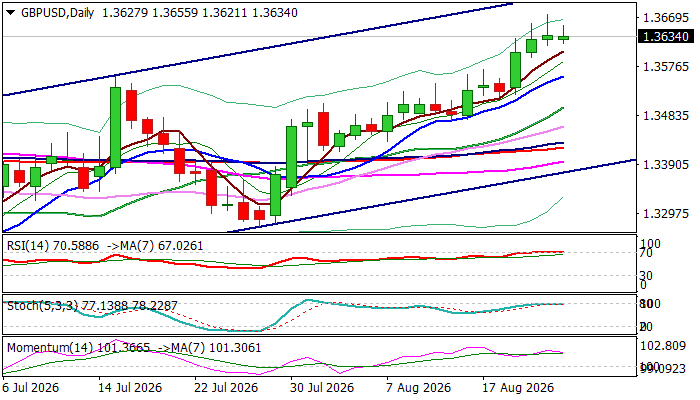
Cable trades near 6 ½ month peak (1.3675, hit on Friday) and moving in more quiet mode on Monday, as traders reduce speed ahead of this week’s key events – release of US PCE Index and the speech of Fed’s Warsh in Jackson Hole symposium, which is expected to provide the latest inflation update as well as potential signal about the US central bank’s steps in coming months.
Negatively diverging 14-d momentum, overbought RSI and long upper shadows on Thu/Fri daily candles, warn that bulls may start losing traction.
Larger bullish structure remains firm and suggests that corrective dips should be shallow (ideally to be contained by rising 10DMA at 1.3559, with deeper pullback to find footstep above 1.3520 – Fibo 38.2% of 1.3273/1.3675 upleg) and keep bulls in play for potential acceleration towards 2026 peak at 1.3869.
Res: 1.3655; 1.3675; 1.3712; 1.3730
Sup: 1.3617; 1.3580; 1.3520; 1.3500
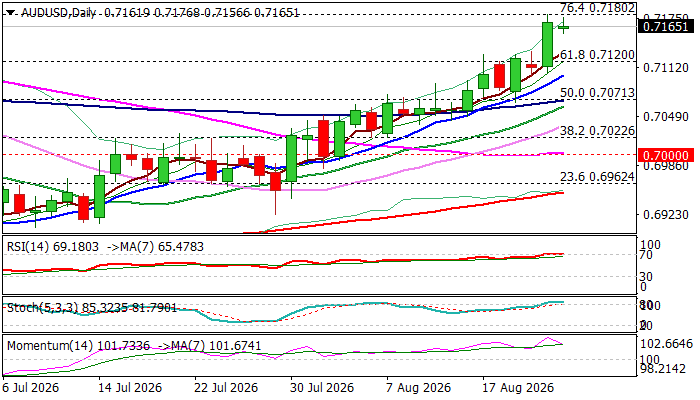
AUDUSD – Bulls Pause After Friday’s Strong Rally, Eye Economic Data for Fresh Signals
AUDUSD consolidates just under new 2 ½ month high on Monday after last Friday’s 0.8% gain completed uninterrupted eight-week rally.
Bulls cracked a double Fibo barrier at 0.7180 (Fibo 76.4% retracement of 0.7277/0.6865 / Fibo 161.8% expansion of the third wave of five-wave cycle from 0.6865, June 30 low) where stronger headwinds could be expected, as daily studies are overbought.
However, larger bulls remain firmly in play (bullish daily studies / favorable fundamentals) with consolidation / limited dips likely to precede fresh push higher.
Firm break of barriers at 0.7180 /0.7200 zone (Fibo / May 29 lower top) to signal bullish continuation and expose key barrier at 0.7277 (May 6 peak, the highest in four years).
Rising 10DMA and broken Fibo 61.8% (0.7100/20) should contain dips to keep larger bulls intact.
Traders focus on releases of RBA minutes (Tuesday), Australia’s July CPI / US July PCE (Wednesday) for fresh signals.
Res: 0.7180; 0.7200; 0.7222; 0.7277
Sup: 0.7156; 0.7120; 0.7100; 0.7071
Sunset Market Commentary
Markets
- Markets took a calm start to the new trading week. We should probably label it wait-and-see indecisiveness before multiple event risk to potentially unravel later this week. US yields decline between 1.5 bps (2-y) and 4.2 bps (30-y). With the 30-y yield holding at 5.23% and last week's multi-year top still (5.33%) still within reach, this hardly can be seen as a sign of relief. CNBC reporting that the US Treasury might be considering to use some cash reserves from the Treasury General Account at the Fed (TGA) ($935bn as of August 20) to fund buybacks of bonds with longer maturities could partially explain today's (bull) flattening of the US yield curve. This strategy of course doesn't fundamentally change the sustainability of US public finances but might give markets an indication on how the US Treasury intends to buy time. Aside from this fiscal narrative, markets continue to look out whether Fed Chair Warsh will be able to 'clarify' his commitment to deliver on the Fed's price stability mandate when addressing the Jackson Hole Symposium on Friday. Whatever the impact of the TGA headlines, this of course doesn't apply to European/German bond markets. German yields are changing between +2 bps (2-y) and -0.5 bps (30-y). A similar 'defensive' wait-and see narrative applies to the stabilization of the oil price (Brent $93+/b). The European reference gas contract (Dutch TTF) even doesn't see any reason to wait the new set of US economic sanctions against Iran (and its trading partners; "the single greatest financial offensive ever marshalled against any adversary"). The TTF reference adds another €2+/MWh to touch €69, heading for the highest close since the start of the Iran conflict end February. It only cements market expectations for the ECB to continue a gradual path of tightening monetary conditions, starting with a next 25 bps step in September. US and European equity markets show a modest risk-off modus heading into this week's event risks (EuroStoxx 50 -0.3%) with tech again underperforming (Nasdaq -0.6% at the open).
- Persistent higher energy prices ahead of the announcement of US sanctions against Iran, a risk-off sentiment and an (admittedly mild) bull flatting of the US yield curve give the dollar some breathing space after last week's setback. EUR/USD holds below the 1.17 big figure (1.167). DXY is testing the 99.00 area. USD/JPY tries to regain the 159 level. Even so any 'USD gains' for now remain limited and technically negligeable.
News & Views
- The Czech composite confidence indicator decreased from 101.1 to 100.5 in August. The slight deterioration came on behalf of weaker consumer sentiment (102.3 from 105.6; lowest since August 2025) with business confidence stabilizing at 100.2. The deterioration was broad-based (overall economic situation over the next 12 months, current financial situation and planning to make major purchases) with only the share of households expecting an improvement in their financial situation over the next 12 months remaining at the level of July. On a sectoral level, business confidence increased only marginally in the industrial sector while decreasing in trade, in construction and slightly in selected services sectors.
- The Hungarian Finance Ministry today announced that it can't reduce the budget deficit further this year due to the cost of drought and energy crisis over the Summer. They target a 7.5% budget deficit which would've been 8.3% of GDP without the post-election budget steps that've already been implemented. Government debt is expected to temporarily rise to 77.5% of GDP this year (from 74.6%). Debt will start falling from 2027 onwards, according to projections the government will publish in October.
Dollar Gets a Breather as CAD Absorbs Tariff Shock and AUD Awaits RBA Minutes
Today's themes:
- Dollar: recovering after last week's slide, but this looks like consolidation after a roughly 2.6% one-month decline rather than a decisive reversal, helped at the margin by Treasury funding details that reduce, but don't eliminate, one institutional financing concern.
- CAD: weakest major currency, absorbing newly-imposed 50% US tariffs with surprisingly contained damage, though Treasury Secretary Bessent's 1:00pm EDT Iran sanctions announcement, and its impact on oil, is the more meaningful test still ahead.
- AUD: trading mid-pack ahead of Tuesday's RBA minutes, which need to show just how close the RBA's August 11 hold came to being a hike.
Why it matters: None of these three stories share a common driver, which is itself the signal, markets are consolidating ahead of specific catalysts rather than reacting to one unifying theme. Bessent's Iran announcement is the most immediate risk to that calm, since a scope surprise could push oil, and then CAD, into a more decisive move.
Dollar Recovers After Last Week’s Slide
Dollar is finally getting some relief after last week’s sharp decline, but Monday’s recovery has yet to overturn broader bearish backdrop. USD leads major currencies, followed by JPY and GBP, while CAD sits at bottom of table. After DXY entered day still down roughly 2.6% over one month, rebound can be read first as consolidation after an extended selloff rather than evidence that Dollar trend has decisively reversed.
Fresh Treasury funding details have helped at margin. Unnamed officials indicated part of near-$1tn Treasury General Account could be used to support expanded long-duration buybacks, reducing need to fund purchases entirely through additional short-term bills. More importantly for recent Dollar debate, officials presented this as removing one potential route by which Fed might be drawn into Treasury financing operations. That narrows one institutional concern, but it does not repair deficit trajectory or remove government borrowing requirement. Broader structural Dollar case is discussed in Dollar Index Faces Structural Breakdown Toward 90, EUR/USD Eyes 1.20 Breakout.
Monday's FX Ranking
- Strongest: Dollar, followed by Yen and Sterling.
- Weakest: Loonie, followed by Kiwi, and Swiss Franc.
Iran Sanctions Keep Oil and CAD on Alert
Conviction is also limited ahead of Treasury Secretary Scott Bessent’s Iran sanctions announcement at 1:00pm EDT. In a Financial Times op-ed published Sunday, Bessent said objective was to sever economic lifelines sustaining Tehran, following increasingly aggressive US rhetoric that included President Donald Trump’s description of campaign as an “economic D-Day.” Iran has responded defiantly, including threats around vessels violating its interpretation of Hormuz transit rules, while rial fell to a record low ahead of announcement.
For markets, most immediate transmission channel runs through crude. Oil has pulled back after two consecutive weekly gains as traders take profits ahead of sanctions details, but that move has not yet developed into a fresh deterioration in underlying supply-demand outlook. Bessent’s announcement could change that quickly depending on scope of measures and Tehran’s response,.
CAD Weakens, but 50% Tariff Shock Fails to Trigger Disorder
Loonie is weakest major currency so far, but selling has been relatively restrained given deterioration in Canada-US trade relations. Negotiations collapsed late Friday, 50% US tariffs are now in force under first-ever presidential use of Section 338 of Tariff Act of 1930, and Ottawa has promised dollar-for-dollar retaliation beginning September 8.
Several factors help explain muted FX response. Some trade-risk premium was already embedded before talks formally failed, while tariffs were known before Monday’s session rather than arriving as fresh intraday shock. Canada’s own countermeasures are also still more than two weeks away, so full two-way tariff confrontation has not yet hit. At same time, Dollar itself is only recovering from a much larger decline rather than beginning an obvious broad-based surge. CAD is therefore absorbing substantial negative headlines without yet showing signs of uncontrolled repricing. Iran announcement and resulting oil reaction may provide more meaningful test later in session.
Canada-US Tariff Escalation
- Trigger: negotiations collapsed late Friday.
- US action: 50% tariffs now in force under the first-ever presidential use of Section 338 of the Tariff Act of 1930.
- Canada's response: dollar-for-dollar retaliation promised, beginning September 8.
- Why FX reaction is muted: risk premium already partly priced, tariffs known before Monday's session, and retaliation still more than two weeks away,
Aussie Waits for RBA Minutes to Show How Close August Hike Was
Australian Dollar is trading in middle of pack ahead of Tuesday’s RBA minutes. The central bank kept cash rate at 4.35% on Aug. 11 in unanimous decision, marking second consecutive hold after hikes in February, March and May. Decision nevertheless carried clear hawkish bias, with Board warning it would tighten again if upside inflation risks materialized.
Governor Michele Bullock has since confirmed both hike and hold were actively discussed, while Deputy Governor Andrew Hauser reinforced hawkish tone last week. With June CPI easing from 4.0% to 3.8% but still above RBA’s 2–3% target range, minutes now need to show just how close Board came to acting.
That makes Tuesday’s question unusually simple. If minutes portray August as genuine near-miss on another hike, AUD and Australian yields could regain support. If discussion instead reveals a more comfortable hold with tightening retained mainly as insurance against future inflation surprises, some of existing hawkish policy premium could fade.
Three Stories, One Quiet Monday
For now, Monday’s FX picture is one of consolidation rather than wholesale repricing. Dollar is getting a breather, CAD is absorbing a severe tariff headline with relatively contained damage, and AUD is waiting for clearer evidence on RBA’s next move. Bessent’s Iran sanctions announcement is most immediate risk to that calm, particularly if it forces oil—and then CAD—into a more decisive move.
Related Coverage
Tariff & CAD Deep Dive
- Read why USD/CAD is treating Canada's 50% tariff shock far more cautiously than the headline severity suggests, with 1.3927 now a key technical test: Canada's 50% Tariff Shock Looks Huge. USD/CAD Is Treating It Differently.
Gold & Fed Deep Dive
- See why only one of the three ways Fed Chair Warsh could address Treasury-Fed coordination at Jackson Hole actually threatens Gold's current rally: The Three Ways Fed Chair Warsh Could Move Gold at Jackson Hole — and Why Only One Threatens the Rally.
Asia-Pacific Data
- Read why New Zealand's Q2 retail sales drop hides a sharp divergence between fuel-driven nominal spending and weaker real volumes: New Zealand Retail Sales Fall -0.35% Q/Q as Fuel Price Surge Masks Weaker Volumes.
Frequently Asked Questions
Q: Why is Dollar's rebound being read as consolidation rather than a trend reversal?
A: Because DXY entered Monday still down roughly 2.6% over one month, so a single day's recovery is a small offset against an extended decline, not proof the trend has reversed. The Treasury funding detail that helped at the margin, using part of the Treasury General Account to reduce reliance on short-term bill issuance, removes one institutional concern about Fed involvement in financing operations, but it doesn't repair the deficit trajectory or the underlying structural Dollar case.
Q: Why hasn't CAD reacted more violently to the 50% US tariffs now in force?
A: Several factors are containing the damage. Some trade-risk premium was already priced in before talks formally collapsed, the tariffs were known before Monday's session rather than a fresh intraday shock, and Canada's own retaliation isn't due until September 8, so full two-way confrontation hasn't hit yet. Dollar itself is also only recovering from a larger decline rather than staging a broad surge, which limits how much CAD weakness shows up in absolute terms.
Q: What would Tuesday's RBA minutes need to show to move AUD?
A: The key question is how close August's hold came to being a hike. If minutes portray it as a genuine near-miss, with the Board seriously weighing a hike before opting to wait, AUD and Australian yields could regain support. If the discussion instead reveals a more comfortable hold with tightening retained mainly as insurance against future inflation surprises, some of the existing hawkish policy premium could fade instead.
Key Takeaways
- Dollar's rebound looks like consolidation, not reversal: DXY is still down roughly 2.6% over one month despite Monday's recovery.
- Treasury funding detail narrows one concern, not the structural case: Using part of the Treasury General Account for buybacks removes one route for potential Fed involvement in financing, but doesn't fix the deficit trajectory.
- CAD is absorbing a 50% tariff shock with contained damage: Risk premium was already partly priced, the tariffs weren't a surprise on the day, and Canada's retaliation isn't due until September 8.
- Bessent's 1:00pm EDT Iran sanctions announcement is the day's biggest swing risk: Its main transmission channel runs through oil and, from there, into CAD.
- AUD is waiting on Tuesday's RBA minutes: The key question is whether August's hold was a genuine near-miss on a hike or a comfortable decision with tightening held mainly as insurance.
- The three stories share no common driver: Monday's market is one of consolidation ahead of separate, specific catalysts rather than a single unifying theme.
What to Watch Next
Bessent's 1:00pm EDT Iran sanctions announcement and oil's reaction to it are the most immediate risk to Monday's calm. Tuesday's RBA minutes will show how close August's hold came to a hike, and Canada's retaliatory tariffs beginning September 8 mark the next stage of the trade dispute with the US.
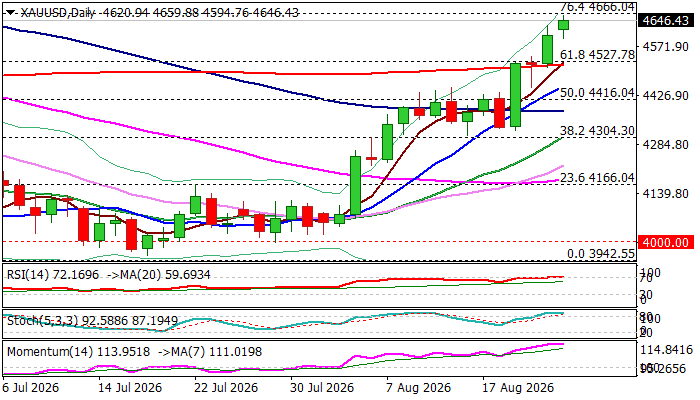
Gold – Bulls Hold Grip Ahead US Inflation Data, Fed Warsh Speech in Jackson Hole
Gold keeps firm tone and holds near four-month high on Monday, following almost 5% advance last week, with surprise US Treasury’s buyback being mainly behind the latest rally.
Traders also look for more cues about the US monetary policy outlook in coming months, with focus on Wednesday’s release of US PCE Index (Fed’s preferred inflation gauge) and speech of Fed Chair Warsh in the Jackson Hole symposium (starts on Thursday) as key economic events of the week.
Multiple MA bull-crosses and strong positive momentum contribute to increasingly bullish structure on daily chart, although overbought conditions warn that bulls may take a breather.
Limited dips should find ground above broken 200DMA ($4516, which reverted to solid support) to keep larger bulls intact and provide better buying levels.
Bulls pressure immediate target bat $4666 (Fibo 76.4% retracement of $4889/$3942), violation of which to open way towards $4773 (May 12 high) and unmask $4889 (Apr 17 peak).
Res: 4666; 4700; 4773; 4833
Sup: 4590; 4516; 4454; 4416