Sample Category Title
EURNZD Double Three Elliott Wave Structure
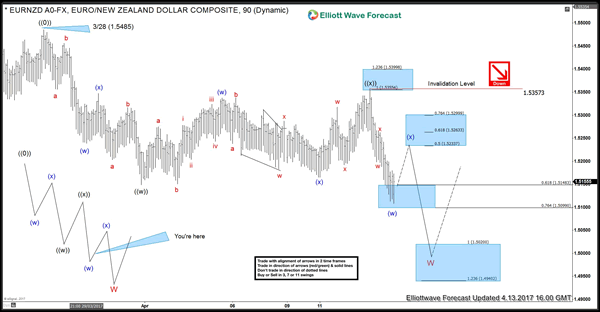
EURNZD rally this week failed as pair found sellers in 1.5355 - 1.5399 area and made new lows below 1.5149 low. With the new low seen today, pair is now showing 5 swings sequence down from 3/24 (1.5485) peak. 5 swings means the sequence is incomplete and pair is in need of another swing lower to complete 7 swings sequence or a double three Elliott wave structure down from 3/24 (1.5485) peak. Decline from 1.5485 to 1.5149 was corrective and hence labelled as ((w)). Bounce to 1.5357 was also corrective and hence labelled wave ((x)). As initial decline from 1.5485 - 1.5149 was corrective, that means decline from 1.5357 should also be in a corrective sequence.
Pair made a new low below 1.5149 and reached 0.618 - 0.764 Fibonacci extension area of ((w))-((x)), this is the typical area for 5th swing to end in a 7 swings sequence. Therefore, from this area, we can see a bounce in the pair to correct the decline from 1.5357 high and then it should turn lower again again. It remains to be seen how big the bounce would be but it should unfold in 3, 7 or 11 swings and 50 - 61.8 Fibonacci retracement area lies between 1.5236 - 1.5265. As far as 1.5357 high remains intact, we expect the bounce to fail and pair to continue lower towards 1.5020 - 1.4940 area to complete a double three (7 swings) Elliott wave structure down from 1.5485 peak. Afterwards, pair should bounce again to correct the decline from 1.5485 peak or at least from 1.5357 high.
EURNZD Elliott Wave Analysis
USD Weaker on Geopolitics Ahead of US Inflation and Retail Sales
The US dollar is weaker across the board since Wednesday's afternoon comments by US President Trump on the currency being "too strong" that prompted a selloff of the currency. Geopolitical risk has risen after the US confirmed the use of a huge non-nuclear bomb in Afghanistan. Risk aversion reversed some of the dollar loses as investors got ready for a long weekend in most major markets and expected lower liquidity on Friday and Monday.
The US Bureau of Labor Statistics will release the Consumer Price Index (CPI) and the core CPI (removing the volatile energy and food components) on Friday, April 14 at 8:30 am EST (12:30 pm GMT). The forecast calls for the core data a 0.2 percent gain and for the full CPI to remain flat. At the same time the US Census Bureau will release the retail sales data. Core retail sales is expected to gain 0.2 percent while adding auto sales will result in a gain of 0.1 percent for the total value of retail sales in the US.
The US consumer continues to be confident about the economy as today's Consumer sentiment shows by hitting a three month high but there has been little spending to go with that increase in confidence. The preliminary report from the University of Michigan also noted a gap between democrats and republicans in regard to their different levels of optimism. Economic indicators back up a stronger US economy but political risk at home and abroad have taken their toll on the dollar which could get a boost form strong sales and inflation data and vice versa could keep on the back foot if low inflation and weak spending get the Fed to reconsider their rate hike path.
The EUR/USD gained 0.142 percent in the last 24 hours. The single pair is trading at 1.0615 after the comments of the USD strength from US President Donald Trump put the greenback on the back foot. It is not usual for a US President to comment on the currency, a job often left to the Secretary of Treasury, but then again Trump is not a usual President. In a strange turn of events he also took the opportunity yesterday to mention that there is a possibility for Fed Chair Janet Yellen to extend her term. During his campaign he was critical of the central bank and its decision to leave rates low to benefit Democrats.
The market would welcome stability and a sign of central bank independence, but as Trump said it is still too early to say. April will be quiet in the central bank front as major central banks are not meeting this month.
The paradox between consumer confidence and spending will be in full display tomorrow as an optimistic University of Michigan confidence report released today, will be compared against retail sales. Retailers have been struggling and were the biggest losers in the last jobs report with a 30,000 loss in the sector. Department stores have been shrinking as shoppers opt to do more of their shopping online.
West Texas gained 0.607 in the last 24 hours. The price of WTI is trading at $53.01 after the US bomb attack in Afghanistan and the comments from the International Energy Agency who said the market is nearing balance. The Organization of the Petroleum Exporting Countries (OPEC) production cut agreement has put supply and demand closer to each other after falls in global stockpiles.
Rig counts in the US hit two year levels after shale producers continue their ramp up of production. US drillers have been the beneficiaries of the production cut deal lead by Saudi Arabia. The price stability that resulted from lower OPEC production combined with supply disruptions have made it attractive for US producers who are now expanding to other markets to take advantage of lower supply from OPEC members. This increase in production in North America will put downward pressure on oil prices even as the OPEC discusses an extension to the current six month deal.
Market events to watch this week:
Friday, April 14
- 8:30am USD CPI m/m
- 8:30am USD Core CPI m/m
- 8:30am USD Core Retail Sales m/m
- 8:30am USD Retail Sales m/m
*All times EDT
Gold Remains High as PPI Misses Estimate
Gold has edged lower on Thursday, following gains in the Tuesday and Wednesday sessions. In North American trade, gold is trading at $1285.38 per ounce. On the release front, it was a busy day in the US which released three key indicators – PPI, Unemployment Claims and the UoM Consumer Sentiment. PPI missed its estimate, but unemployment claims and consumer confidence both beat expectations.
With geopolitical tensions weighing on jittery investors, gold prices have jumped 2.4 percent this week. On Wednesday, gold pushed above $1288, its highest level since November 10. Nervous investors have snapped up the base metal as tensions escalate over Syria and North Korea. The US bombed a Syrian military base last week, in response to a chemical attack by Syrian warplanes. Russia has strongly condemned the US move, chilling relations even further between the US and Russia. President Trump has also sent warships to the Korea peninsula, in a show of strength against North Korea, which continues to test ballistic missiles in defiance of the international community. As well, Donald Trump said in a newspaper interview on Wednesday that the value of the US dollar was too strong and that he was in favor of a low interest rate policy. Trump's comment sent the dollar lower and pushed gold to higher levels.
On Monday, Federal Reserve Chair Janet Yellen said that with the economy close to full employment and 2 percent inflation, Fed policymakers were looking to reduce the support that the central bank was providing the economy. The minutes of the March meeting indicated that the Fed plans to trim the $4.5 trillion balance sheet, which has ballooned as a result of the huge asset-purchase program which started in 2008. The Fed plans to raise rates twice more in 2017, with the next rate expected in June. Yellen emphasized that the Fed's policy stance is neutral, as interest rate increases will be gradual, given that the economy is growing at a moderate pace.
Dollar Rebounds Against Pound on Strong US Jobless Claims
GBP/USD has edged lower in the Thursday session. In North American trade, GBP/USD is trading at 1.2520. On the release front, the BoE released its quarterly credit conditions survey. It was a busy day in the US which released three key indicators – PPI, Unemployment Claims and the UoM Consumer Sentiment. PPI missed its estimate, but unemployment claims and consumer confidence both beat expectations.
Earlier this week, Federal Reserve Chair Janet Yellen expressed satisfaction with economic conditions. Given that the economy is close to full employment and the Fed's inflation target of 2 percent, Yellen said that the Fed was in a better position to reduce its support for the economy. The minutes of the March meeting indicated that the Fed plans to trim the $4.5 trillion balance sheet, which has ballooned as a result of the huge asset-purchase program which started in response to the financial crisis in 2008. Yellen emphasized that the Fed's policy stance is neutral, as interest rate increases will be gradual, given that the economy is growing at a moderate pace. What can we expect from the Fed for the remainder of 2017? The Fed is widely expected to raise rates twice more in 2017, with the next rate expected in June. At the same time, some Fed policymakers are in favor of three more rate hikes, which would bring the total this year to four moves.
The pound has posted gains against the US dollar this week, as risk appetite has diminished due to geopolitical tensions. Investors remain cautious over developments in Syria and North Korea. The US bombed a Syrian military base last week, in response to a chemical attack by Syrian warplanes. Russia has strongly condemned the US move, chilling relations even further between the US and Russia. President Trump has also sent warships to the Korea peninsula, in a show of strength against North Korea, which continues to test ballistic missiles in defiance of the international community. Also, Donald Trump said in a newspaper interview on Wednesday that the value of the US dollar was too strong and that he was in favor of a low interest rate policy. Trump's comment sent the dollar lower against its major rivals, including the pound.
After months of legal wrangling, the British government triggered Article 50 at the end of March, officially ushering in the negotiations stage of the Brexit process. However, Britain and the EU are unlikely to commence talks until late in 2017, given that Germany holds elections in September, and the EU will not enter the complex negotiations until a new German government is in place. It's anyone's guess as to how smooth the talks will go, and the fate of the pound could be closely tied to the talks. If the negotiations go well, the pound could recover up to $1.50, its level on the eve of the stunning Brexit vote back in June. On the other hand, if the talks do not go well, analysts are forecasting that the pound could drop as low as $1.10. With the BoE in a neutral stance as far as interest rate policy, the fortunes of the pound appear more closely tied to the success of the Brexit negotiations, rather than to any monetary moves by the BoE.
Dollar Already Finds its Composure
Headlines
European stock markets opened up to 0.5% lower, but traded in a narrow sideways range afterwards. US stock markets opened marginally lower.
Fewer Americans than forecast filed for unemployment benefits last week (234k vs 245k expected), with applications hovering just above a four-decade low.
US producer prices clocked their first monthly decline since August last month. US producer prices inched lower by 0.1% m/m in March from +0.3% in February. Headline PPI was up 2.3% from a year ago. Excluding more volatile items like food and energy however, producer prices unchanged from the previous month and up 1.6% from a year ago.
Military force cannot resolve tension over North Korea, China said, while an influential Chinese newspaper urged the North to halt its nuclear programme in exchange for Chinese protection.
Global demand for oil is finally close to outstripping supply after nearly three years of surplus production, despite growth in the overhang of unused crude, the IEA said. The agency said oil stocks across the OECD fell by 17.2 million barrels in March.
JP Morgan Chase said its Q1 profit rose 17% as a boost from trading helped results for the nation's biggest bank by assets. Well Fargo said its Q1 profit was flat as the nation's third-largest bank remains stuck in the spotlight for its sales practices scandal than six months later. Citi reported a better-than-expected 17% jump in quarterly profit, boosted by strong fixed-income trading.
The Czech National Bank wanted to take advantage of the "overboughtness" of the koruna to lift its longstanding currency cap earlier than expected, minutes from last week's extraordinary policy meeting reveal. CNB members agreed that a weak crown policy had proved effective and a return to it was "highly unlikely".
Rates
No follow-though action on Trump's comments
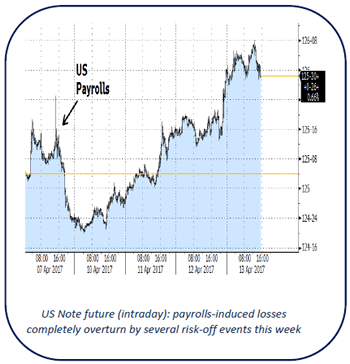
Global core bonds traded sideways today near the high's reached in the wake of US president Trump's comments in a WSJ interview. He said that he would prefer the Fed to keep interest rates low, suggesting he will appoint dovish profiles for the vacant FOMC board seats. Trump also thinks that the dollar is getting too strong. The US 5-yr yield (1.8%), US 10-yr yield (2.3%) and German 10-yr yield (0.2%) all fell below key support levels, but the decline didn't accelerate today. After all, the Fed remains an independent institute which will continue its tightening cycle if growth and inflation develop as expected. There was no immediate return action either though as investor's don't want to be wrong-footed during the long Easter weekend. Especially taking into account everything what happened earlier this week. Trump's comments were the third event this week that took markets by surprise and out of their comfort zone, following extreme-left French presidential candidate Mélenchon's rise in the polls and hostile US comments against Syria/North Korea earlier this week. The eco calendar only contained lower weekly jobless claims and lower US PPI data, but didn't influence trading.
At the time of writing, the German yield curve shifts 1.7 bps (5-yr) to 2.5 bps (30-yr) lower. Changes on the US yield curve range between +0.3 bps (5-yr) and +0.8 bps (2-yr). On intra-EMU bond markets, 10-yr yield spread changes versus Germany vary between +2 bps and -2 bps..
Currencies
Dollar already finds its composure
Trump's attempt to talk the dollar down triggered a one off selling wave yesterday eve, but caused no follow through action today. He said: "I think our dollar is getting too strong, and partially that's my fault because people have confidence in me. But that's hurting—that will hurt ultimately". It looks like markets aren't convinced that Trump can simply talk the dollar down. His progrowth policy, in a context of full employment, not only pushes growth but also inflation higher, obliging the Federal Reserve to increase interest rates. So his talk contradicts the fundamentals.
USD/JPY stabilizes
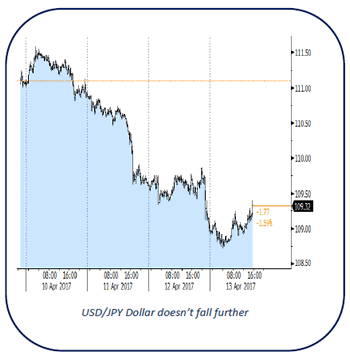
During Asian trading, USD/JPY was still under some downward pressure as Asian investors reacted on Trump and also as the short term trend is yen positive. Some risk aversion sentiment prevails. So for the yen, Trump's comments went with the trend. However, USD/JPY's fall from 109 at the opening ran out of steam around 108.73 and losses were recouped during the European session when the pair hovered between 108.90 and 109.30. European stocks fell at the opening, but very rapidly started to trade sideways at modestly lower levels, suggesting that geopolitical tensions eased. A similar sign came from the Korean won that stabilized. USD/JPY currently changes hands at 109.15, slightly up from opening levels.
EUR/USD lower as dollar decline considered overdone
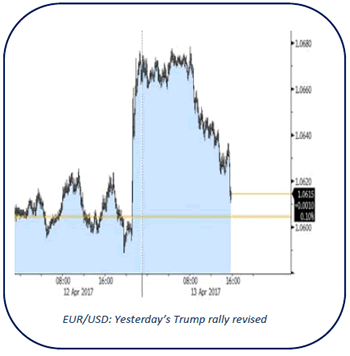
The EUR/USD price action differed from USD/JPY. It rose yesterday eve from 1.06 to about 1.0670. After a sideways move in Asian trading, the dollar started to recoup the losses. EUR/USD fell in a stretched move to about 1.0620, largely erasing yesterday's gains. Geopolitical risks play less of a role and the rate differential didn't change much. Sentiment on the euro is negative, due to the upcoming French elections. So, investors considered the post-Trump rally as an opportunity to buy into the dollar or at least considered yesterday's move as unwarranted. The early US data were mixed with lower than expected PPI and lower than expected initial claims.
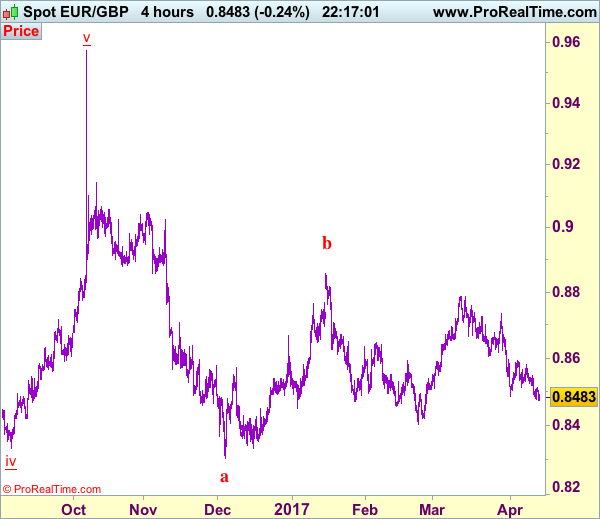
EUR/GBP retests 0.8484 support
In a session devoid of euro area and UK eco data or other event news, general euro weakness prevailed. EUR/GBP slid slowly lower from a 0.8505 opening to the 0.8484 support, with a new ST low at 0.8475. However, the test of the support isn't over yet. Cable lost some ground after being stronger in Asian overnight trading. When EUR/USD started to slide lower, cable followed and looks ready to test the 1.25 level, which compared to the 1.2540 opening. There was no specific sterling story behind the intraday price action.
Trade Idea Wrap-up: USD/CHF – Stand aside
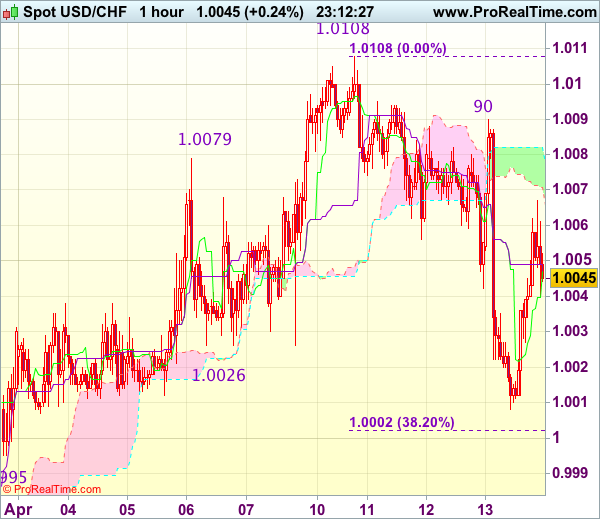
USD/CHF - 1.0045
Most recent candlesticks pattern : N/A
Trend : Near term down
Tenkan-Sen level : 1.0047
Kijun-Sen level : 1.0049
Ichimoku cloud top : 1.0082
Ichimoku cloud bottom : 1.0071
New strategy :
Stand aside
Position : -
Target : -
Stop : -
As the greenback has surged again after staging a strong rebound from 1.0008, suggesting the fall from 1.0108 has ended there and consolidation with mild upside bias is seen for test of resistance at 1.0090, however, a firm break above there is needed to retain bullishness and signal the fall from 1.0108 has ended, bring a retest of 1.0108 but only a break of this week’s high at 1.0108 would confirm recent upmove from 0.9813 has resumed for headway to 1.0140-45 and later towards another previous resistance at 1.0171.
In view of this, would not chase this rise here and would be prudent to stand aside for now. Below 1.0025-30 would signal an intra-day top is formed, bring another fall to 1.0007, once this level is penetrated, this would revive bearishness and extend fall to previous support at 0.9995, then towards 0.9970 (50% Fibonacci retracement of 0.9831-1.0108).
Trade Idea Wrap-up: GBP/USD – Buy at 1.2480
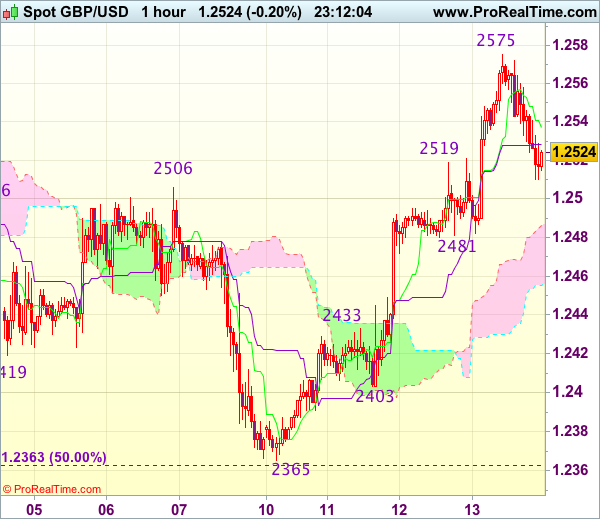
GBP/USD - 1.2521
Most recent candlesticks pattern : N/A
Trend : Near term down
Tenkan-Sen level : 1.2537
Kijun-Sen level : 1.2529
Ichimoku cloud top : 1.2486
Ichimoku cloud bottom : 1.2455
Original strategy :
Buy at 1.2485, Target: 1.2585, Stop: 1.2450
Position : -
Target : -
Stop : -
New strategy :
Buy at 1.2480, Target: 1.2580, Stop: 1.2445
Position : -
Target : -
Stop : -
As cable has retreated after rising to 1.2575, suggesting consolidation below this level would be seen and pullback to 1.2500 is likely, however, reckon support at 1.2480-81 would limit downside and bring another rise later, above said resistance at 1.2575 would add credence to our view that low has been formed at 1.2365 on Monday and extend the rise from there to 1.2585-90 but break of previous resistance at 1.2616 is needed to retain bullishness and extend subsequent upmove to 1.2650-60.
In view of this, would not chase this rise here and would be prudent to buy cable on pullback as 1.2481 support should limit downside and bring another upmove later. Below the lower Kumo (now at 1.2455) would defer and suggest top is formed, risk test of 1.2433 (previous resistance) first.
Trade Idea Wrap-up: EUR/USD – Hold short entered at 1.0665
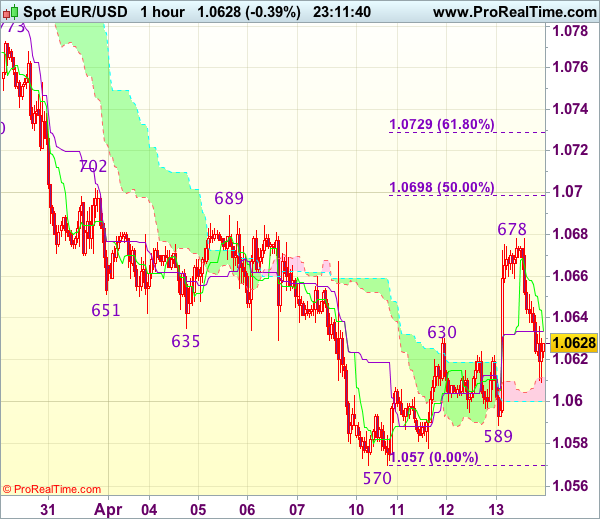
EUR/USD - 1.0632
Most recent candlesticks pattern : N/A
Trend : Near term down
Tenkan-Sen level : 1.0634
Kijun-Sen level : 1.0634
Ichimoku cloud top : 1.0612
Ichimoku cloud bottom : 1.0600
Original strategy :
Sold at 1.0665, Target: 1.0565, Stop: 1.0680
Position : - Short at 1.0665
Target : - 1.0565
Stop : - 1.0680
New strategy :
Hold short entered at 1.0665, Target: 1.0565, Stop: 1.0680
Position : - Short at 1.0665
Target : - 1.0565
Stop : - 1.0680
Although the single currency staged a strong rebound after finding support at 1.0589, as this move from 1.0570 is viewed as retracement of recent decline, reckon upside would be limited and bring retreat later, below the upper Kumo (now at 1.0600) would bring test of said support at 1.0589 but break there is needed to signal the rebound from 1.0570 has ended, bring retest of this Monday’s low, below there would extend the decline from 1.0906 to 1.0550-55 (50% projection of 1.0906-1.0635 measuring from 1.0689), then 1.0525-30.
In view of this, we are holding on to our short position entered at 1.0665. A firm break above intra-day resistance at 1.0678 would abort and suggest low has been formed at 1,0570, bring a stronger rebound to 1.0698-02 (50% Fibonacci retracement of 1.0827-1.0570 and previous resistance).
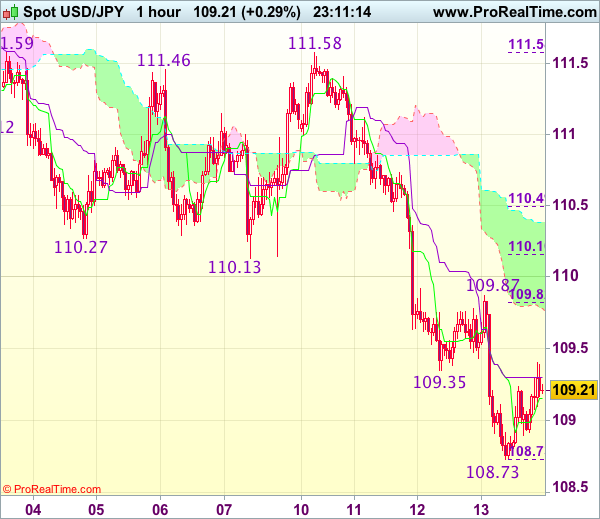
Trade Idea Wrap-up: USD/JPY – Sell at 109.90
USD/JPY - 109.20
Most recent candlesticks pattern : N/A
Trend : Near term down
Tenkan-Sen level : 109.15
Kijun-Sen level : 109.30
Ichimoku cloud top : 110.38
Ichimoku cloud bottom : 109.78
Original strategy :
Sell at 109.90, Target: 108.90, Stop: 110.25
Position : -
Target : -
Stop : -
New strategy :
Sell at 109.90, Target: 108.90, Stop: 110.25
Position : -
Target : -
Stop : -
The greenback has recovered after falling to 108.73, suggesting consolidation above this level would be seen and recovery to 109.50 cannot be ruled out, however, reckon 109.82-87 (38.2% Fibonacci retracement of 111.58-108.73 and previous resistance) would limit upside and bring another decline later, below said support at 108.73 would extend recent decline from 118.66 top to 108.40-50 (100% projection of 118.66-111.55 measuring from 115.51) but loss of near term downward momentum should prevent sharp fall below 108.20-25 (1.618 times projection of 112.20-110.13 measuring from 111.58) and 108.00 should hold, bring rebound later.
In view of this, would not chase this fall here and would be prudent to sell dollar on recovery as said resistance at 109.87 should limit upside and bring another decline later. Above previous support at 110.13 would abort and suggest low is formed, bring a stronger rebound later to the upper Kumo (now at 110.38).
Trade Idea: EUR/GBP – Sell at 0.8590
EUR/GBP - 0.8485
Recent wave: Major double three (A)-(B)-(C)-(X)-(A)-(B)-(C) is unfolding and 2nd (A) has possibly ended at 0.6936.
Trend: Near term down
Original strategy :
Sell at 0.8590, Target: 0.8460, Stop: 0.8630
Position : -
Target : -
Stop : -
New strategy :
Sell at 0.8590, Target: 0.8460, Stop: 0.8630
Position : -
Target : -
Stop : -
The single currency has continued trading lower after breaking previous support at 0.8485, adding credence to our view that recent decline from 0.8788 is still in progress and bearishness remains for further weakness to 0.8450, break there would extend the fall from 0.8788 for retracement of early upmove to 0.8420-25 but previous support at 0.8403 should hold from here.
In view of this, would not chase this fall here and would be prudent to sell euro on recovery as 0.8580-90 should limit upside. Above 0.8620-25 would abort and suggest low is formed instead, bring a stronger rebound to 0.8660-65 and possibly towards 0.8680 but price should falter below 0.8700.
Our preferred count is that, after forming a major top at 0.9805 (wave V), (A)-(B)-(C) correction is unfolding with (A) leg ended at 0.8400 (A: 0.8637, B: 0.9491 and 5-waver C ended at 0.8400. Wave (B) has ended at 0.9413 and impulsive wave (C) has either ended at 0.8067 or may extend one more fall to 0.8000 before prospect of another rally. Current breach of indicated resistance at 0.9043 confirms our view that the (C) leg has ended and bring stronger rebound towards 0.9150/54, then towards 0.9240/50.