Sample Category Title
British Pound Rises after Trump’s Comments
British Pound Rises after Trump's Comments
- Sterling rises after Trump's comments
- Bank of Canada holds rates at 0.50%
- UK markets closed over the Easter Break
The US Dollar tumbled broadly and is now trading as the weakest major currency after US President, Donald Trump, talked down the exchange rate.
In an interview with the Wall Street Journal, US President, Donald Trump, complained that the US Dollar is getting too strong and that ultimately that will hurt. On interest rates, Trump affirmed his preference over a low interest rate policy - this has seen the Pound rise to above 1.25 against the US Dollar, and the commodity currencies are broadly higher.
The Bank of Canada appeared confident over the economic growth outlook, although it maintained the policy rate unchanged at 0.50% yesterday. The central bank upgraded the Gross Domestic Product (GDP) growth forecast for this year amidst strong housing market activities in the first quarter.
In Australia, the Australian Dollar has been boosted by strong employment data today. Employment grew 60.9k in March; triple the expectation of 20k.
Today, there is a raft of inflation and Producer Price Index (PPI) data from Europe, as well US employment figures, which will be released this afternoon.
The UK markets are closed over the Easter break, but the global markets will continue to move over the weekend - please contact your Halo Financial currency consultant to discuss strategies over the holiday period.
Happy Easter everyone.
Easter jokes
How do bunnies stay healthy?
Eggsercise
How can you find the Easter bunny?
Eggs (x) marks the spot
What is the end of Easter?
The letter R
Market Update – European Session: IEA Confident That Oil Market Very Close To Balanced
Notes/Observations
FX in focus as Trump cautions about a too strong USD and withdrew a threat to declare China a currency manipulator
Mar Final CPI readings for France and Germany unrevised and move off multi-year highs
IEA confident that oil market already moving very close to balance
Overnight:
Asia:
China Mar Trade Balance moved back to surplus (+$23.9B v +$12.5Be) as exports surge to a 2-year high (Reminder: Feb Trade Balance registered its 1st deficit since Feb 2014)
Australia Mar Employment change hits a 16-month high (+60.9K v +20.0Ke; Unemployment Rate in-line at 5.9%
(KR) Bank of Korea (BOK) leaves 7-Day Rep Rate unchanged at 1.25% (as expected) for its9th straight pause in the current easing cycle, Monetary policy to remain accomodative but rate cut less necessary than before
US govt and other officials warned that North Korea reportedly placed a nuclear device in a tunnel and it may be detonated this Saturday Apr 15th
Europe:
French presidential race tightens further, markets nervious
Germany's Schaeuble says we need a pro-EU France, hopes Le Pen loses
Americas:
President Trump: US dollar is getting too strong; Will not label China a currency manipulator
Brazil Central Bank (BCB) cut Selic Target Rate by 100bps to 11.25% for its 5th straight cut.
Economic Data
(DE) Germany Final CPI M/M: 0.2% v 0.2%e; Y/Y: 1.6% v 1.6%e
(DE) Germany Final CPI EU Harmonized M/M: 0.1% v 0.1%e; Y/Y: 1.5% v 1.5%e
(FI) Finland Mar CPI M/M: 0.0% v 0.5% prior; Y/Y: 0.8% v 1.2% prior
(FR) France Mar Final CPI M/M: 0.6% v 0.6%e; Y/Y: 1.5% v 1.5%e
(FR) France Mar Final CPI EU Harmonized M/M: 0.7% v 0.7%e; Y/Y: 1.5% v 1.5%e
(CH) Swiss Mar Producer & Import Prices M/M: 0.1% v 0.1%e; Y/Y: 1.3% v 0.9%e
(CN) China Mar Foreign Direct Investment (FDI): +6.7% y/y
(IT) Italy Mar Final CPI (Including Tobacco) M/M: 0.0% v 0.0% prelim; Y/Y: 1.4% v 1.4% prelim
Fixed Income Issuance:
(IN) India sold total INR147.8B vs. INR180B indicated in 2022, 2026, 2034 and 2046 bonds
SPEAKERS/FIXED INCOME/FX/COMMODITIES/ERRATUM
Index snapshot (as of 10:00 GMT)
Indices [Stoxx50 -0.6% at 3,451, FTSE -0.5% at 7,312, DAX -0.3% at 12,113, CAC-40 -0.5% at 5,076, IBEX-35 -0.6% at 10,303, FTSE MIB -0.9% at 19,832, SMI -0.4% at 8,631, S&P 500 Futures -0.1%]
Market Focal Points/Key Themes: European equity indices are trading lower ahead of the long Easter weekend amid ongoing geopolitical tensions; Banking stocks trading sharply lower with shares of SocGen, Santander, and BNP Paribas leading losses seen in the Eurostoxx; shares of Standard Life, RBS, Standard Chartered and HSBC trading weighing in the FTSE 100; heavily weighted peripheral lender FTSE MIB index underperforming as a result; energy stocks trading lower as oil consolidates around yesterday's lows.
Upcoming scheduled US earnings (pre-market) include Apogee Enterprises, Carrefour, Commerce Bankshares, First Horizon National, First Republic Bank, JPMorgan Chase, PNC Financial Services, Wells Fargo, and Yingli Green Energy.
Equities (as of 09:50 GMT)
Consumer Discretionary: [Carrefour CA.FR -0.5% (Q1 sales), Gattaca GATC.UK -10.1% (trading update), Hays HAS.UK -0.7% (Q3 fees), Sodexo Alliance SW.FR +0.3% (H1 results)]
Industrials: [Bauer B5A.DE +3.6% (FY16 results), Scapa SCPA.UK +8.2% (trading update)]
Speakers
BOE Credit Conditions & Bank Liabilities Surveys noted that Lenders saw corporate demand was subdued in Q1as the pace of business lending had eased in recent months. Demand has been higher than expected since the Brexit
Greece govt official: Possible extra Eurogroup meeting in May is possible
Russia Central Bank Dep Gov Yudayeva reiterated view that taking measures to ensure that inflation stayed near the 4% target in both 2018-19 period
Russia Central Bank's Polonsky saw room for cautious rate cuts and reiterates Board view that monetary policy to remain moderately tight
Japan Chief Cabinet Sec Suga reiterated financial stability was important and that would pay close attention to market moves. Markets were aware of geopolitical risks but that the US and global economy remained on firm footing. Would not comment on any specific FX levels
IEA Monthly Report noted that it could be argued confidently that oil market was already very close to balance. Trimmed 2017 global oil demand growth from 1.4M bpd to 1.32M bpd. It raised 2017 Non-Opec oil supply growth forecast from 400K bpd to 485K bpd while Opec production declined from 32.0M to 31.68M, -365K bpd; compliance of 99% v 91% m/m
Currencies
FX markets in the session saw the USD retrace a small fraction of Wed losses after President Trump express concern of a too strong greenback.
USD/JPY hit 5-month lows in Asia at 108.71 which corresponded to the 200-day moving average. The pair at its softest level since Trump won the US election back in early Nov. - The Chinese Yuan currency was firmer after Trump backed off from his campaign pledge to label China a currency manipulator
Commodity currencies were firmer as well – aided by the weak USD and geo-political concerns. The CAD currency (Loonie) hit a 6-week high after the Bank of Canada turned less dovish at rate decision on Wed.
Fixed Income
Bund futures trade at 163.66 up 42 ticks marking fresh contract highs, with Trump overnight comments and potential weekend risk including the Turkish referendum, and the French election vote helping keep futures bid. Futures traded a high of 163.77, with a break back above targeting 163.99 followed by 164.20. A reversal continues to target 163.39 former high followed by 163.18.
Gilt futures trade at 128.73 up 22 ticks trading higher with Bunds, with the overall trend higher remaining in tact. Support moves to 128.16 followed by 127.94 then 127.34. A move above 128.80 high targets 128.96 then 129.29. Short Sterling curve continue to flatten with Jun17Jun18 moving lower to 8.5/9bp, a recent new low.
Thursday's liquidity report showed Wednesday's excess liquidity rose to €1.596T a rose of €3B from €1.593T prior. Use of the marginal lending facility rose to €271M from €265M prior.
Corporate issuance saw $1B come to market via a sole issuer. Daiwa Securities $1B 5 year notes brought weekly issuance to $11.3B, slightly ahead of estimates.
Looking Ahead
(GR) Eurogroup chief Dijsselbloem and German Fin Min Schaeuble to meet on Greece
05:30 (ZA) South Africa Feb Total Mining Production M/M: No est v 1.7% prior; Y/Y: 1.4%e v 1.3% prior
05:30 (HU) Hungary Debt Agency (AKK) to sell Bonds
06:00 (IE) Ireland Mar CPI M/M: No est v 0.6% prior; Y/Y: No est v 0.5% prior
06:00 (IE) Ireland Mar CPI EU Harmonized M/M: No est v 0.5% prior; Y/Y: No est v 0.3% prior
06:00 (UK) DMO to sell combined £B in 1-month, 3-month and 6-month bills (£0.5B, £0.5B and £1.0B respectively)
07:00 (UR) Ukraine Central Bank Interest Rate Decision: Expected to leave Key Rate unchanged at 14.00%
08:00 (PL) Poland Feb Current Account: €0.0Be v €2.5B prior; Trade Balance: €0.Be v €0.2B prior; Exports: €15.3Be v €15.0B prior; Imports: €15.3Be v €14.8B prior
08:00 (BR) Brazil Feb IBGE Services Sector Volume Y/Y: No est v -7.3% prior
08:15 (UK) Baltic Dry Bulk Index
08:30 (US) Mar PPI Final Demand M/M: 0.0%e v 0.3% prior; Y/Y: 2.4%e v 2.2% prior
08:30 (US) Mar PPI Ex Food and Energy M/M: 0.2%e v 0.3% prior; Y/Y: 1.8%e v 1.5% prior
08:30 (US) Mar PPI Ex Food, Energy Trade M/M: 0.2%e v 0.3% prior; Y/Y: No est v 1.8% prior
08:30 (US) Initial Jobless Claims: 245Ke v 234K prior; Continuing Claims: 2.02Me v 2.028M prior
08:30 (US) Weekly USDA Net Export Sales
08:30 (CA) Canada Feb New Housing Price Index M/M: 0.2%e v 0.1% prior; Y/Y: 3.1%e v 3.1% prior
08:30 (CA) Canada Feb Manufacturing Sales M/M: -0.7%e v +0.6% prior
09:00 (RU) Russia Gold and Forex Reserve w/e Apr 7th: No est v $397.9B prior
10:00 (US) Apr Preliminary University of Michigan Confidence: 96.5e v 96.9 prior
10:30 (US) Weekly EIA Natural Gas Inventories
11:00 (BR) Brazil to sell Fixed Rate 2023 and 2027 Bonds
11:00 (BR) Brazil to sell 2017, 2019 and 2020 LTN Bills
17:00 (CL) Chile Central Bank (BCCH) Interest Rate Decision: Expected to leave Overnight Target Rate unchanged at 3.00%
DAX Lower As Trump Takes Aim At Dollar
The DAX has posted losses on Thursday, as the index trades at 12,112.00. On the release front, German Final CPI dropped to 0.2%, matching the forecast. French Final CPI took the opposite direction, improving to 0.6%, matching the forecast. On Wednesday, President Donald Trump said in a newspaper interview that the value of the US dollar was too strong and that he was in favor of a low interest rate policy. Trump’s comment has sent the greenback lower and is weighing on European stock markets.
The DAX continues to lose ground in April, as investors remain jittery about rising tensions in Syria and North Korea. The US bombed a Syrian military base last week, in response to a chemical attack by Syrian warplanes. Russia has strongly condemned the US move, chilling relations even further between the US and Russia. President Trump has declared that he has sent “an armada” to the Korean peninsula in response to North Korea firing ballistic missiles, and the escalation in rhetoric between North Korea and the US is weighing on the stock markets.
German numbers have been a mix this week, as investor confidence jumped, while inflation indicators weakened. The ZEW Economic Sentiment report sparked with a reading of 19.5, crushing the estimate of 13.2. This marked the strongest gain since August 2015, pointing to strong optimism among institutional investors and analysts. However, inflation levels have softened in March. The Wholesale Price Index dropped to a flat 0.0%, compared to 0.5% a month earlier. This was well short of the forecast of 0.4%. The downward trend continued with Final CPI, which dropped to 0.2%, down from 0.6% in February. Eurozone CPI made a big splash in February, when it hit the ECB’s target of 2.0%, and raising speculation that the ECB might need to respond by tightening monetary policy. However, the indicator softened in March to 1.5%, short of the forecast of 1.8%. The softer March inflation numbers have certainly eased the pressure on the ECB, which is not scheduled to reduce its asset-purchase program until December.
Earlier this week, Federal Reserve Chair Janet Yellen said that with the economy close to full employment and 2 percent inflation, the Fed was in a better position to reduce its support for the US economy. The minutes of the March meeting indicated that the Fed plans to trim the $4.5 trillion balance sheet, which has ballooned as a result of the huge asset-purchase program which started in response to the financial crisis in 2008. Yellen emphasized that the Fed’s policy stance is neutral, as interest rate increases will be gradual, given that the economy is growing at a moderate pace. The Fed is widely expected to raise rates twice more in 2017, with the next rate expected in June. At the same time, some Fed policymakers are in favor of three more rate hikes, which would bring the total this year to four moves.
Trade Idea Update: USD/CHF – Buy at 0.9995
USD/CHF - 1.0043
Original strategy :
Buy at 0.9995, Target: 1.0100, Stop: 0.9960
Position : -
Target : -
Stop : -
New strategy :
Buy at 0.9995, Target: 1.0100, Stop: 0.9960
Position : -
Target : -
Stop : -
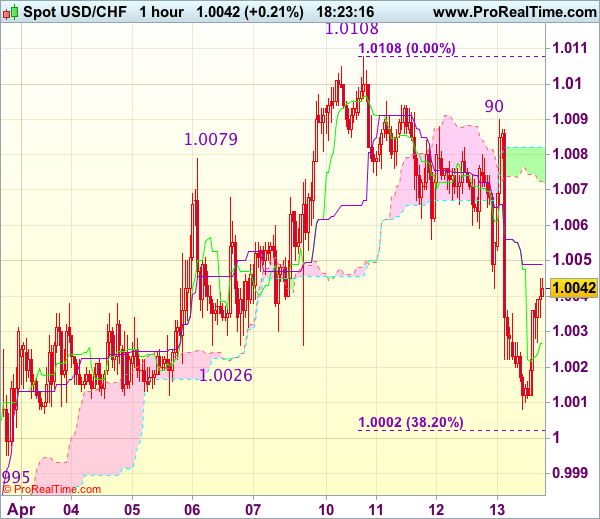
As the greenback dropped quite sharply after meeting renewed selling interest at 1.0090, adding credence to our view that temporary top has been formed at 1.0108 on Monday and initial downside risk remains for weakness to 1.0002 (38.2% Fibonacci retracement of 0.9831-1.0108) but reckon support at 0.9995 would limit downside and bring another rebound later, above the Kijun-Sen (now at 1.0049) would bring rebound to 1.0070-75, break there would signal an intra-day low is formed, bring test of said resistance at 1.0090 first. Having said that, only break of this week’s high at 1.0108 would confirm recent upmove from 0.9813 has resumed for headway to 1.0140-45 but price should falter well below another previous resistance at 1.0171.
In view of this, would not chase this rise here and would be prudent to buy dollar on next decline as support at 0.9995 should limit downside. Below 0.9970 (50% Fibonacci retracement of 0.9831-1.0108) would abort and signal recent upmove has ended, bring correction to support at 0.9948.
Trade Idea Update: GBP/USD – Buy at 1.2485
GBP/USD - 1.2552
Original strategy :
Buy at 1.2485, Target: 1.2585, Stop: 1.2450
Position : -
Target : -
Stop : -
New strategy :
Buy at 1.2485, Target: 1.2585, Stop: 1.2450
Position : -
Target : -
Stop : -
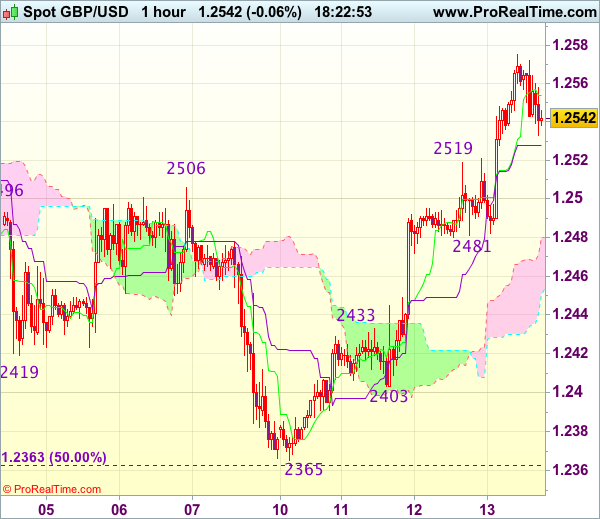
As cable has continued trading with a firm undertone after this week’s rally, adding credence to our view that low has been formed at 1.2365 on Monday and upside bias remains for the rebound from there to extend gain to 1.2585-90, however, break of previous resistance at 1.2616 is needed to retain bullishness and extend further subsequent rise to 1.2650-60.
In view of this, would not chase this rise here and would be prudent to buy cable on pullback as 1.2481 support should limit downside and bring another upmove later. Below the upper Kumo (now at 1.2468) would defer and suggest top is formed, risk test of 1.2433 (previous resistance) first.
Trade Idea Update: EUR/USD – Hold short entered at 1.0665
EUR/USD - 1.0643
Original strategy :
Sold at 1.0665, Target: 1.0565, Stop: 1.0680
Position : - Short at 1.0665
Target : - 1.0565
Stop : - 1.0680
New strategy :
Hold short entered at 1.0665, Target: 1.0565, Stop: 1.0680
Position : - Short at 1.0665
Target : - 1.0565
Stop : - 1.0680
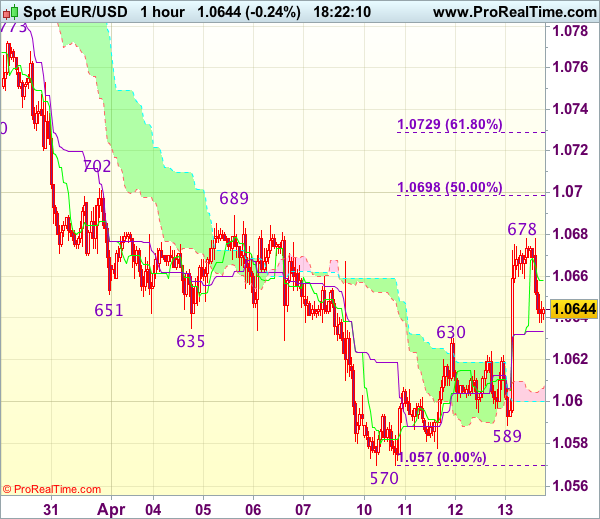
Although the single currency staged a strong rebound after finding support at 1.0589, as this move from 1.0570 is viewed as retracement of recent decline, reckon upside would be limited and bring retreat later, below the upper Kumo (now at 1.0606) would bring test of said support at 1.0589 but break there is needed to signal the rebound from 1.0570 has ended, bring retest of this Monday’s low, below there would extend the decline from 1.0906 to 1.0550-55 (50% projection of 1.0906-1.0635 measuring from 1.0689), then 1.0525-30.
In view of this, we are holding on to our short position entered at 1.0665. A firm break above intra-day resistance at 1.0678 would abort and suggest low has been formed at 1,0570, bring a stronger rebound to 1.0698-02 (50% Fibonacci retracement of 1.0827-1.0570 and previous resistance).
Trade Idea Update: USD/JPY – Sell at 109.90
USD/JPY - 108.97
Original strategy :
Sell at 109.90, Target: 108.90, Stop: 110.25
Position : -
Target : -
Stop : -
New strategy :
Sell at 109.90, Target: 108.90, Stop: 110.25
Position : -
Target : -
Stop : -
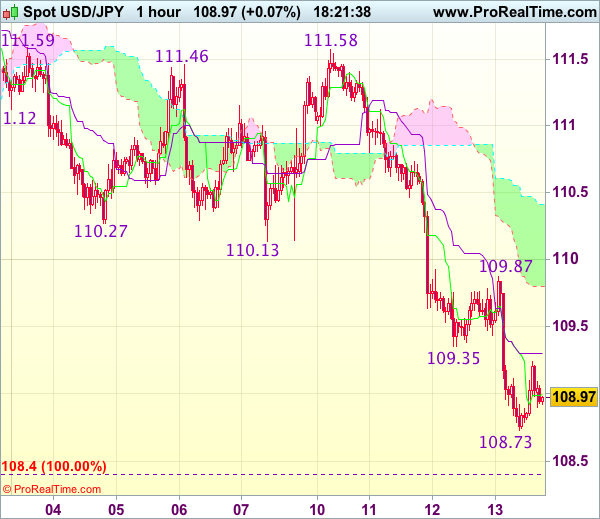
The greenback has dropped again after brief recovery to 109.87, adding credence to our bearish view that recent entire decline from 118.66 top is still in progress, hence downside bias remains for recent selloff to extend further weakness to 108.40-50 (100% projection of 118.66-111.55 measuring from 115.51), however, loss of near term downward momentum should prevent sharp fall below 108.20-25 (1.618 times projection of 112.20-110.13 measuring from 111.58) and 108.00 should hold, bring rebound later.
In view of this, would not chase this fall here and would be prudent to sell dollar on recovery as said resistance at 109.87 should limit upside and bring another decline later. Above previous support at 110.13 would abort and suggest low is formed, bring a stronger rebound later to the upper Kumo (now at 110.45).
Euro Edges Lower As German CPI Falls
EUR/USD has posted slight losses in the Thursday session. Currently, the pair is trading at 1.0640. On the release front, German Final CPI dropped to 0.2%, matching the forecast. French Final CPI took the opposite direction, improving to 0.6%, matching the forecast. In the US, there are a host of key indicators, all of which are expected to weaken. PPI is expected to dip to 0.0%, unemployment claims are forecast to rise to 242 thousand, while UoM Consumer Sentiment is expected to soften to 97.1 points. On Friday, the US releases consumer inflation and spending data.
German data has been a mixed bag this week. The ZEW Economic Sentiment report sparked with a reading of 19.5, crushing the estimate of 13.2. This marked the strongest gain since August 2015, pointing to strong optimism among institutional investors and analysts. However, inflation levels have softened in March. The Wholesale Price Index dropped to a flat 0.0%, compared to 0.5% a month earlier. This was well short of the forecast of 0.4%. The downward trend continued with Final CPI, which dropped to 0.2%, down from 0.6% in February. Eurozone CPI made a big splash in February, when it hit the ECB’s target of 2.0%, and raising speculation that the ECB might need to respond by tightening monetary policy. However, the indicator softened in March to 1.5%, short of the forecast of 1.8%. The softer March inflation numbers have certainly eased the pressure on the ECB, which is not scheduled to reduce its asset-purchase program until December.
Earlier this week, Federal Reserve Chair Janet Yellen said that with the economy close to full employment and 2 percent inflation, Fed policymakers were looking to reduce the support that the central bank was providing the economy. The minutes of the March meeting indicated that the Fed plans to trim the $4.5 trillion balance sheet, which has ballooned as a result of the huge asset-purchase program which started in response to the financial crisis in 2008. Yellen emphasized that the Fed’s policy stance is neutral, as interest rate increases will be gradual, given that the economy is growing at a moderate pace. The Fed is widely expected to raise rates twice more in 2017, with the next rate expected in June. At the same time, some Fed policymakers are in favor of three more rate hikes, which would bring the total this year to four moves.
Dollar Plunged On Trump’s Second Dollar Overly Strong Statement
The dollar index fell to a 2-week low of 99.91 in the early hours this morning, breaking the significant support level at 100.00. The dollar index plunged 0.58% on Wednesday April 12, and 0.88% in the past two days. The sudden fall was caused by Trump's dollar overly strong statement for the second time this year. He expressed that if the dollar is much stronger against other currencies, it will weaken exports and corporate competitivity. Trump's weak dollar stance is likely to keep on reining in the dollar strength. The dollar index saw a rebound in the past two hours, the bulls have recovered the significant level at 100.00.
USD/JPY hit the lowest level of 108.71 since November 17. The recent strengthening of the yen hit Japanese exports. Nikkei 225 index has turned bearish since mid-March, hitting the lowest level of 18292.50 since December 5 this morning.
The Australian employment change for March rose substantially to 60.9K in March, from 2.8K in February, beating expectations of 20K, marking the largest improvement since November 2015. The outperforming data resulted in the surge of AUD/USD this morning, hitting the highest level of 0.7594 since April 4, testing the psychological resistance level at 0.7600.
Yesterday the Bank of Canada (BoC) announced its rate decision on hold at 0.5%. The BoC stated that although the recent data shows the economy is sound. However, the US economic outlook is still uncertain under Trump's administration, which will likely weigh on the Canadian economy. The BoC revised the economic growth forecast upwards from 2.1% to 2.6% in 2017, helped by the sudden rise in residential investment and increase of consumer expenditure. However, business investment and employment are continuing to weaken. The economic growth forecast in 2018 is revised downwards from 2.1% to 1.9%.
The overall statement showed mixed signs.
Uncertainty over the Trump administration will affect not only the economic outlook of Canada, but also that of other neighbouring countries and major economies.
The US EIA crude oil inventories (the week ending April 7), saw the biggest drop in 2.166 million barrels this year. However, the figure failed to push oil prices higher as it was trading at the major resistance zone, where the selling pressure is heavy. Spot WTI retraced around 1%, and spot Brent crude oil retraced around 1.13% on Wednesday April 12.
Keep an eye on the US initial jobless claims (the week ending April 7), to be released ta 13:30 BST this afternoon, followed by the US Michigan consumer sentiment index (Apr) at 15:00 BST. It will likely affect the strength of the dollar and dollar crosses.
The US retail sales and CPI for March, will be released at 13:30 BST on Friday, it is one of the most important pieces of data for this week. Be aware that it will likely cause volatility for the dollar and the dollar crosses.
GOLD More Upside, SILVER Clears Resistance, Crude Oil Bullish Pause.
GOLD More upside.
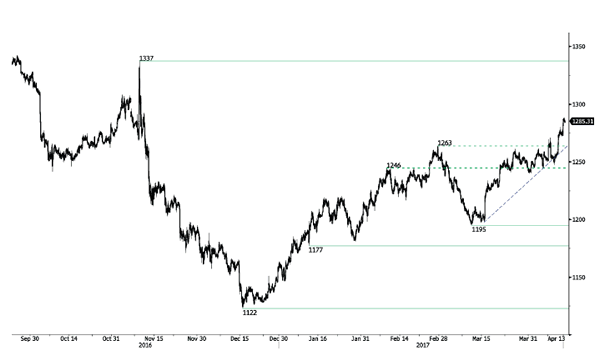
Gold has broken the key resistance area 1263. This validates a bullish reversal pattern with an upside potential at 1337. The hourly support at 1263 (previous resistance) has induced some buying interest. Another hourly support lies at 1260 (rising trendline). An hourly resistance can now be found at 1280 (intraday high).
In the long-term, the technical structure suggests that there is a growing upside momentum. A break of 1392 (17/03/2014) is necessary ton confirm it, A major support can be found at 1045 (05/02/2010 low).
SILVER Clears resistance.
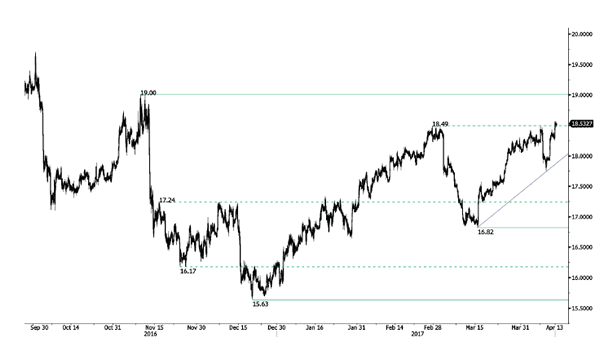
Silver is rising sharply above 18.49, validating the recent technical improvements. Strong resistance is given at a distance at 19.00 (09/11/2017 high). Key support is given at 17.74 (10/04/2017 low) then 16.82 (15/03/2017 low).
In the long-term, the death cross indicates that further downsides are very likely. Resistance is located at 25.11 (28/08/2013 high). Strong support can be found at 11.75 (20/04/2009).
Crude Oil Bullish pause.
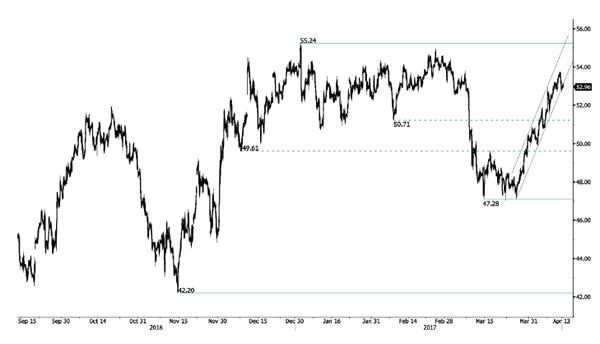
Crude oil has pulled-back after its recent sharp rise. Support stands at 52.80/90 (intraday low and rising trendline). Hourly resistance can be located at 54 (07/04/2017 high then strong resistance stands at 55.24 03/01/2017 high).
In the long-term, crude oil has recovered after its sharp decline last year. However, we consider that further weakness are very likely. Strong support lies at 24.82 (13/11/2002) while resistance can now be found at 55.24 (03/01/2017 high).