

Sample Category Title
EUR/AUD Weekly Outlook
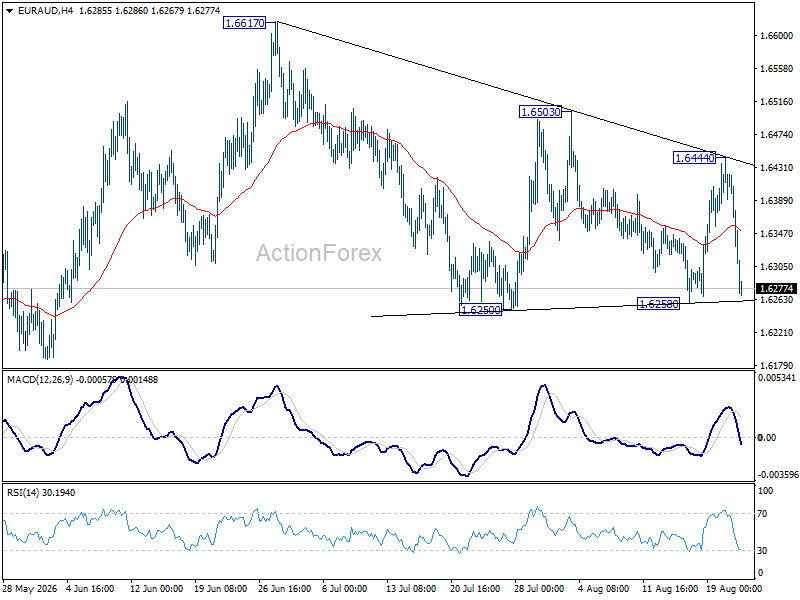
EUR/AUD reversed after rebounding to 1.1644 last week, but stays above 1.6250 support. Initial bias remains neutral this week first. On the downside, firm break of 1.6250 will extend the fall from 1.6617 to retest 1.6108 low. On the upside, above 1.6444 will bring another rebound to 1.6503. Overall, corrective pattern from 1.6108 (or 1.6125) could still extend for a while before larger decline resumption.
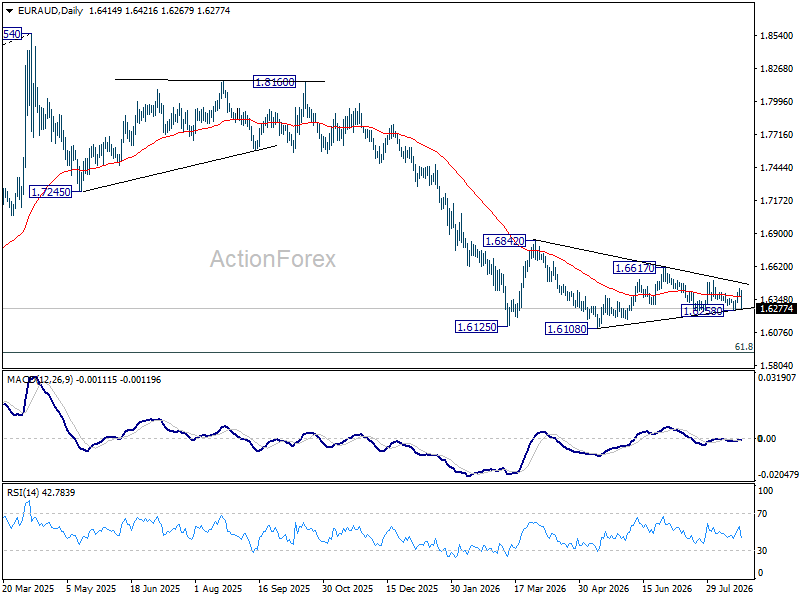
In the bigger picture, outlook will stay bearish as long as 1.6842 resistance holds. Fall from 1.8554 (2025 high) is expected to continue to 61.8% retracement of 1.4281 to 1.8554 at 1.5913. Decisive break there will pave the way back to 1.4281 (2022 low). However, firm break of 1.6842 should confirm medium term bottoming, and bring stronger rally.
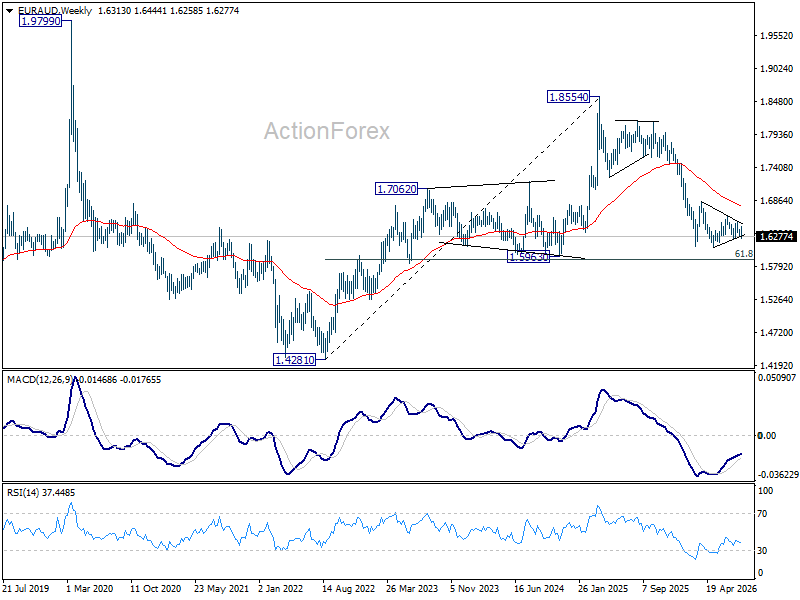
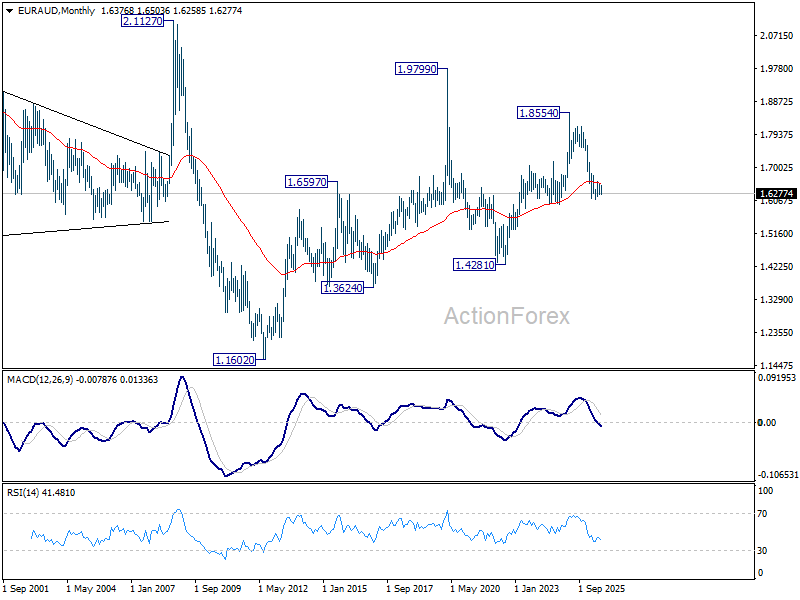
In the longer term picture, fall from 1.8554 is seen as the third leg of the pattern from 1.9799 (2020 high), which is part of the pattern from 2.1127 (2008 high). Sustained trading below 55 M EMA (now at 1.6567) will confirm this bearish case, and pave the way back towards 1.4281.
EUR/CHF Weekly Outlook
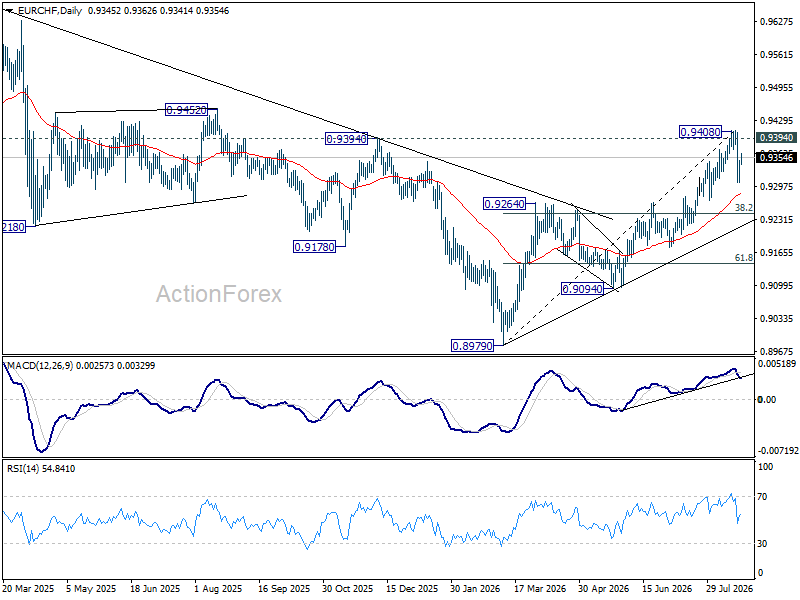
EUR/CHF's steep pullback last week suggests short term topping at 0.9408. Initial bias is neutral this week for some consolidations first. Below 0.9304 will bring deeper pullback, but downside should be contained by 38.2% retracement of 0.8979 to 0.9408 at 0.9244 to bring rebound. Firm break of 0.9408 will resume larger rise from 0.8979.
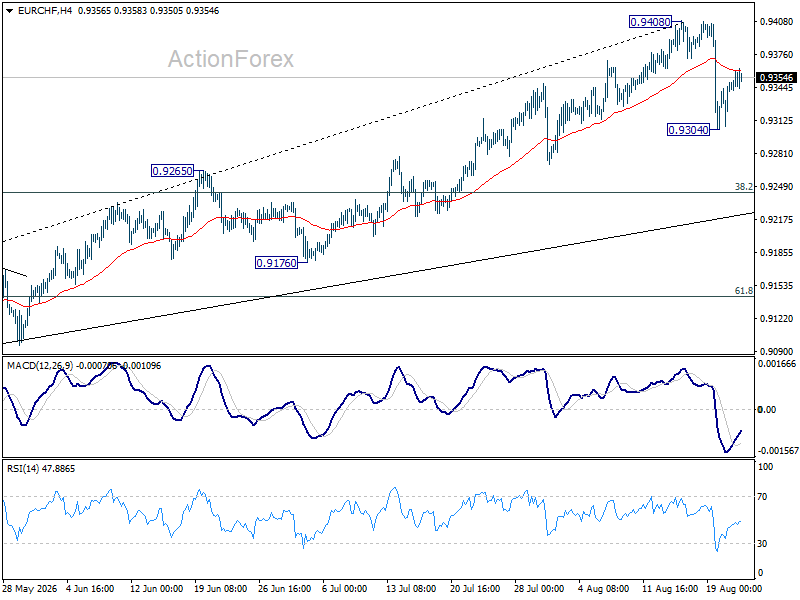
In the bigger picture, the failure to sustain above 0.9394 dampen the bullish case. Outlook is turned neutral first. On the upside, firm break of 0.9394 should confirm that rise from 0.8979 medium term is at least reversing the fall from 0.9928 (2024 high), with prospect of developing into a medium term up trend. Further rally should be seen to 0.9660 resistance next. However, sustained break of 0.9264 resistance turned support will revive medium term bearishness, and bring retest of 0.8979 low instead.
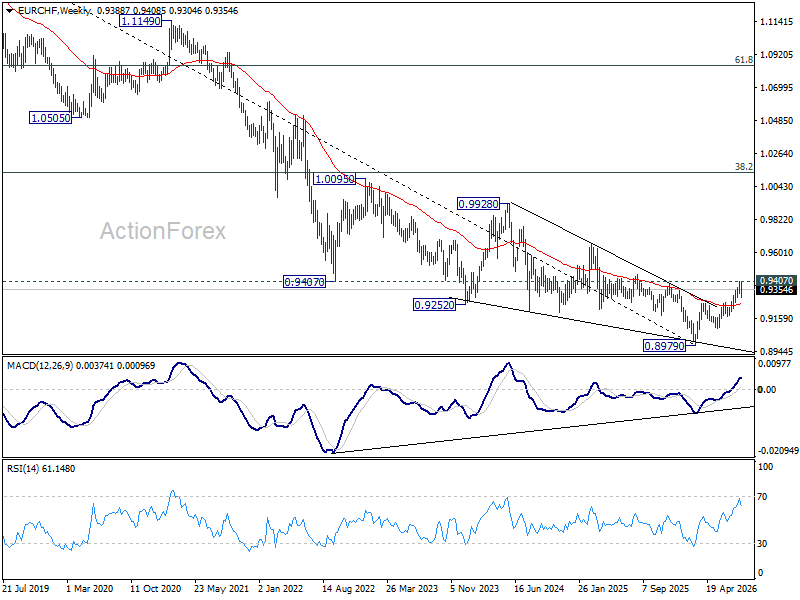
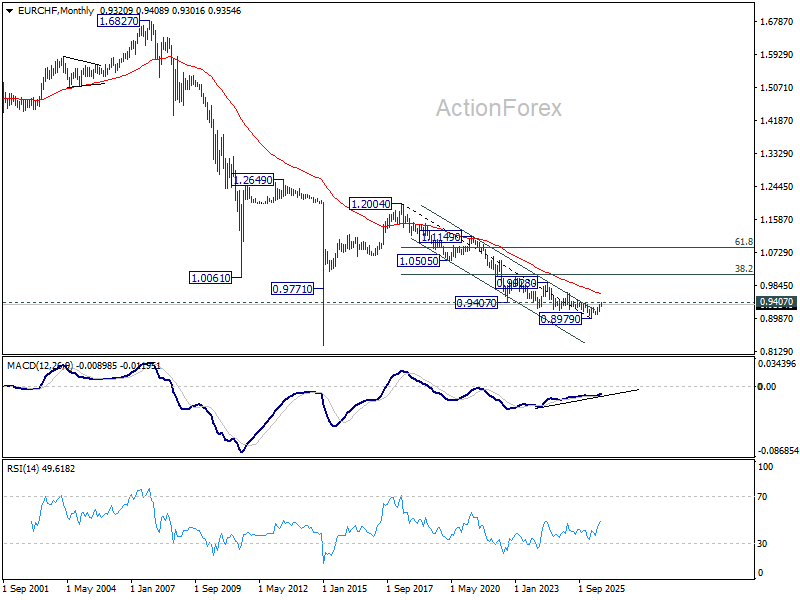
In the long term picture, focus is now on 0.9407 support turned resistance (2022 low). Sustained break there will argue that the down trend from 1.2004 (2018 high) has completed with five waves down to 0.8979. Stronger rebound should then be seen to 38.2% retracement of 1.2004 to 0.8979 at 1.0135 in the medium term.
FX Markets and Central Banks Overview – USD/CAD – AUD/USD
Key takeaways
- Canada inflation & BoC stance: July CPI accelerated to 3.0% YoY, pressuring USD/CAD in the short term, but the Bank of Canada maintains a cautious stance as underlying core metrics continue to moderate.
- Australian labor & RBA dilemma: A sharp contraction in employment pushed unemployment to 4.5%, yet sticky core inflation keeps the RBA constrained in a “higher-for-longer” stance at 4.35%.
- FOMC minutes & rate expectations: Despite hawkish July minutes, markets looked past the rhetoric toward cooler data, with FedWatch pricing for September rate targets rebounding into the 60%–70% range by late August.
- Major currency dynamics: Major pairs rallied against the U.S. dollar during the week of August 17–21, led by NZD/USD (+1.57%) and AUD/USD (+1.33%).
Canada inflation acceleration & Bank of Canada policy stance
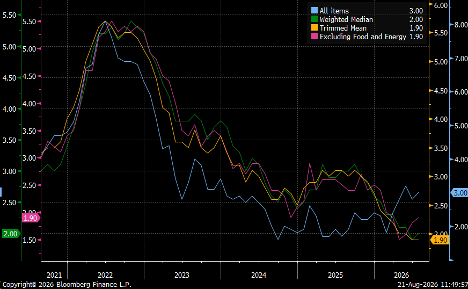
For the week of August 17th, 2026, Statistics Canada released the July CPI report, showing headline inflation accelerating to 3.0% YoY—beating forecasts — driven by surging gasoline and travel costs, while underlying core metrics remained relatively subdued. In response, the Canadian dollar strengthened immediately, pushing USD/CAD down roughly 0.2% to 1.3850 on the day.
Source: Bloomberg Finance L.P. Past performance is not indicative of future results
Despite the headline beat, Bank of Canada (BoC) policymakers maintain a cautious forward stance. The Governing Council is actively balancing near-term inflationary persistence—driven by upticks in the energy and services components—against emerging downside risks to domestic growth, including softer household consumption and elevated debt-servicing costs. While the 3.0% YoY CPI print temporarily suppresses immediate market expectations for aggressive monetary easing, underlying core metrics (CPI-median and CPI-trim) suggest that broader price pressures continue to moderate toward the 2% target band. Consequently, money markets are pricing in a higher probability of a prolonged policy hold, with rate-cut projections shifted further out along the yield curve as central bankers await further confirmation of sustained disinflation before committing to additional policy adjustments.
Australian labor cooling & RBA monetary policy dilemma
This week’s Australian labor force data revealed a surprise cooling in the job market, as headline employment declined by 15,800 jobs in July, significantly missing market forecasts and reversing the previous month’s gain of 80,000 jobs. This contraction was driven entirely by a sharp reduction in part-time roles, which pushed the unemployment rate up to 4.5%—its highest level since late 2021—and contributed to a 0.6% drop in total hours worked. Consequently, the Australian dollar (AUD) faced downward pressure following the report, as investors interpreted the data as a sign of a weaker economic environment, leading the market to dial back expectations for further interest rate hikes from the Reserve Bank of Australia.
However, the initial downward pressure on the Australian dollar proved short-lived, as the currency subsequently staged a strong recovery alongside the broader rally against the U.S. dollar later in the week.
Source: Bloomberg Finance L.P. Past performance is not indicative of future results
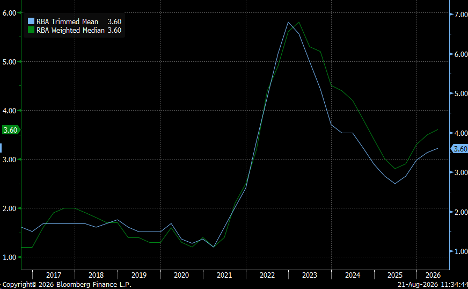
The Reserve Bank of Australia (RBA) finds itself navigating a classic monetary policy dilemma—managing a cooling labor market while stickier price pressures persist. With core inflation, trimmed mean, and weighted median elevated at around 3.6% and headline inflation at 3.8%, both remain above the bank’s 2%–3% target band. However, with the unemployment rate creeping up to 4.5% and net job growth turning negative in July, the RBA is constrained from hiking interest rates further without risking a sharper economic downturn. As a result, the RBA is likely to maintain a “higher-for-longer” policy hold at 4.35%.
FOMC minutes hawkishness & Fed rate probability shifts
The release of the July FOMC meeting minutes revealed a distinctly hawkish division among Federal Reserve officials, highlighted by three dissents favoring an immediate 25-basis-point rate hike and strong warnings regarding upside risks to inflation. Despite this hawkish rhetoric, the foreign exchange market reacted with broad, modest U.S. dollar selling as traders largely dismissed the minutes as backward-looking. Investors prioritized subsequent economic data showing cooling inflation and job losses over the Fed’s July sentiments, shifting their focus toward upcoming commentary at the Jackson Hole Symposium for clearer forward-looking guidance.
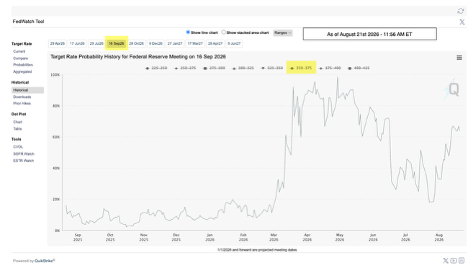
CME Fed watch tool - FOMC September 2026 meeting probabilities
Source: CME Group Past performance is not indicative of future results
The CME FedWatch tool chart shows that after plunging to a multi-month low near 20% in late July, the market-implied probability of a 350–375 bps target rate at the September 16, 2026, meeting rebounded sharply throughout August. The probability climbed back toward the 60%–70% range by August 21st, reflecting shifting interest rate expectations as traders recalibrated the likelihood of a Fed rate cut in response to incoming economic data and central bank communications over the month.
Major currency pair dynamics relative to the U.S. dollar
Source: Tradingview.com. Past performance is not indicative of future results
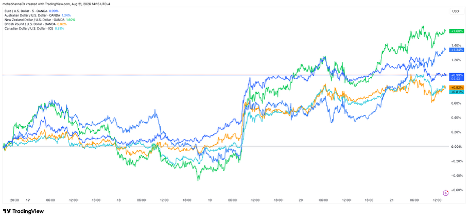
Over the past trading week (August 17–21), major currencies rallied sharply against the U.S. dollar, driven by a broad mid-week greenback sell-off on August 19 as markets looked past hawkish Fed minutes toward cooler U.S. economic data. The New Zealand Dollar (NZD/USD) led gains across the board, extending its advance to +1.57% after recovering aggressively from early-week lows. The Australian Dollar (AUD/USD) followed with a +1.33% gain, while the Euro (EUR/USD) held solid strength at +1.01%. Meanwhile, the Canadian Dollar (CAD/USD) rose +0.82%, supported by earlier domestic inflation strength, and the British Pound (GBP/USD) settled at a +0.80% gain as major pairs maintained their elevated levels heading into the end of the week.
Conclusion
In summary, the week of August 17–21 highlighted diverging monetary policy dynamics and shifting market expectations across major central banks. While Canada’s headline CPI uptick provides short-term support for CAD despite underlying disinflation, Australia’s cooling labor market contrasts with persistent core inflation, keeping the RBA on a cautious hold. Meanwhile, markets largely looked past hawkish FOMC minutes and priced in a higher probability of September Fed rate cuts, driven by softer economic indicators, driving broad gains across major currency pairs relative to the U.S. dollar.
Footnotes
https://www.statcan.gc.ca/en/subjects-start/prices_and_price_indexes/consumer_price_indexes
https://www.asx.com.au/markets/trade-our-derivatives-market/futures-market/rba-rate-tracker
https://www.cmegroup.com/markets/interest-rates/cme-fedwatch-tool.html
The Weekly Bottom Line: Markets Hit Record Highs Amid Resilient Data
Our summary of recent economic events and what to expect in the weeks ahead.
Canadian Highlights
- The U.S. delayed planned 50% tariffs on select Canadian goods by three days, providing brief breathing room as trade talks between the two countries continue.
- Canada's economy grew a much stronger-than-expected 3.3% annualized in Q2, with broad-based strength across exports, business investment, and consumer spending.
- Resilient Q2 growth reinforces our view that the Bank of Canada will likely hold rates steady at its September meeting, even as trade uncertainty lingers.
U.S. Highlights
- Equity markets closed the week at fresh record highs, supported by resilient economic data and strong corporate earnings.
- The Conference Board's Leading Economic Index fell for a fifth straight month, though the pace of decline continued to slow.
- Housing data showed tentative signs of stabilization, with both new and existing home sales posting modest gains in July.
Canada – GDP Delivers a Goldilocks Surprise
As it happens the reprieve was well timed for markets, if not the Canadian economy, with today's release of Q2 GDP data confirming that a 50% tariff was applied to less than 5% of goods trade with the U.S. That's a modest share of trade, but the 3-day reprieve nonetheless offers useful, albeit brief, breathing room as both sides continue working toward what would ideally be a broader and more durable agreement.
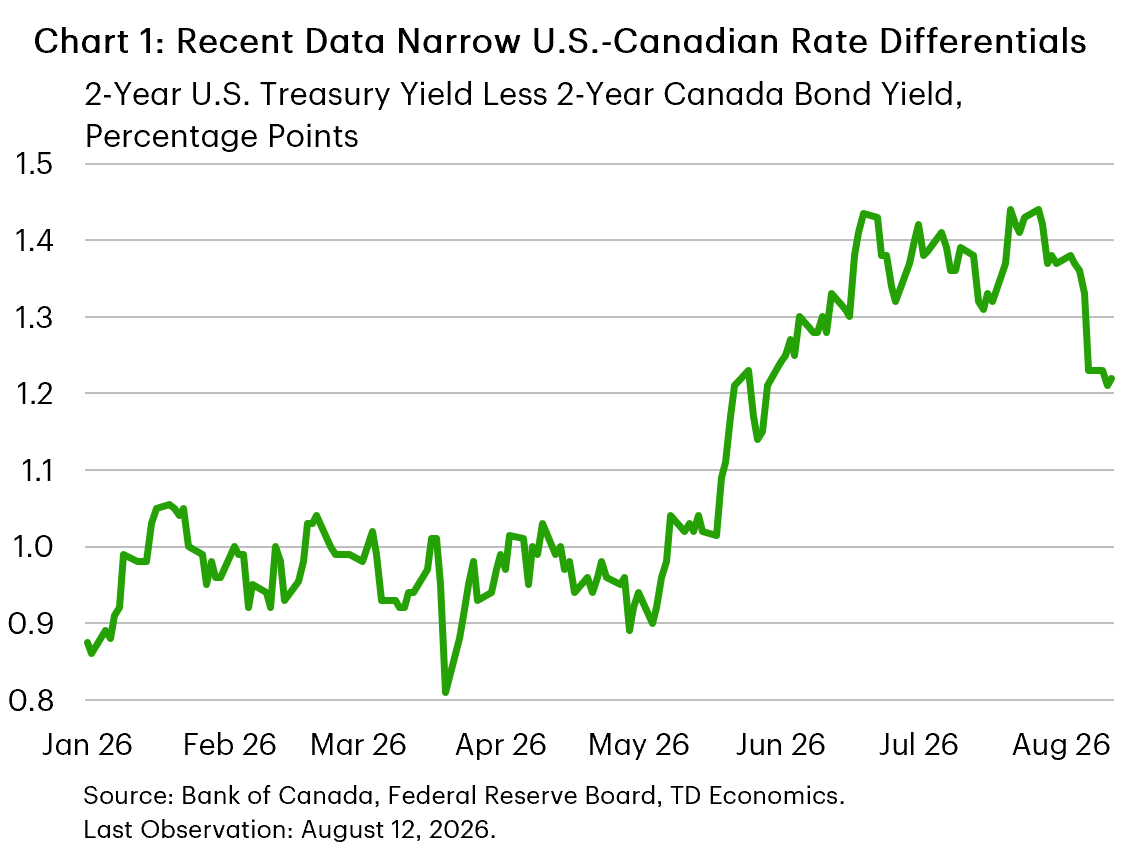
Indeed, this week's Q2 GDP data confirmed just how resilient the Canadian economy has been despite ongoing trade uncertainty, growing by a much stronger-than-expected 3.3% annualized in the second quarter (Chart 1). The upside surprise was broad-based, with strength in exports, business investment, and household spending, alongside a moderate drawdown in inventories. Outsized growth in business investment was particularly notable, jumping 12.7% annualized on the back of a rebound in machinery & equipment spending, alongside continued growth in non-residential structures investment. This pickup in investment aligns with a broader signal from the Bank of Canada's Business Outlook Survey, which showed businesses growing more comfortable with capital spending plans, even as trade uncertainty lingers. On net, this Goldilocks GDP report supports our view that the economy has weathered the trade shock better than feared, and that the Bank of Canada will likely remain on hold at its next meeting in September.
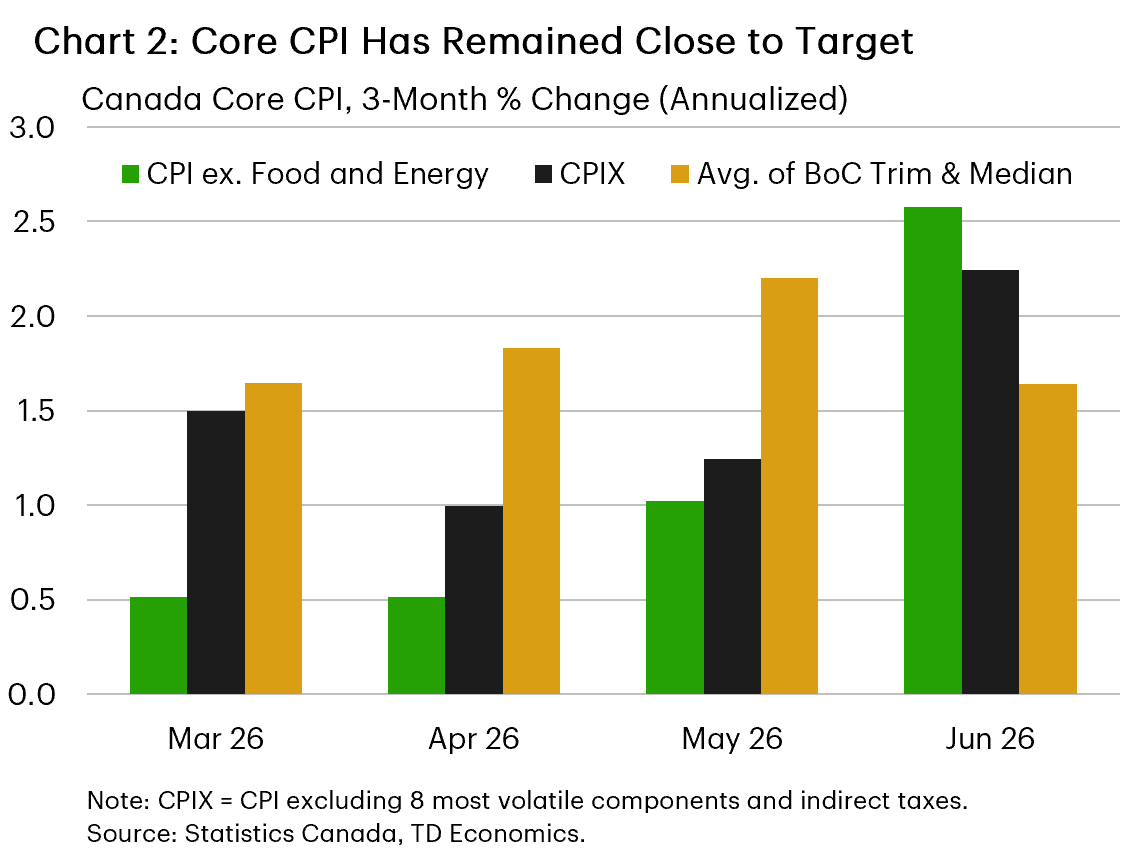
Consumer spending was also a bright spot, rising 4.6% annualized – the fastest pace since late 2023 (Chart 2). This defied expectations for a slowdown following the unwind of the tax rebate boost from Q1, and instead pointed to still-resilient household demand. Purchases of durable goods like vehicles led the charge, up 10.8% annualized, alongside solid growth in services spending. This resilience aligns with recent retail sales data, which showed another solid gain in June, even as high-frequency indicators pointed to some cooling in July.
While the strength in Q2 spending is encouraging, the outlook for household demand remains somewhat uncertain. Softer labour market conditions and elevated household debt levels could act as headwinds to spending in the back half of the year. That said, today's data suggest that consumers, alongside businesses, have shown notable resilience in the face of ongoing trade uncertainty.
The recent flurry of trade headlines will remain in focus as markets look for further signs of progress or setbacks in Canada-U.S. trade talks. With the reprieve now in place, all eyes will turn to whether a more substantive agreement can be reached before the new deadline arrives.
Marc Ercolao, Economist
U.S. – Markets Hit Record Highs Amid Resilient Data
Markets continued their upward march this week, buoyed by a resilient economic outlook, better-than-expected earnings, and growing anticipation of Fed Chair Warsh's remarks at the Jackson Hole Symposium. The S&P 500 and Nasdaq both notched fresh record highs, up 0.3% and 0.5% respectively for the week, while the small-cap focused Russell 2000 surged 2.1%, buoyed by increased expectations of Fed rate cuts filtering through to smaller, more rate-sensitive firms.
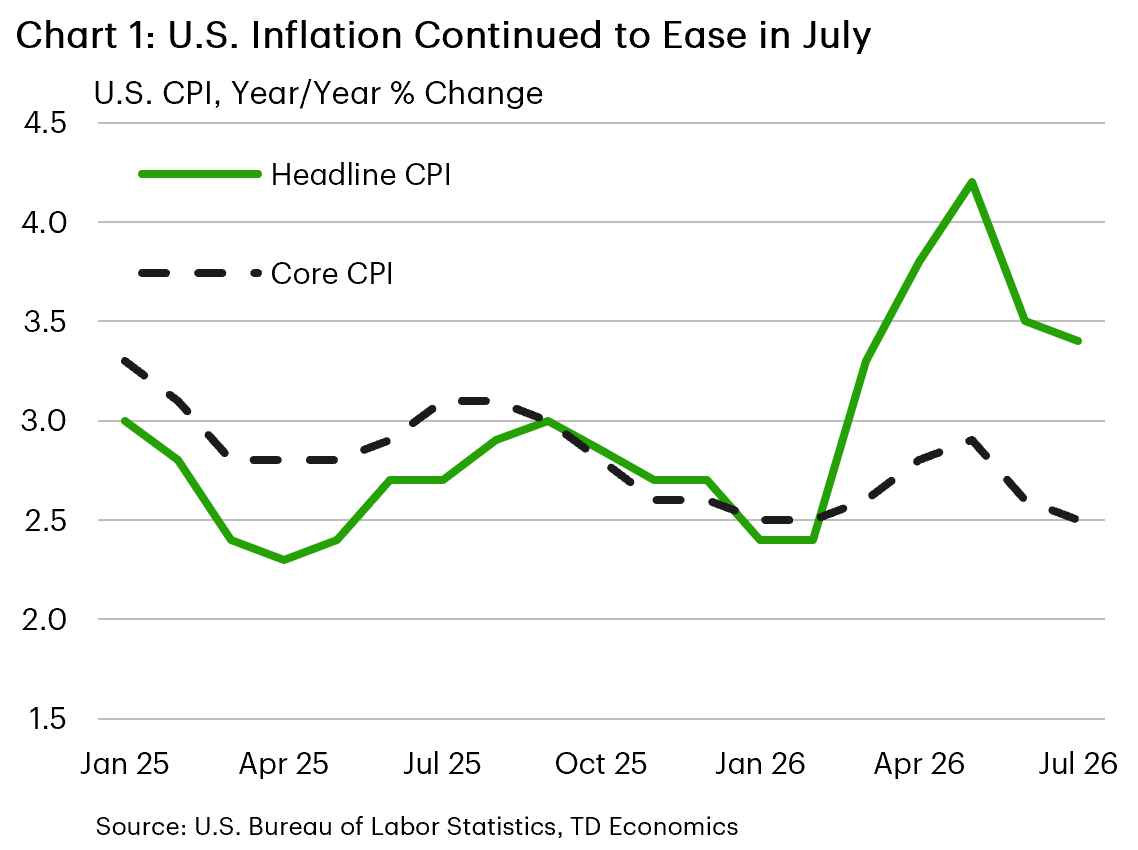
This risk-on tone has been driven in part by data showing a continued moderation in U.S. economic growth, without signalling a sharp deterioration – often referred to as a "soft landing." This week's data releases reinforced this narrative. The Conference Board's Leading Economic Index (LEI) fell 0.1% in July, marking its fifth consecutive month of decline (Chart 1). However, the pace of contraction has slowed meaningfully compared to earlier in the year, suggesting economic momentum, while cooling, remains intact. The share of LEI components in expansion also picked up to 50%, the highest level in nearly a year.
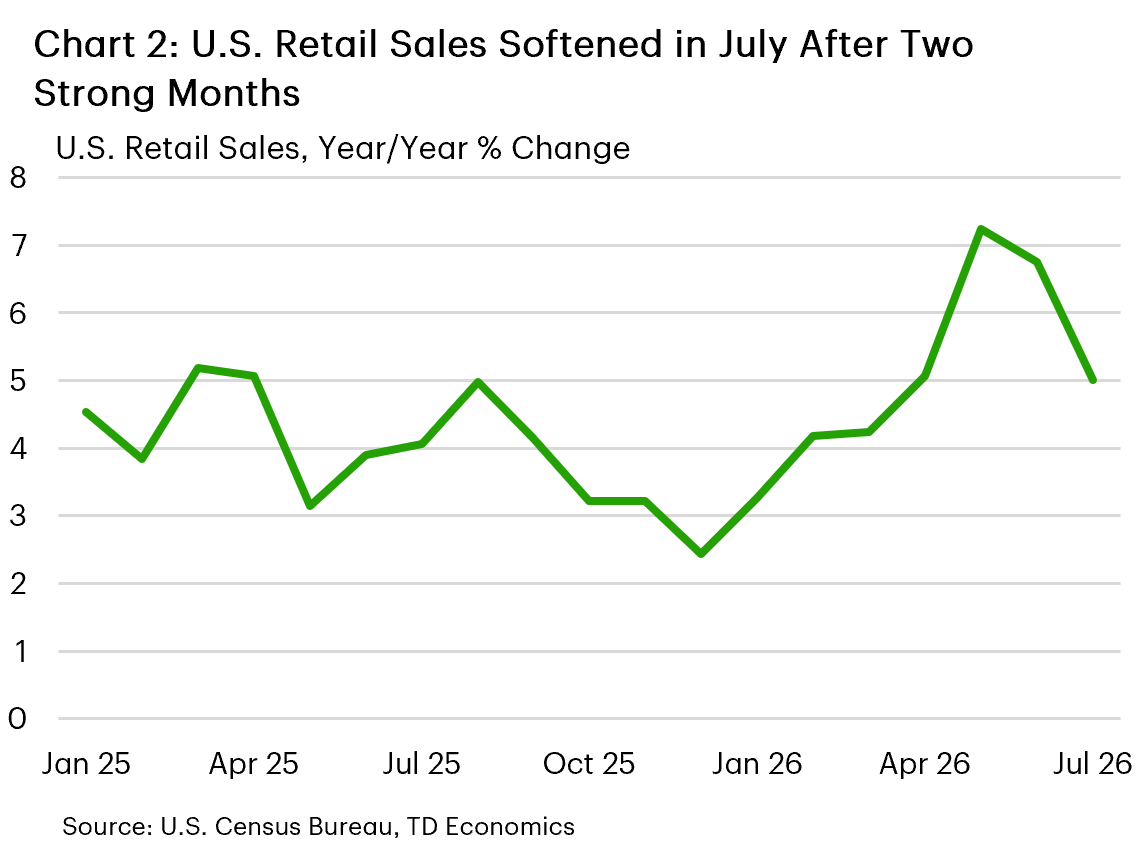
Housing data also pointed to a similar story of cautious stabilization. New home sales rose 4.2% in July, reversing a chunk of the prior month's steep decline, while existing home sales edged up 1.5% – modest but welcome signs of life in an otherwise sluggish housing market (Chart 2). Much of the resilience appears to stem from a modest pickup in mortgage activity, spurred by a small pullback in mortgage rates, alongside continued builder incentives that have helped offset persistently high borrowing costs. Still, affordability challenges remain a significant hurdle, and the housing sector's overall trajectory remains fragile.
Meanwhile, robust corporate earnings continue to support the resilient growth narrative. With roughly 90% of S&P 500 companies having reported for the second quarter, blended earnings growth has come in at a stellar 12% year-over-year, comfortably beating expectations of around 5% heading into the season. This marks the fourth consecutive quarter of double-digit profit growth, reinforcing the view that corporate America remains in a strong position, even as macro uncertainty simmers in the background.
All told, this week's data continue to support the market's preferred narrative: growth is cooling, but not collapsing, and earnings remain a pillar of strength. As we move toward the Jackson Hole Symposium, all eyes will be on Chair Warsh for clues on the Fed's next move, particularly considering how resilient the economy has been in the face of still elevated interest rates.
Economics Week Ahead
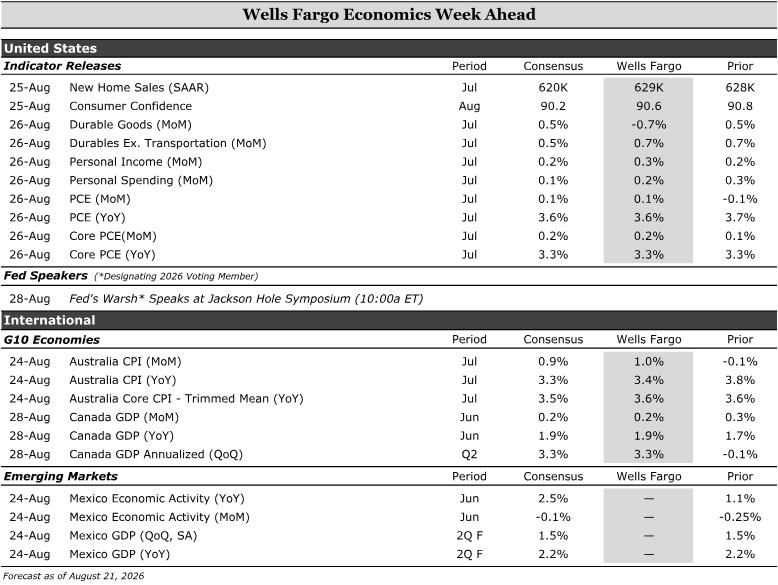
Next week, July's personal income and spending report is expected to show resilient consumer demand, while PCE inflation should point to easing underlying price pressures. Jackson Hole will also be in focus, and Chair Warsh is likely to emphasize the Fed's longer-term policy framework and task force priorities. Meanwhile, Friday's benchmark payroll revision is expected to show only a modest downward adjustment, suggesting labor market conditions have tracked more closely to published estimates than in recent years.
Abroad, Australia's July CPI report is expected to show signs of inflation picking up amid higher fuel costs and sticky underlying price pressures. In Canada, we expect the Q2 GDP report to show the strongest pace of growth in nearly two years, with the economy expanding at a 3.3% annualized rate.
United States: Personal Income & Spending (Wednesday), Jackson Hole Economic Policy Symposium (Thursday – Saturday); Preliminary 2026 Benchmark to Nonfarm Payrolls (Friday)
Advanced Economies: Australia CPI (Wednesday), Canada GDP (Friday)
Source: Bloomberg Finance L.P. and Wells Fargo Economics
U.S. Week Ahead
Personal Income & Spending • Wednesday
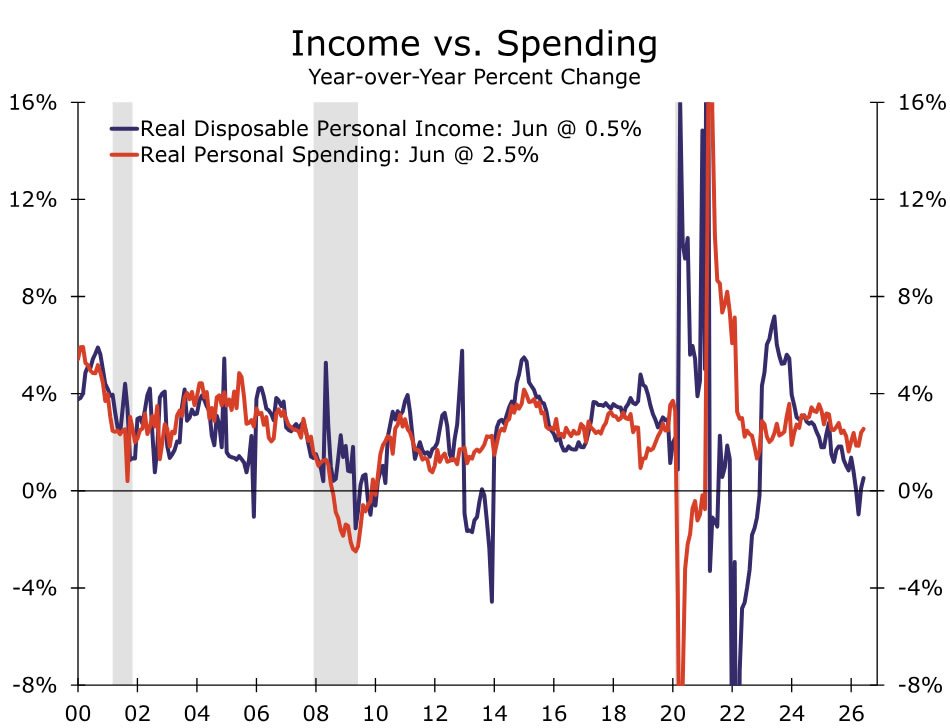
Consumer spending appears to have held up in July, and we forecast a 0.2% gain in nominal spending. While headline retail sales disappointed, the weakness was largely traced to lower gasoline prices and an unusually large drop in nonstore (online sales), likely reflecting the calendar shift of Amazon Prime Day into June this year. Excluding those distortions, control group sales excluding nonstore retailers were up 0.4%, just above its average pace over the past six months and pointing to steady underlying goods demand.
The more important story for markets is what comes next. The boost from larger-than-usual tax refunds that helped cushion households from higher gasoline prices has now largely faded, leaving consumer spending increasingly dependent on underlying income growth. We expect nominal personal income rose 0.3% in July. And if there is any upside surprise it would likely come from proprietors' income, which has been unusually volatile this year due to the timing of USDA-related payments. Even so, real disposable income should continue to gradually improve, and year-over-year growth is likely to grind modestly higher in coming months if labor market conditions remain stable, allowing consumer spending to continue.
We're not expecting much surprise on inflation. The latest CPI and PPI reports point to a 0.1% gain in the PCE deflator in July, nudging the year-over-year rate down to 3.6%. Core PCE inflation is expected to rise 0.2% on the month, leaving the annual rate at 3.3%. While inflation remains above the Fed's target, the recent data are consistent with a gradual easing in underlying price pressure.
Source: U.S. Department of Commerce and Wells Fargo Economics
Jackson Hole Economic Policy Symposium • Thurs. – Sat.
We have always thought entirely too much attention has been placed on the Fed's Jackson Hole event. Over about the last decade and a half there have been only two big speeches that we would describe as truly consequential for the near-term policy path (Powell's "pain" speech in 2022 and Bernanke's hint at QE3 in 2012). That's it. Two speeches in the last 14 years.
You would think given Warsh's proclivity to want to say less, not more, this would be another year when little actually happens. And while we tend to lean in that direction as it relates to JH, the one thing that has us wondering a bit more about this than typical is the "clean up" article that occurred in the FT following the last FOMC presser. If Warsh cared enough to bless that (assuming he did), then it may be on his mind that his current approach may need some refining and could decide to address it.
Source: Federal Reserve Board and Wells Fargo Economics
Warsh has refrained from laying out his near-term reaction function, a tactic we do not think he'll abandon only a few months into his tenure. Besides, with the Committee clearly split on what to do next and another round of inflation and employment data between his speech and the FOMC's next meeting on Sep. 16, revealing his leaning now risks boxing in the Committee—the very issue he's trying to avoid by paring back guidance.
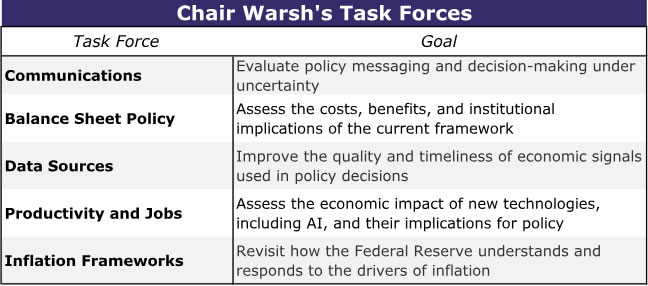
Given his response about Jackson Hole at the last FOMC presser, we wouldn't be surprised if Warsh uses his speech to expand upon some of the "big questions" his task forces are working on that will shape the FOMC's approach to monetary policy. For example, he could lay out some of the potential options on the table, such as the appropriate size and composition of the balance sheet, ways the Summary of Economic Projections could be more effective, or touch on how many meetings the FOMC should hold annually.
That said, we think he will be careful not to get too far ahead of the task forces and commit to any changes. We think he'll also stress that he seeks to keep what's working at the Fed, not just come in and completely upend the place, to warm relations with existing FOMC members and help secure buy-in for the task forces' eventual recommendations.
It's certainly possible Warsh touches on recent developments in the Treasury market and the overlay with monetary policy, or more clearly articulate the Committee's near-term reaction function. However, we think the dominant aim of his speech will be to buy the Committee time until the task force findings are released, and hope the data cooperates with the current policy stance over the interim.
Preliminary 2026 Benchmark Revision to NFP • Friday
The BLS's preliminary annual benchmark to nonfarm payrolls has received a lot of attention the past two years. That's because the historically large downward revisions came at a time when the labor market's momentum was already a source of concern. For the 2026 preliminary benchmark, however, we expect a much smaller downward adjustment (around -100K vs. -911K in 2025), and we even see a risk that the level of payrolls in March 2026 is estimated to be higher, rather than lower.
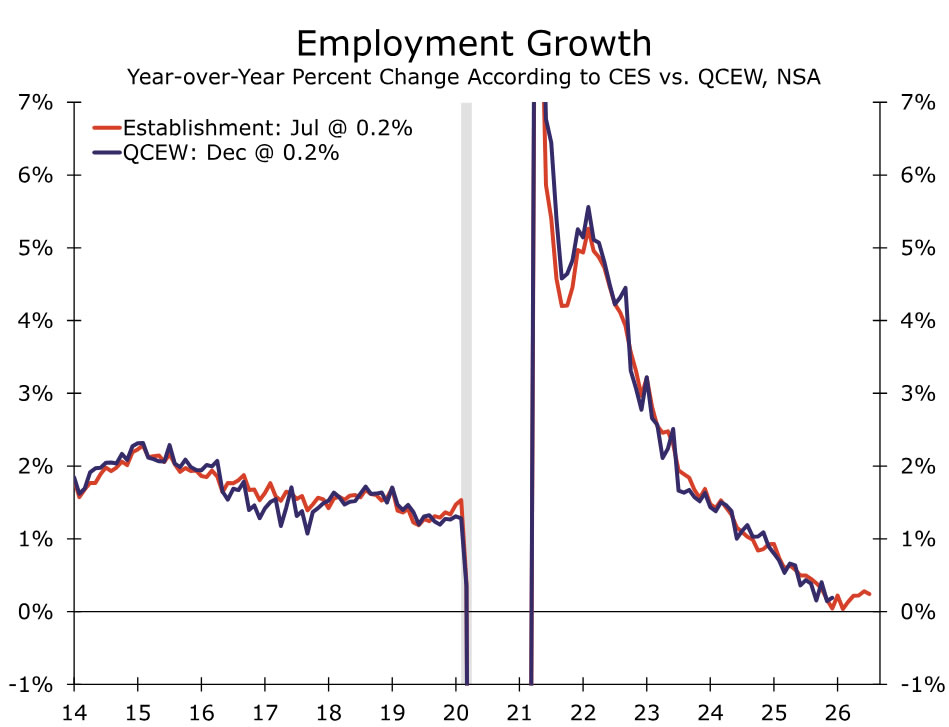
As a refresher, the annual benchmark aligns the March level of employment in the nonfarm payroll survey with administrative data that is less timely but more accurate. The primary source for this administrative data is the Quarterly Census of Employment and Wages (QCEW), and QCEW job growth through the first three quarters of the benchmark period (Q2:25 – Q4:25) has tracked closely with the published payroll data as the nearby chart shows. In fact, through December, QCEW employment has actually risen a touch faster than NFP.
The closer alignment reflects a smaller boost to NFP from the birth-death factor following recent methodology improvements. But sampling and response bias are likely to remain sources of error, with the overall payroll survey response rate (the survey response rate multiplied by the share of eligible firms opting into the survey) still depressed relative to pre-pandemic. The tendency for preliminary Q1 QCEW employment to undershoot the final print also cautions against the preliminary announcement eking out an upward adjustment.
Source: U.S. Department of Labor and Wells Fargo Economics
G10 Week Ahead
Australia CPI • Wednesday
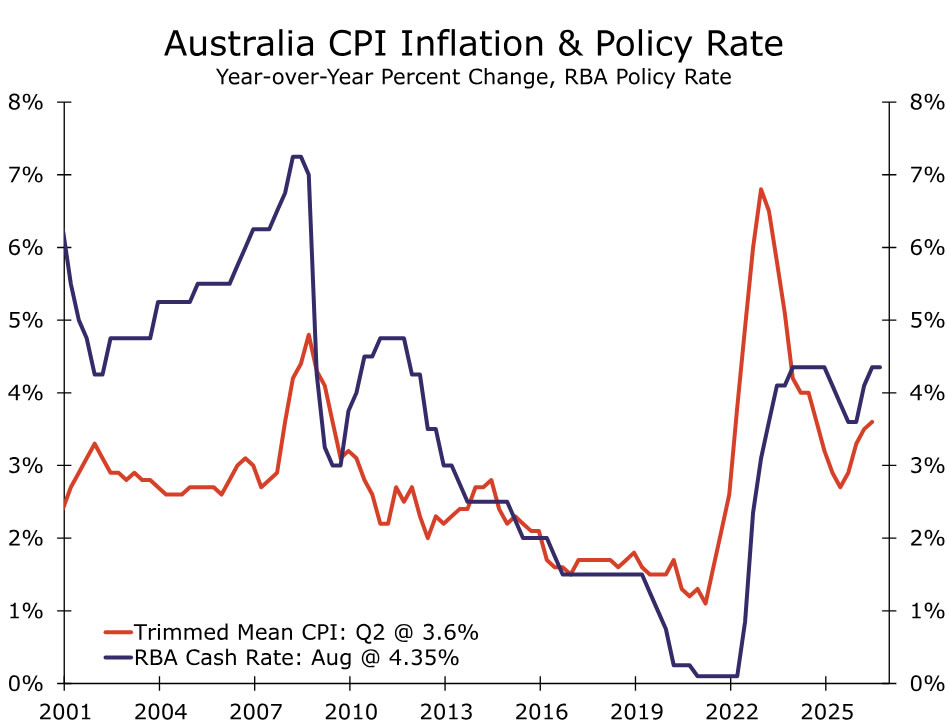
Australia's July CPI release is due next week and will provide another test of whether the inflation relief seen in June can be sustained. We expect headline inflation to rise 1.0% in July, leading the year-over-year rate down to 3.4%, while trimmed mean inflation remains at 3.6% year over year.
The expected increase in monthly headline inflation largely reflects higher fuel prices following the expiration of temporary fuel excise relief and the renewed rise in fuel costs after the re-escalation of the Middle East conflict. Underlying inflation also remains sticky, with July's NAB business survey showing some renewed pressure on costs and selling prices.
While June's CPI report reduced some pressure on the Reserve Bank of Australia (RBA) to tighten further, inflation expectations have moved higher and policymakers continue to describe policy as only "somewhat restrictive." As such, we believe a September or Q4 rate hike remains in play if inflation remains elevated and demand conditions continue to prove resilient.
Source: Bloomberg Finance L.P. and Wells Fargo Economics
Canada GDP • Friday
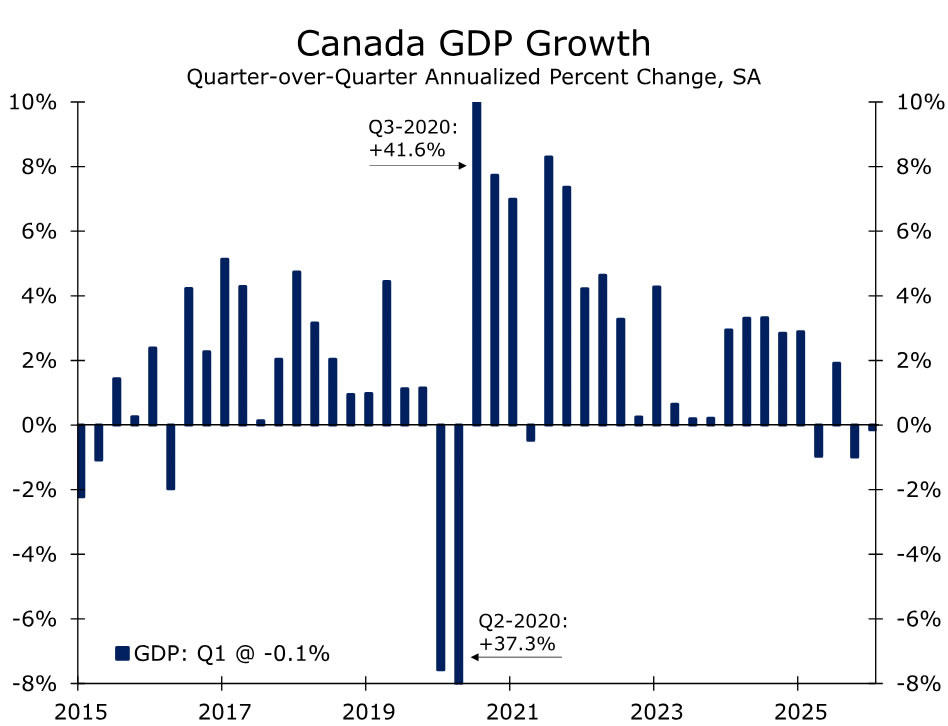
We expect Canada's economy expanded at a 3.3% annualized clip in Q2, marking the strongest quarterly rate of growth in nearly two years.
June appears to have provided some of the quarter's momentum. Statistics Canada's preliminary estimate points to a 0.2% monthly increase in GDP, led by gains in wholesale trade, finance & insurance and retail trade, partially offset by weakness in utilities and agriculture. While that would mark a step-down from growth earlier in the quarter, the broad-based nature of the advance estimate suggests domestic demand held up reasonably well through quarter-end even as tariff uncertainty continued to weigh on business sentiment.
The stronger Q2 backdrop should further alleviate recession concerns and reinforce the Bank of Canada's decision to remain on hold. While uncertainty surrounding trade negotiations continues to argue for caution, incoming data suggest the economy is adapting better than anticipated to external headwinds.
Source: Statistics Canada, Bloomberg Finance L.P. and Wells Fargo Economics
Summary 8/24 – 8/28
Monday, Aug 24, 2026
| GMT | Ccy | Events | Cons | Prev |
|---|---|---|---|---|
| 22:45 | NZD | Retail Sales Q/Q Q2 | 0.10% | 0.90% |
| 22:45 | NZD | Retail Sales ex Autos Q/Q Q2 | 0.30% | 1.00% |
| 22:45 | NZD |
| Retail Sales Q/Q Q2 | |
| Consensus | 0.10% |
| Previous | 0.90% |
| 22:45 | NZD |
| Retail Sales ex Autos Q/Q Q2 | |
| Consensus | 0.30% |
| Previous | 1.00% |
Tuesday, Aug 25, 2026
| GMT | Ccy | Events | Cons | Prev |
|---|---|---|---|---|
| 01:30 | AUD | RBA Meeting Minutes | ||
| 06:00 | EUR | Germany GDP Q/Q Q2 F | 0.20% | 0.20% |
| 08:00 | EUR | Germany IFO Expectations Aug | 87.5 | 86.7 |
| 08:00 | EUR | Germany IFO Business Climate Aug | 87.3 | 86.6 |
| 08:00 | EUR | Germany IFO Current Assessment Aug | 87 | 86.5 |
| 13:00 | USD | Housing Price Index M/M Jun | 0.20% | 0.30% |
| 14:00 | USD | Consumer Confidence Aug | 90.3 | 90.8 |
| 14:00 | USD | New Home Sales M/M Jul | 620K | 628K |
| 01:30 | AUD |
| RBA Meeting Minutes | |
| Consensus | |
| Previous | |
| 06:00 | EUR |
| Germany GDP Q/Q Q2 F | |
| Consensus | 0.20% |
| Previous | 0.20% |
| 08:00 | EUR |
| Germany IFO Expectations Aug | |
| Consensus | 87.5 |
| Previous | 86.7 |
| 08:00 | EUR |
| Germany IFO Business Climate Aug | |
| Consensus | 87.3 |
| Previous | 86.6 |
| 08:00 | EUR |
| Germany IFO Current Assessment Aug | |
| Consensus | 87 |
| Previous | 86.5 |
| 13:00 | USD |
| Housing Price Index M/M Jun | |
| Consensus | 0.20% |
| Previous | 0.30% |
| 14:00 | USD |
| Consumer Confidence Aug | |
| Consensus | 90.3 |
| Previous | 90.8 |
| 14:00 | USD |
| New Home Sales M/M Jul | |
| Consensus | 620K |
| Previous | 628K |
Wednesday, Aug 26, 2026
| GMT | Ccy | Events | Cons | Prev |
|---|---|---|---|---|
| 23:50 | JPY | Corporate Service Price Index Y/Y Jul | 3.20% | 3.20% |
| 01:00 | AUD | Westpac Leading Index M/M Jul | 0.04% | |
| 01:30 | AUD | CPI M/M Jul | 0.90% | -0.10% |
| 01:30 | AUD | CPI Y/Y Jul | 3.20% | 3.80% |
| 01:30 | AUD | Trimmed Mean CPI M/M Jul | 0.30% | 0.30% |
| 01:30 | AUD | Trimmed Mean CPI Y/Y Jul | 3.50% | 3.60% |
| 12:30 | USD | Personal Income M/M Jul | 0.20% | 0.20% |
| 12:30 | USD | Personal Spending Jul | 0.10% | 0.30% |
| 12:30 | USD | PCE Price Index M/M Jul | 0.10% | -0.10% |
| 12:30 | USD | PCE Price Index Y/Y Jul | 3.70% | |
| 12:30 | USD | Core PCE Price Index M/M Jul | 0.20% | 0.10% |
| 12:30 | USD | Core PCE Price Index Y/Y Jul | 3.30% | 3.30% |
| 12:30 | USD | GDP Annualized Q2 P | 1.50% | 1.50% |
| 12:30 | USD | GDP Price Index Q2 P | 6.20% | 6.30% |
| 12:30 | USD | Durable Goods Orders Jul | 0.50% | 0.50% |
| 12:30 | USD | Durable Goods Orders ex Transport Jul | 0.50% | 0.70% |
| 14:30 | USD | Crude Oil Inventories (Aug 21) | 1.9M | 4.4M |
| 23:50 | JPY |
| Corporate Service Price Index Y/Y Jul | |
| Consensus | 3.20% |
| Previous | 3.20% |
| 01:00 | AUD |
| Westpac Leading Index M/M Jul | |
| Consensus | |
| Previous | 0.04% |
| 01:30 | AUD |
| CPI M/M Jul | |
| Consensus | 0.90% |
| Previous | -0.10% |
| 01:30 | AUD |
| CPI Y/Y Jul | |
| Consensus | 3.20% |
| Previous | 3.80% |
| 01:30 | AUD |
| Trimmed Mean CPI M/M Jul | |
| Consensus | 0.30% |
| Previous | 0.30% |
| 01:30 | AUD |
| Trimmed Mean CPI Y/Y Jul | |
| Consensus | 3.50% |
| Previous | 3.60% |
| 12:30 | USD |
| Personal Income M/M Jul | |
| Consensus | 0.20% |
| Previous | 0.20% |
| 12:30 | USD |
| Personal Spending Jul | |
| Consensus | 0.10% |
| Previous | 0.30% |
| 12:30 | USD |
| PCE Price Index M/M Jul | |
| Consensus | 0.10% |
| Previous | -0.10% |
| 12:30 | USD |
| PCE Price Index Y/Y Jul | |
| Consensus | |
| Previous | 3.70% |
| 12:30 | USD |
| Core PCE Price Index M/M Jul | |
| Consensus | 0.20% |
| Previous | 0.10% |
| 12:30 | USD |
| Core PCE Price Index Y/Y Jul | |
| Consensus | 3.30% |
| Previous | 3.30% |
| 12:30 | USD |
| GDP Annualized Q2 P | |
| Consensus | 1.50% |
| Previous | 1.50% |
| 12:30 | USD |
| GDP Price Index Q2 P | |
| Consensus | 6.20% |
| Previous | 6.30% |
| 12:30 | USD |
| Durable Goods Orders Jul | |
| Consensus | 0.50% |
| Previous | 0.50% |
| 12:30 | USD |
| Durable Goods Orders ex Transport Jul | |
| Consensus | 0.50% |
| Previous | 0.70% |
| 14:30 | USD |
| Crude Oil Inventories (Aug 21) | |
| Consensus | 1.9M |
| Previous | 4.4M |
Thursday, Aug 27, 2026
| GMT | Ccy | Events | Cons | Prev |
|---|---|---|---|---|
| 01:30 | AUD | Private Capital Expenditure Q2 | 0.80% | 6.50% |
| 06:00 | EUR | Germany GfK Consumer Confidence Sep | -29.2 | -29.6 |
| 08:00 | EUR | Eurozone M3 Money Supply Y/Y Jul | 3.40% | 3.30% |
| 11:30 | EUR | ECB Monetary Policy Meeting Accounts | ||
| 12:30 | CAD | Current Account (CAD) Q2 | -5.5B | -7.2B |
| 12:30 | USD | Initial Jobless Claims (Aug 21) | 209K | 206K |
| 12:30 | USD | Goods Trade Balance (USD) Jul P | -99.5B | -102.1B |
| 12:30 | USD | Wholesale Inventories Jul P | 0.10% | 0.20% |
| 14:30 | USD | Natural Gas Storage (Aug 21) | 16B |
| 01:30 | AUD |
| Private Capital Expenditure Q2 | |
| Consensus | 0.80% |
| Previous | 6.50% |
| 06:00 | EUR |
| Germany GfK Consumer Confidence Sep | |
| Consensus | -29.2 |
| Previous | -29.6 |
| 08:00 | EUR |
| Eurozone M3 Money Supply Y/Y Jul | |
| Consensus | 3.40% |
| Previous | 3.30% |
| 11:30 | EUR |
| ECB Monetary Policy Meeting Accounts | |
| Consensus | |
| Previous | |
| 12:30 | CAD |
| Current Account (CAD) Q2 | |
| Consensus | -5.5B |
| Previous | -7.2B |
| 12:30 | USD |
| Initial Jobless Claims (Aug 21) | |
| Consensus | 209K |
| Previous | 206K |
| 12:30 | USD |
| Goods Trade Balance (USD) Jul P | |
| Consensus | -99.5B |
| Previous | -102.1B |
| 12:30 | USD |
| Wholesale Inventories Jul P | |
| Consensus | 0.10% |
| Previous | 0.20% |
| 14:30 | USD |
| Natural Gas Storage (Aug 21) | |
| Consensus | |
| Previous | 16B |
Friday, Aug 28, 2026
| GMT | Ccy | Events | Cons | Prev |
|---|---|---|---|---|
| 23:30 | JPY | Unemployment Rate Jul | 2.50% | 2.50% |
| 23:30 | JPY | Tokyo CPI Y/Y Aug | 2% | |
| 23:30 | JPY | Tokyo CPI Core Y/Y Aug | 1.80% | 1.90% |
| 23:30 | JPY | Tokyo CPI Core-Core Y/Y Aug | 2% | |
| 06:45 | EUR | France GDP Q/Q Q2 | 0.20% | 0.20% |
| 07:00 | CHF | KOF Leading Indicator Jul | 103 | 103.5 |
| 07:55 | EUR | Germany Unemployment Change Jul | 8K | 6K |
| 07:55 | EUR | Germany Unemployment Rate Jul | 6.40% | 6.40% |
| 09:00 | EUR | Eurozone Economic Sentiment Indicator Aug | 97.5 | 96.9 |
| 09:00 | EUR | Eurozone Industrial Confidence Aug | -6.1 | |
| 09:00 | EUR | Eurozone Services Sentiment Aug | 4.7 | |
| 09:00 | EUR | Eurozone Consumer Confidence Aug | -16.3 | -15.5 |
| 12:30 | CAD | GDP M/M Jun | 0.20% | 0.30% |
| 12:30 | CAD | GDP Q/Q Q2 | 0% | |
| 13:45 | USD | Chicago PMI Aug | 59.1 | 57.6 |
| 14:00 | USD | UoM Consumer Sentiment Aug F | 51 | 51 |
| 14:00 | USD | UoM 1-Yr Inflation Expectations Aug F | 4.30% | 4.30% |
| 23:30 | JPY |
| Unemployment Rate Jul | |
| Consensus | 2.50% |
| Previous | 2.50% |
| 23:30 | JPY |
| Tokyo CPI Y/Y Aug | |
| Consensus | |
| Previous | 2% |
| 23:30 | JPY |
| Tokyo CPI Core Y/Y Aug | |
| Consensus | 1.80% |
| Previous | 1.90% |
| 23:30 | JPY |
| Tokyo CPI Core-Core Y/Y Aug | |
| Consensus | |
| Previous | 2% |
| 06:45 | EUR |
| France GDP Q/Q Q2 | |
| Consensus | 0.20% |
| Previous | 0.20% |
| 07:00 | CHF |
| KOF Leading Indicator Jul | |
| Consensus | 103 |
| Previous | 103.5 |
| 07:55 | EUR |
| Germany Unemployment Change Jul | |
| Consensus | 8K |
| Previous | 6K |
| 07:55 | EUR |
| Germany Unemployment Rate Jul | |
| Consensus | 6.40% |
| Previous | 6.40% |
| 09:00 | EUR |
| Eurozone Economic Sentiment Indicator Aug | |
| Consensus | 97.5 |
| Previous | 96.9 |
| 09:00 | EUR |
| Eurozone Industrial Confidence Aug | |
| Consensus | |
| Previous | -6.1 |
| 09:00 | EUR |
| Eurozone Services Sentiment Aug | |
| Consensus | |
| Previous | 4.7 |
| 09:00 | EUR |
| Eurozone Consumer Confidence Aug | |
| Consensus | -16.3 |
| Previous | -15.5 |
| 12:30 | CAD |
| GDP M/M Jun | |
| Consensus | 0.20% |
| Previous | 0.30% |
| 12:30 | CAD |
| GDP Q/Q Q2 | |
| Consensus | |
| Previous | 0% |
| 13:45 | USD |
| Chicago PMI Aug | |
| Consensus | 59.1 |
| Previous | 57.6 |
| 14:00 | USD |
| UoM Consumer Sentiment Aug F | |
| Consensus | 51 |
| Previous | 51 |
| 14:00 | USD |
| UoM 1-Yr Inflation Expectations Aug F | |
| Consensus | 4.30% |
| Previous | 4.30% |
Brent Oil Continues to Advance on Persisting Uncertainty in the Middle East
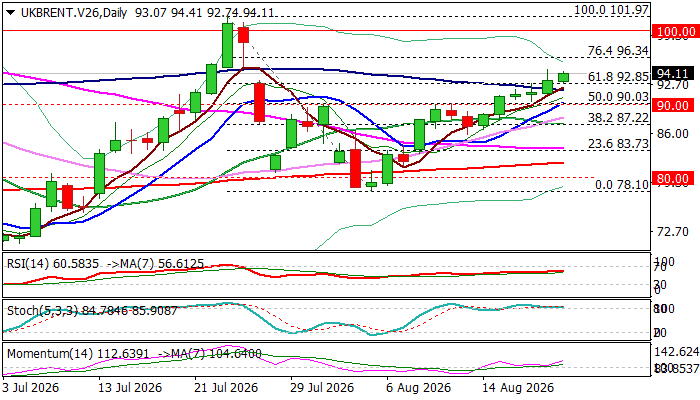
Brent oil price continues to trend higher and holds near one-month high on Friday, on track for the second consecutive strong weekly gain (up almost 6% for the week).
Growing uncertainty in the Middle East, where the US tries to impose the toughest sanctions on Iranian oil export, while Iran keeps Hormuz strait closed and threatens of strong response, may lead towards further escalation.
In such scenario, further supply disruption from major oil producers in the Gulf region would send fresh shockwaves through the world economies and lift oil price above $100 per barrel.
Brent stays above $94 in Friday afternoon trading and will likely register a weekly close above $90 that would contribute to bullish signals on daily chart (strengthening positive momentum / multiple MA bull-crosses).
Broken Fibo level at $92.85 reverted to initial support, followed by daily cloud top ($91.41) which should contain potential dips and provide better levels to re-enter bullish market for fresh push higher.
Res: 94.69; 95.12; 96.34; 98.96
Sup: 92.85; 91.90; 91.41; 90.00
Week Ahead – Fed’s Jackson Hole and Nvidia Earnings to Dictate Markets
- Kevin Warsh to make his Jackson Hole debut amid confusing messaging.
- But a major hawkish surprise unlikely after bond market intervention.
- Nvidia earnings to also determine market direction as stock rally cools.
- US PCE inflation and Tokyo CPI data may spur additional volatility.
All eyes on the Fed
The new Fed chair, Kevin Warsh, has made few public appearances since taking the central bank helm in May, yet he's found it difficult to steer off controversy. Question marks about his relations with the President, Donald Trump, continue to swirl, while markets are still trying to make sense of his approach to monetary policy.
As investors await the outcome of the reviews of his task forces on how the Fed operates, which isn't expected before the end of the year, those hoping that Warsh will offer any significant policy clues at next week's Jackson Hole Economic Policy Symposium will likely be disappointed. The topic for this year's event – Financial Innovation: Implications for Payments and Policy – is conveniently a non-economic one.
This may allow Warsh to avoid focusing greatly on the outlook for inflation and interest rates, risking the ire of the markets, as Jackson Hole has traditionally been used by Fed chairs to signal major policy pivots.
However, even if Warsh sidesteps giving any direct policy signals when he delivers his key address on Friday, the three-day gathering of central bankers could still prove market moving, but probably for the wrong reasons. Warsh's first Jackson Hole as Fed Chair could be quite awkward for two reasons. Other Fed officials speaking at the event will likely voice support for rate hikes if inflation doesn't hit the 2% target soon, highlighting a growing dissent even as Warsh attempts to portray a unified front.
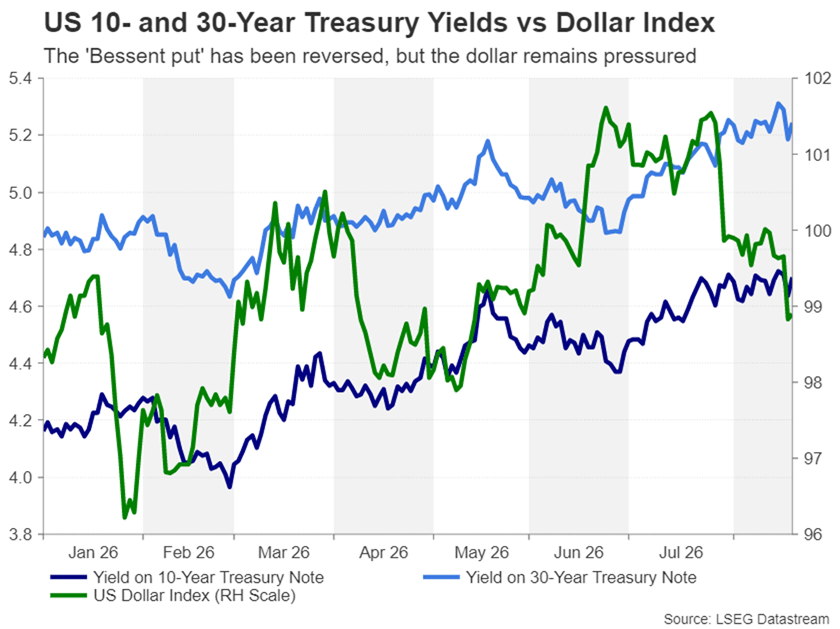
Moreover, this week's intervention in the bond markets by the Treasury Department signals alarm by the Trump administration at the recent spike in long-dated Treasury yields. However, Warsh has in fact been encouraging markets to drive yields higher as a means to tighten financial conditions without lifting the Fed funds rate. Failure to address the volatility in bond markets could spur renewed selling pressure on Treasuries.
Will PCE inflation match recent soft data?
Setting the tone prior to the event will be the July PCE inflation figures, which will be released on Wednesday, a day before policymakers head to the mountain retreat in Wyoming. The core PCE price index is expected to have stayed unchanged at 3.3% y/y in July. Headline PCE is also projected to hold steady at 3.7%, which would suggest the impact of the rebound in oil prices remains limited. Although this still leaves inflation some distance from 2.0%, the recent weak jobs report does make the Fed more prone to be patient.
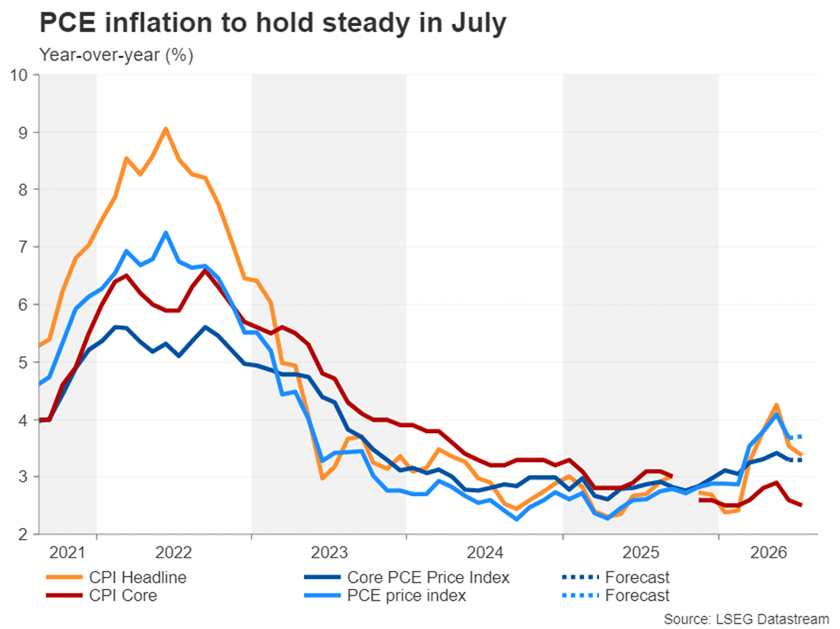
The personal income and consumption numbers will also be watched following the shock drop in retail sales in July, while the second estimate of Q2 GDP due the same day will be important too, especially if there are any sharp revisions.
Also comprising Wednesday's barrage of data are durable goods orders for July. Other releases include the consumer confidence index for August on Tuesday, along with new home sales.
Wall Street might ignore Warsh, look to Nvidia instead
The US dollar took the brunt of the 'Bessent put' that drove 10- and 30-year yields sharply lower. The lack of any convincing hawkish signals from Jackson Hole could deepen the dollar's wounds. However, equity markets have been relatively subdued during the bond market turbulence, so it's unclear how much of a boost a dovish sounding Warsh would provide as the inflation outlook remains highly uncertain amid the ongoing conflict in the Middle East.
Potentially a more crucial catalyst for Wall Street is Nvidia's earnings on Wednesday. The chip giant is expected to report year-on-year growth close to 100% for both revenue and earnings per share. Nvidia has an impeccable record of beating its earnings estimates. Nevertheless, the stock's reaction will depend on multiple factors, such as the guidance for Q3, whether the enviable gross margin of 75% is being maintained, if sales to China are recovering, and any updates on its newest platform – Vera Rubin – as well as any issues with supply chains or ramping up production of its Blackwell processors.
A strong positive surprise could propel the stock, which is trading about 8% below its record, to new highs, lifting the broader tech sector. With the Q2 season drawing to a close, earnings growth for the S&P 500 stands at an incredible 51.6% y/y – the highest since 2021. Subsequently, surging revenues combined with the latest pullback in some AI-related stocks has pushed PE values lower, making them more attractive despite the valuation concerns. Hence, upbeat earnings by Nvidia have the capacity to spark a fresh rally.
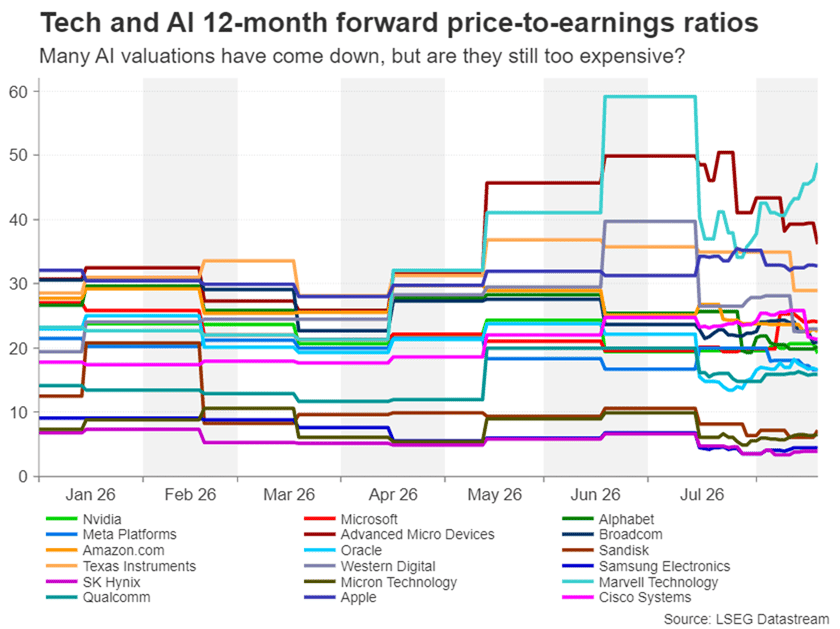
Any progress over the coming week in talks between the US and Iran on renewing the 60-day ceasefire would also be positive for stocks and risk assets in general.
Yen hoping to stretch rebound
The dollar's tumble was good news for Japanese authorities that were probably becoming annoyed by the yen's post-intervention reversal as it re-approached the 160 level. Not that the yen is completely out of the woods as this is likely a temporary relief and the dollar has already recouped some of its losses after dipping to 158.00 yen. Warsh's Jackson Hole speech will undoubtedly be vital for the next direction of travel. The lack of fresh hawkish signals could rekindle selling pressure for the dollar. But inflation data for the Tokyo region will also be key.
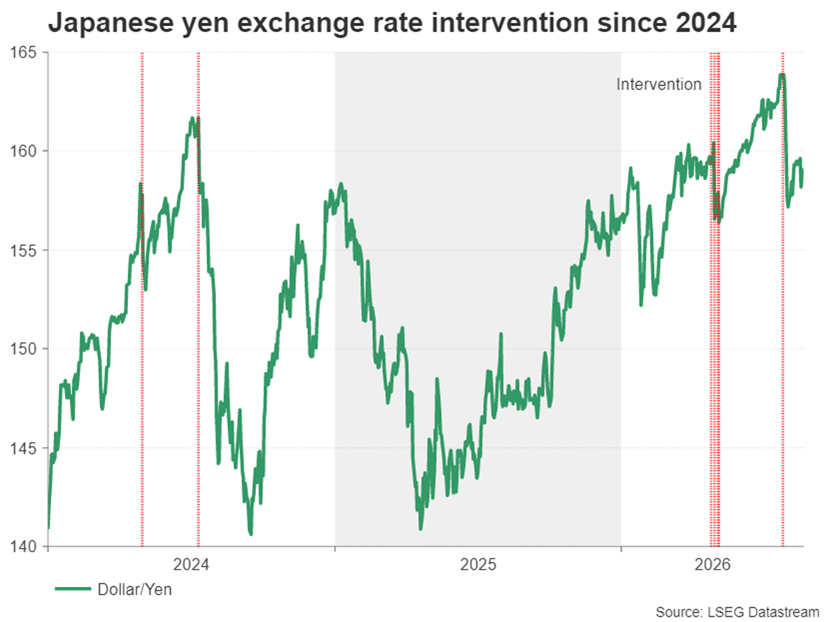
Tokyo's core CPI rate ticked up in July to 1.9%, having fallen for much of the year. Investors will be looking for further signs that the inflation trend is at a turning point when August's preliminary reading comes out on Friday. Weaker-than-expected numbers could lead to expectations for a September rate hike by the Bank of Japan being pared back from the current odds of 67%.
Does the Aussie rally have more legs?
Inflation figures will also be released in Australia, due on Wednesday, where recent data have been less supportive of a rate hike. Headline CPI moderated to 3.8% in June, falling below 4.0% for the first time since February, while employment declined in July, pushing the jobless rate up to 4.5%.
A further slowdown in inflation in July would cast doubt on additional rate hikes by the Reserve Bank of Australia; a 25-bps increase in the cash rate is currently only about 75% priced in by March 2027. However, this hasn't stopped the Australian dollar from staging an impressive uptrend against the US dollar since late July. Any upside surprises in the CPI numbers, particularly in the trimmed and weighted measures, could further fuel the aussie's engines.
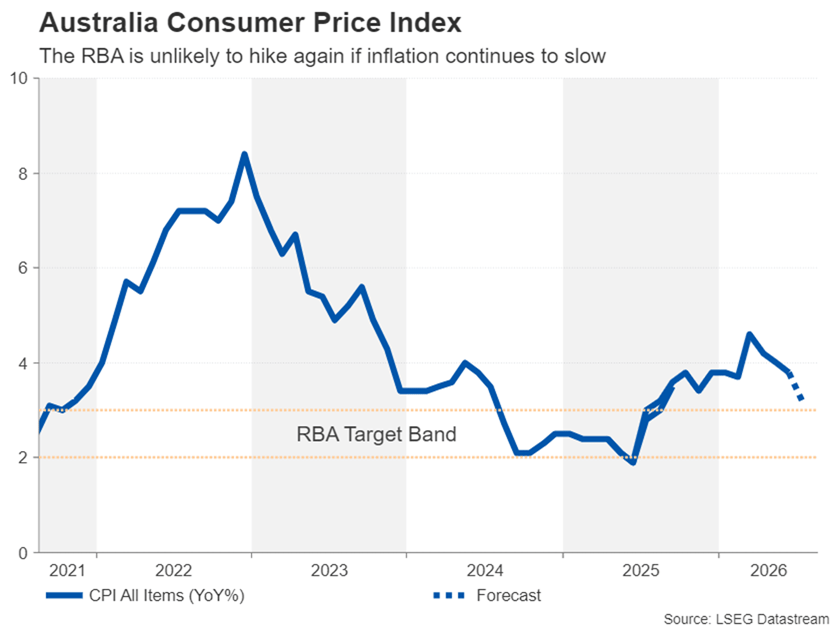
Aussie traders will also keep an eye on second quarter capital expenditure data out on Thursday.
Loonie shines as US and Canada close in on deal
Amid the greenback's pullback, the best performing currency this month has been the Canadian dollar. The loonie has been steadily gaining against the dollar on hopes that trade relations between the two North American neighbours have begun to thaw. A slight divergence in monetary policy after Canada's latest CPI print was a touch hotter while America's was soft has also been supportive for the loonie.
Canada's economy was one of the worst hit from Trump's tariffs as the trade uncertainty and higher levies on some exports were damaging for many Canadian businesses. GDP contracted at the end of 2025 and was flat in Q1. But the Q2 estimate out on Friday will likely show a solid bounce back in growth.
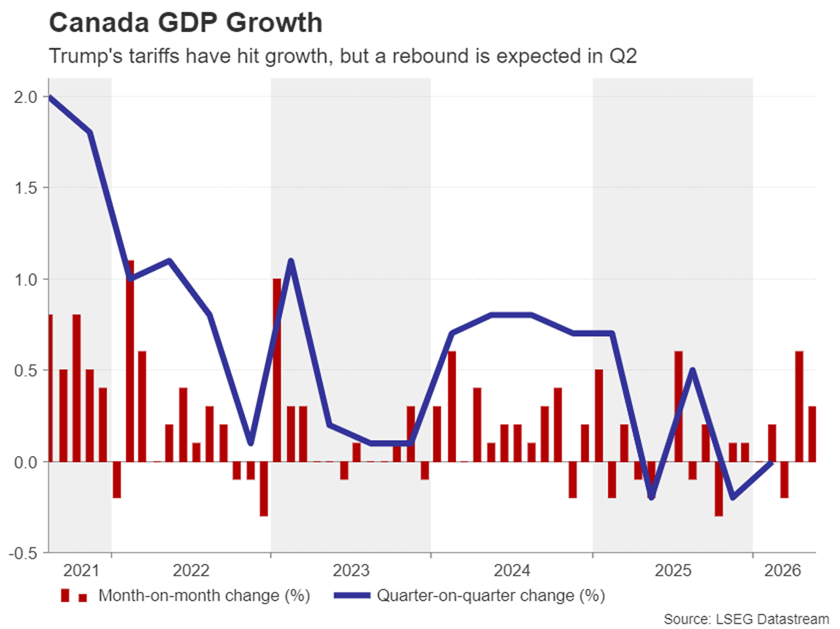
If confirmed, and in addition, US and Canadian negotiators manage to finalize the trade deal over the coming days that would avert 50% tariffs on about 5% of Canadian exports, the loonie could surge past the 1.37 per dollar level, which it last reached in May.
Canadian Growth Rebounded in Q2 with Domestic Demand also Strengthening
Next Friday’s Canadian gross domestic product reports for June and Q2 are expected to confirm a strong rebound in economic activity following stalling growth over the winter.
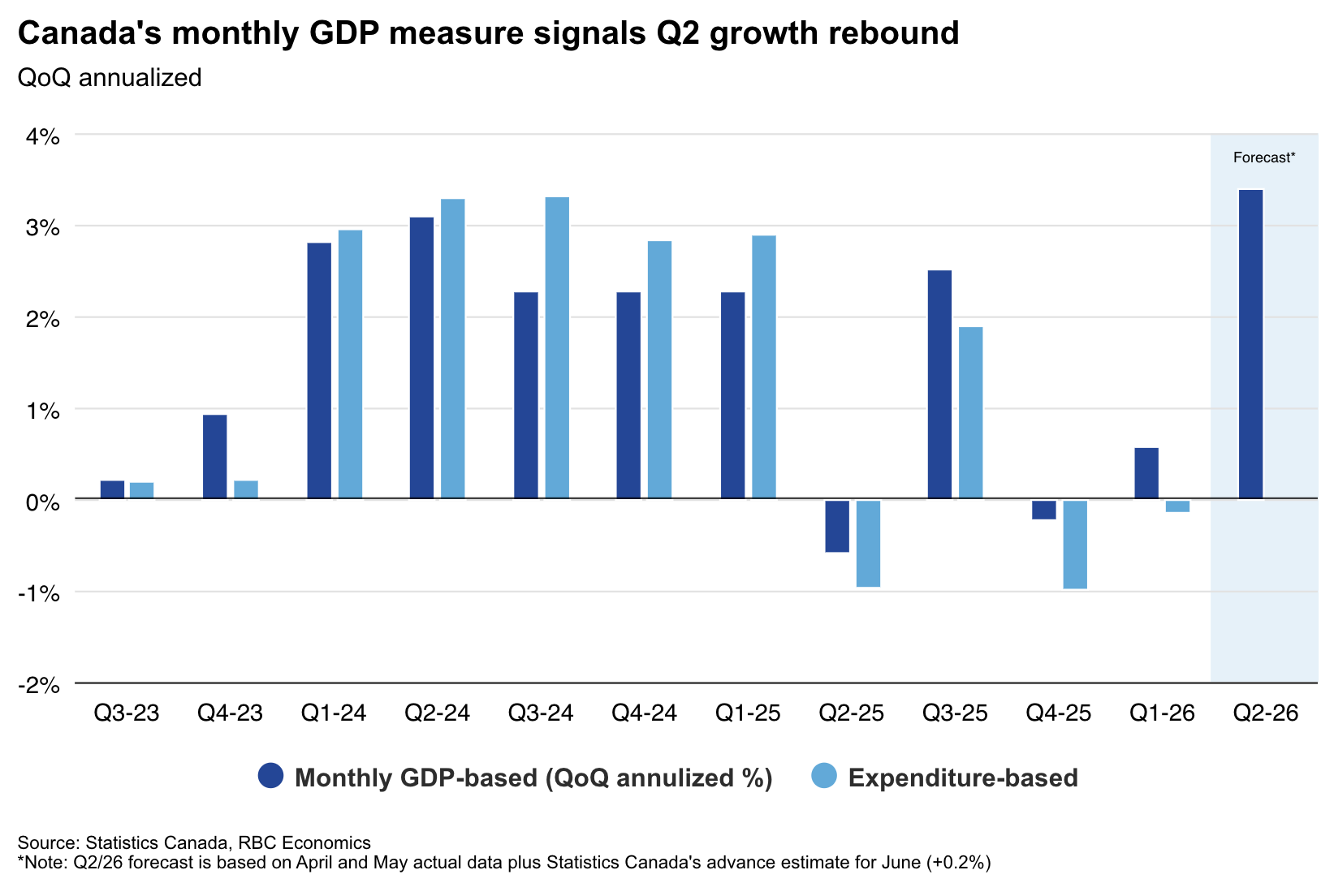
Statistics Canada reports two different measures of real GDP based on monthly production and quarterly expenditure. The two estimates have diverged significantly in recent quarters including Q1 when the production estimate posted a small increase while expenditure saw a second consecutive small decline.
But, monthly GDP data has looked substantially better to date in Q2. We expect a 0.2% increase in June, in line with Statistics Canada’s earlier advance estimate to add to an almost full percentage point increase over April and May.
Monthly numbers have been highly revision prone, but track above 3% annualized growth in Q2 overall. A broad range of indicators have also largely confirmed the bounce-back in Q2 growth. Labour market data have firmed after a slow start to the year.
Some of that Q2 strength reflects a reversal of temporary weakness earlier in the year. Net trade likely made a substantial positive contribution as exports outpaced imports, led in part by a recovery in the auto sector following winter production disruptions.
But Q2’s improvement appears broader than the trade rebound. Our tracking of RBC cardholder transactions showed stronger consumer spending despite higher fuel costs during the quarter. A jump in equipment imports suggests business investment grew more strongly, and residential investment appears to have rebounded alongside improving home resales and housing starts, although housing activity remains soft with a gradual recovery.
The boost from auto production and net trade in Q2 is unlikely to be repeated in coming quarters. And, declining population is still expected to weigh on total GDP growth, while trade uncertainty and remaining product-specific tariffs are still a headwind for business investment.
Q3 growth looks steady so far
Still early indicators, including our tracking of consumer spending and firming in hours worked in July, have remained constructive early in Q3.
Details of the trade deal to prevent additional U.S. tariffs on imports from Canada threatened in July are still pending - with a deadline to finalize the agreement and avoid 50% tariffs on another subset of Canadian exports at midnight tonight (August 21st). But early reports suggest current tariffs on products like autos, steel and aluminum could be lowered. Plus, most Canadian trade maintains duty free access to the U.S. through CUSMA exemptions.
We continue to expect growth to moderate from Q2’s strong pace, but remain positive over the remainder of 2026. That would be consistent with our base case forecast for a gradual cyclical recovery, including further improvement in per-capita growth even as elevated trade uncertainty remains a risk.
Weekly Focus – Bond Market Rollercoaster
News of the week was the unusual intervention in the bond market by the US Treasury on Wednesday, as they announced at least a doubling of "liquidity support buyback operations" in long-dated bonds. Long bond yields had reached new cycle highs at the beginning of the week as a cocktail of higher oil prices, debt concerns and falling credibility in the Fed had weakened long-end demand for US bonds and pushed up yields. The action marks yet another intervention by the US Treasury not long after intervention in the FX market supporting the yen. However, it leaves the impression of lack of control and can backfire, eroding US credibility further. The USD dropped immediately on the announcement and precious metals and bitcoin moved higher; normally a sign of weakening confidence in US governance. Bond yields stayed lower for about a day but then moved back up erasing the decline in 10-year and 30-year yields. Treasury Secretary Scott Bessent said Thursday that the government would soon announce an "increased focus on fiscal consolidation". We continue to look for US 10-year yields to reach 5% in 12 months from the current level around 4.70%.
Oil and European gas prices moved higher again during the week as tensions between US and Iran increased again after Trump declared economic war against Iran and announced that any country doing business with Iran would feel "tremendous" consequences. Brent oil moved from USD88 to USD94 during the week and the TTF European gas price leaped to a new cycle high of EUR66/mwh. We expect the ebbs and flows in the oil market to continue in the coming months.
European Flash PMI data for August showed further improvement with manufacturing PMI rising from 51.9 to 52.8, the highest level since 2022. The global AI investment boom is spilling over to European manufacturing as many companies are sub-suppliers, for example to the chip industry, cooling systems and materials. Service PMI was unchanged at 52.7.
Taiwan export orders stayed at high levels in July and are up 61.9% compared to July last year. Still, there are signs of easing momentum with a decline in the 6-month growth rate. Taiwan's order data is a key indicator for the global AI investment cycle, which in turn is driving the global manufacturing cycle. Taiwan is home to TSMC, the leading producer of advanced AI chips.
Chinese data for July showed a continued two-speed economy with weak consumer demand and continued housing crisis amid surging exports and high-tech investments. Retail sales grew only 0.6% y/y while export data released last week showed growth of just below 25%. Chinese leaders hinted at more forceful stimulus in the second half at their Politburo meeting in late July, see China Flash - Another month of weak domestic demand, 17 August.
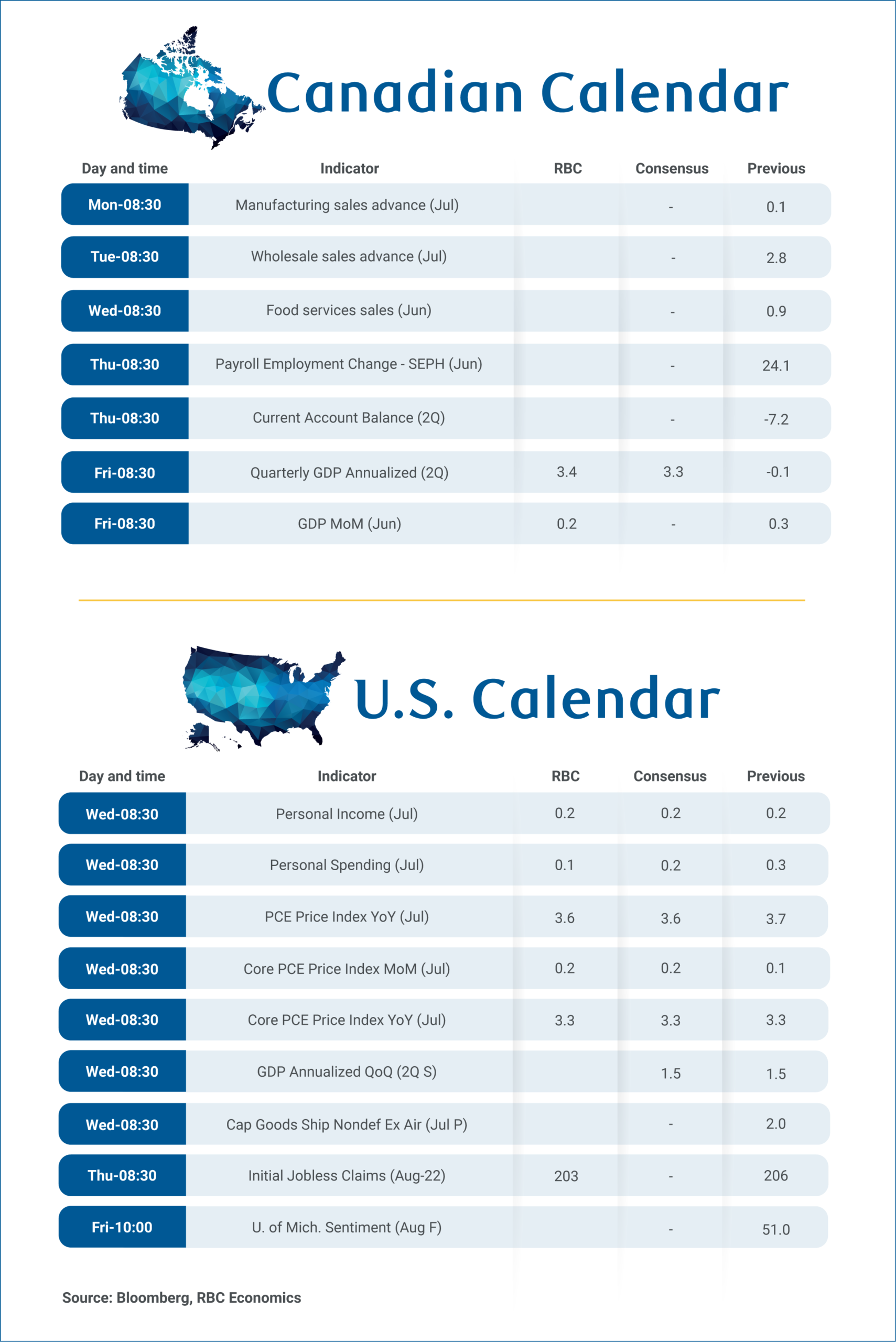
Next week is fairly quiet with the main data releases being the German ifo business confidence index, US core PCE and personal spending and US durable goods orders. The latter is a key investment indicator and gives insight to the AI investment boom.