Sample Category Title
Sunset Market Commentary
Markets
Flash EMU PMI surveys showed eurozone business activity continuing to rise in August amid stronger manufacturing growth. It sets the eurozone up for a robust increase in third quarter GDP around 0.3%, according to S&P Global Market Intelligence. The composite PMI rose from 52 to 52.1, the best level since November of last year and defying expectations for a pullback to 51.7. The services series was unchanged at 51.7 (vs 51.5). Rising tourism spending is helping boost growth, notably outside France and Germany, where the region collectively saw the fastest services growth for over three years. The manufacturing gauge went from 51.9 to 52.8 (vs 51.8 consensus; 51-month high). Alongside the increase in output, a further rise in new orders was also recorded, amid a first expansion in new export business in four-and-a-half years. EMU manufacturers also posted a rise in purchasing activity midway through Q3 2026. Stocks of inputs continued to fall, however, as purchased items were often used to support production. Sharply lengthening suppliers' delivery times also hindered the ability of firms to replenish stocks. Firms also took on extra staff, while there were further signs of easing inflationary pressures. Improved manufacturing was in large part centred on Germany (fastest pace since January 2022). Sentiment regarding the year-ahead outlook for output eased to a three-month low and was weaker than the series average. Input and output price inflation slowed, but the latter was entirely due to Germany as well. Rates of increase ticked up in France and across the rest of the eurozone as a whole. The US August Composite PMI jumped from 54.5 to 56 (vs 54 consensus), fuelled by a surge in service sector activity and rising optimism. The survey data for the third quarter are currently pointing to annualized growth approaching 3%, up solidly from the 1.5% pace seen in the second quarter.
Today's solid EMU PMIs printed too close to consensus to influence trading. Especially with a September ECB rate hike already fully discounted. Overall trading was muted after a volatile trading week. The front end of the US curve does underperform after US PMIs. Quiet returned at the very long end of global yield curves which benefited overall risk sentiment and kept EUR/USD together with the US PMI below 1.0705 technical resistance. Next week centers around US President Trump's economic D-Day against Iran and its trading partners (Monday), July PCE deflators (Wednesday) and the Fed's Jackson Hole meeting (Friday). Fed chair Warsh is scheduled to speak. While he prefers as little communication as possible, he might use the occasion to iron some things out given the chaotic unraveling of the July FOMC meeting. Some believe a reiteration of his hawkish intro in June would help put a lid at the (very) long end of the US yield curve.
News & Views
The National Bank of Belgium's consumer confidence indicator worsened from -5 to -7 in August, matching the series long-term (40-yr) average. Sentiment deteriorated mainly due to a more pessimistic view on the macroeconomic environment. Belgian households viewed the economic situation as weaker than in July with the series dropping from -27 to -32 while unemployment expectations ticked higher from 14 to 16. On a personal level, little has changed. Households expect their financial situation to remain unchanged (-2) and have slightly lowered their saving intentions (22 from 23).
The UK composite PMI improved from 52.2 in July to 52.5 in August. Services carried the uptick with the sector expanding at the quickest rate in six months (52.8 from 52.1). Companies noted a steady upturn in client confidence and improving domestic conditions. Manufacturing output grew at a slower pace than in July (51.2 vs 52.9) amid geopolitical uncertainty and elevated cost pressures. Overall, economy-wide demand improved though with new orders increasing the fastest since February, especially domestically. Staffing numbers continued to fall in August, but the rate of job losses was only marginal and the least marked since October 2025. Input inflation quickened from July's five-month low, driven in particular by the service economy. Respondents referred to higher fuel prices and suppliers passing on rising transportation costs with a number of firms also reporting higher wages. Prices charged/output inflation also picked up. Stronger order books and hopes for a steady economic turnaround supported business optimism for the year ahead in recovering to the highest since February, offsetting the dampening effect of elevated domestic political uncertainty, intense competition and rising input prices.
US PMI Composite Hits 52-Month High as Services Drive August Acceleration
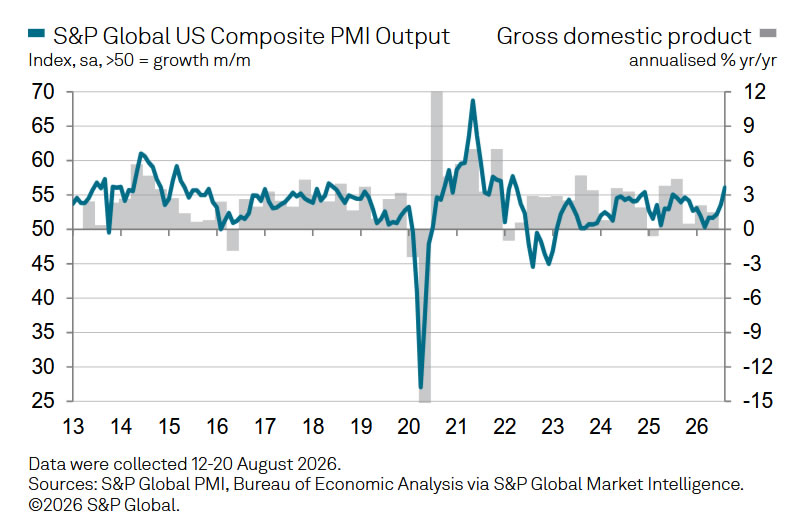
US private-sector growth accelerated sharply in August, with PMI Composite Output rising from 54.5 to 56.0, its highest in 52 months. PMI Services Business Activity climbed from 54.6 to 56.8, a 20-month high, becoming main driver of expansion. PMI Manufacturing eased from 53.9 to 53.2, while PMI Manufacturing Output dropped from 53.9 to 51.9, a 13-month low.
S&P Global said Q3 survey data are now consistent with annualized growth approaching 3.0%, up from 1.5% in Q2. Employment also strengthened as business confidence improved. Manufacturing, however, lost momentum as precautionary inventory building faded and supply delays constrained production. Those delays remained among most severe seen over past four years, with Middle East disruption and energy prices still key concerns.
Inflation pressure eased somewhat but remained elevated, leaving Fed with a mixed but still firm backdrop. Stronger services activity and renewed hiring point to resilient demand, while weaker factory output shows expansion is becoming more dependent on consumers and financial services. With price pressures still vulnerable to another energy shock, August PMI does little to strengthen case for an easier policy stance.
Data Summary
| Component | Current | Previous | Trend |
|---|---|---|---|
| PMI Composite Output | 56.0 | 54.5 | 52-month high |
| PMI Services Business Activity | 56.8 | 54.6 | 20-month high |
| PMI Manufacturing | 53.2 | 53.9 | 5-month low |
| PMI Manufacturing Output | 51.9 | 53.9 | 13-month low |
| Q3 GDP Signal | ~3.0% annualized | 1.5% Q2 | Stronger |
| Employment | — | — | Growth revived |
| Business Confidence | — | — | Improved |
| Input / Price Pressures | — | — | Easing but still elevated |
| Supply Delays | — | — | Among worst in four years |
Key Takeaways
- US PMI Composite Output rose from 54.5 to 56.0 in August, reaching its strongest level in more than four years.
- PMI Services Business Activity accelerated from 54.6 to 56.8, a 20-month high and clear driver of overall growth.
- PMI Manufacturing eased from 53.9 to 53.2, while PMI Manufacturing Output fell more sharply from 53.9 to 51.9.
- S&P Global said Q3 survey data point to annualized GDP growth approaching 3.0%, up from 1.5% in Q2.
- Employment growth revived as business confidence improved.
- Manufacturing lost momentum as precautionary stock building faded and supply delays constrained production.
- Supply-chain disruption remained severe, with Middle East conflict and energy prices still key risks.
- Price pressures eased but stayed elevated, leaving inflation vulnerable to another energy shock.
- For Fed, data point to resilient demand and stronger services activity, limiting scope for a rapid shift toward easier policy.
Treasury Intervention Puts the Dollar Under Pressure
- US long-term Treasury yields reached their highest levels since 2007.
- Higher oil prices revived concerns about inflation and the Federal Reserve’s policy outlook.
- The Treasury doubled the scale of its long-term bond buyback programme.
- The intervention stabilised bonds but pushed EUR/USD above 1.17.
- Markets may increasingly view a weaker dollar as the price of lower US borrowing costs.
The sharp rise in US Treasury yields and the subsequent response from the Treasury Department were the main market developments of the week. Increasing borrowing costs, higher oil prices and persistent tensions in the Middle East initially intensified risk aversion. Later in the week, attention shifted to Washington’s attempt to stabilise the bond market, which simultaneously put significant pressure on the dollar.
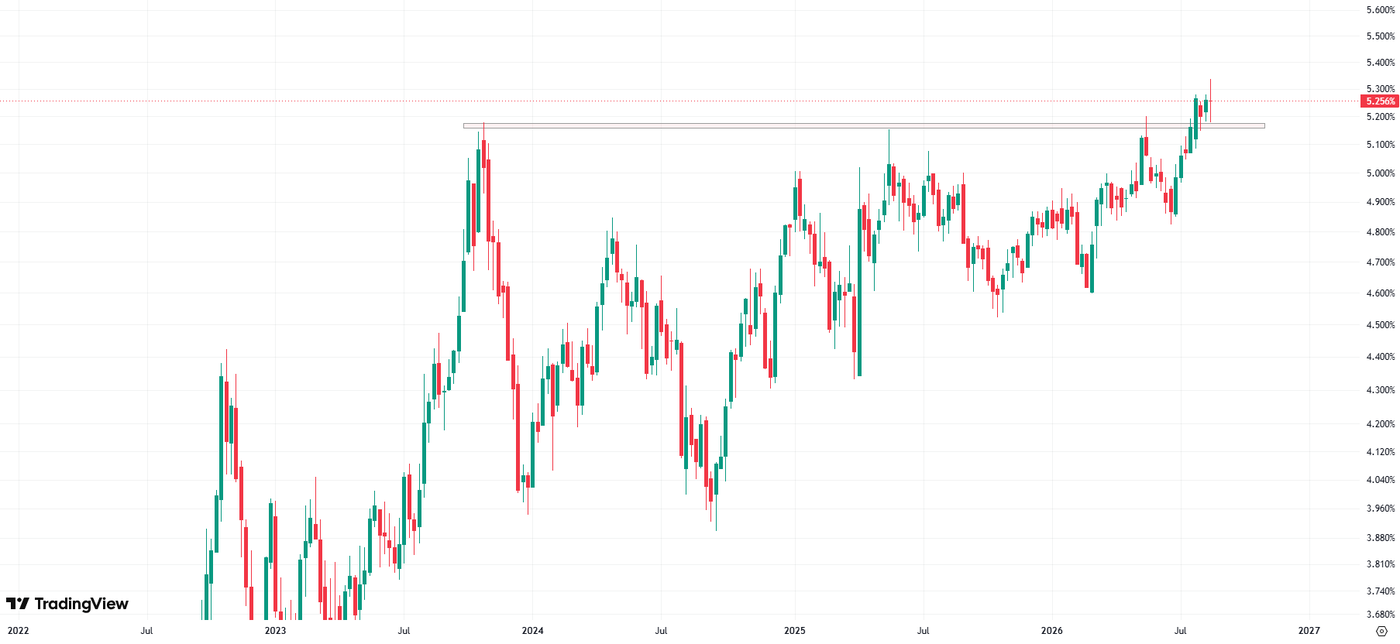
At the beginning of the week, global sovereign bond markets came under heavy selling pressure. The yield on the 30-year US Treasury climbed to 5.32%, its highest level since 2007. The 10-year yield increased to 4.74%. The sell-off also spread to government bonds in Australia, New Zealand and Japan.
Investors were concerned about rising US government spending, record public debt and the substantial supply of long-dated Treasury securities. Another source of risk was the increasing debt of major technology companies financing investment in data centres and artificial intelligence infrastructure.
Oil revives inflation concerns
Higher energy prices added to the pressure on government bonds. Brent crude rose above USD90 per barrel as the prospects of ending the conflict in the Middle East deteriorated. Donald Trump showed no interest in extending the agreement with Iran, while fighting in Lebanon intensified again.
The lack of progress in negotiations increased uncertainty surrounding the reopening of the Strait of Hormuz. Prolonged restrictions on shipping through this crucial route could keep oil prices elevated and intensify global inflationary pressure.
More expensive energy also complicated the Federal Reserve’s policy outlook. Two relatively benign inflation readings and weaker US labour market data had previously reduced expectations of a September rate increase. Persistently high oil prices, however, raised the risk of renewed inflation and strengthened the case for the Fed to maintain a restrictive stance.
Fed minutes provide no breakthrough
In the middle of the week, investors turned their attention to the minutes of the Federal Reserve’s July meeting. Markets were looking for evidence of how close FOMC members had been to raising interest rates and whether such a move remained possible in the coming months.
The importance of the document was limited by economic data published since the meeting. Weaker labour market and inflation figures meant that investors were no longer fully pricing in another rate increase by the end of the year.
The new Fed Chair, Kevin Warsh, also intends to limit communication about future monetary policy decisions and give financial markets greater freedom to interpret economic conditions. The lack of a clear signal from the Fed initially helped stabilise the dollar. This changed after the Treasury Department unexpectedly intervened in the bond market.
Treasury steps into the market
Washington announced that it would at least double the scale of its buybacks of less liquid long-term government bonds. The operations will cover so-called off-the-run securities with remaining maturities of at least 10 years.
The programme is officially designed to improve market liquidity and reduce the risk of primary dealers being left with securities that are difficult to trade. Its timing, however, led investors to interpret the decision as an attempt to halt the rise in long-term yields.
Only two days earlier, the 30-year yield had reached its highest level in almost two decades. At the same time, US public debt exceeded USD40 trillion.
The expanded programme is initially scheduled to operate for two months from 9 September. With seven buyback operations planned, the Treasury could purchase around USD28 billion of long-term securities in September and October, compared with the previously planned USD14 billion.
The programme is not quantitative easing
The scale of the programme remains small compared with the Federal Reserve’s previous asset purchases. At the peak of quantitative easing, the Fed bought USD120 billion of securities every month.
Unlike the central bank, the Treasury cannot create new money to finance its purchases. The buybacks will therefore probably have to be funded through increased issuance of Treasury bills and other short-term securities.
The programme resembles Operation Twist from 2011–2012 more closely than conventional quantitative easing. Its direct effect on long-term yields is therefore likely to be limited. The more important signal is that the Treasury appears to have a level of borrowing costs beyond which it is prepared to intervene.
Bond stabilisation weakens the dollar
The reaction in the foreign exchange market was decisive. Following the announcement, the dollar lost around 0.8% on a trade-weighted basis, while the Dollar Index fell to its lowest level in three months. EUR/USD climbed above 1.17 for the first time since late May.
The dollar weakened despite continued expectations of further Fed tightening and the prospect of increased short-term Treasury issuance. This suggests that investors are beginning to look beyond interest-rate differentials and pay closer attention to the consistency and credibility of US economic policy.
A clear contradiction is emerging. Kevin Warsh argues that market interest rates should contribute to the fight against inflation. The Treasury, meanwhile, responds when higher long-term yields become too painful for the economy and public finances. Such intervention could weaken the tightening of financial conditions and undermine the credibility of the fight against inflation.
Washington’s actions also suggest that, when faced with a choice between higher debt-servicing costs and a weaker currency, the administration may be willing to accept dollar depreciation. Bond buybacks increase demand at the long end of the yield curve and may reduce the term premium, but they also make dollar-denominated assets less attractive.
A new structural risk for the dollar
The expansion of the buyback programme does not imply an immediate dollar crisis. The currency continues to benefit from high interest rates, the depth and liquidity of US financial markets and capital inflows into the technology sector. Periods of dollar weakness may therefore still be interrupted by significant rebounds.
The past week has nevertheless demonstrated that there are politically acceptable limits to the rise in US Treasury yields. If investors conclude that reducing the cost of servicing the public debt has become more important than protecting the value of the currency, downward pressure on the dollar could become more persistent.
The Japanese yen may be the main beneficiary of such a scenario, particularly if the yield gap between the United States and Japan narrows. Gold, the Swiss franc and the euro also remain potential alternatives to the dollar.
The Dollar: from Debt Crisis to Currency Crisis
- The USD index is falling against a favourable backdrop.
- Eroding confidence in the Fed is weighing on the US dollar.
The US dollar is trying to find its footing as Treasury bond yields stabilise. Scott Bessent stated that concerns about the budget deficit are exaggerated. It is rising due to tariff revenue, but import duty revenue in 2026 is expected to be roughly the same as in 2025. The Treasury has a range of tools at its disposal to bring down yields in the debt market, which are currently fundamentally unsupported.
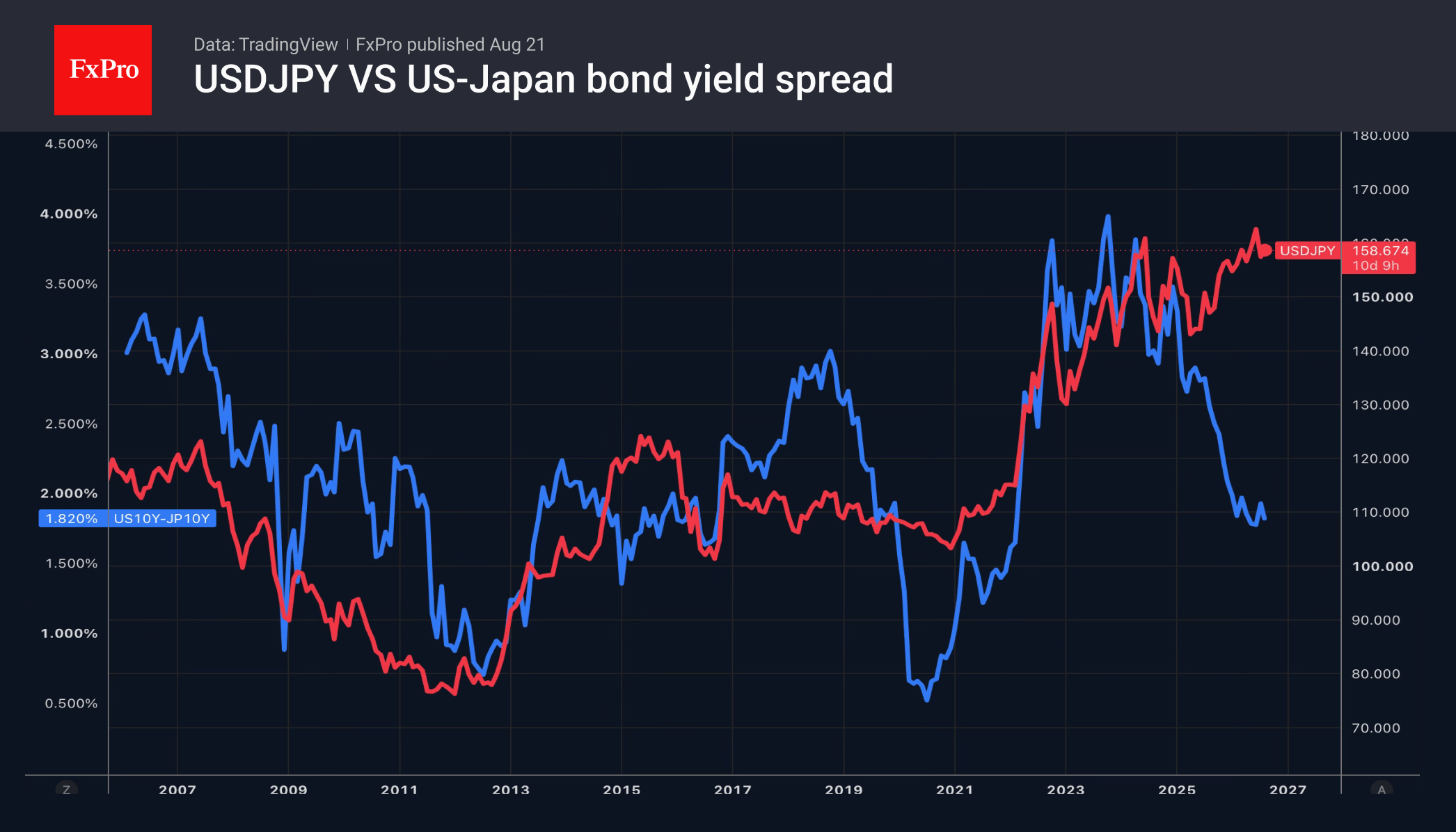
In the forex market, there is a growing view that the debt crisis risks escalating into a currency crisis. The Japanese government’s attempts to control bond yields ultimately resulted in a significant weakening of the yen. The sell-off of UK debt in 2022, caused by the mismatch between Prime Minister Liz Truss’s policies and the Bank of England’s monetary tightening, sent the pound plummeting to historic lows.
At present, the US Treasury’s policy runs counter to the Federal Reserve’s actions. The purchase of long-term bonds closely resembles quantitative easing, which expands the Fed’s balance sheet. Kevin Warsh, on the other hand, insists on reducing it. The Fed Chair believes that rising bond yields can curb inflation; however, Scott Bessent appears ready to do everything possible to lower Treasury yields.
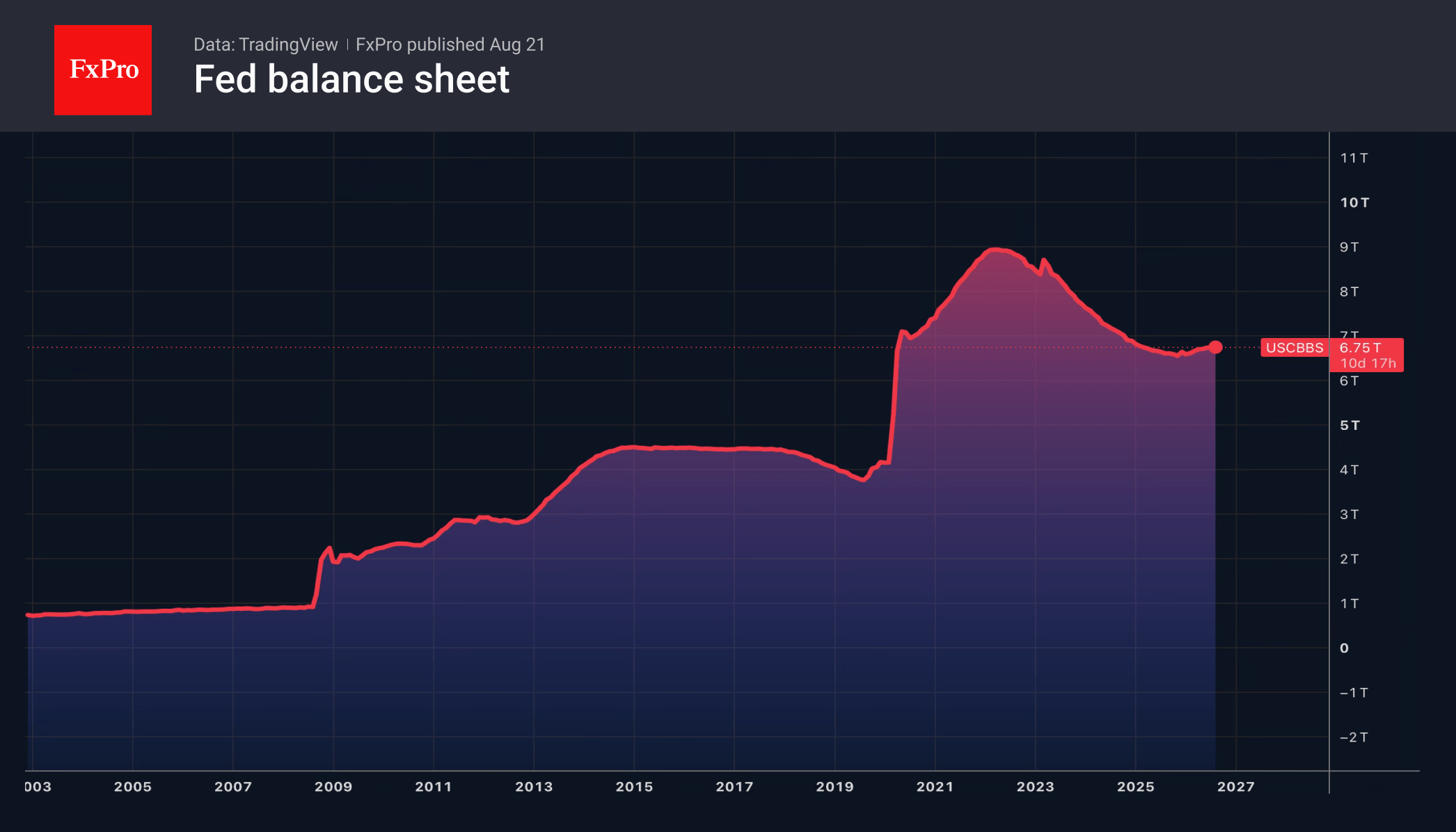
Contradictions in government and central bank policies tend to have a detrimental effect on the national currency. The pound is not the only example. When Sanae Takaichi came to power in Japan, concerns over new fiscal stimulus measures against the backdrop of the BoJ’s tightening of monetary policy sent the yen plummeting to 40-year lows.
Thus, the collapse of the US dollar against what should be a favourable backdrop is beginning to look inevitable. As a rule, falling stock indices, stabilising Treasury bond yields, and rising oil prices due to the conflict in the Middle East act as tailwinds for a safe-haven asset such as the greenback. Not this time. The Treasury’s methods are undermining confidence not only in the Fed but also in the US currency.
In reality, nothing terrible has happened. There is a big difference between the Treasury’s intentions and its actions. As soon as the markets settle down, the US dollar may recoup some of its losses.
The FxPro Analyst Team
Dollar Selloff Deepens and Broadens — What Changed?
Why Dollar weakness is spreading even as its original catalyst fades, and what that shift in market interpretation reveals about the $40 trillion debt problem underneath
Why it matters: UBS and DBS both argue the buyback program redistributes Treasury's financing burden along the yield curve rather than reducing it, since the government's borrowing requirement doesn't disappear. With US federal debt just crossing $40 trillion, Treasury Secretary Bessent's argument that the deficit has "likely peaked" remains untested against actual fiscal data. Markets increasingly appear to be pricing that structural problem rather than the buyback's tactical relief, which is why Dollar isn't recovering even as yields have partly rebounded.
From Treasury Shock to Broad Dollar Weakness
Dollar selloff has changed character. What began on Wednesday as a direct reaction to Treasury's surprise expansion of long-dated debt buybacks has now spread across the major G10 board. DXY is hovering just above 98.50, near its fresh three-month low, while the greenback is weaker broadly both on the day and over the week. That breadth is the important development. A temporary technical reaction to one rates announcement would normally start narrowing as individual currency fundamentals reassert themselves. Instead, Dollar weakness has become more generalized.
The shift suggests markets are distinguishing between what Treasury's buyback program can accomplish mechanically and what it cannot solve structurally. Treasury announced on August 19 that buybacks in the 10-20 year and 20-30 year nominal sectors would at least double from $2bn to $4bn per operation between September 9 and November 4. The announcement came after the 30-year yield had briefly reached 5.34%, its highest since 2007, and immediately triggered a sharp decline in long yields. Four sessions later, however, Dollar has continued lower even as some of that yield decline has reversed.
Buybacks Move Financing Pressure Rather Than Remove It
UBS's mechanical argument helps explain why initial relief has struggled to translate into durable Dollar support. Treasury can retire more long-dated securities, but the government's overall borrowing requirement does not disappear. If buybacks are financed through increased bill issuance, pressure is redistributed along the yield curve rather than eliminated.
That is materially different from Fed quantitative easing. Treasury is changing the maturity composition of financing, not shrinking the aggregate amount markets ultimately have to absorb. UBS summarized the historical problem succinctly, arguing that "bond purchases, buybacks, or issuance adjustments" have not permanently lowered borrowing costs when fiscal dynamics remained unfavorable. Its own positioning reflects that caution, with a preference for shorter and medium-duration quality fixed income rather than assuming long-rate volatility has ended.
Separately, DBS economist Chang Wei Liang reached a similar conclusion, saying "tweaks around buybacks can only have a small, transient impact on markets." The fact that two separate institutions are arriving at essentially the same mechanical conclusion matters. Treasury can improve liquidity and ease pressure in selected maturities. It cannot, through buybacks alone, change the fiscal trajectory.
What Buybacks Change vs. What They Don't
| Changes | Doesn't change |
|---|---|
| Maturity composition of debt, retires long-dated securities, likely offset by more bill issuance | Government's overall borrowing requirement |
| Where financing pressure sits along the yield curve | The underlying fiscal trajectory |
| Near-term liquidity in targeted maturities (20-30 year) | The aggregate amount markets ultimately have to absorb |
$40 Trillion Debt Keeps Focus on the Structural Problem
Timing makes that distinction more important. US federal debt crossed $40 trillion this week, doubling in less than a decade and reaching the milestone sooner than many forecasts had anticipated. That does not mechanically require a weaker Dollar, but it increases market sensitivity to whether policy measures are reducing financing needs or simply managing how those needs reach the bond market.
Treasury Secretary Scott Bessent offered a more optimistic interpretation Thursday. He said there was a "very good chance" the deficit had "likely peaked." He argued the US could "grow our way out" of the debt burden and pointed to "several hundred billion dollars" of prospective consolidation savings. He also maintained that tariff revenue could remain close to 2025 levels despite the Supreme Court ruling against many earlier levies.
Those arguments are testable, but they are not yet demonstrated in fiscal data. Markets can observe the buyback operation immediately. They still need evidence that deficits are actually narrowing, tariff receipts are holding up and nominal growth is strong enough to improve debt dynamics. Until those numbers arrive, verbal reassurance has less weight than existing borrowing arithmetic.
Bessent's Case for Optimism
- Deficit: "very good chance" it has "likely peaked."
- Growth: US could "grow our way out" of the debt burden.
- Consolidation savings: "several hundred billion dollars" prospectively.
- Tariff revenue: could remain close to 2025 levels despite the Supreme Court ruling against many earlier levies.
Yield Rebound Is No Longer Enough to Rescue Dollar
Price action is reinforcing that skepticism. Treasury yields rebounded Thursday as Wednesday's buyback shock faded and Brent's move above $94 added another potential inflation impulse. Yet Dollar barely responded.
That divergence matters. Higher US yields normally support the greenback through wider relative returns on Dollar assets. But if yields are rising because of fiscal supply, term premium or inflation concerns rather than stronger US growth, the relationship becomes less straightforward. It also matters that sovereign yields outside the US have been rising as well, limiting improvement in America's relative-rate advantage.
The more important test now is not whether US yields rebound for one session. It is whether Dollar can respond positively to traditionally supportive catalysts again. If stronger US data, higher yields or hawkish Fed communication repeatedly fail to lift DXY, the market would be signaling that another force is overwhelming conventional rate-differential support.
What Changed? Market Is Pricing the Problem, Not the Fix
The news itself has not changed dramatically since Wednesday. Treasury expanded buybacks. US debt crossed $40 trillion. Bessent argued the deficit has likely peaked. What has changed is market interpretation.
Initial reaction centered on the immediate technical benefit of additional long-end buybacks. Subsequent price action increasingly reflects concern that the program redistributes Treasury supply without reducing the underlying financing requirement. Dollar weakness broadening across G10 suggests that distinction is now becoming more important than the original buyback relief.
That does not make structural Dollar decline inevitable. A credible fiscal consolidation package, stronger-than-expected revenue or genuine growth acceleration could change the narrative. But for now, Dollar is failing to recover even as some traditional supports return. The selloff is not just deeper. It is broader, and that broadening is the strongest evidence that markets are looking past Treasury's tactical fix toward the fiscal problem underneath.
Related Coverage
Currency Deep Dive
- Read why AUD/JPY keeps rising even as Japan's data improve and Australia's weaken, with global yields and a wide rate gap overpowering local fundamentals: Japan's Data Is Strengthening as Australia's Weakens. Why Is AUD/JPY Rising?.
Global PMI Round-Up
- See why UK services strength lifted the composite to a four-month high even as manufacturing momentum faded: UK PMI Services Strengthen in August, but Manufacturing Momentum Fades.
- Read why Eurozone's composite PMI hitting a nine-month high, with employment returning to growth, reinforces the ECB's hawkish bias: Eurozone PMI Composite Hits Nine-Month High, Reinforces ECB Hawkish Bias.
- See why Japan's private-sector expansion accelerated in August, with overseas demand posting its strongest growth in more than eight-and-a-half years: Japan PMI Accelerates as Manufacturing Leads Broad-Based August Growth.
- Read why Australia's factory output slipped back into contraction even as the broader private sector stayed in expansion: Australia PMI Expansion Continues, but Manufacturing Output Slips Back Into Contraction.
UK & Japan Data Deep Dives
- See why UK retail sales' -0.5% July drop still leaves the three-month trend positive, once June's promotion-driven pull-forward is accounted for: UK Retail Sales Fall -0.5% in July, but Three-Month Trend Stays Positive.
- Read why core-core CPI accelerating to 1.9% suggests Japan's underlying inflation is broadening ahead of the BoJ's September meeting: Japan Inflation Is Broadening Again — Core-Core at 1.9% Strengthens BoJ Hike Case.
Frequently Asked Questions
Q: Why is Dollar's selloff broadening now instead of narrowing since Wednesday's buyback shock?
A: Because markets have shifted from reacting to the immediate technical benefit of Treasury's buyback announcement toward pricing what it can't fix. UBS and DBS both argue the program redistributes financing pressure along the yield curve rather than reducing the government's overall borrowing requirement. As that distinction sinks in, Dollar weakness has spread across the G10 board rather than narrowing as the original catalyst fades.
Q: Why don't Treasury buybacks fix the same problem as Fed QE?
A: Because they work through a different mechanism. Fed QE shrinks the aggregate amount of securities markets ultimately have to absorb. Treasury buybacks only change the maturity composition of financing, retiring long-dated securities while likely issuing more bills elsewhere, so the total borrowing need doesn't actually shrink. UBS and DBS both describe the effect as mechanical and transient rather than a genuine fix for fiscal pressure.
Q: Does Bessent's claim that the deficit has "likely peaked" change the picture?
A: Not yet, because it isn't demonstrated in fiscal data. Bessent argued the US could "grow our way out" of the debt burden and pointed to several hundred billion dollars of prospective consolidation savings, but markets need to see deficits actually narrowing, tariff receipts holding up and nominal growth accelerating before that reassurance carries real weight. Until then, existing borrowing arithmetic, underscored by US debt crossing $40 trillion this week, matters more than verbal optimism.
Key Takeaways
- Dollar's selloff has broadened across G10: DXY sits near a fresh three-month low around 98.50, even as some of Wednesday's yield decline has since reversed.
- UBS and DBS both call the buyback relief mechanical, not structural: The program redistributes Treasury's financing burden along the curve rather than reducing the government's overall borrowing requirement.
- Buybacks are materially different from Fed QE: They change the maturity composition of financing, not the aggregate amount markets ultimately have to absorb.
- US federal debt crossed $40 trillion this week: Doubling in under a decade, sharpening market sensitivity to whether policy actually reduces financing needs.
- Bessent's "deficit has likely peaked" argument is untested: It needs confirmation from actual deficit, tariff-revenue and growth data before it can outweigh existing borrowing arithmetic.
- Yield rebound is no longer rescuing Dollar: The real test now is whether Dollar can respond to any traditionally supportive catalyst, stronger data, higher yields or hawkish Fed communication, again.
What to Watch Next
Watch for fiscal data that would confirm or contradict Bessent's deficit-peaked claim, alongside tariff-receipt trends and nominal growth. On Dollar specifically, the key signal is whether DXY can respond to the next round of strong US data or hawkish Fed communication, rather than continuing to fail even as traditional supports return.
Canada Retail Sales Rise 0.6% as Core Spending Strengthens, but July Estimate Warns of Pullback
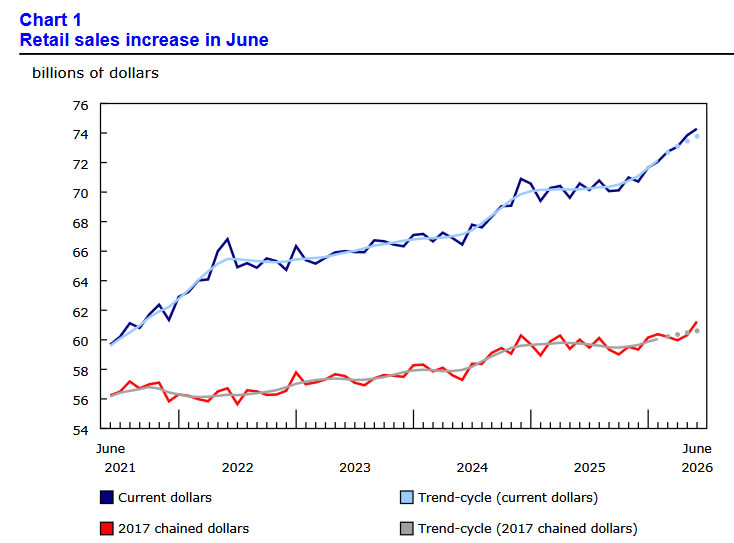
Canada retail sales rose 0.6% m/m in June to CAD 74.3bn, beating expectations for 0.4% and following a revised 1.1% gain in May. Sales increased in seven of nine subsectors. More importantly, core retail sales excluding gasoline and motor vehicles rose 1.2%, extending their advance for a second month. In volume terms, total retail sales increased 1.5%, showing that June’s improvement reflected a meaningful rise in real spending.
General merchandise retailers led core growth with a 2.7% increase. Clothing, footwear, jewelry and related retailers gained 3.1%. Motor vehicle and parts dealers rose 1.0% for a third consecutive month, driven by new-car sales. Food and beverage retailers slipped 0.4%. Gasoline-station receipts fell 4.1%, but volumes increased 4.2%, highlighting the impact of lower fuel prices on nominal sales.
The broader picture is less straightforward heading into Q3. Retail sales rose 2.2% in Q2, though volumes increased a more modest 0.4%. Statistics Canada’s advance estimate points to a -0.8% decline in July, suggesting June’s strength may not have carried forward. The early estimate is based on responses from only 56.5% of surveyed companies and is subject to revision, but it nevertheless tempers the strong June report and points to a potentially softer start to Q3.
Data Summary
| Indicator | Actual | Expected | Previous |
|---|---|---|---|
| Retail Sales m/m | 0.6% | 0.4% | 1.1% |
| Retail Sales ex Autos m/m | 0.5% | 0.2% | 1.2% |
| Core Retail Sales m/m* | 1.2% | — | — |
| Retail Sales Volume m/m | 1.5% | — | — |
| Retail Sales q/q | 2.2% | — | — |
| Retail Sales Volume q/q | 0.4% | — | — |
| July Advance Retail Sales Estimate m/m | -0.8% | — | 0.6% |
*Core retail sales exclude gasoline stations and fuel vendors, and motor vehicle and parts dealers.
Key Takeaways
- Canada retail sales rose 0.6% m/m in June, beating expectations for 0.4%, after May was revised higher to 1.1%.
- Retail sales excluding autos increased 0.5%, also beating the 0.2% forecast.
- Core retail sales rose a stronger 1.2%, extending gains for a second consecutive month.
- Real spending was particularly firm, with retail sales volumes jumping 1.5% m/m.
- General merchandise sales rose 2.7%, while clothing and related categories gained 3.1%.
- Motor vehicle and parts sales increased 1.0% for a third straight month.
- Gasoline-station receipts fell 4.1%, but volumes rose 4.2%, showing lower prices rather than weaker fuel demand drove the nominal decline.
- Retail sales increased 2.2% in Q2, but volumes rose a more moderate 0.4%.
- Statistics Canada’s advance estimate points to a 0.8% decline in July, warning that June strength may not have carried into Q3.
- July estimate is highly provisional, based on responses from 56.5% of surveyed companies, versus an average final response rate of 87.3%.
BTCUSD Hits the Highest in Almost Four Months Following Rally of Over 20% in Past Three Days
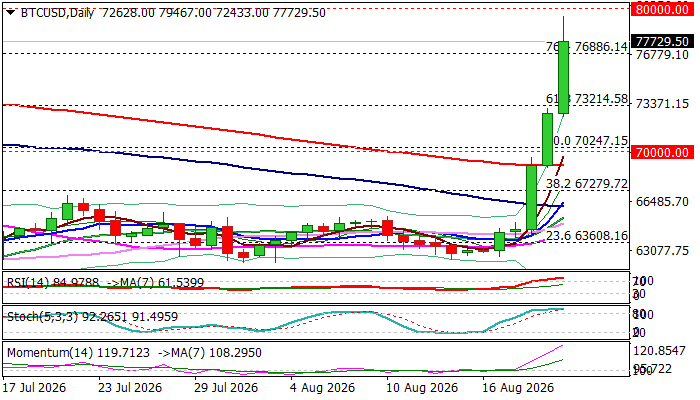
BTCUSD rallies for the third straight day (up over 20%), hitting the levels last traded in mid-May and on track for the biggest weekly gain since the first week of December 2017.
The rally was mainly driven by US Treasury support measures for long duration bonds, which may extend, according to the comments from officials, that resulted in the biggest money inflow into Bitcoin in almost four months.
Break above 200DMA (69636) and psychological 70K barriers generated strong bullish signals that contributed to the latest sharp acceleration higher, which so far retraced over 76.4% of 82821/57673 descend), opening way towards 80K and May 6 peak at 82821.
Meanwhile, corrective easing on partial profit taking at the end of the week / overbought daily studies, should be anticipated.
Dips should be limited and mark positioning for fresh push higher if fundamentals remain in current configuration, with broken Fibo 76.4% offering immediate support at 76886, while deeper pullback should find firm ground above broken Fibo 61.8% (73214) to keep fresh bulls in play.
Res: 79467; 80000; 82044; 82821
Sup: 76886; 74150; 73214; 70000
The Cryptocurrency Bull Market Has Begun
Market Overview
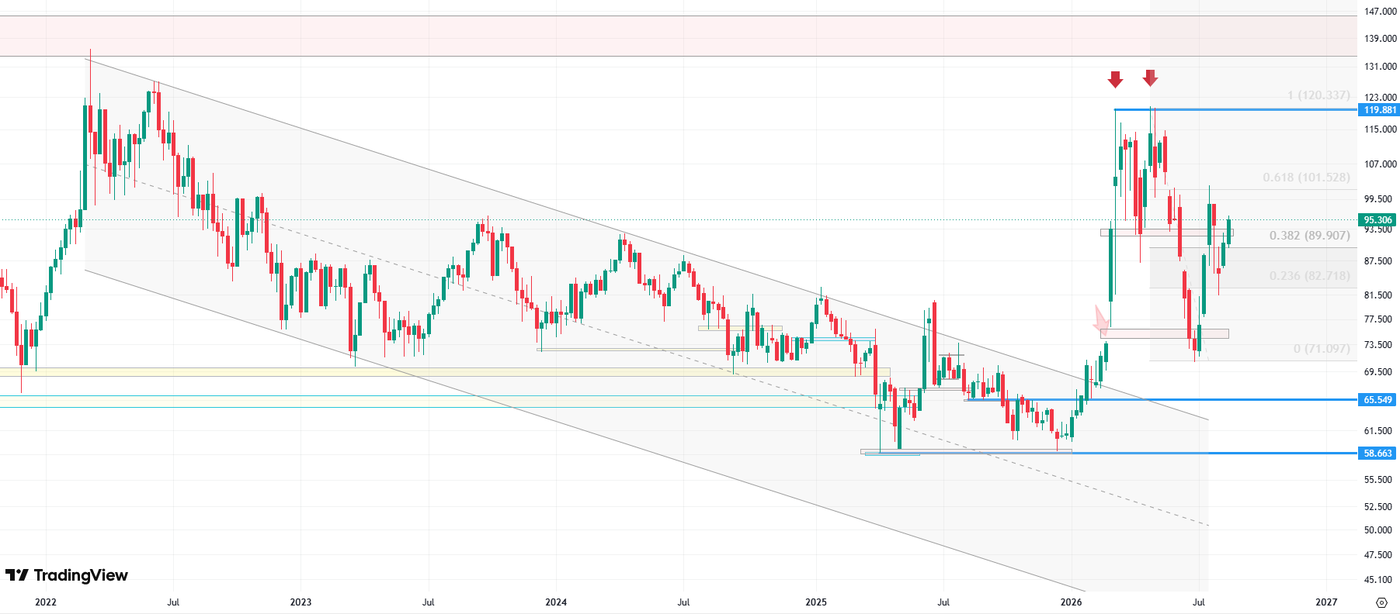
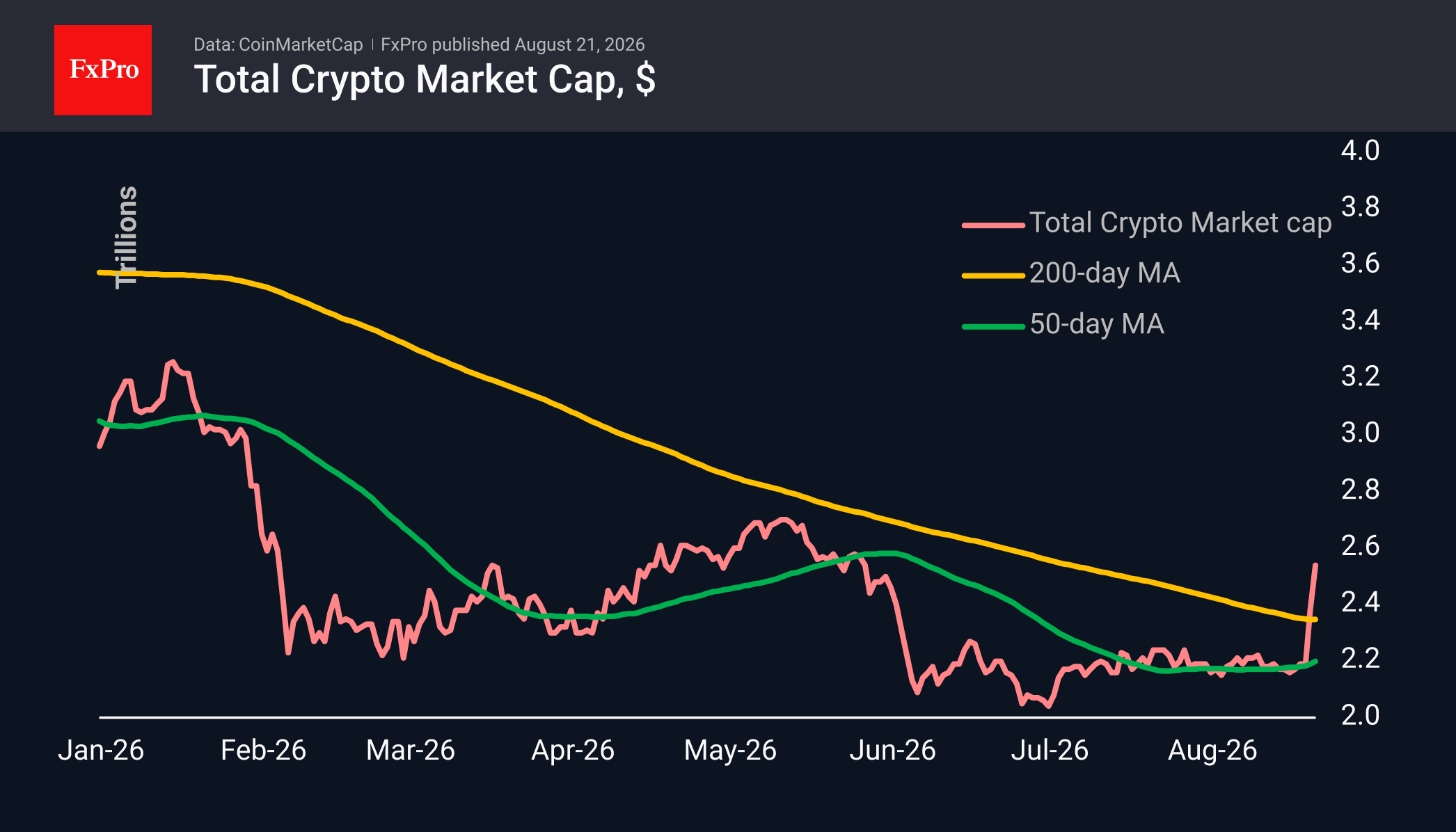
The cryptocurrency market continues to rally, gaining nearly 7% over the past 24 hours to reach $2.51T. Having risen by 18% since the start of the week, the market has demonstrated a dramatic shift in investor sentiment. Since hitting a low of $2.04T in early July, market capitalisation has risen by 24%, marking the formal start of the bull market. However, a negative correlation with the Nasdaq-100 persists, where sellers remain in control despite attempts by the US Treasury Secretary to reassure investors.
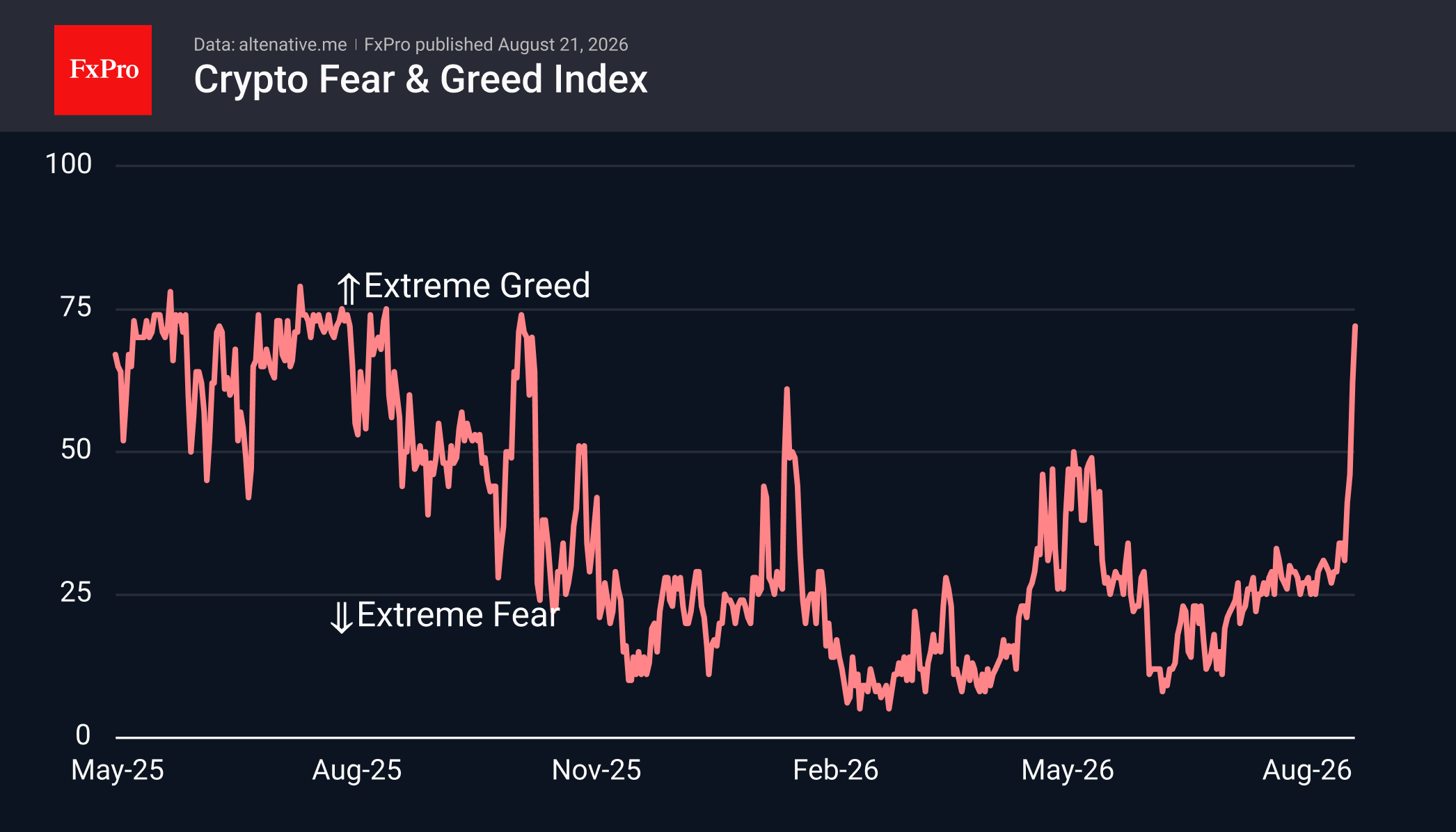
The sentiment index soared to 72, just 3 points below the ‘extreme greed’ level. The index was last above this level on 5 October, when it stood at 74, and it has not sustained such levels for over a year. This provides further confirmation that the market has entered a bullish phase.
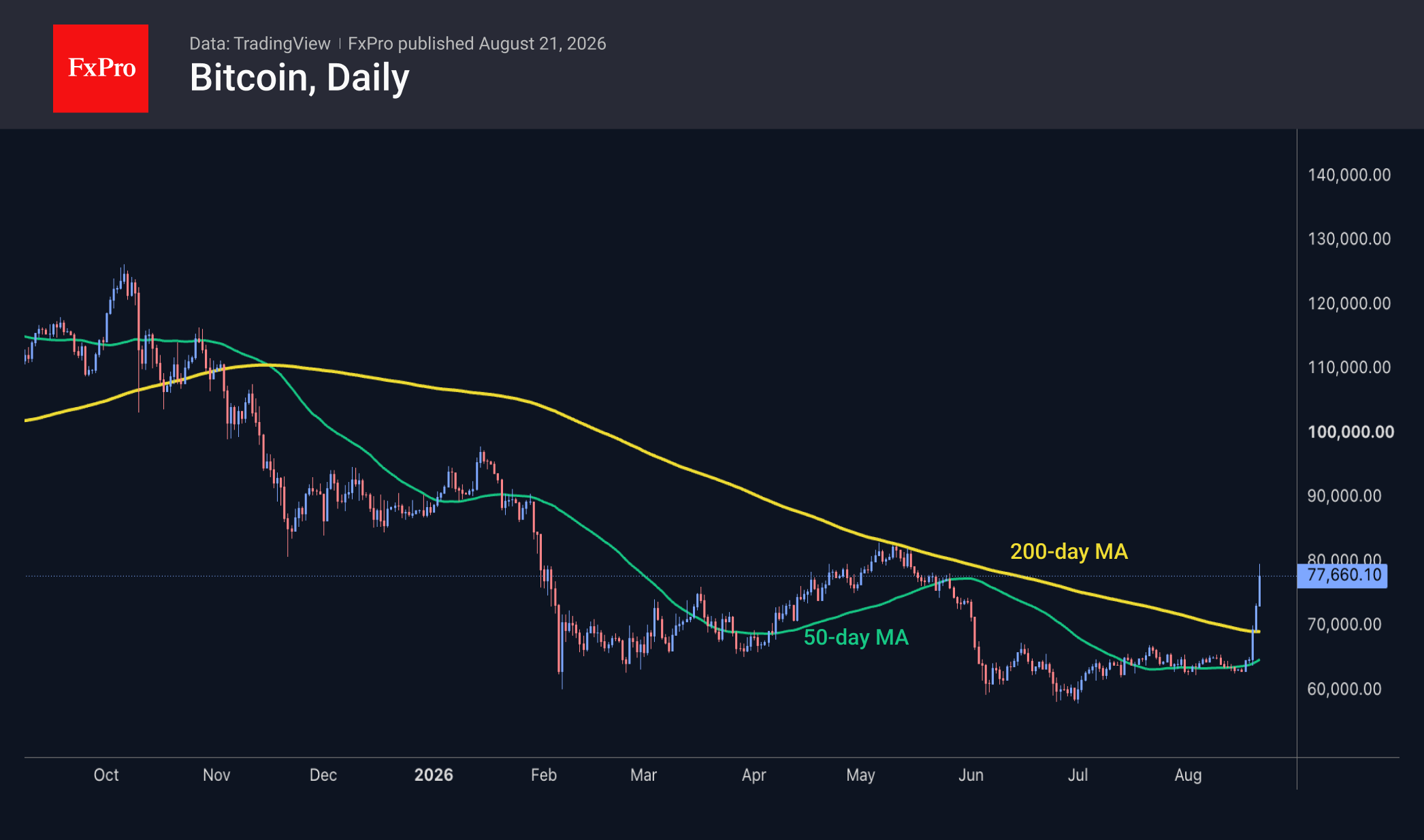
Bitcoin soared to $75.5K at the start of active trading in Europe, which is a high not seen since late May and almost a mirror image of the rate of decline in the first few days of June, when losses over five days approached 20%. Since the start of this week, the rise has already exceeded this figure. The situation appears to be an organised closing out of short positions, as we are not seeing intraday swings of 20–30%, as was the case in February, suggesting that capitulation is still to come. Technically, the nearest significant resistance zone for Bitcoin lies around $82K–$87K, between May’s peak and the December–February support zone.
News Background
Inflows into US spot Bitcoin ETFs on 19 August exceeded $517 million, marking the highest level since early May. Inflows into US spot Ethereum ETFs recorded their best result since mid-October last year.
According to CoinDesk, the volume of short liquidations on 19 August exceeded the record set on 10 October 2025. At that time, during a flash crash, the figure reached approximately $19 billion, but back then, it was the liquidation of long positions.
US President Donald Trump, at a meeting with representatives of the crypto industry, called on Congress to pass a “fair version” of the CLARITY Act, a bill on the structure of the crypto market. The bill has stalled in the Senate amid disagreements over DeFi, cryptocurrency company regulations and ethical restrictions on politicians.
The HYPE token rose by 23% following US President Donald Trump’s statement regarding Hyperliquid. Trump stated that Michael Selig, Chair of the US Commodity Futures Trading Commission (CFTC), is working to launch Hyperliquid in the US “in full compliance with the law”.
According to Artemis Analytics, the restriction on USDT access on European crypto exchanges has not yet led to a significant global outflow from the largest stablecoin. USDT has retained its lead in terms of market capitalisation, although European platforms have switched to USDC.
The FxPro Analyst Team
Gold on Track for Third Consecutive Weekly Gain
Gold traded above 4,500 USD per ounce on Friday, on track to close higher for the third straight week. Demand for safe-haven assets has increased amid heightened volatility in foreign exchange and debt markets. Rising oil prices continue to fuel inflation risks.
Gold surged more than 4% on Wednesday after the US Treasury announced plans to at least double the size of its long-term debt buybacks in an effort to curb borrowing costs. This triggered a sharp decline in US Treasury yields and the dollar, boosting gold’s appeal.
The metal held most of its gains even after bond yields recovered, as investors remain doubtful that the authorities’ measures will provide a lasting solution to high long-term borrowing costs. As a result, demand for gold has remained resilient.
Additional support has come from rising oil prices amid US preparations for a new round of sweeping economic sanctions against Iran, heightening fears of renewed inflationary pressures.
At the same time, gold continues to benefit from investment demand and central bank purchases, particularly from China.
Technical Analysis
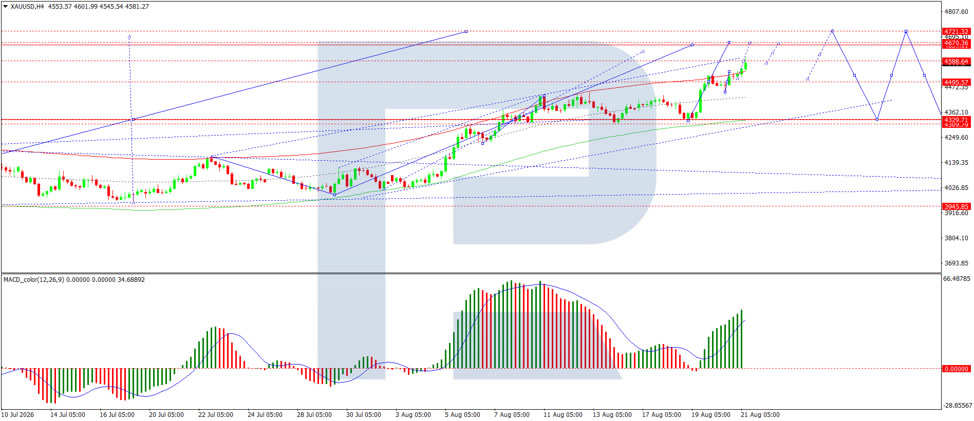
On the H4 XAU/USD chart, the market formed a consolidation range around the 4,330 USD level and, following an upside breakout, moved higher towards 4,660 USD. A new consolidation range is now forming around 4,522 USD, with 4,660 USD anticipated as the local upside target. The MACD indicator supports this scenario, with its signal line above the centre line and trending upward.
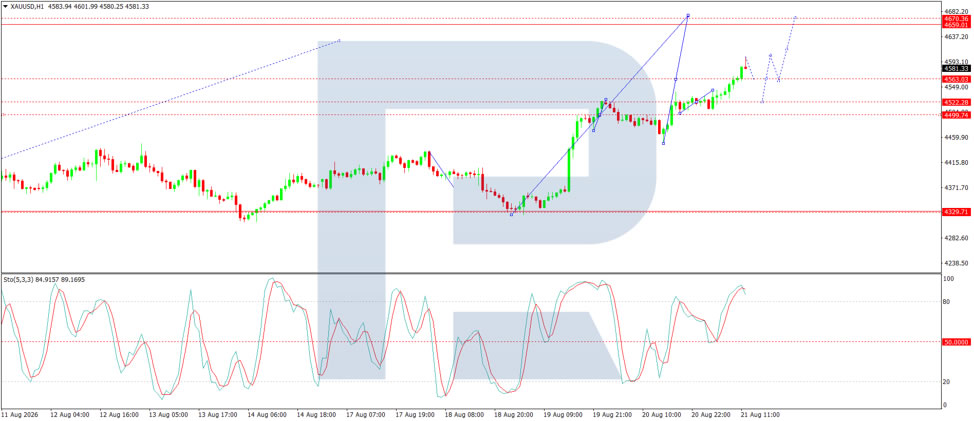
On the H1 chart, the market has broken above the 4,522 USD level and is moving higher towards 4,660 USD. A broad consolidation range is forming around 4,500 USD, with a move higher to 4,660 USD expected, followed by a decline to 4,500 USD. The Stochastic oscillator confirms this scenario, with its signal line above 80 and trending upward.
Conclusion
Gold is set to close higher for the third consecutive week, supported by heightened market volatility, rising oil prices, and sustained inflationary concerns. The US Treasury’s announcement of increased long-term debt buybacks triggered a sharp drop in yields and the dollar, boosting gold’s appeal. Even after bond yields recovered, investors remain sceptical about the lasting impact of the authorities’ measures, sustaining demand for the metal. Additional support has come from rising oil prices amid preparations for new US sanctions against Iran, as well as continued central bank purchases, particularly by China. Technically, gold appears poised for further upside towards 4,660 USD, with any pullback likely to find support around 4,500 USD. The metal’s direction will depend on US monetary policy signals, geopolitical developments, and the trajectory of energy prices.
EUR/USD Daily Outlook
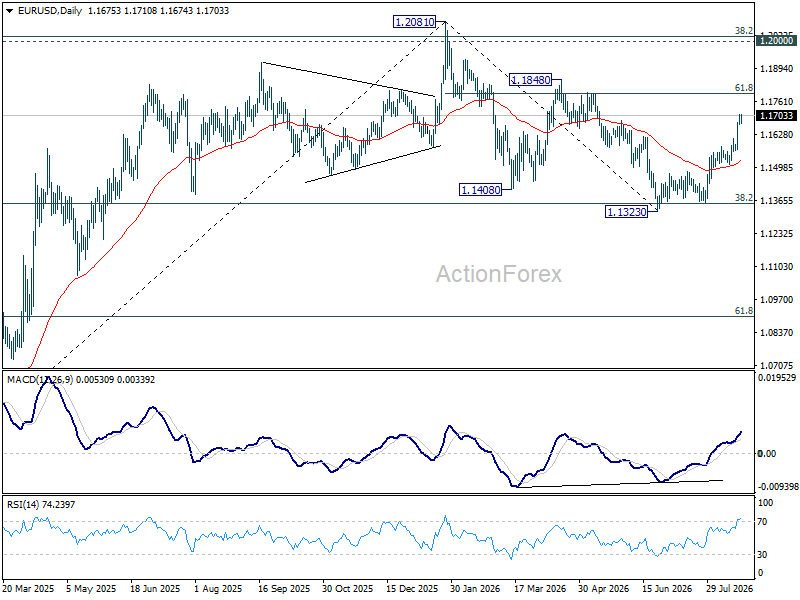
Intraday bias in EUR/USD remains on the upside for the moment. Rise from 1.1323 should target 61.8% retracement of 1.2081 to 1.1323 at 1.1791 next. Firm break there will bring retest of 1.2081 high. On the downside, below 1.1657 minor support will turn intraday bias neutral and bring consolidations first.
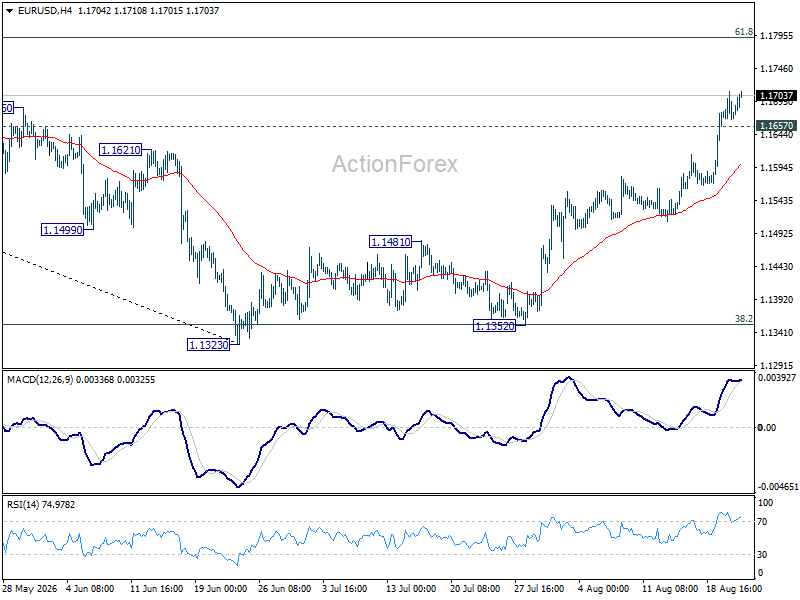
In the bigger picture, current development argues that fall from 1.2081 was a corrective pattern which has completed at 1.1323, after hitting 38.2% retracement of 1.0176 to 1.2081 at 1.1353. Firm break of 1.2081 will resume whole up trend from 1.1716. This will now remain the favored case as long as 55 D EMA (now at 1.1526) holds, in case of retreat.