

Sample Category Title
Bitcoin Bulls Reclaim $74K as Rally Picks Up Steam
Key Highlights
- Bitcoin started a fresh surge above $68,800 and $72,000.
- The bulls could now face hurdles near $75,500 on the 4-hour chart of BTC/USD.
- Ethereum gained pace and settled above $2,250.
- EUR/USD extended gains and traded above 1.1650.
Bitcoin Price Technical Analysis
Bitcoin price formed a base above $62,000 and started a fresh rally against the US Dollar but failed. BTC gained pace for a move above hurdles at $66,650 and $70,000.
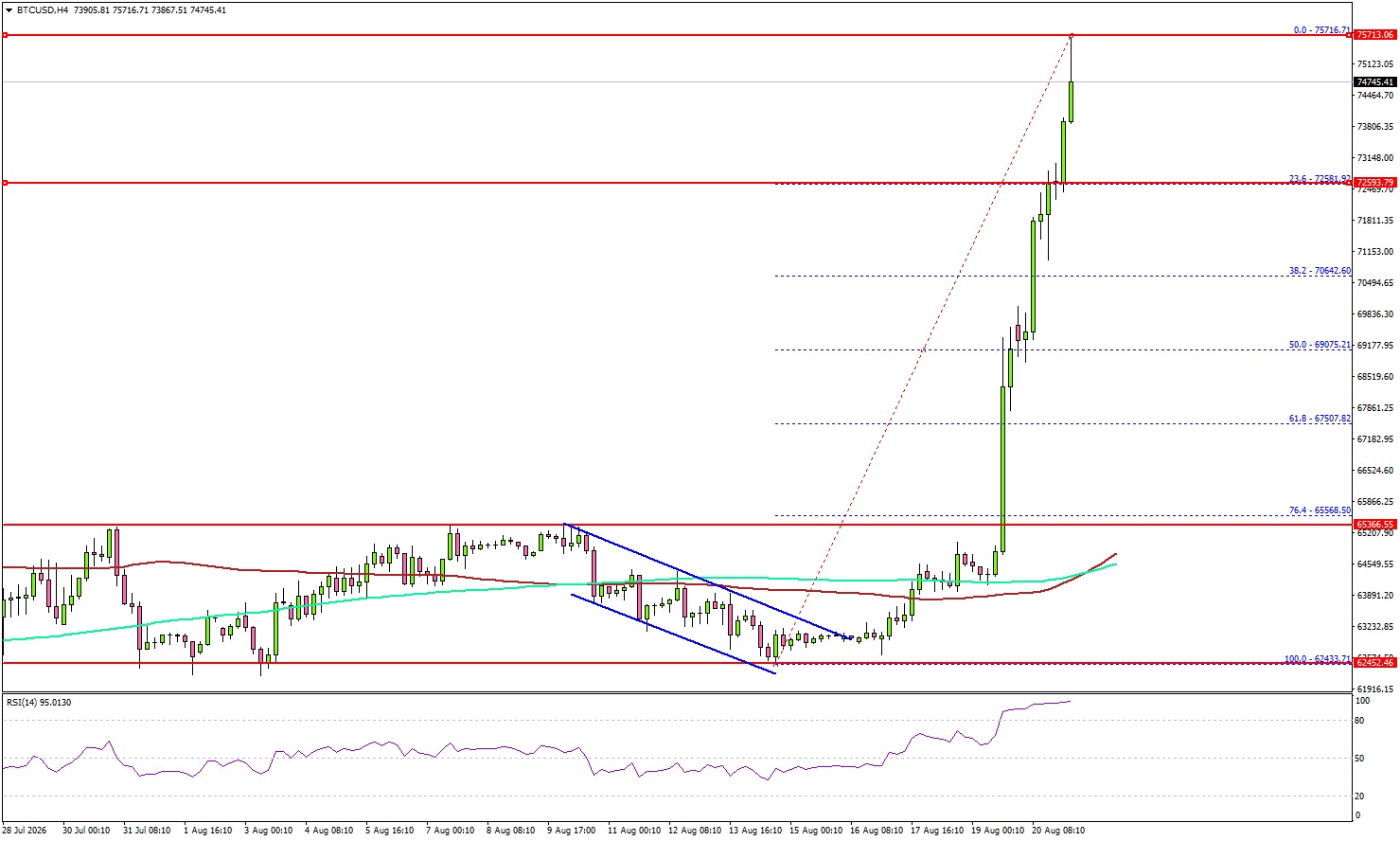
Looking at the 4-hour chart, the price even settled above $72,000, the 100 simple moving average (red, 4-hour), and the 200 simple moving average (green, 4-hour). It gained over 20% in two days and tested the $75,500 resistance.
A high was formed at $75,716 on TitanFX, and the price is now consolidating. If there is a downside correction, the price might find bids near $73,500.
The first major support might be $72,500. A downside break and close below $72,500 could trigger a sharp decline. In the stated scenario, the price could test $70,500 or even $70,000.
On the upside, an immediate resistance could be $75,500. The first major resistance might be $76,200. The main resistance might be $76,800. A close above $76,800 could send the price toward $78,500. Any further gain might call for a test of $80,000.
Looking at Ethereum, the price rallied over 20%, tested $2,375, and might see technical correction in the near term.
Today’s Key Economic Releases
- US S&P Global Manufacturing PMI for August 2026 (Preliminary) – Forecast 53.8, versus 53.9 previous.
- US S&P Global Services PMI for August 2026 (Preliminary) – Forecast 54.0, versus 54.6 previous.
Japan Inflation Is Broadening Again — Core-Core at 1.9% Strengthens BoJ Hike Case
Japan’s inflation pressures strengthened in July, with headline CPI rising from 1.6% to 1.9% y/y, above 1.7% expected, while core CPI excluding fresh food accelerated from 1.6% to 1.8%, matching consensus. More importantly for underlying inflation, core-core CPI excluding fresh food and energy rose from 1.7% to 1.9%, bringing it close to BoJ’s 2% target even as core CPI remained below target for a seventh consecutive month.
Composition suggests pressure is broadening rather than coming solely from energy. Food excluding fresh items rose 3.0% y/y, only slightly slower than 3.1% in June. Services inflation picked up from 1.1% to 1.2%, consistent with gradual pass-through of higher labor costs. Goods prices remained firmer at 2.7%. Energy inflation also turned positive, moving from -0.4% to 0.6%, with propane gas and kerosene rising sharply even as electricity and gasoline prices remained slightly lower from a year earlier.
That mix matters because imported inflation risks are rebuilding just as domestic price pressure is becoming more persistent. Weak Yen continues to raise raw-material costs, while renewed Middle East tensions and higher crude prices threaten another increase in Japan’s energy import bill. Recent PMI data add to the picture: manufacturing and services both strengthened in August, while firms reported output-price inflation near record highs despite some easing in input-cost growth.
For BoJ, July CPI strengthens case for another rate increase at September 17–18 meeting. Core CPI is still below 2%, but core-core inflation at 1.9%, firmer services prices and renewed energy pressure make it harder to argue that inflation is fading cleanly. With private-sector activity strengthening at same time, conditions are supportive of a move from 1.0% to 1.25%, while focus will then shift to whether BoJ is prepared to accelerate tightening pace beyond roughly two increases a year.
Data Summary
| Indicator | Actual | Expected | Previous |
|---|---|---|---|
| National CPI y/y | 1.9% | 1.7% | 1.6% |
| Core CPI y/y | 1.8% | 1.8% | 1.6% |
| Core-Core CPI y/y | 1.9% | 1.7% | 1.7% |
| Food ex Fresh Food y/y | 3.0% | — | 3.1% |
| Services CPI y/y | 1.2% | — | 1.1% |
| Goods CPI y/y | 2.7% | — | — |
| Energy CPI y/y | 0.6% | — | -0.4% |
Key Takeaways
- Japan headline CPI accelerated from 1.6% to 1.9% y/y in July, beating expectations for 1.7%.
- Core CPI excluding fresh food rose from 1.6% to 1.8%, matching consensus and marking second straight monthly acceleration.
- More importantly, core-core CPI excluding fresh food and energy rose from 1.7% to 1.9%, pointing to firmer underlying inflation rather than an energy-only rebound.
- Services inflation edged higher from 1.1% to 1.2%, suggesting gradual pass-through of labor and domestic cost pressures.
- Food excluding fresh items remained elevated at 3.0%, while goods inflation stood at 2.7%.
- Energy inflation swung from -0.4% to 0.6%, with higher kerosene and propane costs adding fresh pressure.
- Weak Yen and renewed Middle East-driven energy costs remain upside risks to import prices, while government subsidies continue to restrain parts of headline inflation.
- For BoJ, mix strengthens case for a September 17–18 rate hike: underlying inflation is approaching 2% just as private-sector activity is strengthening.
Japan PMI Accelerates as Manufacturing Leads Broad-Based August Growth
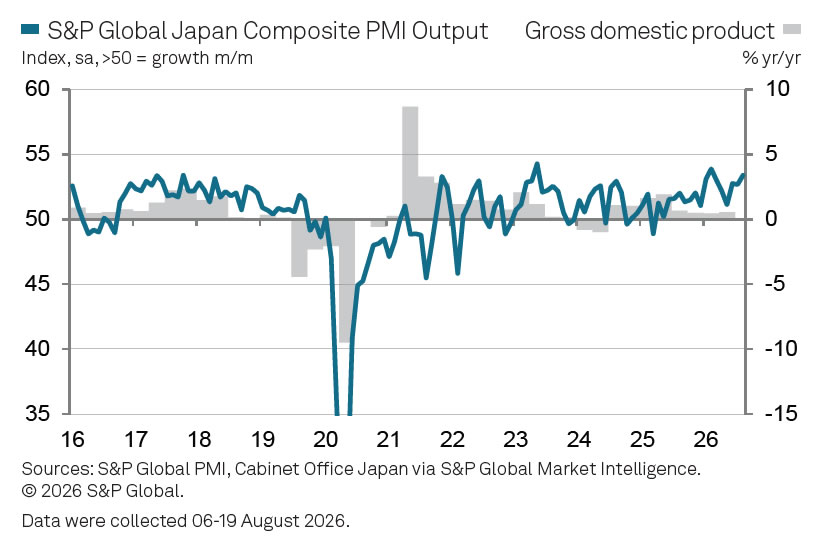
Japan’s private-sector expansion strengthened in August, with PMI Composite Output rising from 52.7 to 53.4, its fastest increase in output since February. PMI Services Business Activity improved from 51.2 to 52.3, while PMI Manufacturing climbed from 54.5 to 55.1. PMI Manufacturing Output remained especially strong at 56.1, only slightly below July’s 56.3, confirming factories continued to lead overall growth.
Demand details were particularly firm. S&P Global said manufacturers recorded sharp increases in production and new orders, while total sales and overseas demand rose at the fastest pace in more than eight-and-a-half years. Semiconductor and AI-related industries remained key sources of new business, strengthening evidence that Japan’s factory sector is benefiting from sustained technology investment and external demand. Employment also increased further, while overall business confidence improved.
Cost pressures eased slightly but remained elevated. Input-price inflation slowed to a five-month low, though firms still cited Middle East-related supply-chain disruption, higher energy costs and weak Yen as important drivers. Output-price inflation nevertheless stayed close to a record pace, suggesting companies remain reluctant to ease pricing while costs are still high. Overall, August PMI points to a stronger growth backdrop led by manufacturing, but persistent price pressure keeps inflation risks relevant alongside improving activity.
Data Summary
| Component | Current | Previous | Trend |
|---|---|---|---|
| PMI Composite Output | 53.4 | 52.7 | Growth accelerated |
| PMI Services Business Activity | 52.3 | 51.2 | Expansion strengthened |
| PMI Manufacturing | 55.1 | 54.5 | Stronger expansion |
| PMI Manufacturing Output | 56.1 | 56.3 | Very strong, slightly softer |
Key Takeaways
- Japan PMI Composite Output rose from 52.7 to 53.4 in August, marking the fastest increase in private-sector output since February.
- PMI Services Business Activity improved from 51.2 to 52.3, showing services growth gained momentum.
- PMI Manufacturing climbed from 54.5 to 55.1, while PMI Manufacturing Output stayed very strong at 56.1.
- Manufacturing remained the main growth engine, with sharp increases in production and new orders.
- Total sales and overseas demand recorded their strongest increase in more than eight-and-a-half years, supported by semiconductor and AI-related industries.
- Employment rose further and business confidence improved, reinforcing the broader expansion signal.
- Input-cost inflation eased to a five-month low, but remained elevated due to Middle East-related supply disruption, energy prices and weak Yen.
- Output-price inflation stayed near record highs, suggesting firms are still passing through elevated costs.
- Overall, August PMI points to stronger growth with persistent pricing pressure, keeping both activity and inflation relevant for BoJ outlook.
Australia PMI Expansion Continues, but Manufacturing Output Slips Back Into Contraction
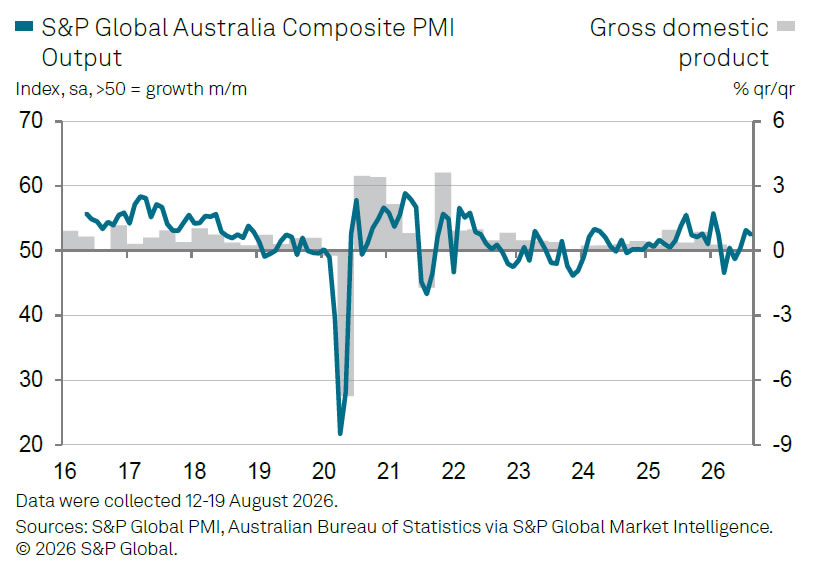
Australia private-sector activity continued to expand in August, although momentum eased slightly. PMI Composite Output fell from 53.2 to 52.5, while PMI Services Business Activity eased from 53.6 to 52.9. PMI Manufacturing held at 52.0, but PMI Manufacturing Output slipped from 50.3 to 49.7, indicating a marginal contraction in factory production even as broader manufacturing conditions stayed expansionary.
The details were mixed but still constructive. S&P Global said order books improved again, with manufacturing recording its strongest increase in new work since the start of the year. Employment also rose modestly, while business confidence strengthened to a six-month high. Services remained the main source of growth, though both activity and new business expanded at a softer pace than in July. Manufacturing output, meanwhile, was held back by supply-chain disruption and rising cost pressures.
Inflation signals were less comfortable. Input-cost inflation accelerated in August, ending the steady easing seen since April, while firms cut the pace of output-price increases to the slowest since the start of the year in an effort to support demand. S&P Global said businesses continued absorbing a large share of higher costs, pointing to ongoing margin pressure. Overall, August PMI still signals modest expansion, but with softer services momentum, weaker factory output and a less favorable cost environment.
Data Summary
| Component | Current | Previous | Trend |
|---|---|---|---|
| PMI Composite Output | 52.5 | 53.2 | Growth slowed |
| PMI Services Business Activity | 52.9 | 53.6 | Expansion eased |
| PMI Manufacturing | 52.0 | 52.0 | Stable expansion |
| PMI Manufacturing Output | 49.7 | 50.3 | Slipped into contraction |
Key Takeaways
- Australia PMI Composite Output eased from 53.2 to 52.5 in August, signaling continued private-sector expansion but at a slightly slower pace.
- PMI Services Business Activity fell from 53.6 to 52.9, keeping services in growth while momentum softened.
- PMI Manufacturing held at 52.0, but PMI Manufacturing Output slipped from 50.3 to 49.7, indicating a marginal contraction in factory production.
- Demand remained relatively resilient, with order books improving and manufacturing recording its strongest inflow of new work since the start of the year.
- Employment continued to rise modestly, while business sentiment improved to a six-month high.
- Cost pressures became less favorable as input-price inflation accelerated, ending the easing trend seen since April.
- Firms nevertheless slowed increases in selling prices to the weakest pace since the start of the year, suggesting businesses are absorbing more of higher costs to protect demand.
- Overall, August PMI points to continued but slower growth, stronger order books and renewed margin pressure.
Higher Long Bond Yields Stem from More Than Just One Thing
AI-related investment and US fiscal incontinence add to the existing tendency for the global rates structure to average higher than pre-pandemic. Expect more US government action to contain debt-servicing costs.
- Bond yields have been rising in recent weeks, especially at the long end of the maturity spectrum. We have long believed that the global structure of interest rates would have a higher centre of gravity in future than it did in the period between the GFC and the pandemic. The factors often cited for the recent rise in yields – larger government deficits globally, the investment boom from AI – were already behind this judgement.
- The question then arises: have we allowed enough for these forces? Getting the direction right is one thing; quantifying the impact is another. In doing so, though, we must take care not to confuse trend and cycle. Some of the recent rise stems from the exceptional demand for funding data centre construction. This effect of the technology wave could last a while, but it is more a cyclical development than a permanent structural one.
- For the Australian economy, developments at the long end of the yield curve tend to be less relevant. Most financing happens at the short end of the maturity spectrum, especially for households. But there are borrowers and investors who are affected by long-dated yields, especially governments.
- Higher yields mean higher debt-servicing costs, particularly for the US government. Expect more manoeuvres like the US Treasury supporting the yen by selling euros not dollars, as well as the buy-back operation this week. These are merely stop-gaps rather than a lasting solution like genuine fiscal consolidation.
Westpac Economics has long held the house view that the global structure of interest rates would be higher in the future than it was in the period between the GFC and the pandemic. Central bank policy might influence the short end, but over a longer period, what matters for interest rates globally is the global balance of saving and investment. Pre-pandemic, saving rates were high, thanks in part to official sectors accumulating reserves. Meanwhile, investment was weak. Confidence had been frayed by the crisis, and some governments were in austerity mode. That decade’s new technologies did not spark the same kind of productivity-enhancing investment boom as computers and the internet did in the late 1990s and early 2000s. And in any case, banks in North America and Europe were recapitalising and less inclined to lend.
There were good reasons to see that period as an aberration, though, including the very long-term evidence we noted two years ago. As we highlighted at the time, a range of forces have been pushing “neutral” rates higher, along with the structure of interest rates more broadly. These include higher government spending as populations age, as well as the private sector needing to invest in both energy transition and AI. Higher defence spending was also in the mix, especially after Germany changed its constitution last year to allow more deficit spending for this purpose. The general fiscal incontinence of the US government was already evident two years ago and worsened under the current administration. All these factors imply greater bond supply, and so higher yields.
To unpack this further, a bond yield is normally thought of as being the combination of several components that are easier to name than to measure. Nominal government bond yields are composed of (expected) inflation plus real yields, where real yields are normally assumed to reflect expected future (real) policy rates plus a “term premium”. The term premium is in principle the compensation investors require for the risk that things turn out differently from their expectations of the other two components, and in practice is a residual grab bag of everything else that might affect demand and supply in the bond market. Corporate bonds add a risk spread to this, reflecting that a company might default but a sovereign issuing in its own currency will never need to.
The higher global structure of interest rates can be seen in all these components. Inflation generally undershot central bank targets in the 2010s; since the pandemic, it has at best been around target, with global supply shocks periodically lifting it above target. Real yields are higher, and with shorter-maturity bonds now paying positive real yields, we are seeing less of the “search for yield” behaviour that compressed both term premia and risk spreads in the 2010s.
But how much?
It is one thing to say rates will be higher on average. We also need to ask: by how much? This is where the AI boom comes in. The scale of the planned global investment in data centres is nothing short of mind-boggling, and it is creating substantial demand for debt finance. The “hyperscaler” tech firms (Alphabet, Amazon, Meta and Microsoft) used to be enormous cash generators. Now they are responsible for some of the largest debt issuances in the market, including Alphabet’s super-sized $A deal this week. Issuance in Australia and other non-US jurisdictions makes sense for these firms. They want to access a diversified pool of investors, and many of the assets they are financing are outside the US, especially now that data centres have become unpopular in many US communities.
The scale of this greater investment call on global savings is one reason to expect longer-dated yields to average even higher in the near term than their range since the pandemic so far.
We must take care, though, to distinguish trend from cycle. This is particularly relevant for the data centre boom, which is likely to be a big thing for the next few years, but settle down as the technology matures and computing capacity expands (and becomes cheaper).
The US government is also making an exceptional call on global saving, and this looks more like a longer-term structural trend than the AI boom does. The US federal government has been running deficits in excess of 4% of GDP for a decade, aside from a brief period in 2022, and more than 6% since the beginning of 2023.
In recent weeks, rumblings of investor discontent about the US fiscal position have become evident in yields. And those hyperscaler bonds, including the $A-denominated ones, are offering a higher yield for companies with similar ratings to the US sovereign. The bonds of governments in better fiscal positions, including Australia’s, also start looking attractive. To this we must add that Japan now looks to be becoming a “normal” economy with positive inflation and interest rates, and an undervalued currency that might tempt some investors to bet on an appreciation. While it remains the case that There Is No Alternative to the US Treasury market for depth and liquidity, some diversification out of USD assets is starting to look both more feasible and more attractive.
The other consequences
For the Australian economy, developments at the long end of the yield curve tend to be less relevant than those at the short end. Most financing happens at the short end of the maturity spectrum, especially for households. But some borrowers and investors are affected by long-dated yields, especially governments, and the local firms involved in data centre construction.
Offshore, we can see higher yields constraining policy decisions by the US government and can expect more on this front. The US government’s debt-servicing costs are becoming more burdensome as large deficits persist and yields rise. Just in the past few weeks, we have seen some unusual currency interventions by the US Treasury, followed by buy-backs designed to shorten the maturity profile of US government debt and lower the term premium paid. And while we expect the Fed will not fold in the face of pressure to keep rates low, we can well imagine the content of the phone calls between FOMC Chair Warsh and President Trump. Expect more manoeuvres by the US authorities along the lines seen recently. These are merely stop-gaps, though, not lasting solutions like genuine fiscal consolidation.
Cliff Notes: The Foundations of Confidence
Key insights from the week that was.
After an upside surprise in June, the labour force survey disappointed in July, reporting a loss of 15.8k jobs. This leaves average monthly employment growth year-to-date at 20.8k, above 2025’s 12.6k but below the pace needed to keep the unemployment rate unchanged. It is therefore unsurprising that the unemployment rate continued to edge higher, reaching 4.5% in July, 0.4ppts above its level at the turn of the year. Hours worked also disappointed, declining 0.6% in the month to be up just 0.2% over the year. Slowly but surely, slack is forming in the labour market, weighing on activity growth but supporting the disinflationary trend. That trend must be sustained if the next move in the cash rate is to be down as Westpac forecasts, albeit not until next August.
The Q2 wage price index was also favourable for the inflation outlook. As expected, the headline wage price index rose 0.8% in Q2 to be 3.2% higher over the year. Private sector wage growth is now at its weakest since Q4 2021 (0.7%qtr, 3.1%yr). Public sector wage momentum provided an offset in Q2, gaining 0.9%qtr and 3.4%yr. The detail suggests that a larger share of public sector jobs received a wage increase than a year ago (25% versus 20%), but that the average hourly wage increase for those jobs was smaller (3.1% versus 3.5%).
Australian consumers are becoming more aware of labour market risks, with the Westpac-MI consumer sentiment survey unemployment index rising above its long-run average in August. But the cumulative impact of cost-of-living pressures remains the major impediment to confidence: both “family finances versus a year ago” and “family finances next 12 months” stayed below average in August, despite mortgage holders receiving a welcome reprieve from the RBA. And improved comfort around family finances is only the first step towards a recovery in consumer demand. “Time to buy a major household item” remains 24% below average despite a monthly bounce, while “time to buy a dwelling” is similarly 20% below average. We expect a lengthy period of weakness in Australia’s economy, with a return to trend activity growth not foreseen until late-2028.
Offshore, attention centred on FOMC messaging. Overall, the July minutes showed a high degree of caution over the inflation outlook, reflecting uncertainty around the Middle East conflict and US economic policy, as well as an expectation that the US economy would maintain its recent momentum. “Most participants anticipated that inflation would step down over the rest of the year as the effects of tariffs and earlier energy price increases wane, but many participants noted the possibility that inflation might be more persistently elevated.” In that context, “many participants assessed that policy tightening would likely be necessary if inflation did not decline”.
Since the meeting, data has been constructive for the disinflationary trend, and the majority of FOMC members who have spoken have recognised the importance of the Committee’s credibility on inflation but also that they have time on their side in assessing conditions.
Turning to Asia, the July China data round underwhelmed yet again. The return from trade is incredible, but retail sales growth has essentially stalled, 0.6%yr, and the decline in fixed asset investment is increasingly broad based, -6.7%ytd. House price declines continue to weigh on household wealth, and domestic equity holdings do not have the scale or breadth to compensate.
Authorities may be keeping quiet on stimulus ahead of the next meeting between President Xi and President Trump, and as the US looks to expand its economic actions against Iran – potentially via third parties with ties to Iran, such as China. But, very clearly, there is an urgent need for stimulus if the 2026 and 2027 growth targets are to be achieved.
Eco Data 8/21/26
| GMT | Ccy | Events | Act | Cons | Prev | Rev |
|---|---|---|---|---|---|---|
| 22:45 | NZD | Trade Balance (NZD) Jul | -1949M | -175M | 23M | -237M |
| 23:00 | AUD | Manufacturing PMI Aug P | 52 | 52 | ||
| 23:00 | AUD | Services PMI Aug P | 52.9 | 53.6 | ||
| 23:01 | GBP | GfK Consumer Confidence Aug | -14 | -18 | -17 | |
| 23:30 | JPY | National CPI Y/Y Jul | 1.90% | 1.70% | 1.60% | |
| 23:30 | JPY | National CPI Core Y/Y Jul | 1.80% | 1.80% | 1.60% | |
| 23:30 | JPY | National CPI Core-Core Y/Y Jul | 1.90% | 1.70% | ||
| 00:30 | JPY | Manufacturing PMI Aug P | 55.1 | 55.1 | 54.5 | |
| 00:30 | JPY | Services PMI Aug P | 52.3 | 51.2 | ||
| 06:00 | GBP | Retail Sales M/M Jul | -0.50% | -0.50% | 1.00% | 0.70% |
| 06:00 | GBP | Retail Sales Y/Y Jul | 1.60% | 2.20% | 4.20% | 3.80% |
| 07:15 | EUR | France Manufacturing PMI Aug P | 51.5 | 50.1 | 49.8 | |
| 07:15 | EUR | France Services PMI Aug P | 48.4 | 49.4 | 49.6 | |
| 07:30 | EUR | Germany Manufacturing PMI Aug P | 54.1 | 52.1 | 52.2 | |
| 07:30 | EUR | Germany Services PMI Aug P | 48.5 | 50.1 | 49.8 | |
| 08:00 | EUR | Eurozone Manufacturing PMI Aug P | 52.8 | 51.8 | 51.9 | |
| 08:00 | EUR | Eurozone Services PMI Aug P | 51.7 | 51.5 | 51.7 | |
| 08:30 | GBP | Manufacturing PMI Aug P | 51.5 | 51.6 | 51.9 | |
| 08:30 | GBP | Services PMI Aug P | 52.8 | 51.8 | 52.1 | |
| 12:30 | CAD | Retail Sales M/M Jun | 0.60% | 0.40% | 1.00% | 1.10% |
| 12:30 | CAD | Retail Sales ex Autos M/M Jun | 0.50% | 0.20% | 1.20% | |
| 13:45 | USD | Manufacturing PMI Aug P | 53.2 | 53.9 | 53.9 | |
| 13:45 | USD | Services PMI Aug P | 56.8 | 54 | 54.6 | |
| 14:00 | EUR | Eurozone Consumer Confidence Aug P | -16 | -16 | -15.9 |
| 22:45 | NZD |
| Trade Balance (NZD) Jul | |
| Actual | -1949M |
| Consensus | -175M |
| Previous | 23M |
| Revised | -237M |
| 23:00 | AUD |
| Manufacturing PMI Aug P | |
| Actual | 52 |
| Consensus | |
| Previous | 52 |
| 23:00 | AUD |
| Services PMI Aug P | |
| Actual | 52.9 |
| Consensus | |
| Previous | 53.6 |
| 23:01 | GBP |
| GfK Consumer Confidence Aug | |
| Actual | -14 |
| Consensus | -18 |
| Previous | -17 |
| 23:30 | JPY |
| National CPI Y/Y Jul | |
| Actual | 1.90% |
| Consensus | |
| Previous | 1.70% |
| Revised | 1.60% |
| 23:30 | JPY |
| National CPI Core Y/Y Jul | |
| Actual | 1.80% |
| Consensus | 1.80% |
| Previous | 1.60% |
| 23:30 | JPY |
| National CPI Core-Core Y/Y Jul | |
| Actual | 1.90% |
| Consensus | |
| Previous | 1.70% |
| 00:30 | JPY |
| Manufacturing PMI Aug P | |
| Actual | 55.1 |
| Consensus | 55.1 |
| Previous | 54.5 |
| 00:30 | JPY |
| Services PMI Aug P | |
| Actual | 52.3 |
| Consensus | |
| Previous | 51.2 |
| 06:00 | GBP |
| Retail Sales M/M Jul | |
| Actual | -0.50% |
| Consensus | -0.50% |
| Previous | 1.00% |
| Revised | 0.70% |
| 06:00 | GBP |
| Retail Sales Y/Y Jul | |
| Actual | 1.60% |
| Consensus | 2.20% |
| Previous | 4.20% |
| Revised | 3.80% |
| 07:15 | EUR |
| France Manufacturing PMI Aug P | |
| Actual | 51.5 |
| Consensus | 50.1 |
| Previous | 49.8 |
| 07:15 | EUR |
| France Services PMI Aug P | |
| Actual | 48.4 |
| Consensus | 49.4 |
| Previous | 49.6 |
| 07:30 | EUR |
| Germany Manufacturing PMI Aug P | |
| Actual | 54.1 |
| Consensus | 52.1 |
| Previous | 52.2 |
| 07:30 | EUR |
| Germany Services PMI Aug P | |
| Actual | 48.5 |
| Consensus | 50.1 |
| Previous | 49.8 |
| 08:00 | EUR |
| Eurozone Manufacturing PMI Aug P | |
| Actual | 52.8 |
| Consensus | 51.8 |
| Previous | 51.9 |
| 08:00 | EUR |
| Eurozone Services PMI Aug P | |
| Actual | 51.7 |
| Consensus | 51.5 |
| Previous | 51.7 |
| 08:30 | GBP |
| Manufacturing PMI Aug P | |
| Actual | 51.5 |
| Consensus | 51.6 |
| Previous | 51.9 |
| 08:30 | GBP |
| Services PMI Aug P | |
| Actual | 52.8 |
| Consensus | 51.8 |
| Previous | 52.1 |
| 12:30 | CAD |
| Retail Sales M/M Jun | |
| Actual | 0.60% |
| Consensus | 0.40% |
| Previous | 1.00% |
| Revised | 1.10% |
| 12:30 | CAD |
| Retail Sales ex Autos M/M Jun | |
| Actual | 0.50% |
| Consensus | 0.20% |
| Previous | 1.20% |
| 13:45 | USD |
| Manufacturing PMI Aug P | |
| Actual | 53.2 |
| Consensus | 53.9 |
| Previous | 53.9 |
| 13:45 | USD |
| Services PMI Aug P | |
| Actual | 56.8 |
| Consensus | 54 |
| Previous | 54.6 |
| 14:00 | EUR |
| Eurozone Consumer Confidence Aug P | |
| Actual | -16 |
| Consensus | -16 |
| Previous | -15.9 |
Daly Defends Fed Independence as Treasury Steps Into Bond Market
San Francisco Fed President Mary Daly pushed back against concerns that Treasury’s intervention in long-dated debt markets could blur lines between fiscal debt management and monetary policy. Speaking on Bloomberg television Thursday, Daly said it was too early to judge how Treasury’s expanded buybacks might affect Fed’s work, noting “these are early days” and she did not want to be preemptive before policymakers had time to assess implications. She stressed that “the Treasury Secretary is different than the Fed,” adding that central bank remains focused on its congressional mandate and returning inflation to 2%.
Daly also played down idea that recent surge in long-term yields should dictate immediate policy action. She said rise in long yields is a global phenomenon driven by multiple forces and “doesn't give us a lot of signal about what we should do in the policy adjustments or the policy calibration for the Fed.” By contrast, she said shorter-dated yields suggest markets understand Fed’s reaction function. Daly described current monetary policy as being in a “good place” and strongly backed July decision to keep federal funds target range at 3.50–3.75%.
Her strongest message was institutional rather than directional. Daly said “the Federal Reserve cares about its independence and its credibility and sticks to its remit,” while adding, “I don't see our credibility at risk.” She also rejected pressure for immediate preemptive moves, saying she sees little evidence that either a cut or hike is an urgent problem to solve given recent data. The implication is clear: Treasury can alter debt-management mechanics, but Fed intends to keep its policy decisions anchored to inflation and labor-market conditions rather than react mechanically to long-end bond volatility.
Key Takeaways
- San Francisco Fed President Mary Daly said it is too early to judge how Treasury’s expanded long-dated buybacks and possible issuance changes could affect Fed policy implementation.
- Daly stressed institutional separation, saying “the Treasury Secretary is different than the Fed” and that central bank remains focused on its congressional mandate and returning inflation to 2%.
- She played down recent long-yield volatility as a direct policy signal, saying higher long-term yields are driven by global forces and “doesn't give us a lot of signal” about Fed rate calibration.
- Daly said shorter-dated bonds are more informative because they “seem to be signaling to us that they understand our reaction function.”
- She described monetary policy as being in a “good place” and strongly supported July decision to hold rates at 3.50–3.75%.
- On credibility, Daly said “I don't see our credibility at risk” and emphasized that Fed “cares about its independence and its credibility and sticks to its remit.”
- She also rejected urgency for either a preemptive hike or cut, saying recent data do not point to an immediate policy problem that needs solving.
Sunrise Market Commentary
Markets
By upping the amount of long-term Treasury buybacks in off-cycle timing (two weeks after the quarterly refunding statement), US Treasury Secretary Bessent implicitly revealed to markets there's a yield pain barrier. But while yields fell around 9 bps in a kneejerk, perhaps shocker, reaction yesterday, they are recouping more than half already today. First of all, the increase in size (at least double to $4bn per operation) is all but irrelevant in the broader picture. Second, it doesn't address the underlying: soaring budget deficits and a relentlessly rising debt mountain. Third, Bessent blinked and it's in markets' nature to now find out how firm the UST's commitment actually is. Last but definitely not least: rising oil prices towards the $94 barrier amid president Trump warning Iran of an economic D-Day. The 30-yr yield enjoyed the biggest rally yesterday but underperforms the rest of the curve currently by adding about 5 bps. Other changes vary between +3.3 bps (2-yr) and 4.7 bps (10-yr). European/German bond yields change less than 1 bp across the curve. Especially the long end of the curve stays put near the recent multi-year or even multi-decade highs. Intra-EMU spreads (vs. swap) have been grinding higher throughout August with underperformance by Italy along with semi-cores Belgium (highest since early May) and France (highest since October 2025). Given their public finance track record, it suggests the topic remains firmly on the market radar.
US yields are already returning from their lows, but the dollar isn't. It could be indicative of the greenback having lost some credibility following what some say is politics fiddling with financial markets. EUR/USD attempted to take out the 1.17(03) resistance level but failing to do so triggered some minor return action back to 1.1687 currently – slightly higher than yesterday's closing levels. Because of USD/JPY appreciating, the trade-weighted index DXY keeps steady around 98.8. Cable (GBP/USD) touched the highest level since February (1.3659) before paring gains somewhat to 1.3637. Economic data was second-tier but in any case included a much better-than-expected Philly Fed business outlook indicator and fewer jobless claims than anticipated (206k vs 210k). The Philly Fed gauge rose from 41.4 to 47.4, the highest since April 2021 and defying expectations for a decline to 24.8. Details were solid with the employment series jumping to a 4-yr high. The forward looking indicator (6 months ahead) soared to a 1983-high!
News & Views
The Swedish Riksbank kept its policy rate unchanged at 1.75% today. The central bank assesses that the probability of a rate increase later this year remains, but the picture is not clear-cut. While growth and inflation have been higher than was forecast in June and underlying inflation risks remain, companies' pricing plans have been subdued, disruptions in global supply chains have declined and the labour market has been somewhat weaker than expected. In June, the Riksbank had put the chance of a 25 basis-point hike in 2026 at 50%. Swedish money markets are somewhat more convinced, putting the probability around 90%, but they weren't influenced by today's outcome. The Swedish krone loses ground, having hoped for a stronger signal by the central bank while higher energy prices weigh as well. EUR/SEK rises from 11.01 to 11.09, approaching 11.11 resistance.
The UK's CBI Industrial trends survey showed manufacturing order books improving in August. The rebound comes after a sharp deterioration over April-July. Total order books were reported as below "normal" to the least extent since November 2024 (-25% from -45%), with export order books recovering to "normal" for the first time in over four years. Output volumes fell again in the three months to August, but at a slower pace relative to July. Manufacturers expect the pace of decline to slow further in the three months to November. Selling price expectations strengthened in August (+22% from +11% in July) and remain above historical norms (+8%). Stocks of finished goods were seen as adequate in August, standing slightly above the long-run average.
Brent Breaks $94, Global Yields Push Higher — but Dollar Refuses to Follow
What's happening: Brent crude broke above $94 and WTI through $87 today, both fresh highs since late July, after Trump threatened "TREMENDOUS Economic Consequences" against countries helping Iran evade sanctions. That oil breakout is dragging global bond yields higher again, US 10-year toward 4.70%, 30-year toward 5.24%, clawing back much of Wednesday's Treasury-buyback-driven decline, with German, UK and Canadian yields rising too.
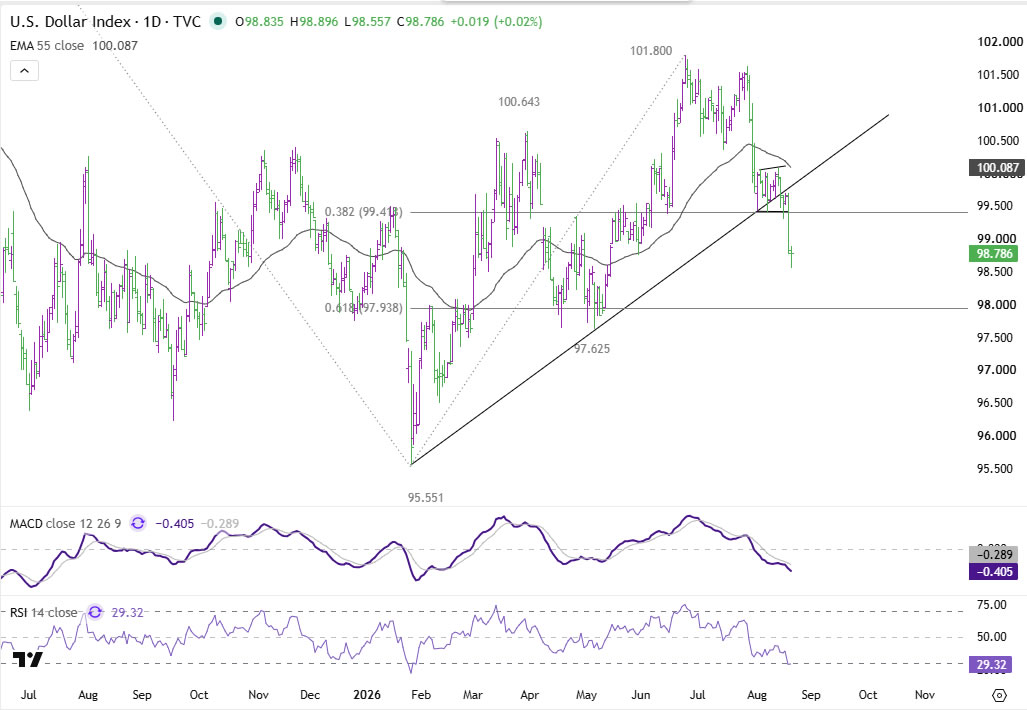
Why it matters: Under normal circumstances, US yields rebounding this much would restore some Dollar support, but DXY is broadly flat. That's because Thursday's yield increase is global, not uniquely American, limiting any relative US yield advantage, and DXY has already suffered a technical breakdown. Watch whether yields keep recovering while DXY stays below 100.08, Dollar's non-reaction becomes the real signal, versus a renewed global yield decline combined with DXY breaking 97.93, which would reinforce the bearish Dollar setup.
Oil Rally Accelerates as Trump Turns Up Economic Pressure on Iran
Brent crude accelerated above $94 today, while WTI pushed through $87, extending both benchmarks to their highest levels since late July. Move marks a fresh phase in oil rally rather than simple consolidation of earlier gains, as markets increasingly price prolonged disruption to Middle East energy supplies and diminishing prospects for a quick US-Iran settlement.
Latest escalation followed US President Donald Trump’s Wednesday warning of an “ECONOMIC D-DAY” against Iran. Trump threatened “TREMENDOUS Economic Consequences” for countries allowing their financial institutions, businesses, airports or government entities to provide Iran with an economic lifeline. Threat extended specifically to channels used to circumvent sanctions, including oil smuggling, swap lines, cash transfers, exchange houses, ship registries and front companies. UAE’s suspension of economic and financial ties with Iran added another layer of pressure.
Iran showed no sign of backing down. Foreign Minister Abbas Araghchi described Trump’s threat as “economic terrorism,” while Deputy Foreign Minister Kazem Gharibabadi argued Washington had turned toward economic warfare after its military campaign failed to achieve its objectives. With Strait of Hormuz disruption already constraining regional trade, increasingly aggressive economic confrontation raises risk that disruption lasts considerably longer than markets initially expected.
Trump's "Economic D-Day" Threat
- Target: countries allowing financial institutions, businesses, airports or government entities to give Iran an economic lifeline.
- Named channels: oil smuggling, swap lines, cash transfers, exchange houses, ship registries and front companies.
- UAE: suspended economic and financial ties with Iran, adding another layer of pressure.
- Iran's response: Araghchi called it "economic terrorism"; Gharibabadi said Washington turned to economic warfare after its military campaign fell short.
Brent $94 Adds Another Inflation Problem for Global Bonds
Oil breakout is now spilling back into bond markets. US 10-year Treasury yield rebounded toward 4.70% on Thursday, while 30-year climbed back toward 5.24%, clawing back a substantial portion of Wednesday’s Treasury-buyback-driven decline.
Importantly, move is not confined to US. German, UK and Canadian government yields are also higher. That breadth makes oil a plausible common contributor. A purely US technical reversal following Treasury buyback announcement would not naturally explain simultaneous selling across several major sovereign markets, whereas Brent above $94 raises headline inflation and inflation-expectation risks across energy-importing economies.
Still, oil should not be assigned all of blame. Thursday’s move is better viewed as combination of renewed global inflation concerns and fading relief from Wednesday’s Treasury announcement. Whether breakeven inflation rates begin rising alongside nominal yields will provide an important test of how much of latest bond selloff is actually being driven by oil.
Treasury Buybacks Provided Relief, Not a Fiscal Solution
Wednesday’s dramatic yield decline followed Treasury’s decision to at least double maximum size of long-dated buybacks, particularly in 20- and 30-year sectors. Markets immediately front-ran prospect of greater liquidity support even though enlarged operations do not begin until September 9.
But buybacks did not change underlying fiscal backdrop or broader Treasury financing requirements. J.P. Morgan argued that program “does nothing to address” structural forces driving yields, including unsustainable fiscal deficits and firmer inflation expectations. Standard Chartered’s Eric Robertsen similarly characterized intervention as an attempt to influence natural supply and demand rather than address underlying pressures.
Thursday’s rebound therefore carries an important message. Treasury announcement was powerful enough to trigger an immediate repricing of long-duration bonds, but market has yet to demonstrate that it can permanently suppress structural pressure on long yields. A return by 30-year yield toward this week’s 5.30–5.33% highs would reinforce view that buybacks changed short-term positioning more than long-term equilibrium.
Higher Treasury Yields Fail to Rescue Dollar
Dollar’s reaction is arguably more striking. DXY is broadly flat despite 10-year Treasury yield recovering toward 4.70% and 30-year returning above 5.20%. Under normal circumstances, such a rebound in US yields would be expected to restore at least some support to greenback.
One reason is that Thursday’s yield increase is global rather than uniquely American. German, UK and Canadian yields are rising alongside Treasuries, limiting improvement in relative US yield advantage. Oil itself also produces competing currency effects, supporting some commodity currencies while putting pressure on energy importers.
Oil, Bonds and Dollar Are Not Moving in Lockstep
Three distinct forces are now intersecting. Oil is responding directly to escalation in US-Iran economic confrontation and increasingly persistent disruption around Hormuz. Global bonds are responding both to renewed energy-driven inflation risks and structural pressures that Wednesday’s Treasury buyback announcement did not remove. Dollar, meanwhile, is failing to capitalize on higher US yields because those yields are rising alongside their global counterparts and DXY has already suffered an important technical breakdown.
That makes Dollar’s non-reaction one of most important signals to watch. If Treasury yields continue recovering while DXY remains below 100.08, it would suggest simply restoring higher nominal US yields is not sufficient to rebuild Dollar’s previous support. Conversely, a renewed fall in global yields combined with DXY breaking 97.93 would reinforce bearish Dollar setup. For now, Brent above $94 is again putting pressure on global rates—but unlike earlier phases of yield surge, greenback is refusing to follow.
US Data Deep Dive
- Read why falling initial jobless claims came alongside a rise in continuing claims and a higher four-week average: U.S. Jobless Claims Fall to 206K, but Continuing Claims Rise.
Asia-Pacific Data Deep Dives
- See why Japan's headline 23.2% export surge overstates the real story, with volumes up only 5.2% once weak Yen and higher prices are stripped out: Japan Exports Surge 23.2%, but Weak Yen and Oil Shock Distort the Headline.
- Read why Australia's -15.8K July jobs drop and unemployment rising to 4.5% give the RBA clearer evidence the labor market is cooling: Australia Jobs Fall -15.8K as Unemployment Hits 4.5%, Giving RBA More Evidence of Slowdown.
Fed Deep Dive
- See why July's Fed minutes revealed more hawkish concern than the 9-3 vote suggested, even as the data behind that meeting is already out of date: Fed Had More Hawks Than the 9-3 Vote Suggested — But July Is Already Stale.
Frequently Asked Questions
Q: Why is Dollar not rallying even though US Treasury yields are recovering?
A: Because Thursday's yield increase is happening globally, not just in the US. German, UK and Canadian yields are rising alongside Treasuries, so the US isn't gaining a relative yield advantage the way it normally would. DXY has also already suffered a technical breakdown, so a rebound in nominal yields alone isn't enough to restore Dollar's previous support.
Q: Why aren't Wednesday's Treasury buybacks fully explaining Thursday's bond selloff?
A: Because the buyback program addresses liquidity, not the structural fiscal deficit and inflation expectations actually driving yields toward two-decade highs, as J.P. Morgan and Standard Chartered both noted. Thursday's global scope, German, UK and Canadian yields all rising too, wouldn't be explained by a US-specific technical reversal, which points to Brent's break above $94 as a more plausible common driver.
Q: What would confirm oil is now driving the global bond selloff rather than something else?
A: Whether breakeven inflation rates start rising alongside nominal yields. If they do, it would support the idea that Brent above $94 is feeding directly into inflation expectations across energy-importing economies. For Dollar specifically, watch DXY against 100.08 and 97.93, staying below 100.08 while yields recover would show Dollar's disconnect from yields persisting, while a break of 97.93 alongside falling global yields would reinforce the bearish setup.
Key Takeaways
- Brent broke above $94 and WTI above $87 after Trump threatened "TREMENDOUS Economic Consequences" against countries helping Iran evade sanctions.
- The oil breakout is spilling into bonds globally, not just the US: German, UK and Canadian yields rose alongside Treasuries, arguing against a purely US-technical explanation.
- Wednesday's Treasury buyback relief didn't fix the structural backdrop: J.P. Morgan and Standard Chartered both said the program doesn't address the fiscal deficit and inflation expectations driving yields, and Thursday's rebound is clawing much of that relief back.
- Dollar failed to rally despite recovering US yields: DXY stayed broadly flat even as the 10-year moved toward 4.70% and the 30-year back above 5.20%.
- The disconnect comes from yields rising globally, not just in the US: That limits any relative US yield advantage, and DXY has already suffered a technical breakdown.
- Two levels frame what comes next: DXY staying below 100.08 while yields recover would confirm Dollar's disconnect from yields; a break of 97.93 alongside falling global yields would reinforce the bearish setup.
What to Watch Next
DXY's behavior relative to 100.08 and 97.93 is the clearest read on whether Dollar's disconnect from yields persists or reverses. Breakeven inflation rates will show how much of the bond selloff is genuinely oil-driven, and further escalation in Trump's economic pressure on Iran, along with the persistence of Hormuz disruption, remains the key upside risk for Brent.