

Sample Category Title
Sunrise Market Commentary
Markets
The (very) long end of the US yield curve rallied yesterday with the curve bull flattening. Daily changes ranged from -0.8 bps (2-yr) to -9.2 bps (30-yr). The US Treasury's unexpected decision to increase by at least double (from $2bn per operation), the size of liquidity support buyback operations for longer-dated nominal coupon securities (10y to 20y and 20y to 30y) triggered the rally. This will apply to 7 more buyback operations from September 9 through November 4 after which the Treasury will announce more on future sizes at the next Quarterly Refunding statement. The Treasury purchases off-the-run nominal coupon securities and TIPS from primary dealers, financed by simultaneously issuing new on-the-run securities. The goal is to retire illiquid older debt and replace it with more actively traded benchmarks, improving overall market depth. While the higher volumes are clearly no game-changer, they signal that "big brother" (Treasury Secretary Bessent) is watching the long end of the curve. The end-of-July joint efforts with Japanese authorities to stem JPY-weakness were also partially inspired by this. Bessent wanted to avoid the situation where Japan accelerated selling of US Treasury holdings to fund FX interventions. The US 30-yr yield moved above 5.3% for the first time since 2007 earlier this week, driven by real yields rather than inflation expectations. The US administration is focused on interest rates as election pledges to lower mortgage rates risk backfiring at upcoming US-midterm elections. Apart from the political aspect, elevated interest rates significantly weigh on the US budget deficit. Focus now turns to next week's Jackson Hole meeting with some expecting Kevin Warsh to team up with Scott Bessent by putting a hawkish message in the market. A credible tightening signal could help put a lid on the inflation risk premium embedded in long term bond yields. Yesterday's FOMC Minutes failed to trigger an intraday turnaround but highlighted broader support for a rate hike than the three official dissenters. "Several" participants favored raising rates with "many" assessing that tightening would be needed if inflation didn't decline. They highlighted that "after several years of inflation above 2%, continued elevated inflation rates could begin to affect inflation expectations and wage- and price-setting decisions".
The Treasury announcement had consequences beyond FI markets. The dollar lost appeal with EUR/USD clearing the 1.16 technical resistance area to close at 1.1677 (highest since end May). The pair is now again in the middle of the dominant trading range in place since last summer (roughly 1.14-1.20). US stock markets managed a slight positive close while gold rallied to its best level since early June on the drop in US real yields. The next couple of days will show whether Bessent's deterrence strategy works or not. On the surface, it doesn't seem sufficient enough to stem recent worries.
News & Views
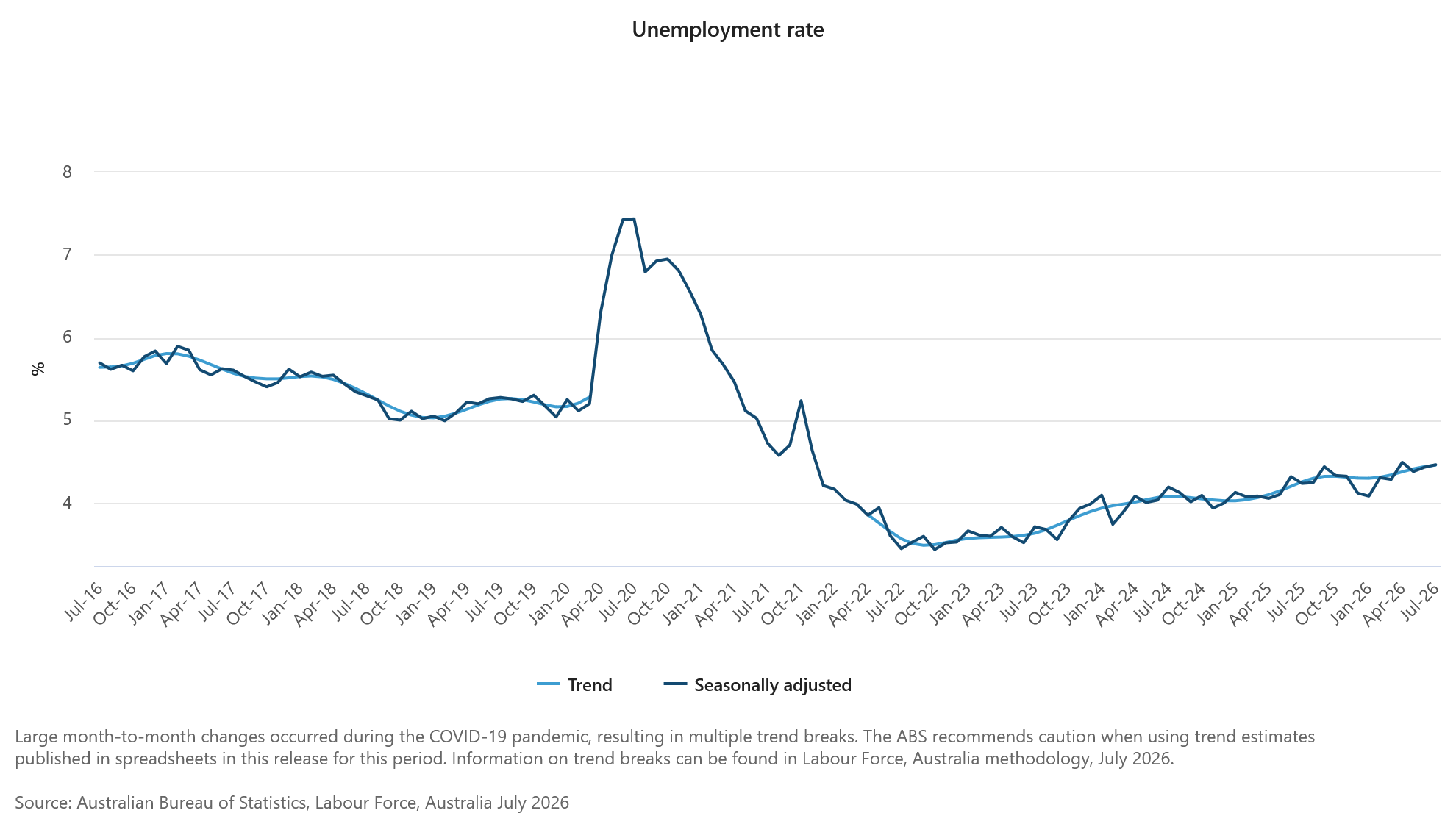
Australian employment unexpectedly fell by 15.8k last month, coming on the back however of a stellar June (upwardly revised to 80.2k). A 32.2k employment loss in the part-time sector was only partially compensated by a rise in full-timers (+16.3k). The employment-to-population ratio and the participation rate both fell 0.2 pps, to 63.9% and 66.9% respectively, the Australian Bureau of Statistics reported. The unemployment rate unexpectedly rose to 4.5% from 4.4%. The overall slightly weaker-than-expected labour market report comes after some hawkish signals from key central bank policymakers, including governor Bullock and assistant-governor Hauser. That contradiction is now causing some kneejerk bull steepening in the Australian yield curve with changes currently varying between -2 (30-yr) and -5.1 (3-yr) bps. The Aussie dollar barely changes. AUD/USD holds virtually steady near a two-month high around 0.711.
Hungary's Paks nuclear plant is able to avert a full shutdown thanks to water levels on the Danube river expected to remain high enough. The water serves as the plant's main coolant, and recent low levels had already caused it to work at just 25% of capacity. In normal times, the power plant generates nearly half of Hungary's electricity. PM Magyar hailed the recent engineering work that has already managed to raise the water level by 10-15 centimeters. It began constructing a riverbed sill last week that should raise levels by up to 1 meter but its completion is still some time away. A short-term solution consisted of sinking two barges near Paks.
EUR/CHF Daily Outlook
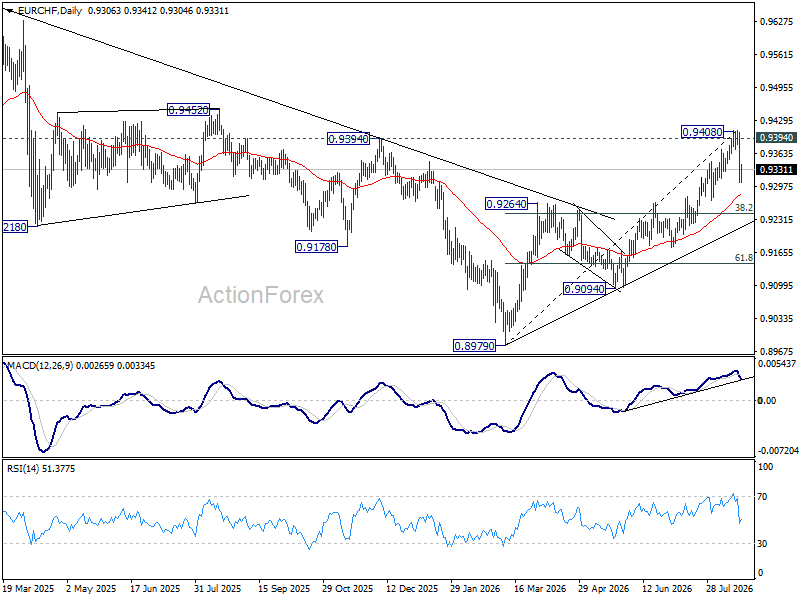
EUR/CHF's steep decline suggests short term topping at 0.9408. Intraday bias is mildly on the downside for deeper pullback to 55 D EMA (now at 0.9281). But downside should be contained by 38.2% retracement of 0.8979 to 0.9408 at 0.9244 to bring rebound. For now, more consolidations would be seen first as long as 0.9408 holds, in case of recovery
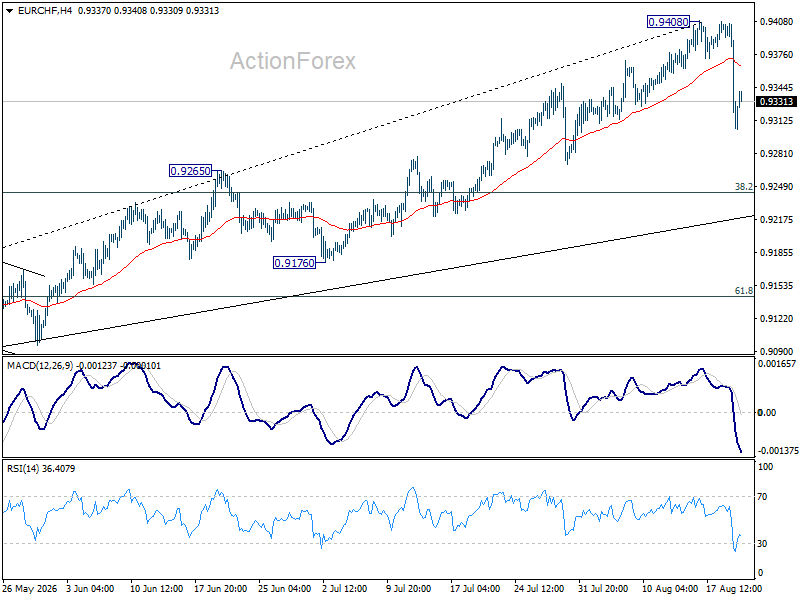
In the bigger picture, the failure to sustain above 0.9394 dampen the bullish case. Outlook is turned neutral first. On the upside, firm break of 0.9394 should confirm that rise from 0.8979 medium term is at least reversing the fall from 0.9928 (2024 high), with prospect of developing into a medium term up trend. Further rally should be seen to 0.9660 resistance next. However, sustained break of 0.9264 will revive medium term bearishness, and bring retest of 0.8979 low instead.
ECB Minutes in Focus as Markets Price September Hike
In focus today
- In the euro area, the ECB publishes the minutes from its July meeting, at which policy rates were left unchanged. We expect the minutes to show a bias towards a rate hike in September, which is also fully priced in by markets. Guidance beyond September is likely to remain limited.
- In Japan, nationwide July inflation data will be released overnight. Based on the Tokyo print, we expect CPI inflation (excl. fresh food) to edge slightly higher from 1.6% y/y in June. Government energy subsidies continue to hold down inflation, while underlying inflation (excl. fresh food and energy) remains modest at 1.2% y/y, helping explain the Bank of Japan's cautious hiking cycle.
- In Sweden, the Riksbank announces its rate decision. Markets widely expect the policy rate to be left unchanged, leaving communication in focus. We expect the Riksbank to signal that the probability of a rate hike before year-end has increased from the 50/50 likelihood communicated in June. This is supported by stronger growth, upside inflation surprises, and higher energy prices. A repeat of the June message, as some analysts expect, would in our view be dovish.
- In Norway, Norges Bank will publish the Q3 Expectations Survey, where CEOs' inflation expectations will be particularly important. In the previous survey, CEO's expected price growth of 4.1% on both the 1-year and 2-year horizon. A significant decline in expectations would ease inflation risk and reduce the need for further rate hikes. Wage expectations from labour market organisations will also be watched closely.
- In Denmark, we get the first version of the national accounts for Q2. We expect GDP growth of 0.5% q/q after the very strong 1.5% in Q1, taking the y/y growth rate from 6.2% to 5.0%. Industrial production grew 1.5% q/q and indicators point to modest growth in the service sector. For once, windmills rather than pharmaceuticals drove industrial growth, with production up 11.7% q/q.
Economic and market news
What happened overnight
In China, the People's Bank of China kept its Loan Prime Rates (LPRs) unchanged overnight, leaving the 1-year LPR at 3.0% and the 5-year LPR at 3.5%, in line with expectations. The decision was unsurprising, as the LPRs typically follow changes in the 7-day reverse repo rate, which has not been adjusted recently.
What happened yesterday
In the US, the FOMC minutes from the July meeting contained no major surprises. Views on inflation diverged, with 'many' participants assessing that "policy tightening would likely be necessary if inflation did not decline". Some also noted that financial conditions might not be sufficiently restrictive to return inflation to 2%, consistent with hold-voters signalling openness to future hikes following the meeting. AI was also discussed, though conclusions remained mixed, with hawks pointing to upward demand pressures and doves emphasising longer-term productivity gains. Chairman Warsh flagged the possibility of reducing meeting frequency to six per year from the current eight, though no decisions were taken and any change would not affect the 2026 schedule.
In the euro area, final inflation data confirmed the flash estimate of 2.9% y/y, with core inflation at 2.5% y/y. Underlying inflation measures were broadly unchanged, with only small increases, suggesting it remains quite sticky, but price pressures have not risen significantly following the energy shock. Separately, the Q2 Labour Cost Index eased to 3.1% y/y from 3.2% y/y in Q1, suggesting that wage pressures continue to moderate and should remain a disinflationary force. We therefore continue to expect only one further 25bp rate hike from the ECB.
In the UK, July CPI came in broadly as expected, with headline inflation rising to 2.9% y/y (cons: 2.9%, prior: 2.6%), mainly driven by the 13% increase in the Ofgem energy price cap from 1 July. Core inflation was slightly higher than expected at 2.6% y/y (cons: 2.5%, prior: 2.6%), while services eased in line with expectations to 3.4% y/y (cons: 3.4%, prior: 3.6%). Importantly for the Bank of England (BoE), food inflation declined further to 1.2% from 1.6%, suggesting limited spillover effects. Together with yesterday's weak labour market data, the release has taken the top off BoE pricing for the remainder of the year.
Equities: Equities rebounded slightly on Wednesday, following several straight sessions of declines this week. S&P 500 closed up 0.2% but near session lows and despite markedly lower yields. Stoxx 600 slid -0.1%. Health care was the big sector leader, up 3.5% in one go, with pharma and biotech in focus. Moderna jumped 180% and Merck surged up 12% on positive Phase 3 trial results for their mRNA cancer vaccine. However, it was defensives in general that fared well yesterday, including consumer staples and real estate. Tech was the main drag but the sector was mixed. Software was higher while semiconductors sold off -2% along with regional banks. US futures are slightly higher again this morning.
FI and FX: EUR/USD spiked higher after the US Treasury announced an increase in the buyback volumes of longer-dated Treasury bonds and the bond curve flattened. At 4.64% currently, the 10Y UST is now 10bp below the peak on Tuesday. The move in US yields only partly spilled over to Europe, where the primary market has opened with plenty of SSA and covered bond deals. Today, the Riksbank is widely expected to stay on hold at 1.75%, but there is more uncertainty about the extent to which it will shift to a more hawkish tone in its verbal communication. While we expect two hikes from the Riksbank this year, we see the risk of a soft market reaction. EUR/NOK continues to drift lower, as has been the case since early August, supported by higher energy prices.
Elliott Wave Outlook: Gold (XAUUSD) Resumes Strong Impulsive Advance
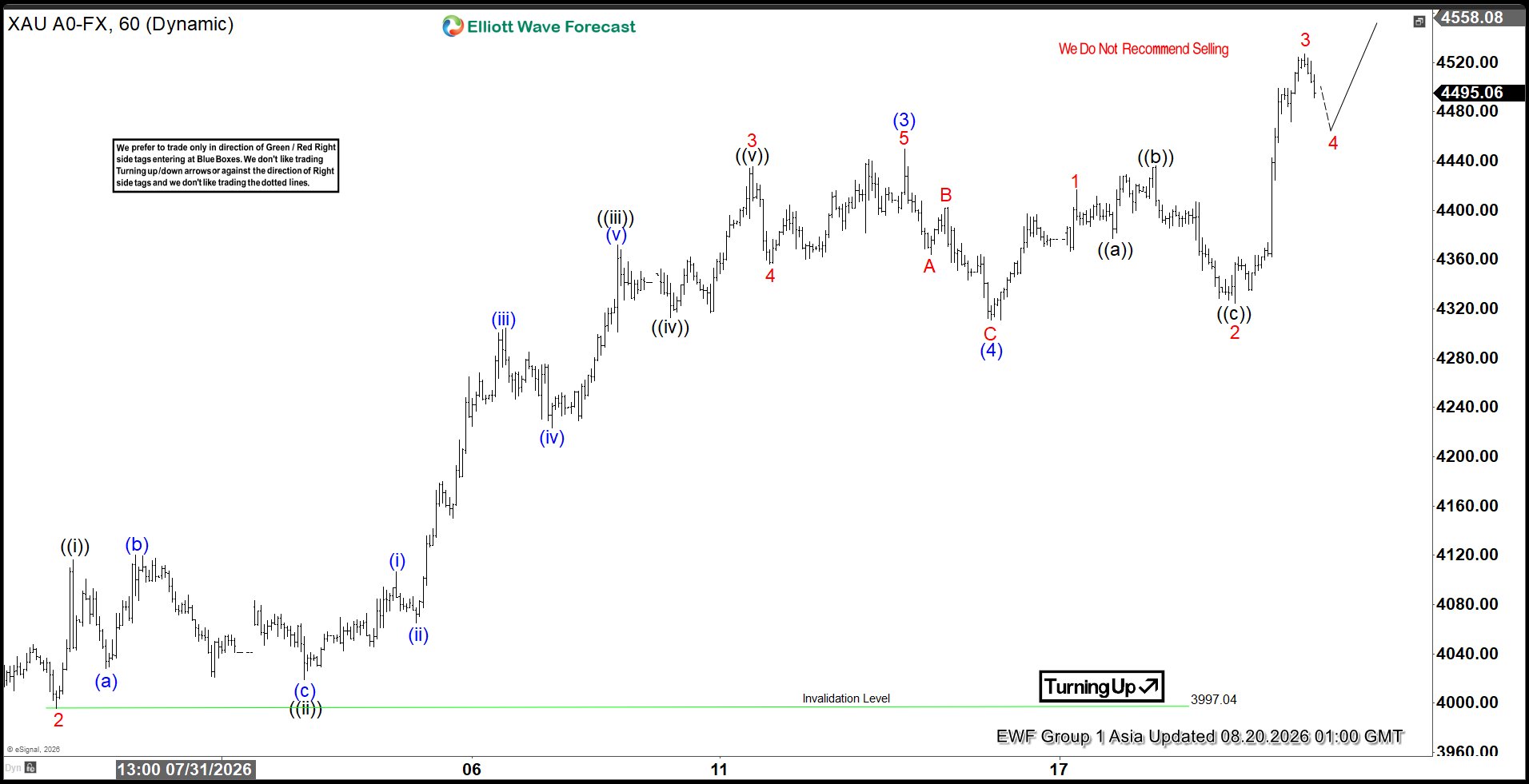
The short‑term Elliott Wave view in Gold (XAUUSD) indicates that the rally from the June 30 low is unfolding as an impulsive structure. From that level, wave (1) advanced and ended at $4203.21, followed by a corrective pullback in wave (2) that concluded at $3959.37. The subsequent rally in wave (3) extended sharply higher and finished at $4449.73, as reflected in the one‑hour chart. Afterward, the market entered a corrective phase in wave (4), which developed as a zigzag formation. Within this decline, wave A ended at $4363.84, wave B retraced to $4402.12, and wave C moved lower to $4310.65, completing wave (4) at a higher degree.
From that point, the metal resumed its upward trajectory in wave (5). Rising from the wave (4) low, wave 1 advanced to $4416.46, while the corrective pullback in wave 2 ended at $4324.23. The next leg, wave 3, pushed higher and concluded at $4527.24. A pullback in wave 4 is now anticipated, with support expected to emerge in either three or seven swings, setting the stage for further upside to complete wave 5 of (5). In the near term, as long as the pivot at $3997.04 remains intact, the outlook favors continued strength. The structure highlights a sustained bullish bias, with the impulsive sequence reinforcing the potential for additional gains.
Gold (XAUUSD) 60 Minute Elliott Wave Chart
XAUUSD Elliott Wave Video
https://www.youtube.com/watch?v=_wQ0RcaiJGM
Gold $5,000 Comes Into View as Dollar and Yields Break Down on Treasury Buybacks
TL;DR: Gold surged 3.7% to $4,495 after a Treasury buyback shock sent long-end yields and the Dollar tumbling — a real-yield move that survived hawkish FOMC minutes and now puts a break above $4,600 within reach of $5,000.
Treasury Buyback Shock Cracks Long Yields
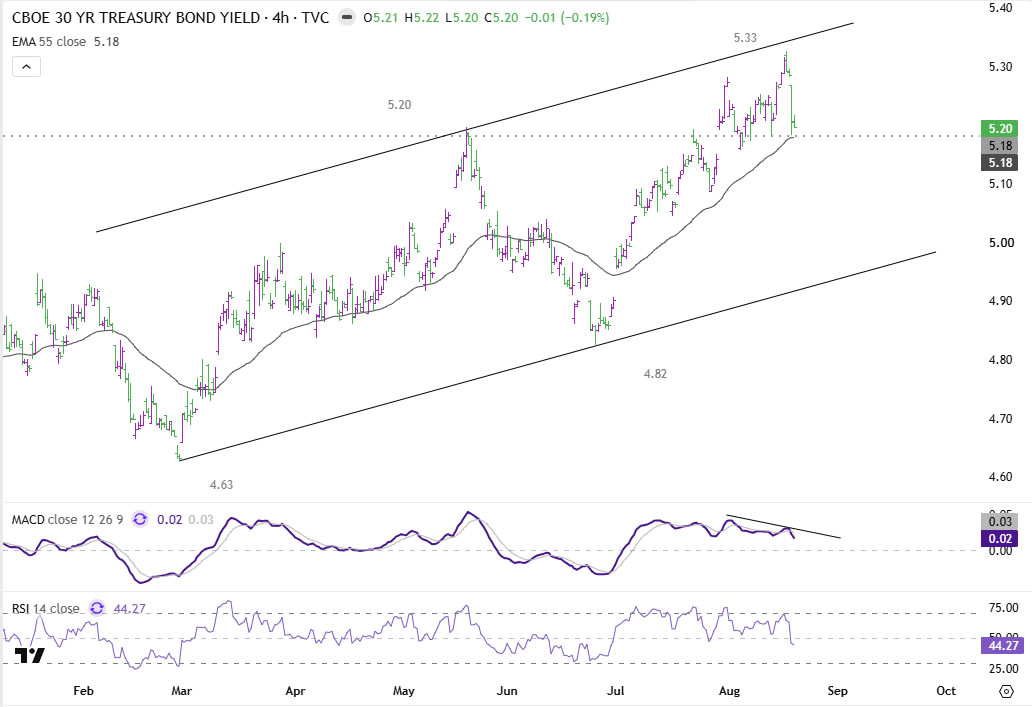
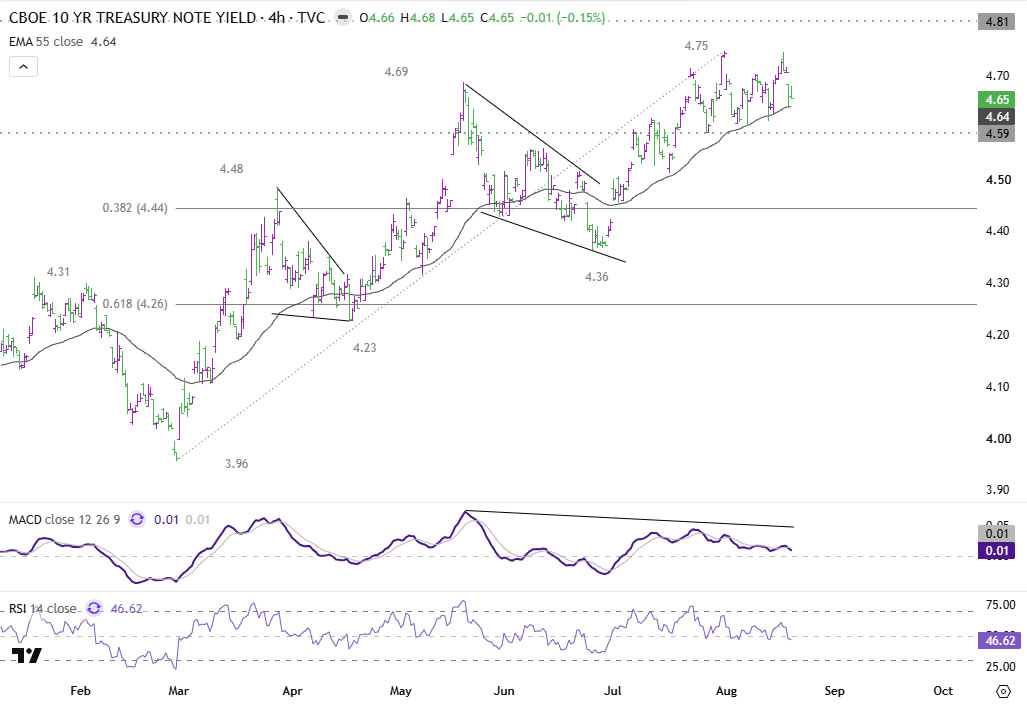
Gold’s path toward $5,000 has become more credible after Wednesday’s Treasury buyback shock triggered a sharp reversal across US yields and Dollar, giving bullion precisely kind of real-rate backdrop needed to extend its medium-term recovery. Gold surged around 3.7% to $4,495 on August 19, its strongest level since early June, while 30-year Treasury yield dropped from this week’s near-two-decade high above 5.33% to around 5.20% and 10-year yield retreated from around 4.75% to 4.65%. Dollar Index simultaneously slid roughly 0.8% to a fresh three-month low near 98.85. Importantly, Gold rose alongside equities and Bitcoin rather than in isolation, pointing to falling real yields and weaker Dollar—not classic risk aversion—as dominant transmission mechanism.
Catalyst was Treasury Department’s unexpected decision to at least double maximum size of long-dated debt buybacks, from $2bn to at least $4bn, targeting 10–20 year and 20–30 year sectors from September 9 through November 4. Actual enlarged operations are still weeks away, yet bond market repriced immediately. That reaction highlights how stretched long end had become after persistent selling pressure. Markets effectively front-ran future liquidity support and relief to duration pressure, driving yields lower before Treasury had purchased a single additional bond.
Hawkish Fed Minutes Couldn’t Reverse the Move
More strikingly, rates move survived release of more hawkish-than-expected July FOMC minutes. Several participants favored an immediate hike, many saw further tightening as likely if inflation failed to fall, and some questioned whether financial conditions were sufficiently restrictive.
That makes Gold's move more significant. Bullion didn't need a dovish Fed to break higher — the Treasury market did the work instead. Duration repricing was powerful enough to overwhelm a Fed message that, in isolation, should have supported yields and the Dollar.
This Was a Real-Yield Move, Not a Debasement Trade
Breakeven inflation data provide clearest evidence for underlying mechanism. 10-year breakeven inflation stayed around 2.30% on both August 18 and August 19, even as nominal yields dropped sharply.
With inflation expectations unchanged, decline in nominal yields translated primarily into lower real yields—the more direct textbook support for Gold. That also argues against interpreting Wednesday’s move primarily through currency-debasement lens. Fed minutes were hardly signaling accommodation, inflation expectations did not jump, and identifiable catalyst was Treasury-driven compression in long-duration yields.
Nothing in Aug 19 price action requires a debasement explanation. For now, Gold’s rally is better explained by a specific real-yield shock.
Dollar Breakdown Confirms Gold’s Reversal
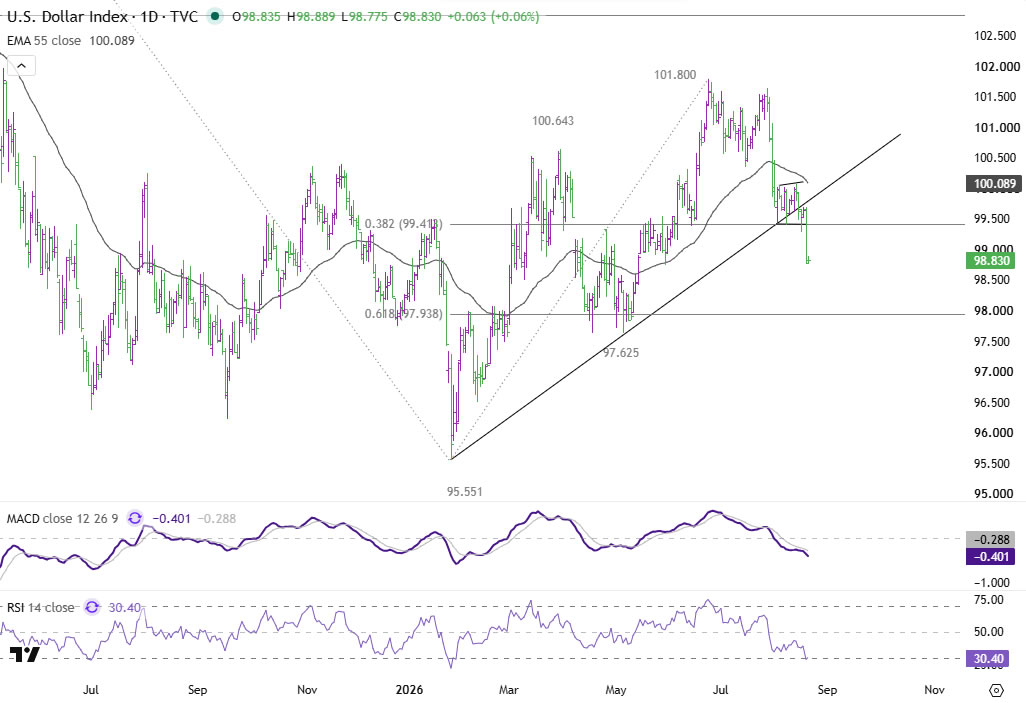
Dollar chart is reinforcing same story. DXY has broken decisively below 99.41, 38.2% retracement of 95.55–101.80 rebound, strengthening case that advance from 95.55 to 101.80 completed as a three-wave corrective move.
Further decline is favored while 55-day EMA near 100.08 caps recovery, with 97.93, 61.8% retracement, next downside objective.
Gold and Dollar are therefore confirming each other from opposite directions: Gold is breaking medium-term resistance just as DXY is a key near term support. A move in DXY through 97.93 would add further support to Gold’s rally.
Gold 4,600 Is Gateway to $5,000
Gold’s own technical structure has shifted significantly. Larger fall from 5,598.75 increasingly looks to have completed as a triangle at 3,942.43. Daily MACD bullish divergence, break above 55-day EMA near 4,272, and this week’s clean break of descending medium-term trend line all strengthening reversal case.
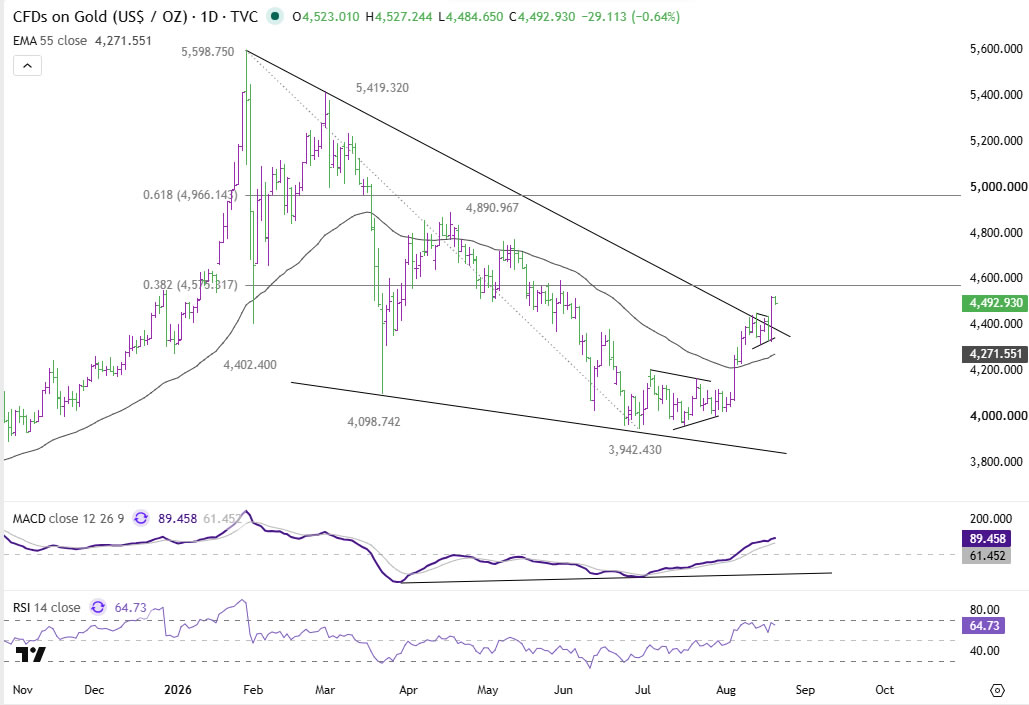
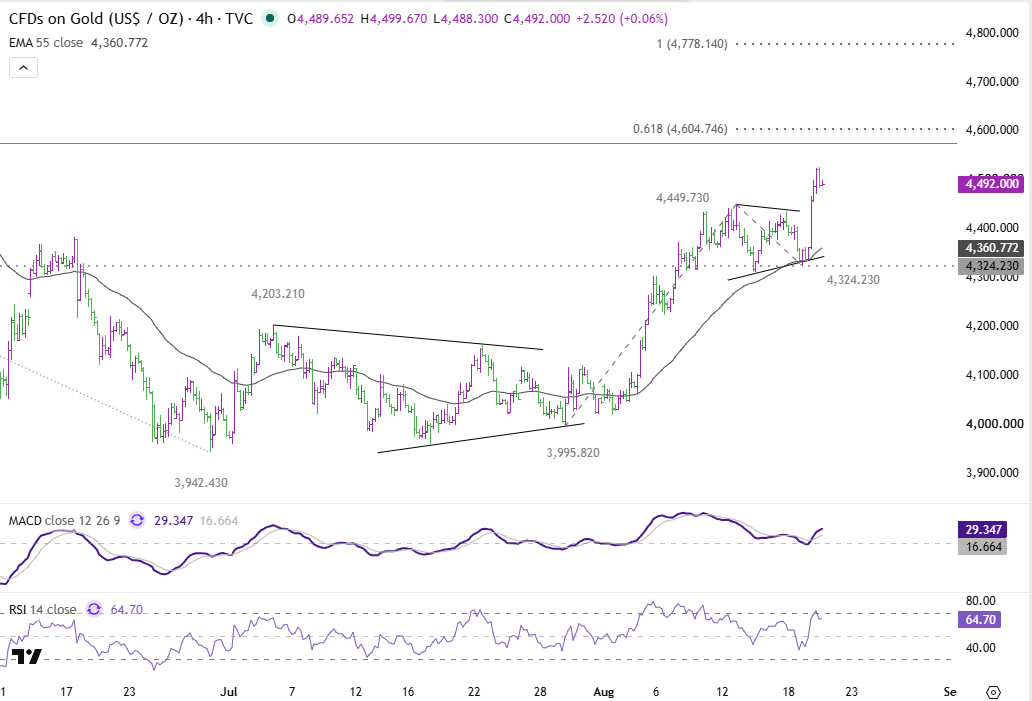
Near-term outlook stays bullish while 4,324.23 support holds. Next decisive test is resistance cluster between 4,575.31 (38.2% retracement of 5,598.75–3,942.43 decline) and 4,604.74 (61.8% projection of 3,995.82–4,449.73 from 4,324.23).
A clean break of 4,575–4,605 zone would open 161.8% projeciton at 4,778.14 first, followed by 61.8% retracement at 4,966.14—effectively putting $5,000 directly into medium-term view.
Watch 30-Year Yield First, 10-Year Second
Rates remain key confirmation. 30-year yield at 5.18% should be watched first, because Treasury buyback impact is concentrated toward long end and this maturity has led latest reversal. Sustained break below 5.18 would indicate duration repricing still has room to run.
10-year support around 4.59% is confirmation level. If 30-year breaks lower while 10-year holds 4.59, move would remain concentrated in long end—still Gold-positive, but less powerful for Dollar. A break of both would signal broader yield compression and strengthen case for DXY extending toward 97.93 while Gold challenges 4,600.
Final check is breakevens. If nominal yields continue falling while inflation expectations stay flat or ease, real yields would compress further and preserve cleanest bullish setup for Gold. If breakevens instead begin rising sharply, story would shift toward inflation repricing and become less straightforward. Track T10YIE/T30YIE alongside the yield levels themselves, not price in isolation.
For now, signal is unusually coherent: long yields are breaking lower, Dollar is breaking support, real yields are compressing and Gold has cleared its medium-term downtrend. $5,000 is not there yet, but decisive break above 4,600 would make it far more than a distant target.
Key Takeaways
- Gold surged 3.7% to $4,495 after the Treasury unexpectedly doubled its long-dated debt buyback size, triggering an immediate repricing in long-end yields.
- The move survived hawkish July FOMC minutes, confirming duration repricing, not Fed dovishness, is driving Gold's rally.
- Flat 10-year breakevens around 2.30% alongside falling nominal yields point to a real-yield mechanism, not a currency-debasement trade.
- The DXY has broken below 99.41 support, confirming Gold's reversal from the opposite direction and opening a path toward 97.93.
- A break above the 4,575-4,605 resistance cluster would open 4,778.14 and then 4,966.14, putting the $5,000 level within medium-term view.
Ethereum Explodes Higher, Posting a Stunning 20%+ Rally
Key Highlights
- Ethereum started a fresh surge above the $2,000 resistance.
- It surged over 20% and even tested the $2,300 resistance on the 4-hour chart of ETH/USD.
- Bitcoin price also started a decent increase above the $66,650 resistance.
- XRP climbed higher after it formed a base above the $1.00 pivot zone.
Ethereum Technical Analysis
Ethereum started a fresh increase from $1,850 against the US Dollar. ETH/USD climbed above $1,950 to enter a short-term positive zone.
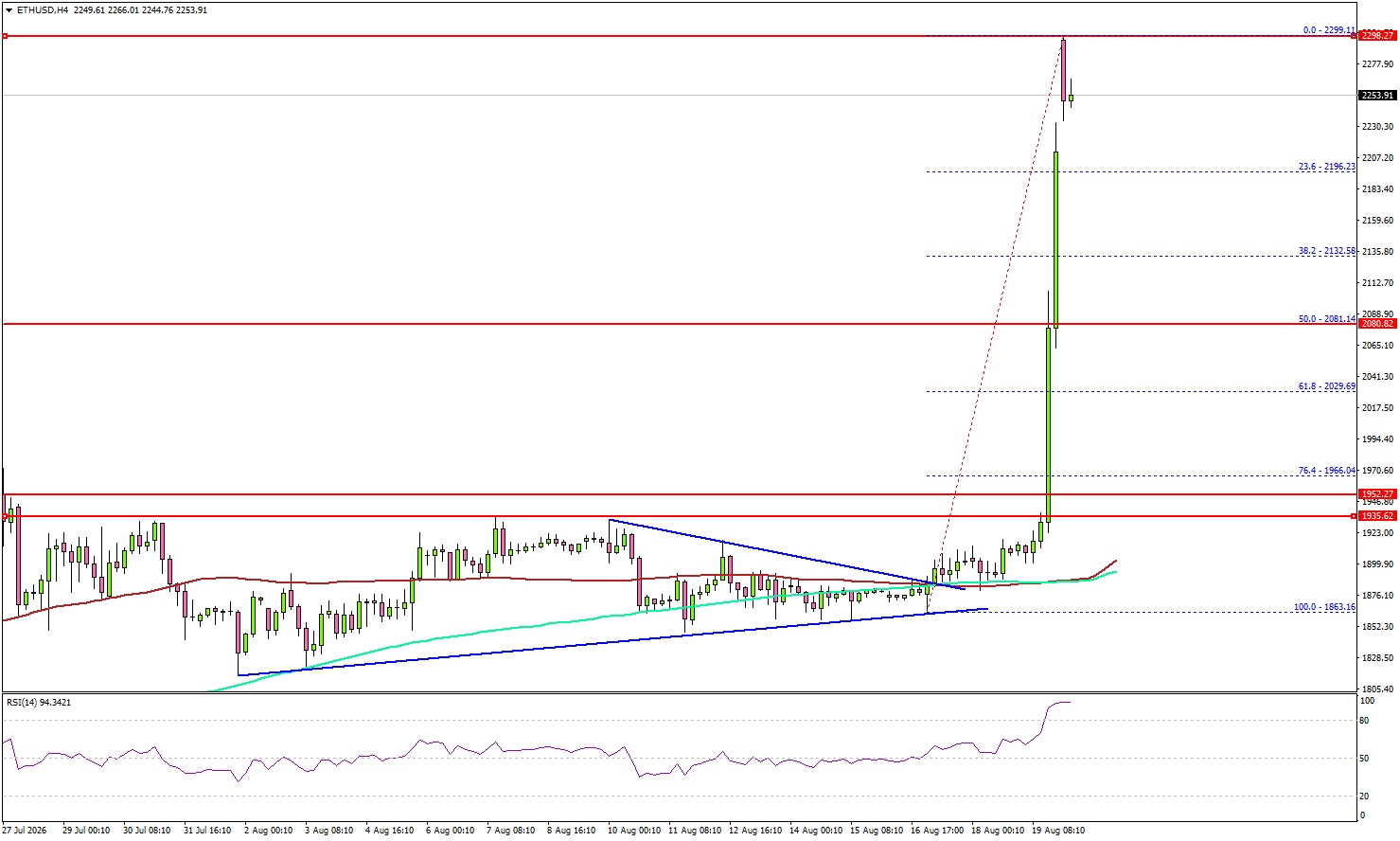
Looking at the 4-hour chart, the price cleared a key contracting triangle with resistance at $1,880. Besides, there was a close above $2,050, the 100 simple moving average (red, 4-hour), and the 200 simple moving average (green, 4-hour).
The bulls pumped the price over 20%, and the price traded close to the $2,300 resistance on TitanFX. On the upside, the bears might remain active near $2,280 and $2,300.
The first key resistance could be near the $2,320 level. The main hurdle for bulls sits near $2,350. A close above the $2,350 level could open doors for a larger upward movement. In the stated case, ETH could rise toward $2,500.
On the downside, the bulls might be active near $2,220 and $2,000. The first major support might be $2,080 and the 23.6% Fib retracement level of the upward move from the $1,863 swing low to the $2,299 high. Any more losses might call for a move toward $2,020. The main support could be $1,950.
Looking at Bitcoin, the price started a steady increase, and the bulls might aim for a move above the $70,000 resistance.
Economic Releases
- US Initial Jobless Claims - Forecast 210K, versus 209K previous.
- Philadelphia Fed Manufacturing Survey for August 2026 – Forecast 25.0, versus 41.4 previous.
Australia Jobs Fall -15.8K as Unemployment Hits 4.5%, Giving RBA More Evidence of Slowdown
Australia’s labor market softened noticeably in July, with employment falling -15.8K after a revised 80.2K increase in June, missing expectations for an 11.4K gain. Unemployment rate rose from 4.4% to 4.5%, above 4.4% forecast. Weakness extended beyond headline: participation rate slipped from 67.0% to 66.9%, while employment-to-population ratio fell from 64.0% to 63.9%.
Hours worked reinforced cooling signal, dropping -0.6% m/m, or 12 million hours, from 2.010bn to 1.998bn. Employment losses were concentrated among males, down -11K, while female employment fell -5K. Female full-time employment actually rose 17K, but this was outweighed by a 22K decline in part-time positions. Underemployment rate held at 6.4%, suggesting labor-market deterioration is still measured rather than broad-based.
For RBA, report provides fresh evidence that tighter financial conditions are slowing employment after Deputy Governor Andrew Hauser said Wednesday Bank had already seen “a bit of a slowdown in consumption and employment growth, but needs to see more still.” July delivers more of that evidence, with employment, participation and hours worked all weakening together. It does not eliminate tightening risk while inflation and energy costs remain elevated, but it reduces urgency for another near-term hike and raises importance of upcoming inflation data in determining whether RBA’s hawkish bias survives.
Data Summary
| Indicator | Actual | Expected | Previous |
|---|---|---|---|
| Employment Change | -15.8K | +11.4K | +80.2K |
| Unemployment Rate | 4.5% | 4.4% | 4.4% |
| Participation Rate | 66.9% | — | 67.0% |
| Employment-to-Population Ratio | 63.9% | — | 64.0% |
| Underemployment Rate | 6.4% | — | 6.4% |
| Monthly Hours Worked | 1.998bn | — | 2.010bn |
Key Takeaways
- Australian employment fell 15.8K in July after a revised 80.2K increase in June, well below expectations for an 11.4K gain.
- Unemployment rate rose from 4.4% to 4.5%, exceeding consensus for no change.
- Weakness extended beyond headline employment, with participation rate falling from 67.0% to 66.9% and employment-to-population ratio slipping from 64.0% to 63.9%.
- Hours worked fell 12 million, or 0.6% m/m, providing another sign of softer labor utilization.
- Underemployment held at 6.4%, suggesting cooling has not yet turned into a broad deterioration.
- Male employment fell 11K, while female employment declined 5K despite a 17K increase in female full-time jobs.
- For RBA, July delivers more evidence of slowdown in employment that Deputy Governor Andrew Hauser said policymakers still needed to see.
- Report reduces urgency for another near-term hike, although inflation and oil-related upside risks mean RBA’s tightening option remains open.
Japan Exports Surge 23.2%, but Weak Yen and Oil Shock Distort the Headline
Japan’s exports accelerated to 23.2% y/y in July, beating 19.9% consensus and marking fastest growth since October 2022, as semiconductor-related demand continued to power overseas shipments. Electrical machinery exports rose 29.4%, while semiconductor-related shipments jumped 49.1% in value. Machinery exports increased 18.4%, including 40.9% growth in semiconductor manufacturing equipment, while motor vehicle exports climbed 19.5%. Geographic demand was also broad, with exports to China rising 25.8% and shipments to US up 22.0%.
But headline considerably overstates underlying growth in real export demand. Overall export volumes rose only 5.2%, indicating that weak Yen and higher selling prices accounted for much of 23.2% increase in nominal value. Autos illustrate that split particularly clearly: passenger-car export value jumped 20.8%, while unit shipments increased just 1.2%. Semiconductor machinery showed firmer underlying demand, with shipment quantities rising 36.4%, suggesting AI-related capital spending remains one of more genuine sources of export strength.
Imports delivered another distortion in opposite direction. Import growth accelerated to 27.8% y/y, above 26.5% expected and strongest since November 2022, outpacing exports and widening trade deficit from JPY 156.3bn a year earlier to JPY 634.5bn. Iran conflict and resulting oil-price surge played a major role, with petroleum imports jumping 87.8% in value. For an economy heavily dependent on imported energy, stronger oil prices quickly translate into a larger import bill even when overseas demand for Japanese goods is performing well.
July report therefore gives a more nuanced picture than export headline alone suggests. External sector remains an important support for growth, following its strong contribution to Q2 GDP, while AI-related demand is providing a clear lift to Japan’s industrial exporters. Yet only a fraction of nominal export surge came from higher volumes, and much stronger energy imports overwhelmed export gains at trade-balance level. Japan is benefiting from weak Yen and global technology demand on one side, while paying increasingly expensive bill for imported energy on other.
Data Summary
| Indicator | Actual | Expected |
|---|---|---|
| Exports y/y | 23.2% | 19.9% |
| Imports y/y | 27.8% | 26.5% |
| Trade Balance | JPY -634.5bn | — |
| Export Volume y/y | 5.2% | — |
| Export Detail | Current y/y | Contribution to Growth |
|---|---|---|
| Electrical Machinery | 29.4% | +5.2ppt |
| Transport Equipment | 20.7% | +4.6ppt |
| Machinery | 18.4% | +3.3ppt |
| Semiconductors etc. | 49.1% | +3.0ppt |
| Motor Vehicles | 19.5% | +3.1ppt |
| Semiconductor Machinery | 40.9% | +1.5ppt |
| Chemicals | 22.9% | +2.4ppt |
Trade balance in July 2025: JPY -156.3bn.
Key Takeaways
- Japan’s exports surged 23.2% y/y in July, beating 19.9% expected and recording fastest growth since October 2022.
- Semiconductor-related demand remained a major driver. Semiconductor exports jumped 49.1%, while semiconductor manufacturing equipment rose 40.9%.
- Export strength was broad geographically, with shipments to China up 25.8% and exports to US up 22.0%.
- But export volumes increased only 5.2%, showing weak Yen and higher selling prices accounted for much of 23.2% nominal increase.
- Autos highlighted that divergence: passenger-car export values rose 20.8%, while unit shipments increased only 1.2%.
- Imports accelerated even faster, rising 27.8% y/y versus 26.5% expected, strongest growth since November 2022.
- Petroleum import values surged 87.8% as Iran conflict pushed oil prices higher, exposing Japan’s vulnerability to expensive imported energy.
- Trade deficit consequently widened sharply to JPY 634.5bn, from JPY 156.3bn a year earlier.
- Overall picture is two-sided: AI and semiconductor demand are supporting Japanese manufacturing, but weak Yen and oil shock are inflating both export values and import costs, limiting benefit to net trade.
Fed Had More Hawks Than the 9–3 Vote Suggested — But July Is Already Stale
Minutes of Federal Reserve’s July 28–29 meeting showed a more hawkish policy debate than 9–3 decision to hold rates at 3.50–3.75% might suggest. While three members formally voted for a 25bp hike, minutes said “several participants favored an increase of 25 basis points”, while “many participants assessed that policy tightening would likely be necessary if inflation did not decline.” Some also questioned whether financial conditions were sufficiently restrictive to return inflation to 2%. Taken together, discussion suggests concern about persistent inflation extended well beyond simple tally of three dissenting votes, even if minutes do not establish that additional members would have voted for an immediate hike.
Inflation debate centered increasingly on risk that repeated shocks keep delaying disinflation. Most participants still expected inflation to step down over rest of year as tariff and earlier energy effects faded, but officials judged risks were “skewed to the upside.” Several warned that “successive supply shocks have repeatedly delayed the expected return of inflation to 2 percent,” while renewed Middle East conflict was seen as capable of extending supply-chain problems and lifting prices again. AI was emerging as another complication: some officials saw investment boom already boosting aggregate demand and prices, even as eventual productivity gains could increase supply and lower costs later.
Stable labor market gave hawks room to emphasize price stability. Participants judged labor demand and supply to be broadly balanced, unemployment close to longer-run estimates and economic activity still expanding at a solid pace. A few officials favoring a July hike argued that acting then could “help forestall the need for a steeper and potentially more costly sequence of tightening moves at a later stage.” That effectively captures insurance-hike argument: tighten modestly before inflation becomes entrenched rather than risk a larger adjustment later.
But minutes describe Fed’s assessment at end of July, making their hawkish message less straightforward for markets today. Subsequent softer employment, inflation, retail-sales and producer-price readings have altered information set substantially. July record is therefore more useful as a guide to Fed’s reaction function than as a direct September signal: failure of inflation to fall would revive tightening pressure, while clearer weakening in labor demand and consumption gives hold camp more reason to wait. Minutes reveal how easily tightening debate could return, but whether July hawks still command same urgency depends on data that arrived after meeting.
Key Takeaways
- July FOMC minutes showed broader hawkish concern than 9–3 vote alone suggested. Three members formally dissented for a 25bp hike, while “several participants” favored raising rates and “many” saw further tightening as likely if inflation failed to decline.
- Some officials questioned whether financial conditions were restrictive enough to bring inflation sustainably back to 2%.
- Hawkish argument included an “insurance hike” logic: acting sooner could reduce risk of needing a steeper and more costly tightening sequence later.
- Fed remained concerned that successive supply shocks were repeatedly delaying return of inflation to target, with Middle East tensions adding fresh upside risk.
- AI investment was becoming part of inflation debate, with some officials seeing stronger aggregate demand and price pressure before longer-term productivity gains arrive.
- Labor market was still viewed as broadly stable in July, giving hawks more room to prioritize inflation.
- But minutes are already partly stale. Softer jobs, CPI, retail-sales and PPI data released since meeting have weakened immediate case for tightening.
- Best interpretation is hawkish reaction function, outdated economic snapshot: minutes show what could revive hike debate, not necessarily what Fed would do today.
FOMC Minutes Show Fed Trying to Communicate Less Without Saying Less
- The Federal Open Market Committee (FOMC) held the federal funds rate at a target range of 3.50% to 3.75% at its July meeting, with three dissents in favor of a 25-basis-point rate increase.
- The minutes reinforce that the Fed’s communication strategy has shifted under Chair Warsh. The Committee appears intent on reducing explicit forward guidance and putting more weight on realized data, while still emphasizing that inflation remains above target and price stability remains non-negotiable.
- On inflation, participants continued to see upside risks as material. Supply shocks, including energy-related pressures tied to the Middle East conflict, were seen as a risk to the return to 2%, leaving officials unwilling to treat the inflation shock as temporary or fully contained.
- The minutes show the meeting should not be received as a one-sided case for imminent tightening. Participants still saw growth as solid and the labor market as broadly balanced but also acknowledged elevated uncertainty and downside risks to activity, giving the majority reason to wait for more confirmation before moving rates higher.
- Three members, Beth Hammack, Neel Kashkari, and Lorie Logan, dissented from the majority, preferring a 25-basis-point hike because they judged that still-elevated inflation and upside risks to the inflation outlook warranted an immediate increase.
Key Implications
- The main takeaway is communication: the Fed is trying to reduce explicit forward guidance, but doing so raises the burden on officials to explain their reaction function and assessment of the economy clearly as the inflation-growth tradeoff evolves.
- The minutes should also be read with an important timing caveat. The July meeting took place before the July CPI and retail sales reports, which materially reduced the near-term case for additional tightening. These minutes are best read less as a live signal of imminent hikes and more as evidence that the Fed was struggling with a real inflation-growth tradeoff before the latest data softened the tightening argument.