

Sample Category Title
USD/JPY Remains Range-Bound: What Comes Next?
USD/JPY held around 159.53, with the Japanese yen trading sideways for more than a week. The currency has lost approximately half of the gains made following the joint intervention by Tokyo and Washington at the end of July.
Pressure on the yen persists due to a wide interest rate differential, rising fiscal risks, and elevated energy and import costs.
At the same time, markets are increasingly pricing in a Bank of Japan rate hike in September to support the yen and contain inflation. The yield on 10-year Japanese government bonds climbed to 30-year highs this week, reflecting expectations of near-term policy tightening and concerns over the state of public finances.
Core machinery orders rose 9.7% in June, significantly exceeding forecasts and providing further support for expectations of tighter policy while signalling robust business capital expenditure.
Technical Analysis
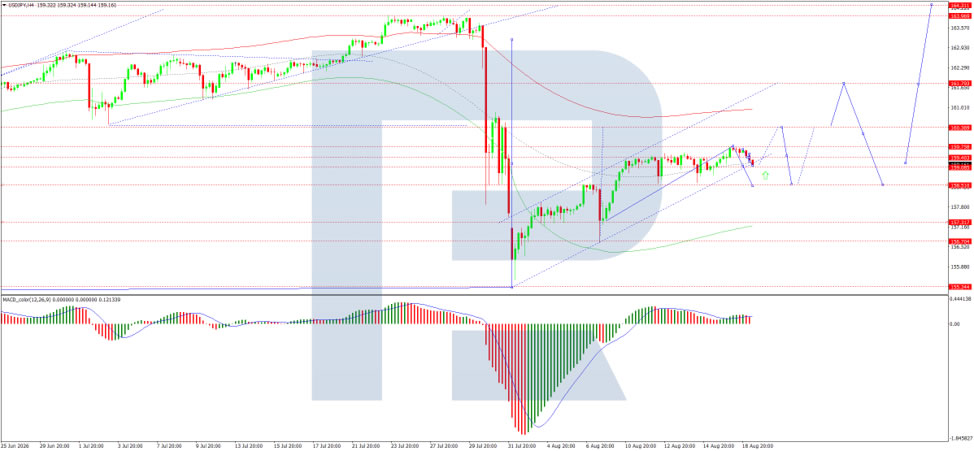
On the H4 USD/JPY chart, the market is forming a consolidation range around the 159.49 level, currently extending down to 159.20. A move higher to 159.49 is expected today, followed by a decline to 159.00. A break below this level would open the way for a correction towards 158.54. The MACD indicator supports this scenario, with its signal line above zero and trending downward.
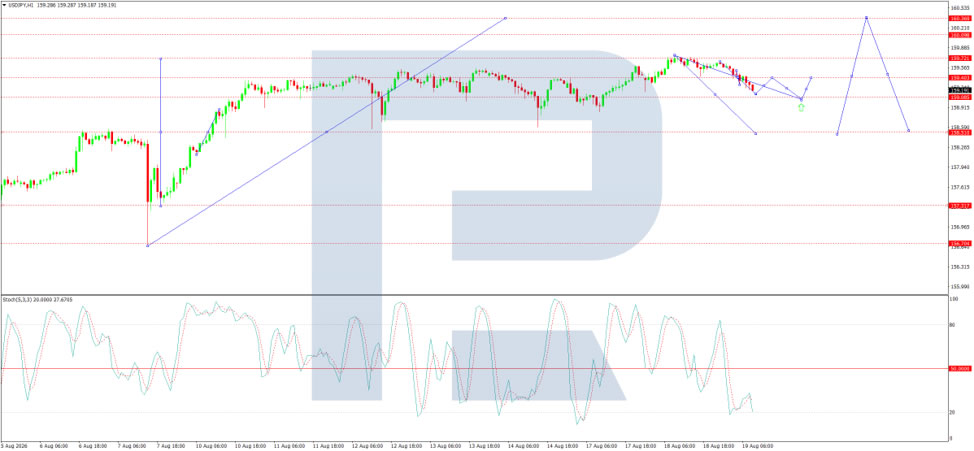
On the H1 chart, USD/JPY has moved up to 159.65. A consolidation range is currently forming below this level. A downside breakout would open the way for a move lower to at least 159.00. The Stochastic oscillator confirms this scenario, with its signal line below 50 and trending downward towards 20, indicating short-term downside pressure.
Conclusion
USD/JPY remains range-bound as the yen struggles to sustain gains from the late-July intervention. The currency has given back roughly half of its post-intervention appreciation, weighed down by persistent fundamental headwinds. However, markets are increasingly pricing in a September rate hike from the Bank of Japan, supported by rising bond yields and stronger-than-expected machinery orders data. Technically, the pair may see a short-term pullback towards 159.00 and potentially 158.54 before its next directional move. The yen’s outlook will depend on Bank of Japan policy signals, US economic data, and the trajectory of energy prices.
BTC Is Range-Bound, Shrugging Off the Weakness in Equities
Market Overview
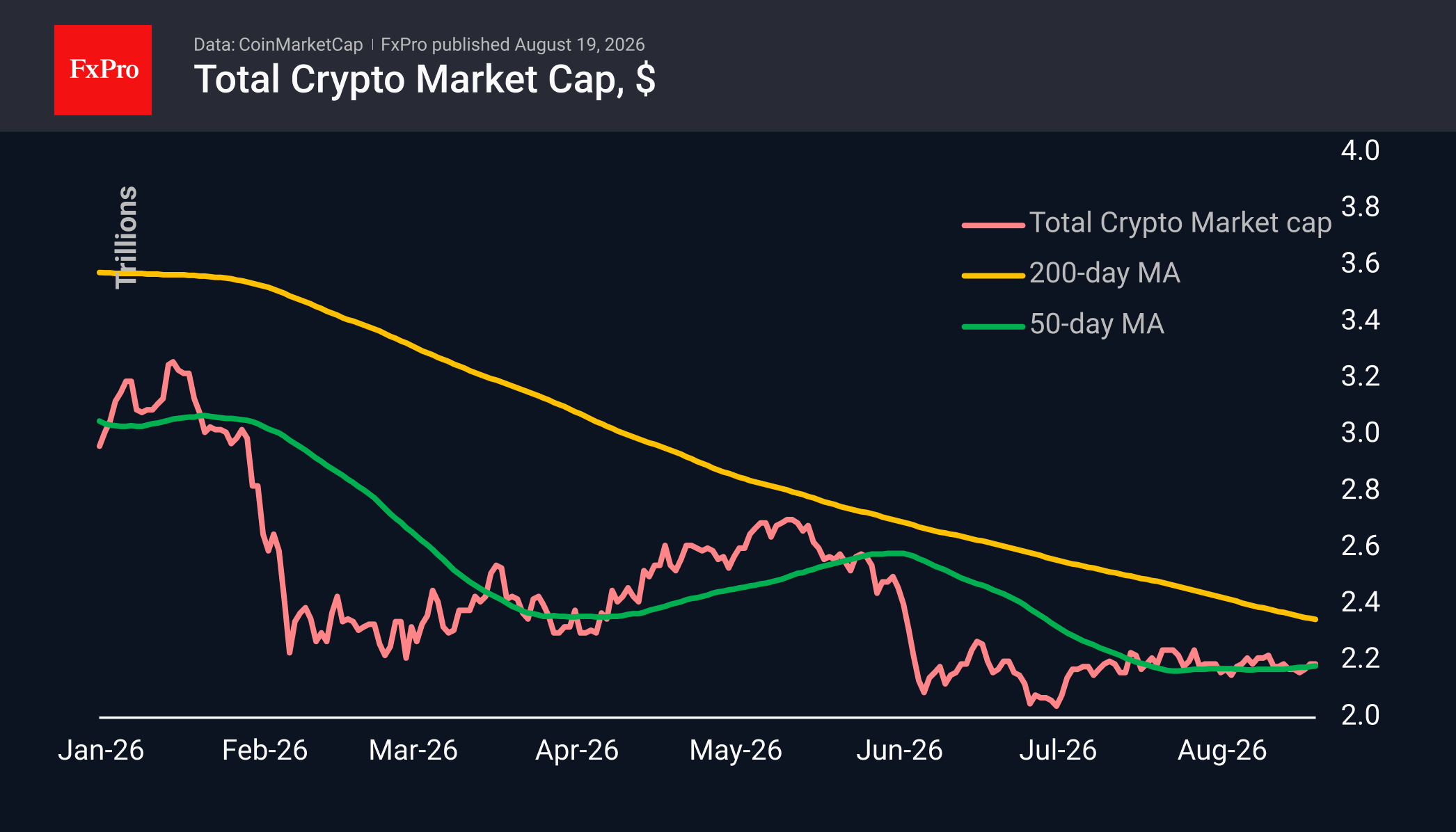
The crypto market capitalisation has changed little over the past 24 hours, remaining close to $2.19T. Still, polarisation within the market has intensified, widening the trading range of the most actively traded coins. The top three performers were IOTA (+3.9%), Polkadot (+2.8%) and Hedera (+2.5%); the three worst performers were Immutable (-5.6%), Near Protocol (-3.6%) and Internet Computer (-2.9%). Once again, the crypto market showed a negative or virtually non-existent correlation with the equity market, which saw a significant sell-off on Tuesday.
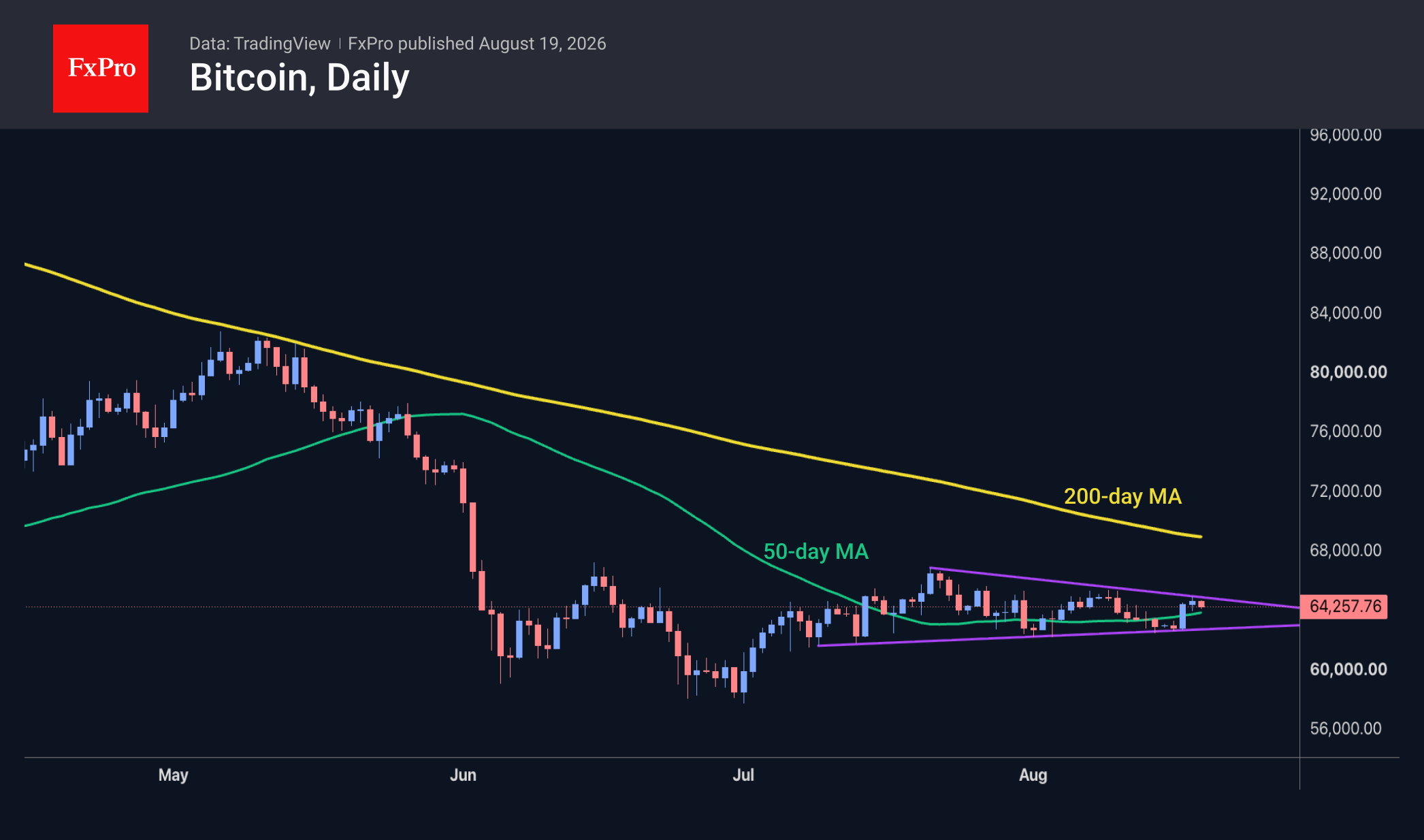
Bitcoin touched the $65K level at the start of US trading on Tuesday, but was subsequently met with cautious yet fairly persistent selling pressure, pushing the price down to $64.3K. A sequence of lower local highs and higher lows suggests that the battle is centred around the $63.7K level. We will only be able to say that BTC has chosen a direction once it breaks out of the $62.7K-$65.3K range. Although the short-term divergence between Bitcoin and equities is nothing new, a sustained decline in equities will drag cryptocurrencies down with it, starting with the flagship asset.
News Background
Bitcoin is showing gains on some days, but continues to underperform the stock market. Over the past three months, BTC has outperformed the S&P 500 index in only 37.8% of trading sessions, a six-year low, according to Glassnode.
Bitcoin funding rates have returned to this year’s highs, reaching a 20-month peak. Sentiment in the derivatives market is positive for the leading cryptocurrency, with the majority of traders opening long positions, according to CryptoQuant.
There are currently 9.57 million bitcoins in private wallets, representing 45.6% of the total supply of the leading cryptocurrency, according to River’s calculations. Of these, 1.62 million BTC (7.7%) are considered irretrievably lost. Centralised crypto exchanges hold 2.91 million BTC (13.9%), while third-party custodial services control 4.66 million BTC (22.2%). Exchange-traded funds (ETFs) hold 1.51 million BTC (7.2%), while public companies hold 1.05 million BTC (5%).
Harvard maintained its investment ($101.4 million) in BlackRock’s Bitcoin ETF at the end of the second quarter. Before this, its holdings in the fund had been reduced for two consecutive quarters.
Bitmine increased its Ethereum purchases by a third last week. The company purchased an additional 9,926 ETH, bringing the total amount of Ethereum in its reserves to nearly 5.82 million coins. To reach its target of acquiring 5% of the Ethereum supply, the company needs to purchase a further 220,000 ETH.
The FxPro Analyst Team
Eurozone CPI Finalized at 2.9% as Energy and Services Keep ECB on Guard
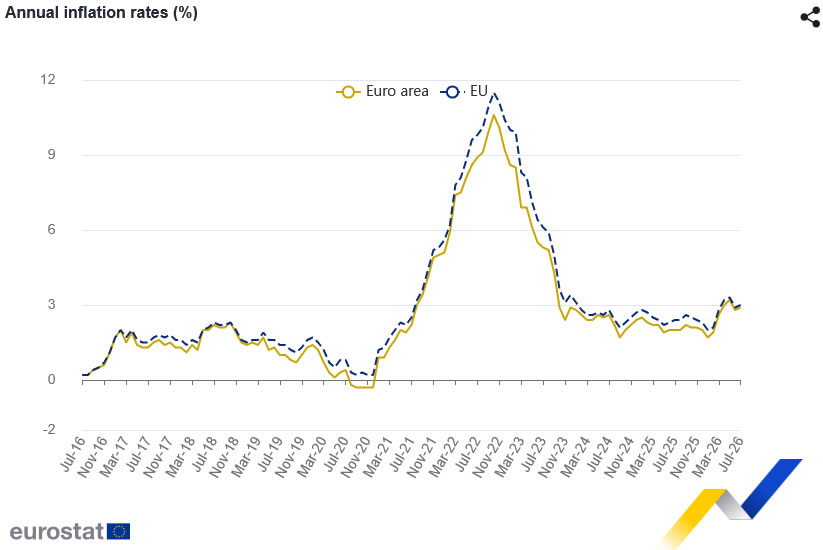
Eurozone inflation edged higher in July, with headline CPI final rising from 2.8% to 2.9% y/y, confirming preliminary estimate and standing well above 2.0% recorded a year earlier. Core inflation also firmed from 2.4% to 2.5%, showing that latest increase was not purely an energy effect. Across EU as a whole, annual inflation rose from 2.9% to 3.0%.
Energy provided strongest fresh upward pressure, with annual inflation accelerating from 8.5% to 10.3% and contributing 0.94 percentage point to headline rate. Services remained largest source of inflation overall, with annual growth edging from 3.2% to 3.3% and contributing 1.55 percentage points. Non-energy industrial goods also strengthened from 0.7% to 0.9%, while food, alcohol and tobacco inflation slowed from 1.5% to 1.2%, providing some offset.
Monthly details reinforced uneven composition. Energy prices rose 2.7% m/m and services increased 1.1%, while non-energy industrial goods fell -2.2% and food, alcohol and tobacco slipped -0.1%. Inflation also remained highly dispersed across EU member states, ranging from 0.3% in Sweden to 8.2% in Romania, highlighting very different national inflation conditions beneath common headline.
For ECB, final July numbers reinforce case for maintaining a restrictive stance. Headline inflation is moving higher, core inflation has edged up, and services remain sticky above 3%, while renewed energy pressure adds another external inflation risk. Softer food prices offer some relief, but broader composition gives policymakers little reason to assume inflation is returning smoothly toward target, keeping further tightening firmly in discussion.
Data Summary
| Indicator | Actual | Expected | Previous |
|---|---|---|---|
| Eurozone CPI y/y | 2.9% | 2.9% | 2.8% |
| Eurozone Core CPI y/y | 2.5% | 2.5% | 2.4% |
| Energy y/y | 10.3% | — | 8.5% |
| Services y/y | 3.3% | — | 3.2% |
| Non-Energy Industrial Goods y/y | 0.9% | — | 0.7% |
| Food, Alcohol & Tobacco y/y | 1.2% | — | 1.5% |
| Unprocessed Food y/y | 2.4% | — | 3.1% |
| EU CPI y/y | 3.0% | — | 2.9% |
| Contribution to Eurozone CPI | July 2026 | June 2026 |
|---|---|---|
| Services | +1.55ppt | +1.51ppt |
| Energy | +0.94ppt | +0.77ppt |
| Non-Energy Industrial Goods | +0.23ppt | +0.18ppt |
| Food, Alcohol & Tobacco | +0.23ppt | +0.29ppt |
Key Takeaways
- Eurozone headline inflation rose from 2.8% to 2.9% y/y in July, confirming flash estimate.
- Core CPI also firmed from 2.4% to 2.5%, meaning headline acceleration was not solely an energy effect.
- Energy inflation accelerated sharply from 8.5% to 10.3%, increasing its contribution to headline inflation from 0.77 to 0.94 percentage point.
- Services inflation edged up from 3.2% to 3.3% and remained largest contributor to inflation at 1.55 percentage points.
- Non-energy industrial goods inflation strengthened from 0.7% to 0.9%, adding to broader firmness.
- Food provided main offset, with food, alcohol and tobacco inflation slowing from 1.5% to 1.2%, while unprocessed food eased from 3.1% to 2.4%.
- Inflation dispersion across EU remained wide, ranging from 0.3% in Sweden to 8.2% in Romania.
- For ECB, mix is uncomfortable: stronger energy is lifting headline CPI, while firmer core and services inflation make it harder to dismiss July increase as temporary commodity noise.
Trump Pauses Canada Tariff Threat — Relief for CAD, but No Trade Reset Yet
TL;DR: Canada has avoided an immediate 50% US tariff for three days while paperwork is finalized, but the Loonie's muted reaction suggests markets see this as deadline relief, not the broader trade normalization needed to justify a bigger CAD rally.
Canada Dodges One Deadline, Not the Trade War
Canada has avoided an immediate 50% US tariff, but only for three days. US President Donald Trump announced Wednesday that planned levy on a wide range of Canadian products would be paused while both sides finalize paperwork on what he called a deal. Tariff had been due to take effect at midnight, so delay clearly reduces near-term risk for Canadian businesses and gives CAD another reason to hold recent gains.
What it does not yet provide is certainty. Ottawa has not confirmed detailed terms, paperwork remains unsigned, and Canadian Prime Minister Mark Carney had only days earlier expressed caution over whether an agreement would be completed in time. Trump’s suggestion that Keystone XL pipeline could return as part of improved relationship adds another potentially important element, but without concrete details it is not yet something markets can price with confidence.
That leaves headline in an awkward middle ground: positive enough to remove an immediate shock, but not complete enough to justify calling broader trade dispute resolved.
Bigger Tariff Architecture Is Still Standing
Most important limitation is scope. Threatened 50% tariff is only one part of much larger trade confrontation that has built between US and Canada since early 2025. Separate measures covering steel and aluminum, autos and softwood lumber remain in place unless final agreement unexpectedly addresses them too.
Canada has consistently pushed for a broader settlement rather than a narrow fix. Latest 50% threat, however, arose from a smaller group of disputes involving vehicle rules, provincial alcohol restrictions and dairy access. That leaves market with a critical unanswered question: is this paperwork a comprehensive trade package, or simply a settlement of most urgent current dispute?
Difference matters enormously for CAD. Removing one tariff threat reduces near-term uncertainty. Removing broad tariff structure would change Canada’s medium-term growth and investment outlook much more substantially.
Until scope is known, calling this a trade reset would run ahead of evidence.
Even a Signed Deal May Not Solve Everything
Provincial alcohol restrictions show why implementation may remain difficult even after federal signatures.
US has objected to limits on sale of American alcohol imposed by Canadian provinces. Yet Ottawa cannot simply order every province to change its liquor policy, and Ontario and British Columbia have already shown resistance to backing down.
So part of dispute sits outside direct control of federal negotiators. Washington and Ottawa could announce agreement while provincial-level friction persists.
That is a useful reminder that trade conflict is not always resolved by one bilateral document. Some underlying disputes may survive even if immediate tariff is withdrawn permanently.
Loonie’s Muted Reaction Is Telling
Canadian Dollar strengthened after Trump’s announcement, but not dramatically. That matters because market reaction helps distinguish relief from genuine regime change.
If investors believed US-Canada relationship had suddenly shifted toward comprehensive normalization, CAD would have had reason to rally much more aggressively. Instead, modest response suggests market is reserving judgment until details are signed and confirmed.
There is another reason not to over-credit tariff pause. Canadian Dollar was already strengthening before announcement. Stronger domestic GDP, a large employment beat and firmer inflation had improved Canadian fundamental backdrop, while higher oil prices provided additional terms-of-trade support.
This creates a useful test for next few sessions. If CAD keeps strengthening even with tariff story quiet and Brent consolidating, domestic fundamentals are carrying move. If gains fade once deadline relief is fully priced, trade announcement itself probably had limited lasting impact.
ActionForex's Technical View on USD/CAD: 1.4002 Keeps USD/CAD Bearish Case Alive
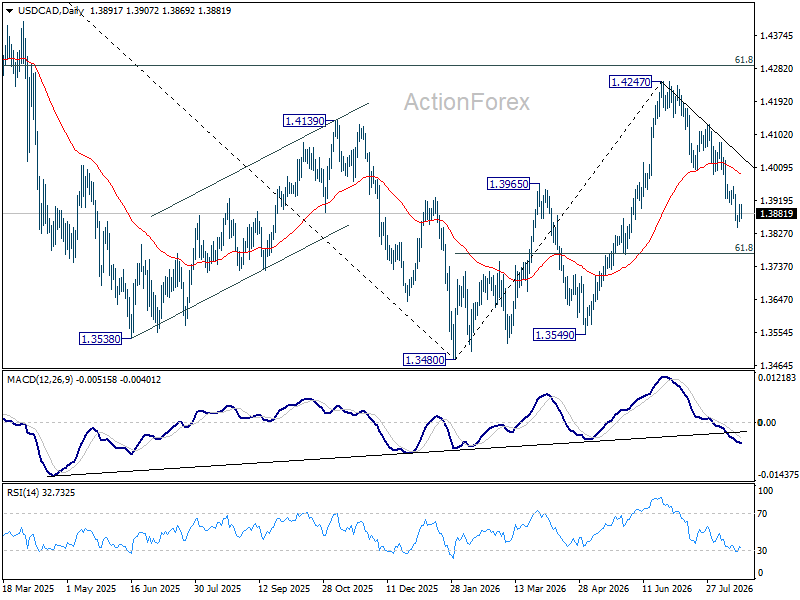
USD/CAD chart still favors further downside despite current recovery from 1.3843, which looks like a temporary low. Some consolidation is natural after recent decline, but recovery should remain corrective while 1.4002 resistance holds.
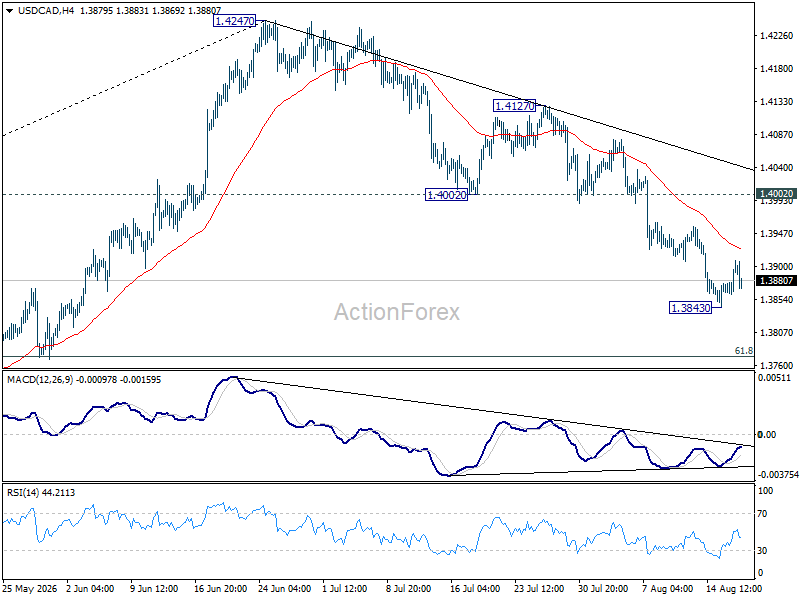
Medium-term structure is more important. Advance from 1.3480 to 1.4247 is currently favored as a completed three-wave correction. If that interpretation is correct, decline from 1.4247 should eventually resume toward 1.3773, the 61.8% retracement of that entire advance.
Break below 1.3843 would provide first confirmation that current consolidation has ended. Decisive break of 1.3773 would then materially strengthen bearish case and shift focus back to 1.3480 January low.
Bullish invalidation is clear as well. Firm break above 1.4002 would argue decline from 1.4247 has already run its course and revive possibility that broader rebound from 1.3480 remains intact.
The Next Three Days Matter More Than the Announcement
Markets now need three answers.
First, does agreement actually get signed before pause expires? Second, does Ottawa confirm same terms and scope Washington is describing? Third, does settlement extend beyond this specific tariff fight into older disputes involving metals, autos and lumber?
If answer to third question is no, latest development should be viewed as another episode of deadline de-escalation rather than genuine normalization of US-Canada trade relationship.
That still matters for Canadian Dollar because one major downside risk has been removed temporarily. But it does not replace stronger Canadian data and oil as broader drivers of recent CAD performance.
Key Takeaways
- Trump's 50% tariff pause is a three-day paperwork delay, not a confirmed deal, with terms still unsigned and unconfirmed by Ottawa.
- Separate tariffs on steel, aluminum, autos, and softwood lumber remain untouched, meaning even a signed deal wouldn't necessarily resolve the broader trade dispute.
- Provincial-level disputes, like alcohol restrictions, sit outside federal control and could persist even after a federal agreement is signed.
- CAD's muted reaction to the announcement, combined with gains that predate it, suggests domestic data (GDP, jobs, inflation) and oil are the bigger drivers, not the tariff pause itself.
- USD/CAD's bearish case stays intact below 1.4002 resistance; a break of 1.3843 and then 1.3773 would open a retest of the 1.3480 low.
Euro and Pound Remain Cautious Ahead of FOMC Minutes
The Euro and British pound are trading cautiously against the US dollar as markets await the release of the minutes from the Federal Reserve’s latest meeting. At its July meeting, the Fed left interest rates unchanged and reiterated that future decisions would depend on incoming economic data.
Investors will pay particular attention to how FOMC members assessed inflation risks, labour-market conditions and the outlook for interest rates. Following softer inflation data and signs of a cooling labour market, a more dovish tone in the minutes could strengthen expectations of monetary easing and weigh on the dollar. Conversely, a continued emphasis on inflation risks and a restrictive policy stance could provide additional support for the US currency.
For sterling, today’s UK inflation figures will provide an additional catalyst. The data will be closely assessed for clues about the Bank of England’s next policy steps. Persistent price pressures could reduce the scope for further monetary easing and support the pound, while a more pronounced slowdown in inflation could reinforce expectations of lower interest rates.
With few major domestic catalysts for the euro, EUR/USD is likely to remain particularly sensitive to movements in the US dollar. As a result, the FOMC minutes could become a key driver of the pair’s next move.
EUR/USD
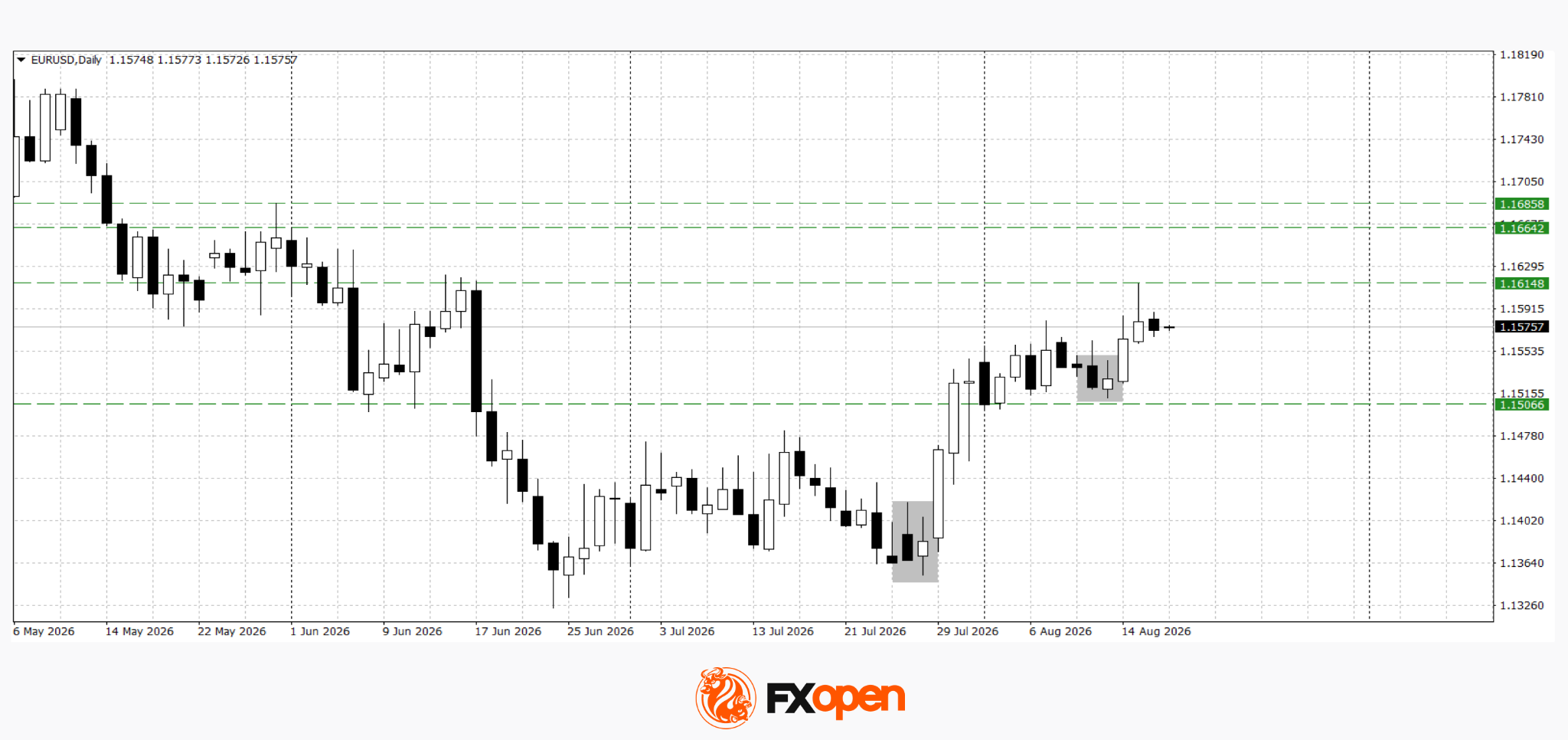
EUR/USD tested the June highs near 1.1600 yesterday. From a technical perspective, the pair could extend its advance towards 1.1660–1.1680 if the previous session’s high is successfully turned into a support level.
Failure to establish a firm foothold above the current levels, however, could trigger a corrective move and bring the pair back towards the 1.1500 support area.
Key events for EUR/USD:
- today at 12:30 (GMT+3): German 10-year Bund auction;
- today at 17:30 (GMT+3): US crude oil inventories;
- today at 21:00 (GMT+3): release of the FOMC minutes.
GBP/USD
GBP/USD buyers have managed to push the pair above the important 1.3500 resistance level over the past few sessions. If the pair can maintain its position above this threshold, the next upside targets could be found around 1.3600–1.3640.
A decisive move back below 1.3500, on the other hand, could signal the start of a bearish correction towards the 1.3430–1.3470 area.
Key events for GBP/USD:
- today at 09:00 (GMT+3): UK Consumer Price Index (CPI);
- today at 11:30 (GMT+3): UK house price index;
- tomorrow at 15:30 (GMT+3): US Philadelphia Fed Manufacturing Index.
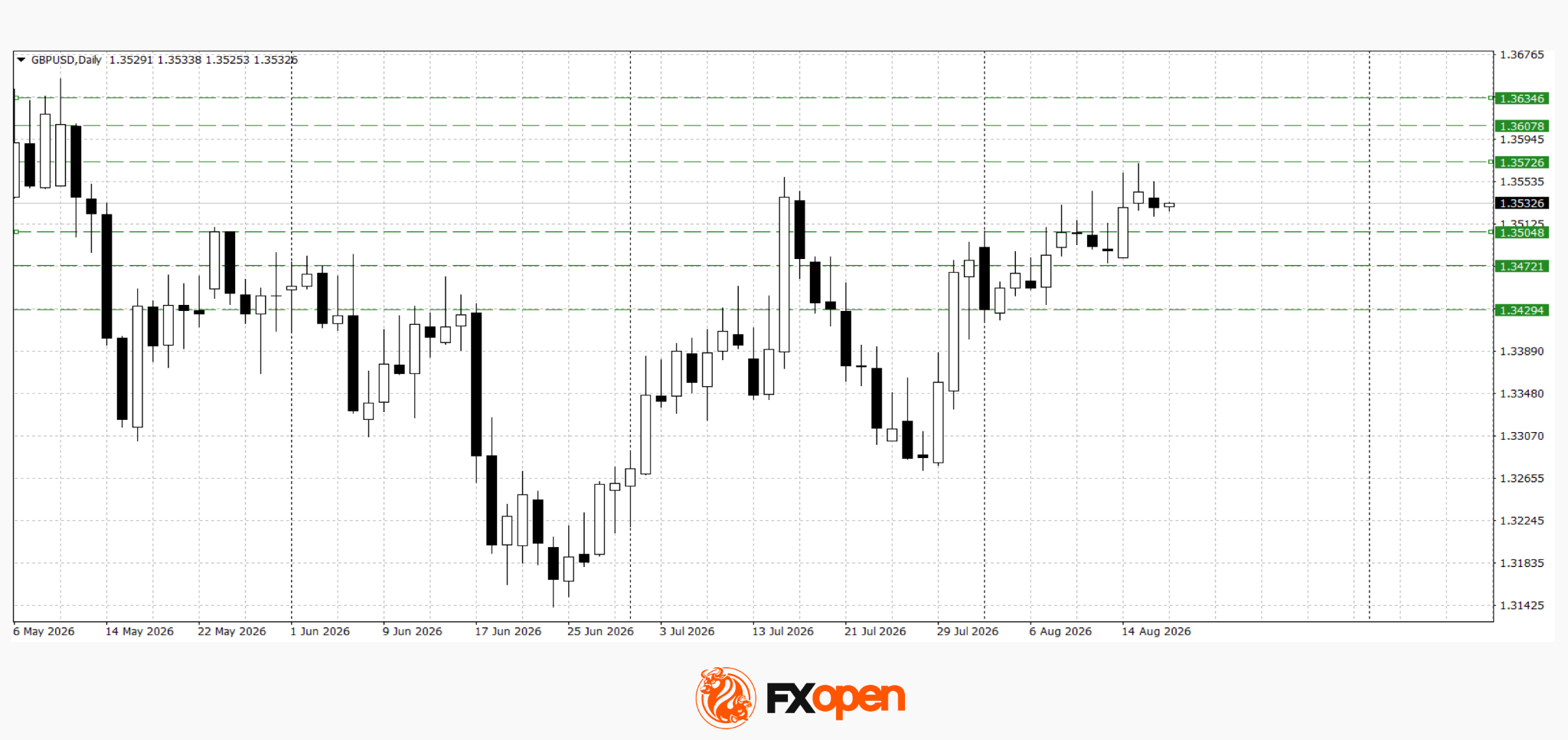
EUR/USD and GBP/USD are both holding close to important technical levels, leaving the next directional move dependent on fresh fundamental signals. UK inflation will be the first major catalyst for sterling, while the FOMC minutes represent the main event for both currency pairs.
A more dovish message from the Federal Reserve could put renewed pressure on the dollar and support further gains in the euro and pound. Conversely, a persistently hawkish stance could strengthen the US currency and trigger corrective declines in both EUR/USD and GBP/USD.
Trade over 50 forex markets 24 hours a day with FXOpen. Take advantage of low commissions, deep liquidity, and spreads from 0.0 pips (additional fees may apply). Open your FXOpen account now or learn more about trading forex with FXOpen.
This article represents the opinion of the Companies operating under the FXOpen brand only. It is not to be construed as an offer, solicitation, or recommendation with respect to products and services provided by the Companies operating under the FXOpen brand, nor is it to be considered financial advice.
Sunrise Market Commentary
Markets
Bear steepening turned into bear flattening in Europe yesterday. Daily changes on the German yield curve ranged between +2.4 bps (30-yr) and +5 bps (2-yr). EU swap rates added 0.9 bps (30-yr) to 4.5 bps (2-yr). The US/Iran stalemate and higher energy prices offer a first explanation. Both parties don't seem to be on speaking terms with their Memorandum of Understanding, signed in June and including a truce extension to reach a lasting peace deal within 60 days, expiring on Monday. Brent crude climbed above $91/b with the reference European gas contract (Dutch TTF) hitting €64/MWh for the first time since March 19. First public ECB comments since July 31st added to the intraday underperformance at the front end of the curve. Chief economist Lane warned that EMU inflation will hover around 3% probably for the rest of this year. Further upward pressure is expected in 2027 coming from food inflation. The European economy is doing okay-ish with Lane stressing a clear priority to curb price pressures and avoid them staying too high for too long. For EMU money markets, it was a validation of their clear conviction that the central bank will raise its policy rate a second time this year at the next, September 10, policy meeting. As long as energy prices don't spiral out of control, they stick to a gradual tightening path with the market implied probability of a third move come December currently reaching 70%. It is fully discounted by the March 2027 meeting. ECB President Lagarde today participates in a panel discussion titled "Global Economic Outlook" at the WEF's International Business Council. Together with Minutes of the July FOMC meeting, it serves as one of today's economic highlights. Her comments will likely be in line with the ones from Lane yesterday. FOMC Minutes could be a hawkish read as more Fed governors than the three official dissenters probably backed a rate hike. However, market momentum to fully embrace them going into the September 17 meeting dwindled last week following weak payrolls and tame inflation data.
Yesterday's front end interest rate support failed to trigger a second test of the EUR/USD 1.16 resistance area. Higher oil prices and weaker risk sentiment offered some balance. European stock markets corrected up to 1% with key US indices closing up to 1.33% (Nasdaq) lower. From a technical point of view, there's room for a more pronounced move lower. The Iran narrative and rising real rates at the (very) long end of the curve offer short term headwinds for overall risk sentiment with indices near all-time highs. UK July CPI figures printed nearly completely in line with consensus this morning (0.3% M/M & 2.9% Y/Y; core 2.6% Y/Y; services 3.4% Y/Y) and fail to inspire UK markets.
News & Views
The Canadian dollar strengthened vs its US counterpart to USD/CAD 1.388 this morning after the Trump administration delayed a 50% tariff that was set to go into effect mere hours later. The US president proclaimed that both countries have reached a deal, "subject to the finalization of documents". The tariff threat is still there but the deadline was moved by three days to allow for further negotiations. Trump announced the 50% levy in late July in a response to Canadian retaliatory measures against the flurry of tariffs the US had introduced last year. Particularly provincial bans on US alcohol sales and counter-tariffs against US-made cars and trucks triggered US frustration.
The Australian central bank's No. 2 warned that inflation (3.8% in Q2) is still too high. Deputy governor Hauser said that while policymakers last week concluded that the policy rate level (4.35%) is fine where it is for now, worries about the outlook remain. Should upside inflation risks crystallise, rates will have to be raised again, Hauser said. Some of the upward price pressures stem from the conflict in the Middle East but some also have domestic roots in the form of capacity pressures. Hauser also noted that house prices have come down in recent months but that even after these recent declines, they remain about 50% higher than before the pandemic. RBA assistant governor Kent last week suggested that these softer housing market conditions take away some of the need for monetary policy to constrain the economy. Australian money markets currently do not price in any further hikes in the foreseeable future. The market implied probability for an end-of-year hike stands at 60%.
Inflation Prints and FOMC Minutes Take Centre Stage
In focus today
In the US, the minutes from the FOMC's July meeting are released this evening. Markets are looking for a more detailed sense of the committee's thinking beyond Kevin Warsh's limited forward guidance. Three participants voted in favour of a hike, and since then, several others have flagged willingness to support a hike if warranted by incoming data.
In the euro area, final July HICP inflation is due and is expected to confirm the flash estimate at 2.9% y/y for headline inflation and 2.5% y/y for core inflation. Wage developments will also be in focus with the release of Eurostat's Q2 Labour Cost Index (LCI), the first read on wage growth for the quarter. While a useful early indicator, the LCI measures labour costs per hour worked, whereas the ECB tends to focus on compensation per employee as its preferred wage-growth gauge.
In the UK, July CPI is released. The UK has been on a disinflationary trend since the fall, although both headline and core inflation remain above target at 2.6%. The PMI survey suggests price pressures have eased further in July, but new energy price caps are set to pull headline inflation higher to 2.9% y/y.
In China, the 1-year and 5-year Loan Prime Rates (LPRs) are due overnight. We expect both to remain unchanged, as they have been since May last year. While the People's Bank of China has signalled room for easing, it typically lowers the reverse repo rate before adjusting the LPRs, and the reverse repo rate has not changed recently. Still, we expect moderate monetary easing soon after the Politburo signalled more policy support in July.
Economic and market news
What happened overnight
In the US, President Trump announced a three-day pause in planned 50% tariffs on around USD20bn of goods from Canada, which were otherwise set to take effect at midnight. Trump said the two sides had reached a deal, subject to final documentation, and raised the possibility of reviving Keystone XL, a proposed oil project. Canada has not confirmed the full terms, while Prime Minister Mark Carney said important work remains.
In commodities, Brent crude briefly topped USD92/bbl overnight as fresh geopolitical headlines added to uncertainty. UAE missile alerts were followed by Abu Dhabi saying two missiles launched from Iran had targeted maritime traffic, prompting it to suspend trade and financial transactions with Tehran. UK maritime authorities also reported a vessel strike while leaving Hormuz, and a separate cargo ship was hit off Yemen. The incidents point to widening disruption across key shipping routes, with Hormuz traffic still limited despite Trump's claims that the strait is open.
What happened yesterday
In the UK, the July/June labour market report was on the weak side. July payrolls declined by 13K and revisions pointed to heavier job losses in June as well. The unemployment rate was unchanged at 4.9%, slightly above consensus at 4.8%. Wage pressures eased, but somewhat less than expected, with private sector (3M rolling average) wage growth declining to 2.8% in June from 2.9% in May, while average earnings excl. bonuses came in at 3.5%, slightly above consensus. Overall, the report supports our call for the BoE to remain on hold for the foreseeable future.
In Germany, the ZEW economic sentiment surprised to the upside in August, with expectations rising to 34.2 (cons.: 30.0, prior: 26.3), while the assessment of the current situation improved to -61.1 (cons.: -69.3, prior: -77.6). The current situation is now almost back at the levels seen before the war in Iran, although expectations remain somewhat lower. The data follows a string of upside growth surprises in the euro area. Growth is also increasingly supported by fiscal stimulus.
In the US, import prices came in below expectations in July, falling 0.4% m/m (cons.: +0.1%, prior: -0.3%) and marking the largest monthly decline since May 2025. The decline was driven by lower fuel prices, as falling petroleum prices more than offset higher natural gas prices, while nonfuel prices increased.
Also in the US, industrial production and manufacturing output both rose 0.2% m/m in July, only slightly below June's 0.3% increase. Manufacturing excl. motor vehicles and parts rose 0.4%, while mining output increased 0.2% and utilities output rose 0.5%.
Equities: Equities were markedly lower on Tuesday, with the S&P 500 and Stoxx 600 both down 0.7%. Investors have so far digested higher yields largely through a classic value-versus-growth rotation. European banks have outperformed real estate by 7pp since long-end yields began rising meaningfully about a month ago. Yesterday, however, the rotation shifted towards a more traditional defensive preference. Investors bought sectors such as consumer staples and health care, funded by cyclicals, such as tech, industrials and materials, all of which were down 2-3%. Futures are continuing lower this morning. This kind of defensive rotation is what we expect to see more of going forward, as outlined in last week's Equity and Cross-Asset Strategy report. Higher yields revive the risk of a rollover in leading indicators, which are already more prone to rollovers, simply as they sit on elevated levels. Such a rollover would normally be accompanied by defensive outperformance.
FI and FX: It was an ugly cocktail for European assets yesterday with equities moving lower, European yields rising as the curve bear-flattened and commodities tracking higher. While risk sentiment remains sour in Asia, US yields have steadied in overnight trading and the 10Y UST yield has dropped from an intraday high of 4.75% yesterday to 4.69%. In our Yield Outlook released yesterday, we conclude that markets expect too many ECB hikes and see room for European rates to move lower. EUR/USD is trading sideways around 1.1580. EUR/NOK continues to drift lower, supported by oil prices as Brent crude closes in on USD92/bbl amid the deadlock in the US-Iran negotiations. Today's focus is on the release of UK inflation data for July, and later this evening we get the Fed minutes from the July meeting. The ECB's Lagarde is also scheduled to speak. In Sweden, focus is on tomorrow's Riksbank decision and the SNDO's 10Y SGB auction, which we see as an attractive buying opportunity in the SGB1067 (Oct-36).
UK CPI Rises to 2.9%, but Services Inflation Moves Lower
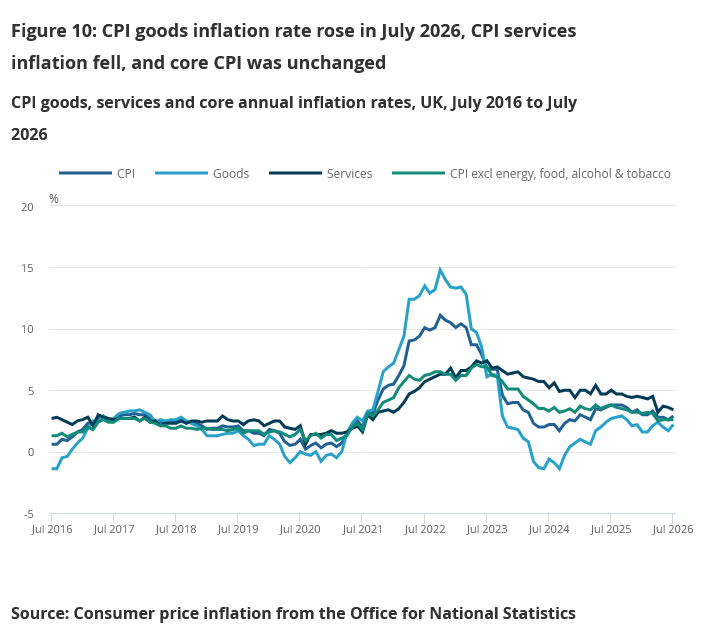
UK inflation accelerated in July, with CPI rising from 2.6% to 2.9% y/y, matching consensus. Prices increased 0.3% m/m, compared with 0.1% in July 2025. Core CPI held at 2.6% y/y, slightly above expectations for 2.5%, but composition was less inflationary than headline suggested: services inflation eased from 3.6% y/y to 3.4%, while goods inflation accelerated from 1.7% y/y to 2.2%.
Housing and household services drove much of increase, with annual inflation jumping from 1.2% y/y to 4.6% and prices rising 2.3% m/m on month. Health inflation also accelerated from 2.5% y/y to 3.7%, while clothing and footwear moved from -0.5% y/y to 0.5% and alcohol and tobacco from 2.1% y/y to 2.5%. Those increases were partly offset by softer food inflation, which eased from 1.7% y/ to 1.3%, and transport inflation, which slowed sharply from 5.7% y/y to 3.6%.
Overall, July was a firmer inflation report at headline level without showing a broad-based reacceleration in underlying pressure. Services inflation, one of more persistent parts of UK price picture, continued to cool, while acceleration was concentrated more heavily in goods and housing-related categories. That leaves headline inflation moving higher even as some of stickier components show further moderation.
Data Summary
| Indicator | Actual | Expected | Previous |
|---|---|---|---|
| CPI y/y | 2.9% | 2.9% | 2.6% |
| CPI m/m | 0.3% | 0.3% | 0.1%* |
| Core CPI y/y | 2.6% | 2.5% | 2.6% |
| CPI Goods y/y | 2.2% | — | 1.7% |
| CPI Services y/y | 3.4% | — | 3.6% |
| Housing & Household Services y/y | 4.6% | — | 1.2% |
| Health y/y | 3.7% | — | 2.5% |
| Food & Non-Alcoholic Beverages y/y | 1.3% | — | 1.7% |
| Transport y/y | 3.6% | — | 5.7% |
| Restaurants & Hotels y/y | 4.0% | — | 4.4% |
*Monthly comparison in supplied ONS release is against July 2025.
Key Takeaways
- UK headline CPI accelerated from 2.6% to 2.9% y/y in July, exactly matching consensus.
- Core CPI held at 2.6%, slightly above expectations for a decline to 2.5%.
- Inflation composition was mixed rather than uniformly hotter. Goods inflation accelerated from 1.7% to 2.2%, while services inflation eased from 3.6% to 3.4%.
- Housing and household services provided a major upward contribution, with annual inflation jumping from 1.2% to 4.6%.
- Health inflation also strengthened from 2.5% to 3.7%, while clothing and footwear returned to positive annual inflation.
- Several categories cooled, including food inflation from 1.7% to 1.3%, transport from 5.7% to 3.6%, and restaurants and hotels from 4.4% to 4.0%.
- Overall, July delivered firmer headline inflation without a broad resurgence in persistent services pressure, leaving underlying picture more balanced than 2.9% headline alone suggests.
Silver (XAGUSD) Elliott Wave Perspective: Higher Extension to Finalize Impulse
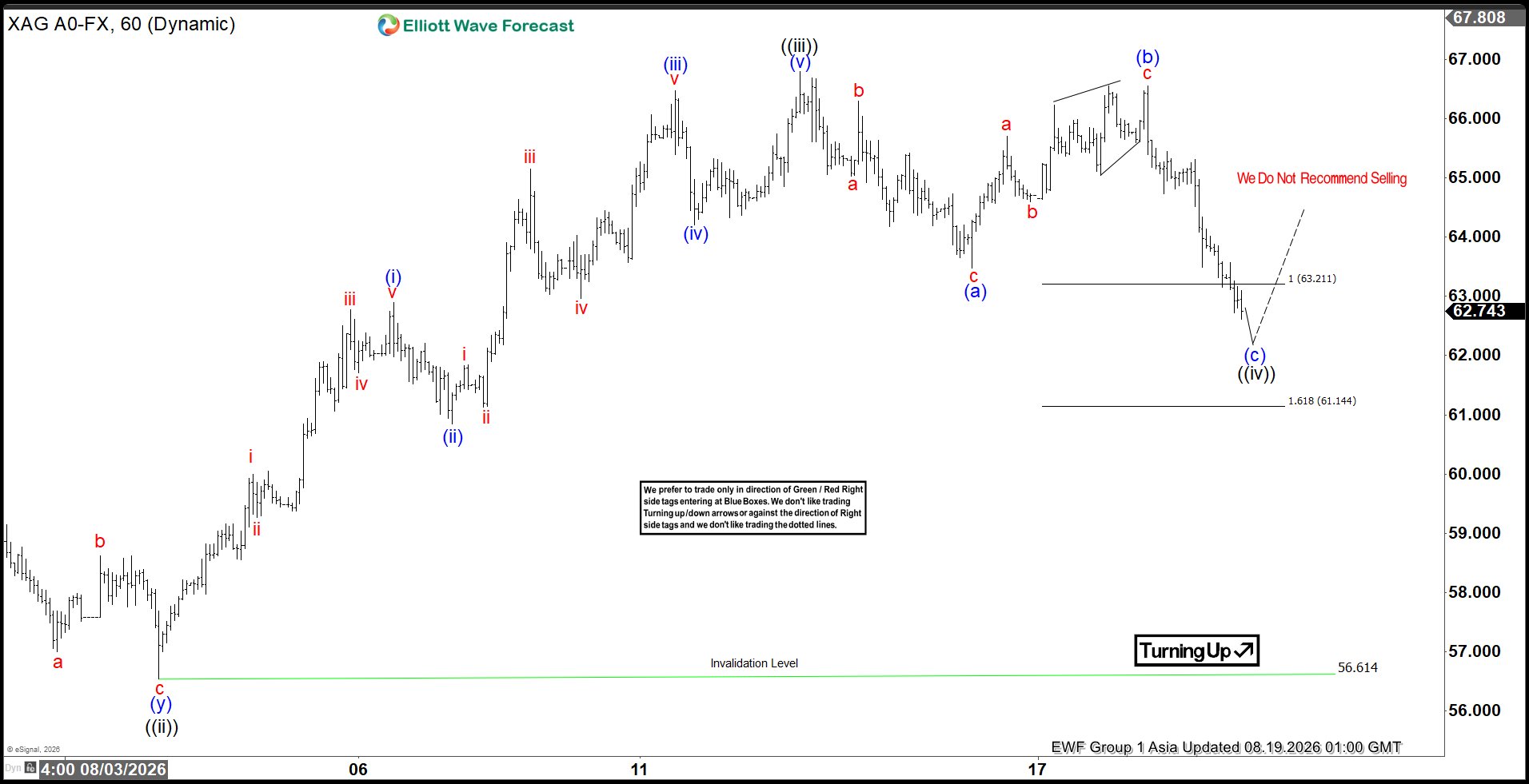
The short‑term Elliott Wave view in Silver (XAGUSD) indicates that the metal is unfolding an impulsive structure from the July 17 low. From that level, wave ((i)) advanced to $60.93 before a corrective pullback in wave ((ii)) reached $56.54. Following this retracement, the market resumed higher in wave ((iii)), which developed as another impulse of lesser degree. Within this sequence, wave (i) ended at $62.9, while the subsequent dip in wave (ii) found support at $60.85. The rally in wave (iii) extended to $66.47, and the pullback in wave (iv) settled at $64.2. The final leg, wave (v), concluded at $66.8, thereby completing wave ((iii)) at a higher degree.
At present, the market is correcting in wave ((iv)), which is unfolding as a flat Elliott Wave structure. Down from the wave ((iii)) peak, wave (a) ended at $63.47, followed by a rally in wave (b) that reached $66.55. The decline in wave (c) is expected to terminate within the $61.1–$63.2 area. This zone should provide support for another leg higher or at least a three‑wave rally. In the near term, as long as the pivot at $56.6 low remains intact, the pullback is anticipated to complete in either three or seven swings. The overall structure suggests that Silver retains bullish potential once the correction in wave ((iv)) is finished.
Silver (XAGUSD) 60 Minute Elliott Wave Chart
XAGUSD Elliott Wave Video
https://www.youtube.com/watch?v=QKNZFTN-qPg
RBA’s Hawkish Warning Gets Clearer: Disinflation Stalls, Rates Rise Again
RBA Deputy Governor Andrew Hauser sharpened central bank’s tightening warning on Wednesday, saying another rate increase would follow if inflation stops improving. Speaking at an event in Queensland, Hauser said: “If those upside risks to inflation crystallise and we don't see inflation coming down, we will have to raise interest rates again and we will do so.” The message reinforces RBA’s August decision to retain explicit tightening optionality even after holding cash rate at 4.35%, following 75bps of increases since February.
Hauser identified three upside risks in particular: Middle East conflict, global AI boom and weak productivity growth. Middle East risk has become increasingly relevant as oil prices climb again, potentially feeding energy and transport costs into inflation. AI investment presents a different challenge by supporting demand and competing for resources, while poor productivity limits economy’s ability to grow without generating additional price pressure. Taken together, these risks leave RBA unwilling to assume recent disinflation will continue automatically.
At the same time, Hauser acknowledged that tighter monetary policy is already slowing economy. RBA has seen “a bit of a slowdown in consumption and employment growth,” although he added that policymakers “need to see more still.” He rejected a more severe characterization of current conditions: “That is not a slump. It is not a depression... but it's a lot slower than Australia has known in the past and it's a lot slower than recently.” Recent softer inflation readings and weaker housing conditions therefore matter, but RBA does not yet appear convinced demand has cooled enough to neutralise upside risks.
Markets are reflecting that uncertainty, pricing around a 60% chance of another increase to 4.60% by December as renewed oil strength brings imported inflation risks back into focus. Hauser’s remarks do not make another hike inevitable, but they clarify RBA’s reaction function: continued disinflation allows policy to stay on hold; stalled inflation combined with materialisation of oil, AI or productivity risks would bring tightening back. That leaves upcoming inflation and labor-market data as the evidence needed to decide which side of that conditional warning becomes relevant.
Key Takeaways
- RBA Deputy Governor Andrew Hauser made tightening bias more explicit, saying rates “will have to” rise again if upside inflation risks materialise and disinflation stalls.
- Hauser identified Middle East conflict, global AI boom and weak productivity as three key upside risks to inflation.
- He acknowledged consumption and employment growth have slowed, but said RBA “needs to see more still,” indicating current cooling is not yet sufficient to remove inflation concern.
- Hauser rejected a recessionary interpretation, saying economy is “not a slump” or depression, but is growing much more slowly than Australia has been used to.
- Markets are pricing roughly 60% probability of another hike to 4.60% by December, reflecting renewed concern that oil and other inflation risks could keep RBA tightening option alive.
- Core message is conditional but hawkish: continued disinflation supports a hold; stalled disinflation alongside stronger upside risks would bring another hike back into play.