

Sample Category Title
Bitcoin Attempted to Push the Market Off Its Low
Market Overview
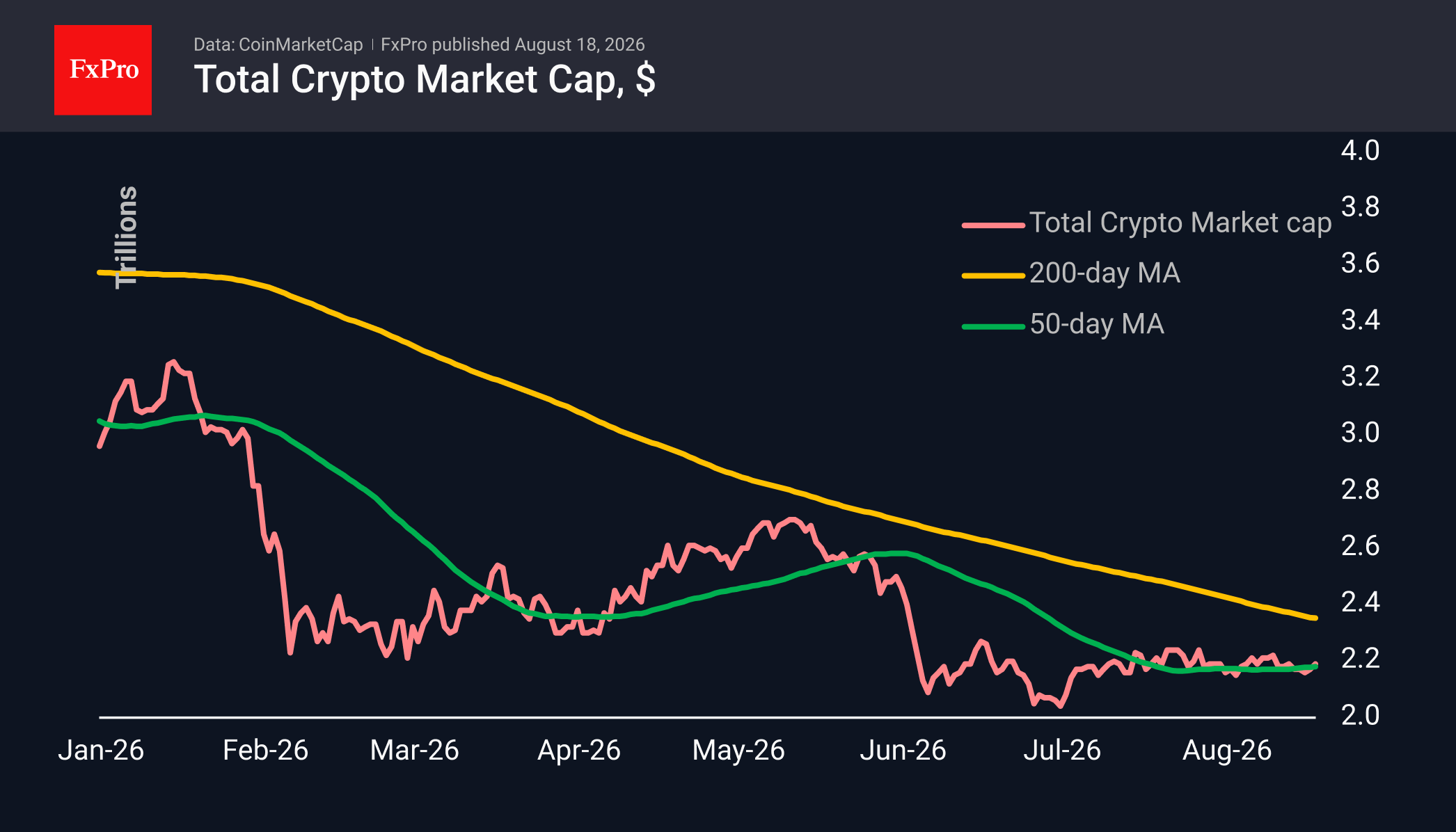
The crypto market capitalisation has risen by 1.6% over the past 24 hours to $2.19T, continuing to consolidate within a fairly narrow range, having pulled back from the lower boundary of the channel it has been trading within for the past month and a half. Among the most actively traded coins, the top gainers were Tezos (+3.6%), Aave (+2.9%) and Bitcoin (+1.3%). The decline was more widespread and sharp, but concentrated among smaller coins such as Immutable (-6.4%), Filecoin (-5.7%) and Cosmos (-4.8%).
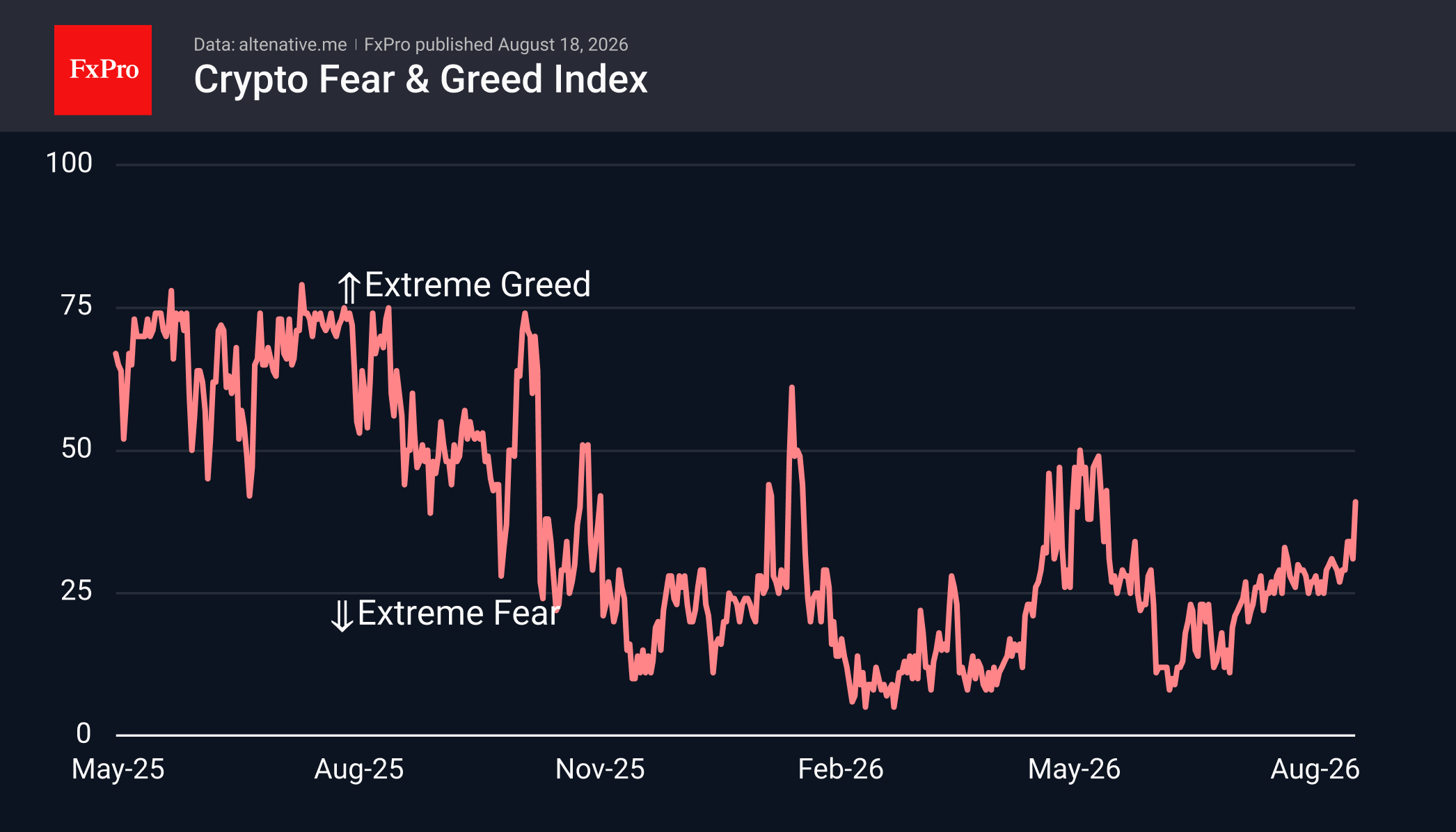
The sentiment index rose to 41. This is still in the ‘fear’ zone, but the indicator has not reached this level since mid-May. This upward trend prompts us once again to remind readers that only a sustained move above 50 can be regarded as a shift in the market cycle; for now, early optimists could easily fall into a trap.
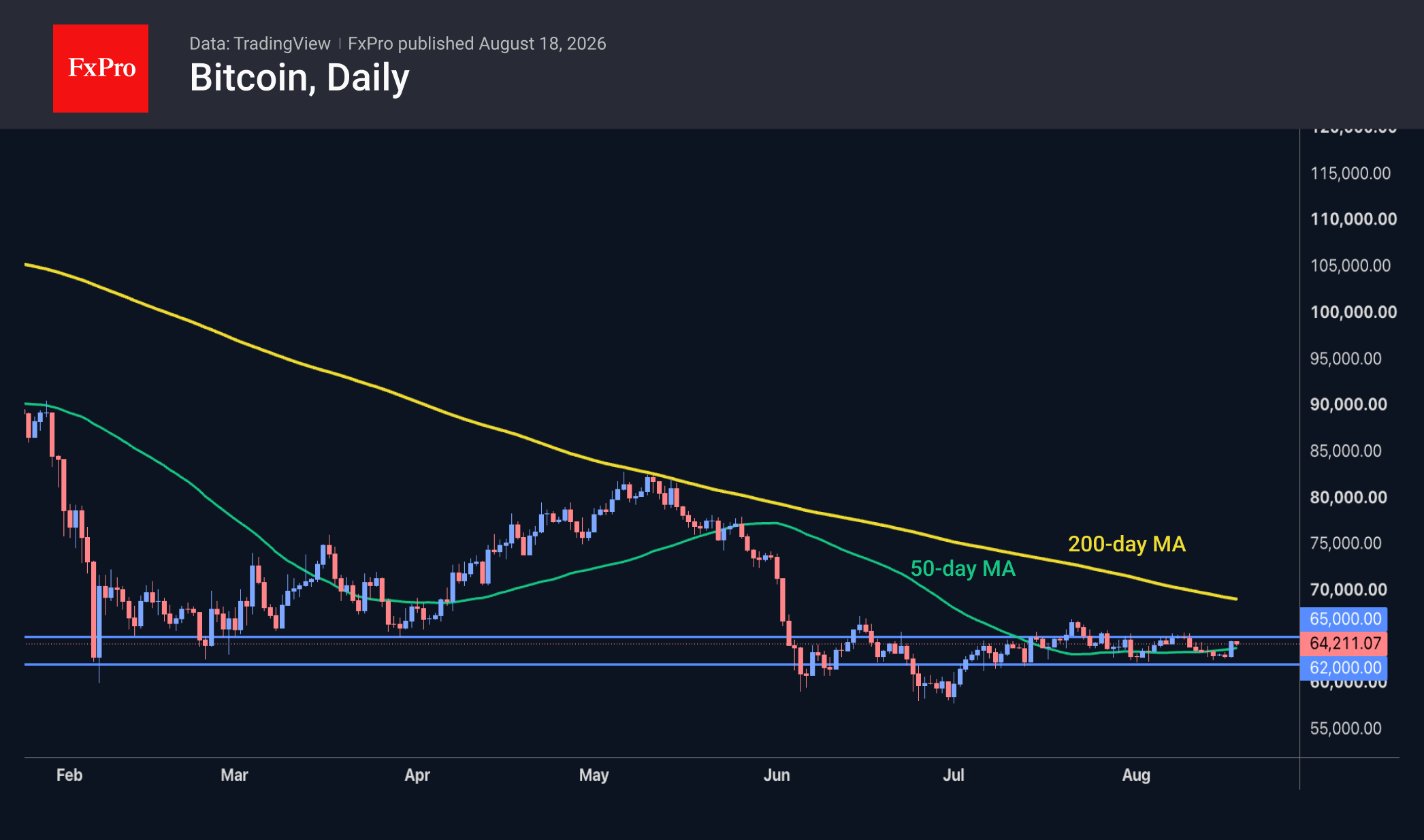
On Monday, Bitcoin rose above $64.5K, recouping the losses of the past seven days as Strategy ceased selling the asset. However, as it approaches its recent highs, the leading cryptocurrency is once again facing increased selling pressure. BTCUSD remains extremely balanced, fuelling expectations that a breakout from this consolidation phase will trigger a sustained, strong trend in the breakout direction. In theory, there is a greater chance of a bull market recovery after nearly a year of decline. Still, history suggests we should remain open to the possibility of a final sell-off, which could prove very painful for the bulls.
News Background
Strategy has neither bought nor sold bitcoins following two weeks of BTC sales. Last week, the company continued to repurchase STRC preference shares and replenish its US dollar reserve by selling MSTR ordinary shares. The dollar reserve for dividend payments was increased to $4.8 billion; the Bitcoin reserve remained at 840,447 BTC, with an average purchase price of $75.4K per coin.
Swiss bank UBS increased its exposure to call options on Bitcoin ETFs 24-fold in the second quarter. Its direct position in IBIT rose by 12% over the quarter, while its exposure to put options fell by 53%.
Cardano developers have published a roadmap for the Dijkstra update, which is expected to speed up transaction processing on the blockchain. The hard fork will be rolled out in two phases. The first phase is scheduled to be completed by the end of the year; the second phase is planned for the second quarter of 2027.
SafePal, a manufacturer of hardware crypto wallets, has reported a data breach affecting around 40,000 users, including names, delivery addresses, telephone numbers, email addresses and details of customer orders. The incident did not affect seed phrases, private keys, passwords, bank details, card numbers or document numbers, as SafePal does not collect or store such information.
The US Department of the Treasury has presented draft regulations to implement the GENIUS Act, the first federal law on payment stablecoins. The document sets out requirements for issuers, reserves and the supervision of the issuance of dollar-pegged ‘stablecoins’.
According to Bloomberg, US President Donald Trump is set to attend a meeting at the White House on 19 August with the heads of crypto companies and prediction market platforms. The heads of the main US market regulators are also expected to attend the meeting.
The FxPro Analyst Team
Oil Shock Is Working Twice for CAD/JPY — Can It Reach 120?
TL;DR: Brent's break above $90 is doing double duty for CAD/JPY — strengthening Canada's terms of trade while pushing global bond yields higher and deepening Yen funding pressure — and this time Canada's own data are contributing too, unlike June's Yen-only rally.
CAD/JPY Has Found a Rare Double Tailwind
Brent’s break above $90 is doing more than lifting Canadian Dollar. It is also pushing global inflation expectations and bond yields higher, adding pressure to Yen. For CAD/JPY, that creates an unusually clean setup: same US-Iran shock strengthens one side of cross while weakening other.
June 17 ceasefire framework formally expired on August 17 without renewal, leaving no clear diplomatic settlement in sight. Higher oil improves Canada’s terms of trade and supports petro-currency, while renewed energy and freight inflation keeps global yields elevated. For Yen, still one of market’s principal funding currencies, wider yield differentials reinforce carry pressure. Instead of two separate narratives, CAD strength and JPY weakness are being driven by same underlying shock.
This Time Canada Is Contributing Too
That is important because CAD/JPY has rallied on Yen weakness before. Late-June advance eventually stalled because Canadian Dollar itself offered limited independent support. Current move starts from a stronger domestic backdrop.
May GDP rose 0.3% m/m, beating 0.2% forecast and expanding across 13 of 20 sectors. July labor data then surprised decisively, with employment jumping 75K against 15K expected and unemployment dropping to a two-year low of 6.4%. July CPI followed with headline inflation accelerating from 2.8% to 3.0% y/y, above 2.9% consensus, while Trimmed and Median CPI firmed to 1.9% and 2.0% respectively.
Gasoline was a substantial part of headline inflation surge, rising 25.7% y/y, and part of that effect is linked to tax treatment that rolls off in September. That argues against treating CPI as proof that BoC has already returned to a tightening path. But combined with stronger growth and employment, data have at least reopened hike discussion after it had largely disappeared. For CAD, that is enough to distinguish current rally from June’s mostly Yen-driven move.
Oil Shock Is Also Hurting Yen Through Bonds
Global bond market supplies second leg. US 30-year yield has climbed to around 5.31%, highest in 19 years, while 10-year is near 4.74%. Germany’s 10-year Bund has reached about 3.22%, highest since 2011, and Canada’s 10-year recently touched 3.75%, a 26-month high.
Current rise in yields carries a stagflationary flavor rather than a straightforward growth signal. Hormuz disruptions and higher energy and freight costs are lifting inflation concerns and encouraging investors to price restrictive rates for longer. That is exactly environment in which Yen’s yield disadvantage becomes harder to ignore.
BoJ normalization may eventually narrow that gap, but global yields are moving higher in meantime. Until Japanese rates catch up more substantially, higher overseas yields continue to reinforce Yen-funded carry trades. Brent above $90 therefore creates a double effect for CAD/JPY: stronger Canadian terms of trade and greater funding pressure on Yen.
Brent Consolidation Will Tell Us Whether CAD Strength Is Real
Best test of this rally may come when oil stops rising.
If Brent consolidates around $90–91 and CAD/JPY continues holding or extending gains, that would be strong evidence that Canadian Dollar’s domestic improvement is doing meaningful work. GDP, employment and CPI would then be providing enough support for CAD to carry rally even without another daily oil breakout.
If CAD/JPY instead stalls immediately whenever crude stops climbing, move would look more like June again: predominantly Yen weakness with limited independent CAD follow-through.
That gives current trade a falsifiable fundamental test. A durable move toward 120 should increasingly survive without requiring Brent to make new highs every session.
Japan Can Still Interrupt the Trade
Main risk does not currently come from Canada. It comes from Japan.
USD/JPY is moving back toward 160 intervention-sensitive zone, reviving possibility of verbal or direct action from Japanese authorities. September 18 BoJ meeting also approaches with substantial probability of another rate increase already priced.
Either development could hit CAD/JPY even if oil remains high. Actual intervention would likely trigger broad Yen buying across crosses, while a BoJ hike would challenge carry mechanism more fundamentally.
That makes 120 a plausible target, but not a low-volatility one. Stronger oil and global yields are pushing Yen in exactly direction that increases likelihood of Japanese response.
ActionForex's Technical View on CAD/JPY: Break of 117.50 Would Put 120.86 on Map
Technical structure supports bullish case. CAD/JPY has decisively reclaimed 55-day EMA around 114.52, adding to argument that correction from 117.50 ended at 110.82 in a three-wave structure. That low held around 111.28, 38.2% retracement of larger rise from 101.24 to 117.50, preserving medium-term uptrend.
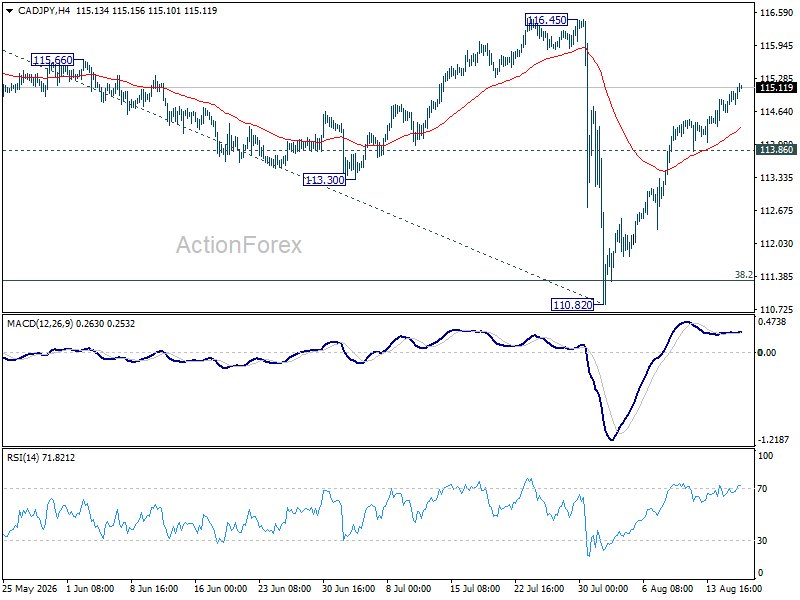
Near-term bias stays higher while 113.86 holds. 116.45 is first resistance and a firm break would strengthen case that rebound has enough momentum to retest 117.50. Decisive break of 117.50 would be more important, signaling likely resumption of broader uptrend and opening 120 psychological level, followed by 120.86, 61.8% projection of 101.24 to 117.50 from 110.82.
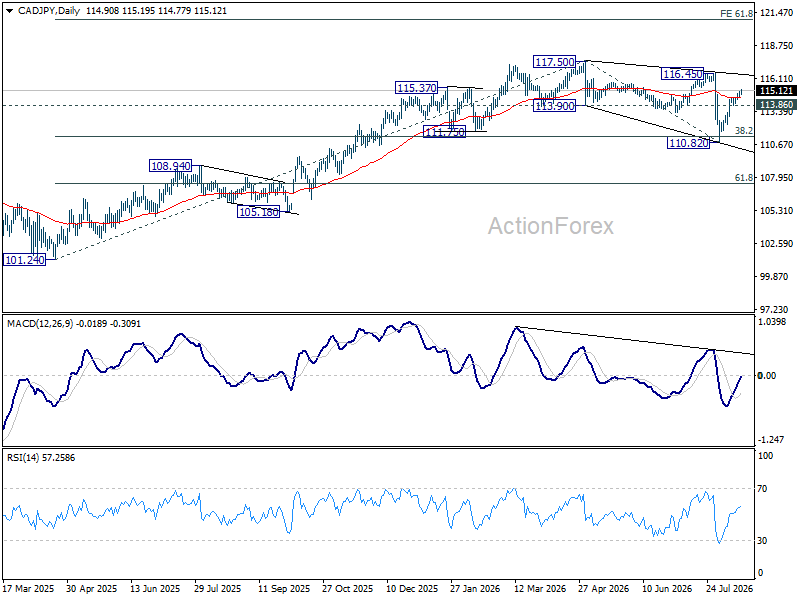
Break below 113.86 would postpone that bullish scenario and suggest correction from 117.50 is extending. But while oil stays elevated, Canadian data remain firm and global yields keep Yen under pressure, CAD/JPY has a stronger foundation than during June’s failed advance. This time, both sides of cross are helping.
Key Takeaways
- Brent's break above $90 is strengthening CAD/JPY from both sides: improving Canada's terms of trade while pushing global yields higher and pressuring the Yen's carry-funding role.
- Unlike June's Yen-only rally, Canada's own data are now contributing, with a 75K jobs beat, firmer May GDP, and CPI reopening the BoC hike discussion.
- Global bond yields are rising with a stagflationary character, with the US 30-year at a 19-year high and German and Canadian yields at multi-year highs.
- Brent stabilizing around $90-91 is a falsifiable test: continued CAD/JPY strength without new oil highs would confirm the domestic Canadian story is real.
- 117.50 is the key resistance for a run toward 120 and then 120.86, but USD/JPY nearing the 159.6-160.6 intervention zone and the September 18 BoJ meeting remain the main risks to that path.
Germany ZEW Sentiment Strengthens to 34.2 as Current Conditions Improve
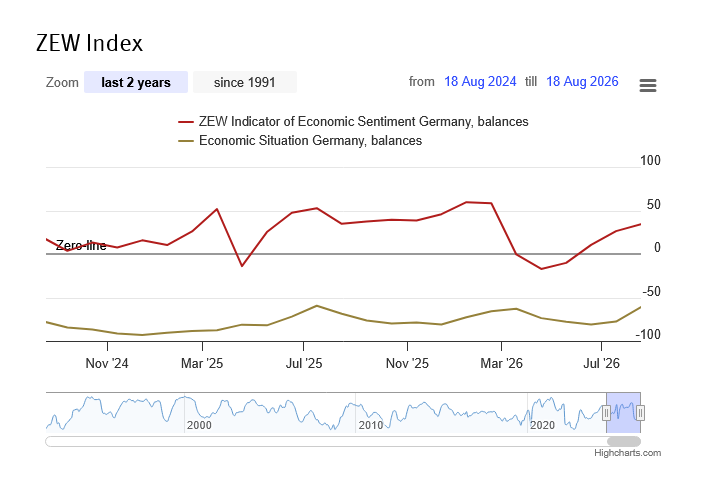
German investor sentiment improved further in August, with ZEW Economic Sentiment rising from 26.3 to 34.2, above 30.1 consensus. Current Situation Index also strengthened sharply from -77.6 to -61.1, much better than -68.8 expected. ZEW attributed improvement to solid quarterly corporate results, strong recent exports and support from federal infrastructure programs, although current-condition reading remains deeply negative.
The improvement was broad across sectors. Vehicle-industry expectations jumped by 22.2 points, though balance stayed below zero, while chemical and pharmaceutical, mechanical engineering and metals industries also recorded strong gains. Private-consumption expectations improved by 9.0 points to -6.2, while construction expectations edged up to +2.1. ZEW nevertheless flagged record-low Rhine water levels as an acute risk to activity.
Eurozone sentiment followed same direction. Economic Sentiment rose from 23.4 to 31.4, beating 25.0 forecast, while Current Situation assessment improved by 16.2 points to -21.5. Overall, August survey points to a more convincing improvement in expectations across Germany and wider Eurozone, though still-weak current-condition readings show recovery in confidence is running ahead of the underlying economy.
Data Summary
| Component | Current | Previous | Trend |
|---|---|---|---|
| Germany ZEW Economic Sentiment | 34.2 | 26.3 | Improved strongly |
| Germany ZEW Current Situation | -61.1 | -77.6 | Less negative |
| Eurozone ZEW Economic Sentiment | 31.4 | 23.4 | Improved strongly |
| Eurozone ZEW Current Situation | -21.5 | -37.7 | Less negative |
| Germany Private Consumption Expectations | -6.2 | -15.2 | Improved |
| Germany Construction Expectations | 2.1 | 0.7 | Improved |
Key Takeaways
- Germany ZEW Economic Sentiment rose from 26.3 to 34.2, comfortably above 30.1 consensus.
- Current Situation Index improved sharply from -77.6 to -61.1, also beating -68.8 expected.
- Improvement was broad across industries, led by a 22.2-point rise in vehicle-sector expectations.
- Private-consumption expectations strengthened from -15.2 to -6.2, while construction expectations improved from 0.7 to 2.1.
- ZEW linked stronger outlook to solid corporate results, recent export strength and federal infrastructure programs.
- Record-low Rhine water levels were highlighted as an acute downside risk to activity.
- Eurozone sentiment also strengthened, with Economic Sentiment rising from 23.4 to 31.4, above 25.0 consensus.
- Eurozone Current Situation improved from -37.7 to -21.5, though it remained in negative territory.
- Overall, August survey shows confidence improving faster than actual conditions, with expectations increasingly positive while current assessments remain weak.
AUD/CAD: Two Hawkish Central Banks, One Triangle Left to Break
The Aussie enters this week with genuine hawkish backing. RBA Assistant Governor Christopher Kent reaffirmed that tighter policy is working as intended, with markets now pricing roughly a 70% chance of one final hike to 4.60% by early next year, even as inflation eased below forecasts last quarter. That combination of commodity strength, gold, iron ore and LNG all running above forecast, and a still-hawkish central bank has kept AUD broadly supported near multi-week highs, with all eyes now on Thursday's July employment report.
The loonie tells an even stronger story. Canada's economy expanded at a blistering 3.4% annualised pace in Q2, well above the Bank of Canada's own 2.5% forecast, while July employment surged by 75,100 jobs against expectations of just 15,000, pulling unemployment down to a two-year low of 6.4%. That combination of surprising growth and labour market strength has fuelled speculation the BoC could hike if elevated energy prices persist, giving CAD real independent momentum of its own.
The result: two resource-linked currencies both riding genuinely hawkish narratives, leaving AUD/CAD's next move to hinge on which central bank blinks first.
Technical Analysis of AUD/CAD
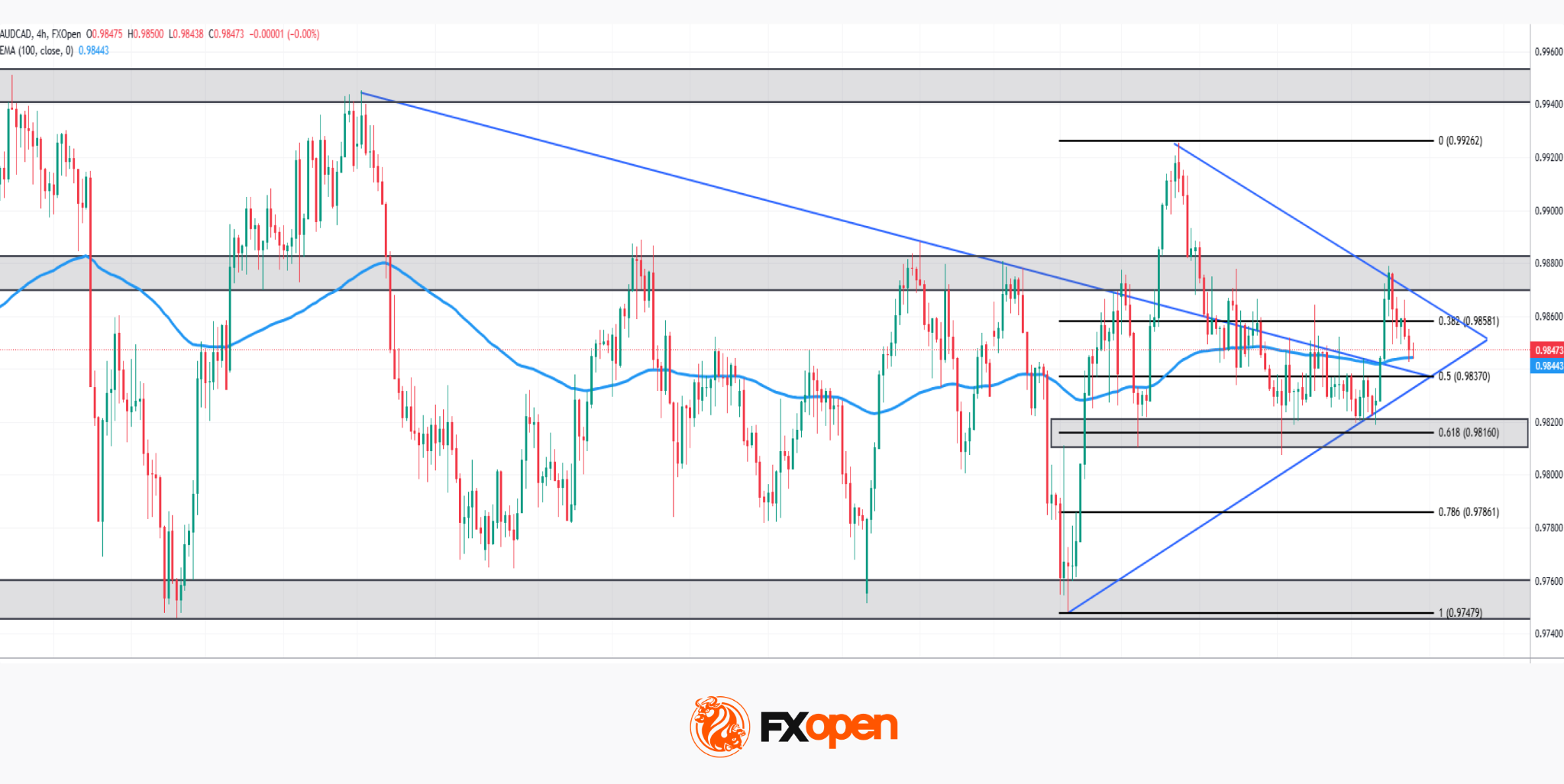
As the chart shows, AUD/CAD has been compressing into a symmetrical triangle since early August, with a descending trendline from the 0.9926 high converging with an ascending trendline off the 0.9748 low, both meeting right around current price near 0.9847, exactly where the 100-period EMA also sits.
Bullish Scenario
Should buyers break above the descending trendline and the 0.382 retracement near 0.9858, the path would open towards the 0 level at 0.9926, a confirmed breakout that would suggest genuine momentum returning to the pair.
Bearish Scenario
Conversely, a break below the ascending trendline and the 0.5 retracement near 0.9837 would expose the 0.618 level near 0.9816, with a deeper slide risking a retest of the 0.786 retracement around 0.9786, or even the 0.9748 low that anchored this entire structure.With price coiled right at the apex of this triangle, sitting exactly on the 100-period EMA, AUD/CAD looks primed for a decisive break, will the Aussie's hawkish backing prove enough, or does the loonie's stronger data ultimately win out?
Trade over 50 forex markets 24 hours a day with FXOpen. Take advantage of low commissions, deep liquidity, and spreads from 0.0 pips (additional fees may apply). Open your FXOpen account now or learn more about trading forex with FXOpen.
This article represents the opinion of the Companies operating under the FXOpen brand only. It is not to be construed as an offer, solicitation, or recommendation with respect to products and services provided by the Companies operating under the FXOpen brand, nor is it to be considered financial advice.
Gold Pulls Back Amid Middle East Tensions and Fed Rate Uncertainty
- Gold retreats after being rejected near $4,435 again.
- Middle East tensions and Trump’s threats cap gains.
- But softer US data keeps September hike odds low.
- Wednesday’s Fed minutes could help gold break above $4,435.
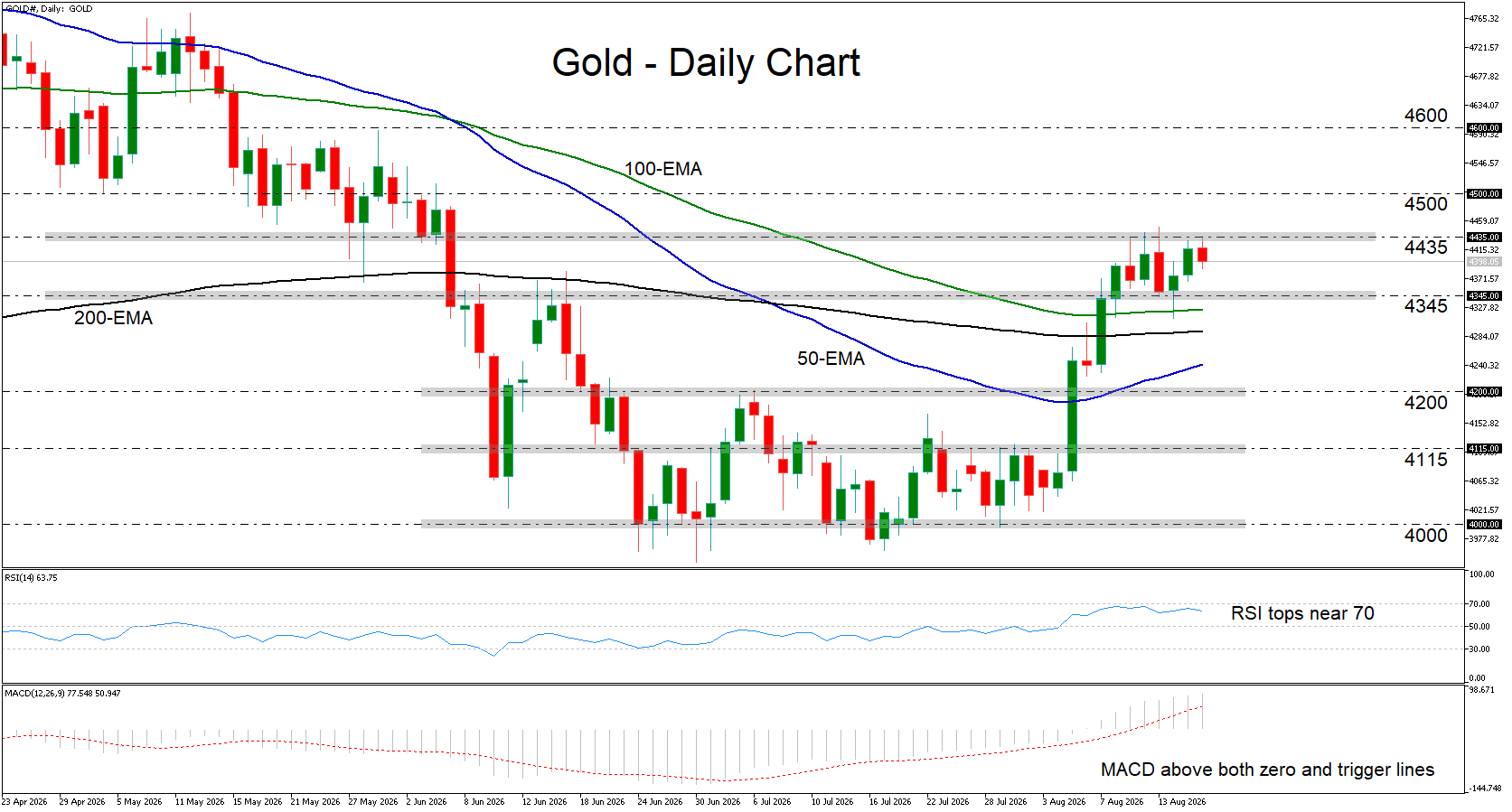
Gold extended its gains on Monday, but it is pulling back today after failing once again to emerge above the temporary ceiling of $4,435. Tensions between the US and Iran over the Strait of Hormuz remain elevated, but US President Trump escalated his rhetoric to another level on Monday, when he threatened to strike Oman if the nation “gets in the way” and distorts negotiations with Iran on a deal to reopen the strait.
WTI crude oil closed above $85 per barrel for the first time since July 31, but according to Fed funds futures, it failed to significantly revive concerns about inflation. Following the disappointing NFP report for July, the soft inflation data for the same month, and the weak retail sales, investors are now assigning a 35% chance of a September rate hike, while they are penciling in only 40bps of rate increases by the end of 2027.
Maybe that’s why the slide in gold was modest. The precious metal experienced a strong recovery from near the key $4,000 zone amid the weakness in the US dollar and the flattening of the Fed’s implied rate path, but it is now struggling to overcome the $4,435 area.
Should the bulls manage to take charge from above the $4,345 zone this week, they could overcome that hurdle and aim for the $4,500 barrier. If they breach through that territory as well, then the next stop may be at $4,600, defined as resistance by the high of May 29.
What could add fuel to such a rally could be less hawkish-than-expected Fed minutes. If the minutes suggest that policymakers were in no rush to raise rates even before the latest bunch of soft US data, then the probability of a September hike could decline further, thereby reducing the opportunity cost for holding the precious metal.
On the other hand, a significant escalation in the Middle East that puts the September hike well back on the table, could push gold below $4,345, a move that could encourage the bears to dive all the way down to the $4,200 zone, marked by the inside swing high of July 6.
The Picture in Gold Has Become More Complicated: What Is Happening Today
Gold dipped below 4,400 USD per ounce on Tuesday, reversing earlier gains. Pressure on the metal intensified amid a broader correction in the metals market and profit-taking following a strong rally.
An additional negative factor was the rise in oil prices, which once again heightened inflation risks and concerns over interest rates.
The geopolitical backdrop also remains tense. Prospects for a new US-Iran agreement deteriorated after Donald Trump announced that he was not interested in extending the interim peace deal.
At the same time, gold continues to draw support from diminished expectations of Federal Reserve tightening, following a series of weak US economic data. Markets are now primarily pricing in a rate hold in September, with a hike by year-end no longer fully priced in-a marked shift from just a week ago.
Additional support for the metal is coming from investment demand and central bank purchases, particularly from China.
Technical Analysis
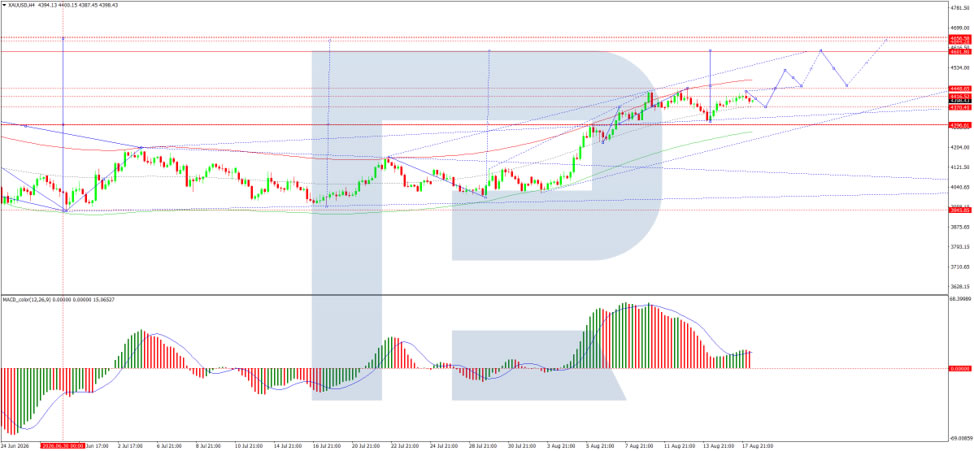
On the H4 XAU/USD chart, the market formed a consolidation range around the 4,370 USD level and, with an upside breakout, completed a growth wave to 4,435 USD. A consolidation range is now forming below this level. A downside move and decline to 4,370 USD is expected, with a possible extension to 4,340 USD. Further growth to 4,516 USD is anticipated as a local target. The MACD indicator confirms the beginning of short-term downside momentum, with its signal line above the centre line and bracing for further lows.
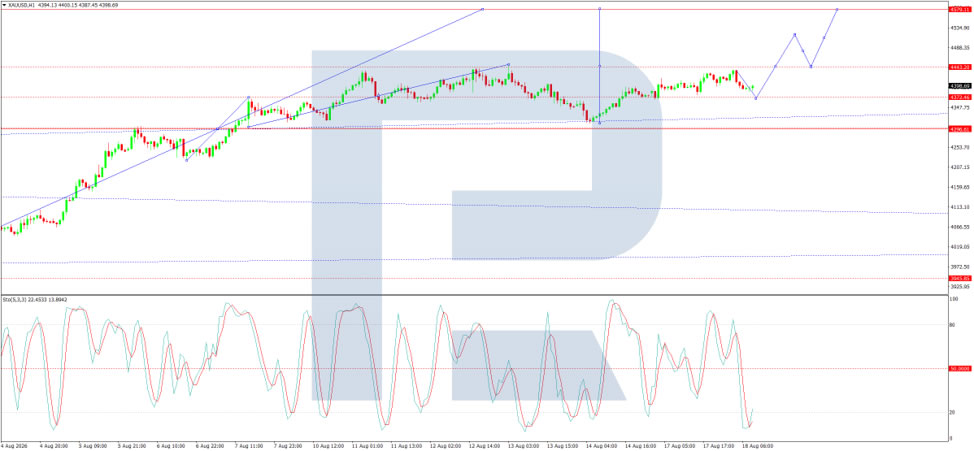
On the H1 chart, the market broke above the 4,372 USD level and completed a growth wave structure to 4,434 USD, followed by a correction to test 4,372 USD from above. A broad consolidation range is practically forming around 4,372 USD. A range expansion up to 4,516 USD is expected, followed by a decline to 4,444 USD. The Stochastic oscillator confirms this scenario, with its signal line remaining below the 20 level and pointing strictly upwards to 80.
Conclusion
Gold's outlook has become more complex as the metal retreats from recent highs amid profit-taking and a broader metals market correction. Rising oil prices have rekindled inflation concerns, while geopolitical tensions have worsened following Trump's rejection of an extended US-Iran peace deal. However, support remains from diminished Fed tightening expectations after weak US data, with markets no longer fully pricing a hike by year-end. Central bank buying, particularly from China, continues to underpin demand. Technically, gold may see further short-term downside towards 4,340–4,370 USD before potentially resuming its uptrend towards 4,516 USD. The metal's direction will hinge on US economic data, geopolitical developments, and signals from the Federal Reserve.
Sunrise Market Commentary
Markets
The very long end of global yield curves continues to catch most attention. The US yield curve bear steepened yesterday in absence of any particular economic or monetary input. Daily changes on the curve ranged between +0.6 bps (2-yr) and +4.7 bps (30-yr). The US 30-yr yield yesterday topped 5.3% for the first time since the eve of the financial crisis in 2007. The German and UK curves moved in parallel fashion, but intraday changes were slightly less outspoken. The UK 30-yr yield closed at its second highest level since 1998 with the German equivalent at the most elevated point since 2011. The same goes for the 30-yr EU swap rate. The Japanese 30-yr yield is inches away from the 4.2% top which is the highest in its 27-yr history. Yesterday, both real yields and inflation expectations inspired the latest leap higher. The normalization of term premia in the face of deteriorating public finances and the absence of central bank bond buying started becoming a theme again as governments start readying draft budgets for next year. The massive amount of corporate bond supply to fund the AI boom might also have its effect. Inflation premia mimic energy prices. Brent crude cleared the $91/b hurdle for the first time in over a month as US President Trump says that he is in no hurry to reach a deal with Iran. The problem being that Iran holds that view for longer already, having withstood two spans of military attacks and economic blockades. Iran-backed Houthi rebels are also escalating attacks along the Red Sea coast including the Strait of Bab al-Mandeb. Rising (real) rates triggered some caution on equity markets yesterday with key benchmarks correcting up to 0.5% lower both in the US and in Europe. The dollar failed to profit from these settings (higher oil price, weaker risk sentiment) with higher yields obviously being an expression of higher US risk premia. EUR/USD even went for the 1.16 resistance area, but the first attempt to break the barrier failed. EUR/USD closed at 1.1580 from a start at 1.1564.
Yesterday's market themes will remain in play today given the second-tier eco calendar. US (June!) housing and production data and German ZEW investor sentiment won't move the market needle. ECB Chief Economist Lane joins a panel discussion "Monetary Policy in a Geopolitically Fragmented World" which could provide some interesting headlines. A September ECB rate hike is already discounted though. This morning's UK labour market report was mixed with slightly slower than expected employment growth, but somewhat stronger wage growth. Sterling is unbothered at EUR/GBP 0.8555.
News & Views
Data from the US Treasury Department yesterday showed that foreign holdings of Treasuries fell in June. The total amount slipped from $9371 bn to $9299 bn. Foreign holdings were up 2.3% compared to a year earlier though. The monthly decline was led by Japan, the UK and China. While remaining the biggest non-US Treasury owner, Japanese holdings eased 2.3% from May to $1116 bn. The peak stood at $1325 bn in November 2021. The UK comes in second. Its holdings fell 1% to $940 bn. China takes the third place, even as its Treasury assets fell by 13% over the past year. In a monthly perspective, holdings dropped a solid 4% to $633bn, the lowest since September 2008.
Brazil's finance minister Durigan in a Bloomberg interview said investors are raising legitimate questions about government finances, in particular the unsustainable trajectory that it needs to address. Durigan has been trying to soothe market concerns in a series of meetings and interviews since taking over the job from his predecessor Haddad in March. Things have been escalating over the course of last week, when polls showed that president Lula da Silva is consolidating his front-runner position over his main competitor Bolsonaro. The prospect of a victory by the leftist Lula is fueling fiscal uncertainty and has kept inflation expectations above the 3% central bank target for the foreseeable horizon. Brazilian assets have paid the price with amongst others the real having depreciated from USD/BRL 5.08 to 5.20 yesterday. The country's main stock index slid around 3.5% over the same period. The Brazilian yield curve has added between 8 and 20 bps in bear steepening fashion over the past week.
German ZEW and UK Labour Market in Focus
In focus today
- In Germany, the ZEW indicator for August is released. The assessment of the current situation is expected to increase by consensus due to the ongoing resilience of the economy amid the energy shock and as the fiscal easing is increasingly supporting growth.
- In the UK, the latest labour market report is released today. The labour market is expected to remain on a cooling trend with modest decline in jobs and easing wage pressures, suggesting limited second-round effects on inflation. Wage growth is expected to come down from an elevated level of average weekly earnings above 4%, while unemployment is expected to stay below 5%. Hence, this alone does not warrant a change in policy stance from the Bank of England (BoE). Markets price one rate hike from BoE by year-end, while we expect the Bank Rate to remain unchanged.
- In the US, July industrial and manufacturing production data is due, with both expected to show slightly stronger growth than in June. Housing data is also due.
Economic and market news
What happened overnight
In commodities, Brent crude rose above USD91/bbl as geopolitical tensions in the Middle East intensified. The original 60-day MoU signed by the US and Iran in June expired without an extension or a final resolution, while Reuters cited a senior official in Iran saying Tehran would shift to a "fully offensive" stance if diplomacy with the US fails. Progress towards normalising tanker traffic through the Strait of Hormuz has stalled, and Trump's threat of military action against Oman added to tensions. Meanwhile, the Houthis claimed an attack on vessels near Bab el-Mandeb.
What happened yesterday
In the US, both the NY Fed Empire Manufacturing Index and the NAHB Housing Market Index came in higher than expected in August. The Empire index rose to 20.6 from 15.6 in July, above consensus expectations of 11, while the NAHB index edged up to 35 from 34, slightly above expectations of 33.
In Sweden, Origo inflation expectations edged higher in August, mainly at the 1-year horizon, rising to 1.97% from 1.83%. At the 2-year horizon, expectations increased to 2.07% from 2.02%.
In China, the July data batch pointed to another weak month. Retail sales slowed to 0.6% y/y (cons.: 1.5%, prior: 1.0%), while industrial production fell to 4.5% y/y (cons.: 5.0%, prior: 5.3%). The housing market remained weak, with new home prices down 0.18% m/m and property investment continuing to contract sharply, by close to 20% y/y year-to-date, although home sales showed tentative signs of stabilisation. The figures underline continued weak domestic demand, with exports and high-tech still driving growth. They also highlight the need for more policy support, although Politburo signals in late July suggest further stimulus rather than a big policy lift.
Equities: Equities were lower on Monday, for a second session in a row, as energy and yields continued higher. S&P 500 edged down -0.5% and Stoxx 600 -0.2%. The move lower in equities did not give "risk off", however. In fact, tech was in green yesterday, and particularly semiconductors, while software sold off -2% after a strong run. AI buildout names like Applied Materials, Micron and LAM all rose 4-5% yesterday while Meta and Microsoft shed 3-4%. The preference between cyclicality vs defensiveness was less clear though. Health care continues to do well and particularly biotech, which is interesting given how fast risk-free rates have been rising, which would normally limit risky biotech funding. Instead, consumer staples kept underperforming, down almost -2% yesterday, due to higher rates spilling over negatively to the bond-proxy sector, coupled with higher energy prices raising costs while also restraining household purchasing power. US futures are negative this morning.
FI and FX: EUR/USD briefly broke 1.16 yesterday before reversing and, in overnight trading, moving back below 1.1580. Oil prices are rising, with Brent crude above USD91/bbl, as the original 60-day MoU between the US and Iran ended yesterday without any extension or final resolution in sight. Global yields are trading higher in a bearish steepening move, and 30-year US Treasury yields hit the highest level since 2007, underscoring concerns about US debt. NOK is benefiting from higher energy prices and reduced Fed rate-hike expectations, and we maintain a neutral-to-positive near-term view on the NOK. EUR/SEK continues to hover around the 11.00 mark.
UK Payroll Employment Falls as Unemployment Holds at 4.9%
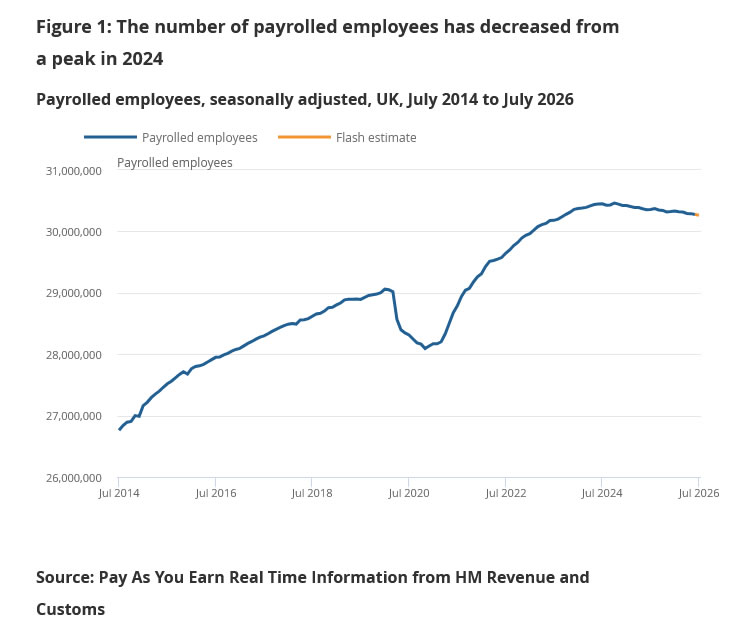
UK labor market continued to soften in July, with early payroll estimates showing employee numbers falling by -13,000 from June and by -94,000 from a year earlier. June’s monthly decline was also revised from -4,000 to -13,000, reinforcing gradual downtrend from 2024 peak.
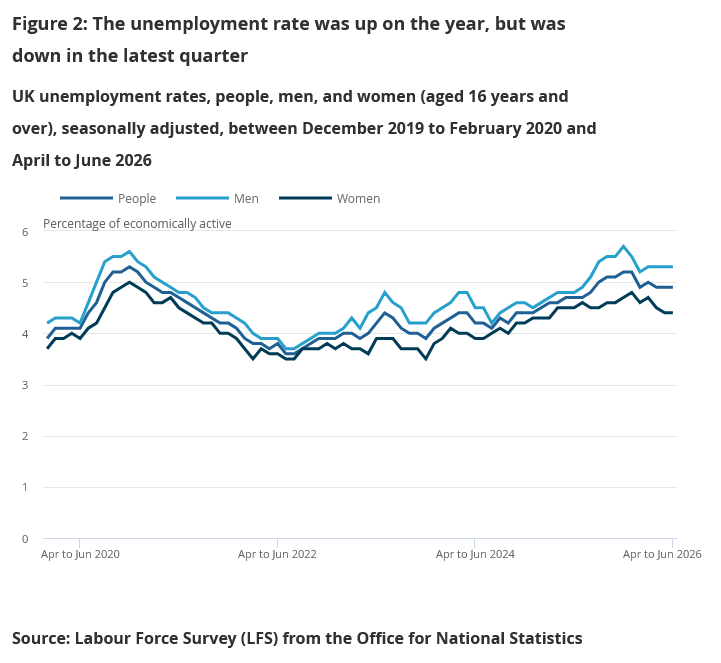
ILO unemployment rate held at 4.9% in three months to June, slightly above 4.8% expected, although claimant count moved in opposite direction with an -11,000 decline versus expectations for a 16,500 increase.
Wage data were mixed. Regular earnings growth edged up from 3.4% to 3.5% y/y in April-June, above 3.4% consensus Total earnings growth slowed from 4.3% to 4.1%, matching expectations.
More timely payroll-based median pay growth also eased from 4.5% to 4.2% y/y in July, suggesting underlying wage momentum is gradually cooling despite firmness in regular pay.
Overall, employment conditions are weakening more clearly than wages. Payrolls continue to drift lower and unemployment remains elevated, but pay growth is proving slower to soften.
Data Summary
| Indicator | Actual | Expected | Previous |
|---|---|---|---|
| Payrolled Employees m/m, Jul | -13K | — | -13K* |
| Payrolled Employees y/y, Jul | -94K | — | — |
| Payrolled Employees y/y, Jul | -0.3% | — | — |
| Payrolled Employees Level, Jul | 30.3M | — | — |
| ILO Unemployment Rate, 3M to Jun | 4.9% | 4.8% | 4.9% |
| Claimant Count Change, Jul | -11.0K | +16.5K | +6.7K |
| Average Earnings ex Bonus, 3M y/y Jun | 3.5% | 3.4% | 3.4% |
| Average Earnings incl Bonus, 3M y/y Jun | 4.1% | 4.1% | 4.3% |
| Median Monthly Pay y/y, Jul | 4.2% | — | 4.5% |
*June payroll decline was revised from -4K to -13K.
Key Takeaways
- UK payrolled employment fell another 13K in July, while June was revised to show the same decline, reinforcing gradual weakening from 2024 peak.
- Payrolls were 94K lower than a year earlier, equivalent to a 0.3% annual decline.
- ILO unemployment rate held at 4.9%, slightly above 4.8% consensus.
- Claimant count provided main positive surprise, falling 11K instead of expected 16.5K increase.
- Wage signals were mixed. Regular earnings growth firmed from 3.4% to 3.5%, while total earnings slowed from 4.3% to 4.1%.
- More timely median payroll pay growth eased from 4.5% to 4.2% in July.
- Overall picture is one of employment weakening faster than wages, with payrolls drifting lower but pay growth cooling only gradually.
GBP/USD at a Crossroads with UK Jobs Data Up Next
Key Highlights
- GBP/USD started a decent increase and climbed above 1.3520.
- A bullish trend line is forming with support near 1.3510 on the 4-hour chart.
- Bitcoin could continue to face heavy resistance near $64,650 and $65,500.
- EUR/USD gained traction and cleared the 1.1580 resistance.
GBP/USD Technical Analysis
The British Pound found support near 1.3440 against the US Dollar. GBP/USD started another increase above the 1.3500 resistance zone.
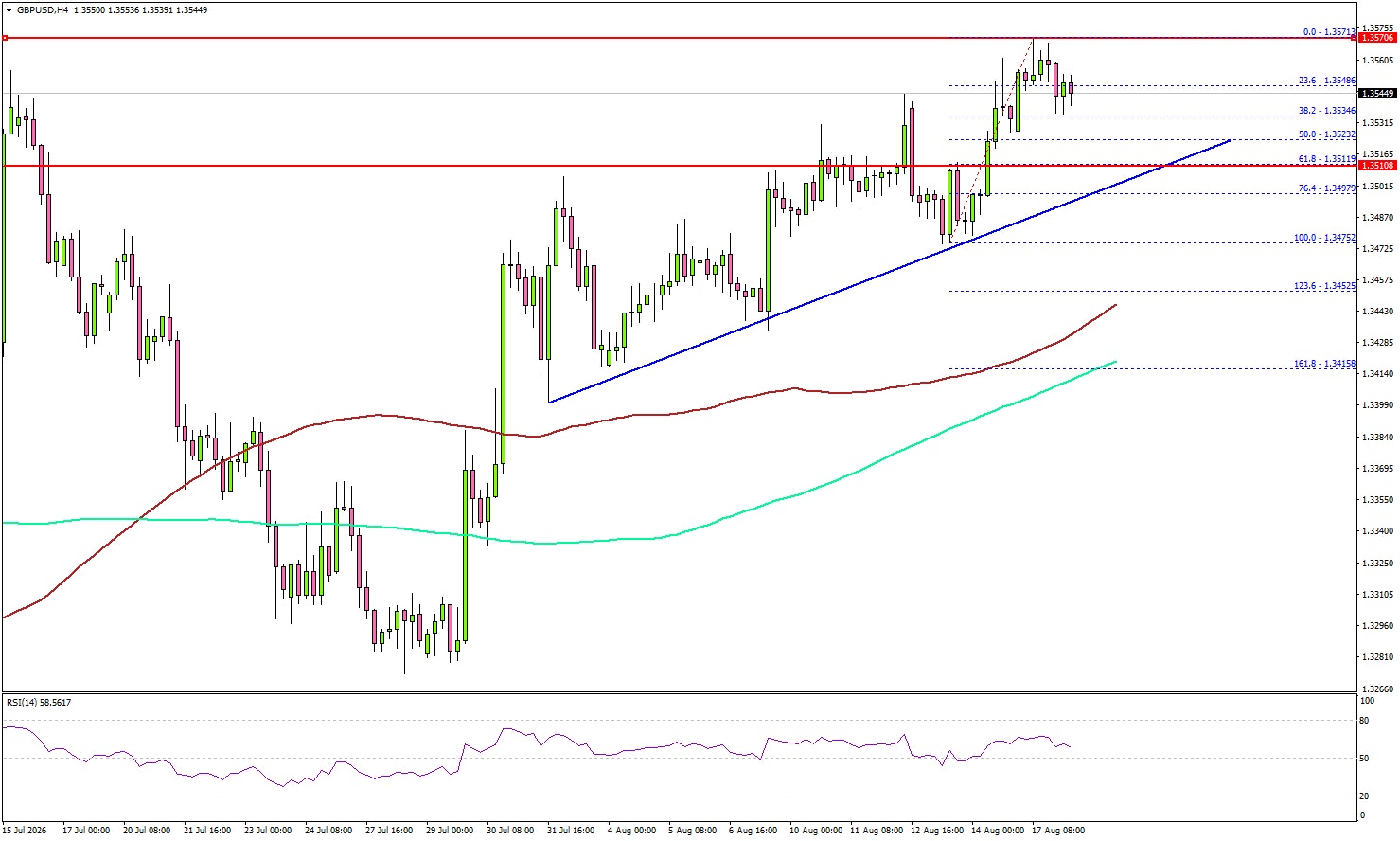
Looking at the 4-hour chart, the pair settled above 1.3520, the 100 simple moving average (red, 4-hour), and the 200 simple moving average (green, 4-hour). The pair even attempted to settle above the 1.3565 resistance zone.
On the upside, the pair is now facing a major hurdle at 1.3580. The next major resistance might be 1.3620. A close above 1.3620 could start another steady increase. In the stated case, the bulls could aim for a move to 1.3700.
Any further gains might open the door for a test of 1.3750. If there is a fresh decline, the pair might find bids near 1.3500. There is also a bullish trend line forming with support at 1.3510. The next major support could be near 1.3450 and the 100 simple moving average (red, 4-hour).
The main support might be 1.3420 and the 200 simple moving average (green, 4-hour). A downside break and close below 1.3420 might send the pair toward 1.3315. Any more losses could open the door for a test of 1.3250.
Looking at Bitcoin, the price must settle above $64,650 and $65,500 to decrease bearish pressure and start a steady increase.
Upcoming Key Economic Events:
- UK Claimant Count Change for July 2026 – Forecast 11.2K, versus 6.7K previous.
- UK ILO Unemployment Rate for June 2026 (3M) – Forecast 4.8%, versus 4.9% previous.